Persephone into shadow c.., p.1
Persephone (Into Shadow collection),
p.1


This is a work of fiction. Names, characters, organizations, places, events, and incidents are either products of the author’s imagination or are used fictitiously. Otherwise, any resemblance to actual persons, living or dead, is purely coincidental.
Text copyright © 2022 by Cozy Horse Limited
All rights reserved.
No part of this book may be reproduced, or stored in a retrieval system, or transmitted in any form or by any means, electronic, mechanical, photocopying, recording, or otherwise, without express written permission of the publisher.
Published by Amazon Original Stories, Seattle
www.apub.com
Amazon, the Amazon logo, and Amazon Original Stories are trademarks of Amazon.com, Inc., or its affiliates.
ISBN-13: 9781662511950 (digital)
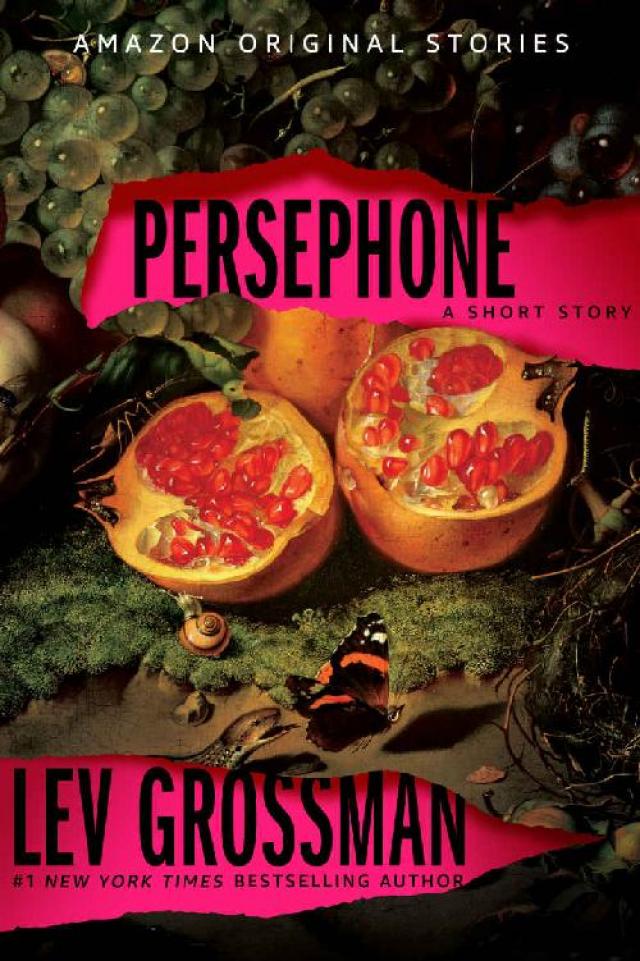
Cover design by Will Staehle
Cover image: © Johnny Van Haeften Ltd., London / Bridgeman Images
That morning I took the bus to school as usual. I sat alone. I watched the rich pageant of suburban America scroll past me in the rain: white clapboard houses, green lawns, gray asphalt, autumn trees weeping. Even nonwillow trees were weeping, that’s how rainy it was. My head hurt, one of those Advil-proof, hot-coal-in-the-skull headaches.
The only thing out of the ordinary on this particular rainy Tuesday was that the cast lists for the Winter Plays were going up. I’d tried out a week earlier in a fit of extrovertedness that even I was having a hard time explaining to myself. I told nobody, not even my mom.
The bus was thick with resignation, like a prison bus. Some kids slept. Others—the boys mostly—seemed to actually be stimulated by the atmosphere of despair; they ran feral, like being on a school bus meant they were in international waters. A kid named Evan Standard grabbed my bag and then made a big show of handing it back to me. Evan was notorious for having been accused—but never convicted!—of stealing embalmed dead rats from the bio lab.
He made a V with his fingers and stuck his tongue through it.
“I’m sorry, Evan,” I said. “But I’m not going to lick your vagina.”
That was literally my only human interaction till I got to school, where I was joined at my locker by my friend, Lindsay. I didn’t have a ton of friends. Just the one, actually. I used to have more, but five years ago my dad disappeared.
He worked at a company that did data-center design, out on Route 128, and which I could tell you more about except it would immediately cause you to fall into a deep and relaxing sleep. One day he got up; had breakfast; watched Avatar: The Last Airbender with me, which I was probably too old for and he was definitely too old for, but he seemed to enjoy it, and anyway it was a father-daughter thing we did together—then he left for the office. He never got there. Somewhere in between home and work he fell off the face of the earth.
Three days later they found his car in the Wachusett Reservoir. We had police, TV, amateur internet sleuths calling in bogus sightings, the works, but as there were no signs of foul play, or any other kind of play, they ended up leaving it as a missing persons case, the implication being that he had probably decided to up and abandon his family and done a pretty neat job of it too.
Either that or he drowned himself in the Wachusett Reservoir. It’s a big reservoir. I don’t know if I believe either of those theories. Up until then he’d been a pretty good dad. Like me, he liked poetry. Unlike me, he always believed in me. He always told me I was special, that I had a gift, and I just had to wait till I grew up to find out what it was.
After he disappeared, my mom worked more and talked less. She kind of iced over, and I guess I did too. For some people bad things happening brings them together. We were the other kind of people. It didn’t help that I was sprouting up at a disturbing rate—I’m five-ten in my socks and still growing. Most of my friends drifted gracefully away from me, like carelessly tended helium balloons. I spent more and more time in my room rereading The Phantom Tollbooth and Anne of Green Gables.
If you saw me, you might think, Maybe she’s not just a weird loner! Maybe she collects exotic seashells or rebuilds old pocket watches so that they run backward or draws blueprints of impossible imaginary cathedrals or something! She’s a foot soldier in the war on bland conformity, marching to the beat of her own drum, et cetera, et cetera. But you’d be 100 percent wrong. I was just about as close to nobody as you could get. Nothing to see here. Move along. It was like I’d become a ghost without having to go through the messy intermediate step of actually dying.
Now I was in tenth grade, and Lindsay was the only one of my friends who’d stuck around. I guess she believed in ghosts.
“Hey, Seph,” she said. “You do the reading?”
(It’s short for Persephone, a goddess who went out picking flowers one day and wound up married to the god of death because she ate some pomegranate seeds. My parents either read way too much Greek mythology or not nearly enough.)
“Which reading.”
“English. That poem by that guy, what’s his name, Andrew Marvell. There’s going to be a quiz.”
“I read it.”
“‘Andrew Marvel’ sounds like a fake name. Does it have the X-Men in it?”
“It’s Marvell with two l’s,” I said. “The poem’s called ‘To His Coy Mistress.’ It’s about a guy who’s trying to convince a girl to have sex with him. You didn’t read it?”
“I think I lost my poetry book. Does she do it?”
“You never find out,” I said. “It’s a cliff-hanger.”
“See, this is why nobody reads poetry anymore.” Lindsay slammed her locker shut. “Are you coming to the track meet?”
“Doctor’s appointment.”
“But track is far more important than your personal health.”
“It’s just running fast! You are literally going nowhere fast.”
“Piffle.” Lindsay was on a campaign, so far unsuccessful, to bring this word back into general usage. “Running fast is a basic human survival skill.”
“That’s why we invented cars.”
My phone buzzed. It was my mom. Come straight home after school.
“She must think you’re going to do drugs and have sex with people like Andrew Marvell.”
For the record no one had ever offered me even a single drug. Or any sex for that matter.
“You are OK though, right?” Lindsay peered at me.
“I just get these headaches.” That sounded self-pitying, so I added a joke. “Plus I have crimes to solve. This is just my secret identity, I’m really Supergirl.”
“Supergirl doesn’t have a secret identity. Or not on Prime Earth anyway. She uses her real name. Which is Kara Zor-El.”
The source of this information wasn’t me or Lindsay; it was a boy who’d been casually walking along behind us. I knew his name was Alonzo and that he was new this year, but that was all. He was tall, taller than me, with a big nose and short thin brown hair. Also he had a limp. I had never heard him talk before, or in fact make any noise of any kind.
“She’s Superman’s cousin,” Alonzo went on. “She used to be Linda Lang back on New Earth, but that universe got eliminated in the Crisis on Infinite Earths. I think.” He was losing steam. “The continuity is tangled.”
We stared at him.
“See?” Lindsay said to me. “I knew you were making that shit up.”
“I stand corrected,” I said.
That seemed to be enough for Alonzo. He limped away on a new trajectory. Boys: you could see why I’d been putting that one off.
Lindsay left for class, and without her protective social radiance around me, the halls became a noticeably less friendly place. A lacrosse player—or at any rate he had a lacrosse stick—grabbed my math book and frisbeed it into the trash. I didn’t say anything, just waited till he got bored, then fished it out again. I took all that stuff and put it in what I thought of as a mental disposal facility. I could picture it quite vividly: it was gray and metal and industrial looking, roughly riveted together, with the words CONTENTS UNDER PRESSURE stenciled on it in red. It was a toxic emotional waste storage site. Its capacity was infinite.
I thought about swinging by the music room to see if the cast lists for the Winter Plays were up. Maybe acting was the gift my dad had been talking about. I knew I would be tough to cast because I was taller than most of the boys, but then again they were doing three different one-acts, so there were a lot of parts, and although I didn’t like to think it out loud—in case it might potentially cheapen any future thespian triumph on my part—practically everybody who tried out for the Winter Plays got something. Even if it was just an old-lady part.
I would take it. I didn’t care. I just wanted to be somebody else, I didn’t care who. Sometimes I felt like I couldn’t breathe, like I was drowning in myself.
I wondered if that was how my father had felt. In the reservoir, when the dark water poured in.
I headed outside into the rain—English was on the far end of school from my locker. This was all happening in my hometown of Lexington, Massachusetts, by the way, which is an almost aggressively uninteresting suburb of Boston where it can get very cold and wet in October. I hurried. I got to English five minutes early.
The only other people there were Stephanie Silver and Nathan Giocardi. They were boyfriend and girlfriend, I think. When Nathan saw me, he began sportscasting into a fist microphone.
“Here comes Lexington High School’s seven-foot center, Persephone Cockburn!”
/>
Yes, I know. When I turn eighteen, I’m going to set a land-speed record for changing my last name by deed poll. They went back to their conversation. They were talking about the Winter Plays, about who got what.
“The cast lists are up already?” I couldn’t help myself.
They both looked at me as if they couldn’t even believe I had actually uttered words, still less that those words were addressed to them. Reluctantly, like she didn’t want to sully it with Persephone-ness, Stephanie passed me her phone in its neon-turquoise leopard-print case. She’d taken a picture of the lists.
I studied them. My name did not appear anywhere on them. Some people’s names appeared several times, in several different roles. Not mine. I checked and checked again. A weird shudder went through the room, rattling the desks and shaking chalk dust from the blackboard, as if someone had started up heavy machinery in the basement. I hardly noticed it at the time.
Honestly I could not have explained why I cared so much, but it was like someone had stuck a blunt sword right through my chest and was prying my ribs apart and crushing my heart. Even this, even this I could not have.
But of course I couldn’t. I couldn’t believe I’d been so stupid. I couldn’t believe I’d thought I could pass for an actual person. More than anything at that moment I wished my father were here, just sitting there watching cartoons with me. Being with him was the last time I could remember when it took no actual effort for me to believe that I was a real person.
“Thanks,” was all I said.
I reached across the aisle to give Stephanie her phone back.
“Majestic is the word for that wingspan, Chet. Majestic!” Nathan had gone back to sportscasting into his fist. “I understand she’s actually capable of short flights under her own power.”
“Stop.” Stephanie put a playful hand on his chest to restrain him in case he became too hilarious.
I said nothing. Straight into the toxic waste facility. Class started. Mr. Jenner—short, plump, sandy hair, beard, could have been Santa Claus aged thirty-five—began a dramatic reading of “To His Coy Mistress,” by Andrew Marvell.
Had we but world enough and time,
This coyness, lady, were no crime.
My phone buzzed. No number. As I put it back, my hand touched something in my bag. It was stiff and cold and damp. And furry.
I snatched my hand away. There was a dead rat in my bag.
Evan Standard, you sly dog. The rat lay in there snugly, on its back, its yellow teeth bared in ratty indignation, not so much aggressively but more as if it were just stunned and appalled by how things had turned out for it, that even in death it must endure this indignity, and it was saying, Can you even believe this shit?
I could not.
“Rumor has it Persephone gets her unusual height from her father,” Nathan whispered, “who I understand was part giraffe!”
“Fuck you,” I snapped. “I don’t have a father.”
But at my back I always hear
Time’s wingèd chariot hurrying near
I didn’t ask for much. All I wanted was a part in the Winter Plays, even if it was an old-lady part. And I wanted a book bag without any rats in it. And I wanted to know where my dad was. I heard a rushing sound all around me.
I stood up. I’m losing it, I remember thinking lucidly. I am actually losing it. At the sound of my chair scooching back, most of the class turned around to look, but Mr. Jenner, who was really in a groove with his poem reading, kept right on going.
Now let us sport us while we may,
And now, like amorous birds of prey
I tilted my face up to the ceiling, like a soft cool rain was falling on it. I closed my eyes. The palms of my hands felt suddenly radiant with heat. I felt like I was Anne of Green Gables, and I was at long last going to shank Gilbert Blythe’s punk ass and leave him for dead. I felt like somewhere inside me that gray industrial canister with CONTENTS UNDER PRESSURE stenciled on it was tearing open, rivets popping like gunshots. I was wrong: its capacity wasn’t infinite. I had ignored the warning label. I’d been ignoring it all my life.
Whatever was inside it had woken up my gift. It’s finally here, I thought. It’s arrived, just like Dad said, it’s right here in this room, and I don’t know what it is, but it feels like a big, big surprise.
And I brought enough for the whole class.
Let us roll all our strength and all
Our sweetness up into one ball
The world went white. All I could hear was the sound of Mr. Jenner’s voice:
And tear our pleasures with rough strife
When I opened my eyes again, I was in the middle of an empty circle. All the desks and chairs were pushed against the walls.
Dust drifted in the air, and a loose sheet of paper slipped across the floor. My ears were ringing. Stephanie Silver lay on her back on the floor.
I blinked. Something had happened. One of the windows was gone, and cold rain was blowing in. My headache was completely gone. I knelt down next to Stephanie.
“Are you—are you OK?”
Nothing. Her nose was bleeding. She was covered in dust. Nathan lay a few yards away, out cold, his body uncomfortably twisted as if he’d fallen from a height. One of the ceiling panels above me was gone and another was dangling by a corner; you could see through to the ducts overhead.
It was like a bomb had gone off in the room, but it hadn’t touched me. Whatever that was, it was not a gift. Maybe the gift was that I was bombproof. Stephanie made a groaning noise. Her shoes were gone. Behind me a girl took a deep breath and started screaming.
“Call somebody!” I didn’t know who I was talking to. I started looking for my bag. I was breathing hard. “Call the nurse!”
Then somebody pulled me up by my arm. It was short, round Mr. Jenner. He’d evidently been outside the blast radius, or whatever kind of radius it was.
“Let’s go, Persephone.”
He dragged me toward the door. Far away an alarm started to jangle.
“What just happened?” I kept saying. “What just happened?”
“Don’t look back. No cell phones! No cameras,” Mr. Jenner shouted over his shoulder as he steered me out into the hall. “Phones away! Everything’s fine!”
Then we were out in the hall and walking fast, his arm around my shoulders. I didn’t know what to do, but Mr. Jenner seemed to, so I just let him herd me along. We left them lying there—Stephanie and Nathan on the floor, everybody else in shock. Classroom doors were slamming. Adults passed us running the other way.
“What happened?” I kept saying it. “What’s happening?” Everything was not fine. My hands were trembling. I was sweating; I felt weak and empty, like I’d just run a mile on an empty stomach.
“Mr. Jenner—”
“Be quiet, Persephone!” he snapped. “I don’t want to hear another word.”
A couple of people tried to get his attention, but he hustled past them. Our destination turned out to be the nurse’s office: a cinder block room with no windows and an exam table covered in sterile paper.
“Mr. Jenner—”
“Just wait.”
He checked his watch impatiently, then checked it again, and then the nurse bustled in: big shoulders, white uniform, black mane.
I had only ever seen her once before, at an assembly at the beginning of the year where she told us what to do if somebody had a seizure because there was a kid in my class who had epilepsy. The girl’s name was Onjela, and she once told me privately that if it was up to her, death would actually have been preferable to being annually singled out as Seizure Girl. But it wasn’t up to her.
Maybe I’d had a seizure. It made as much sense as anything else. My thoughts were jittery shards, and I kept trying to put them back together and cutting my mental fingers on the sharp edges.
“Just tell me if everybody’s OK.” My voice wouldn’t stay steady. “That’s all I want to know.”
“They will be,” the nurse said. “Please relax.”
“Just get a profile and get her out of here.” Mr. Jenner still wasn’t alarmed, but he was obviously getting impatient. It was like he’d become a different person. He stepped out into the hall and closed the door, already typing on his phone.
The nurse snapped on rubber gloves—like Stephanie Silver, she seemed not to want to touch me—and hurriedly took my blood pressure with a sphygmomanometer, a word I knew because how could you forget it: sphygmomanometer. She took my temperature. She nipped some blood from my fingertip, and snipped a lock of my hair and put it in a vial, and felt for various glands, and she had me take my shirt off and cough, which didn’t make me feel the slightest bit self-conscious, not at all.