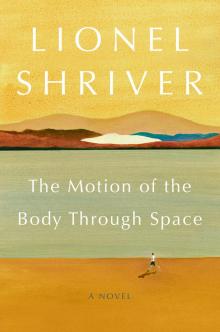
The motion of the body t.., p.9
The Motion of the Body Through Space,
p.9


Lavishing still more limited resources on a normal human activity that in the olden days was free, Serenata had eschewed the budget motels on the edge of town, which might have risked the appearance of an under-ardent attitude, instead booking three rooms at the Saratoga Hilton on Broadway. A private plus: it had a fitness suite.
The lobby was a sea of sportswear. The majority of contestants wouldn’t arrive until tomorrow, so this was just the beginning.
As Serenata waited to check in while the others circled for a place to park, the woman behind her in the unexpectedly long line asked, “You do have reservations, right?” Affirmative. “Because they’ve increased the number of runners admitted this year to five thousand. I think it’s cynical—more admission fees, and of course the town is greedy for all the extra tourists. Since so many entrants show up with a whole entourage, the pressure on hotel rooms is intense. Oh, I’m sorry,” she apologized. “I’m just assuming—you are one of the marathoners, aren’t you?”
“No,” Serenata said.
“Well, gosh—I hope you take it as a compliment, then—it’s just, you look like one. I mean, like a real runner. Not one of the plodders.”
Serenata was both flattered and depressed. “Plodders?” she asked blankly.
The woman lowered her voice. “The dregs at the back. Also known as the run-walk crowd. Emphasis on walk. The charity and novelty acts are bad enough. But nowadays, all these”—she lowered her voice further—“fat, out-of-shape bucket-list box-tickers take seven or eight hours to finish, and still claim afterward they’ve ‘run a marathon.’ We’re talking, like, a twenty-minute mile. Holy crap, in Honolulu, which has no time limit whatsoever, the plodders take a break for lunch. They cheapen what completing this distance means. Sorry, that’s just me. I guess my outlook isn’t very democratic. Maybe there’s a thin line between being in the elite and being an elitist.”
Indeed, the woman had a look that had grown recognizable. Clad in Lycra and an unzipped fleece, she was stringy and weathered with cropped hair. She had a small cave under the center of her rib cage, where even trim postmenopausal women usually gathered flesh. Much like Nancee, she couldn’t stand still, lifting one Adidas and then the other, shaking each leg out. At least fifty-five, she doubtless imagined that she didn’t look anywhere near that old, though her bony, sinuous frame advertised every year. Alas, you couldn’t think such a thing about another woman at Serenata’s age without its boomeranging back in your face. Serenata didn’t imagine she looked sixty, either.
“I’m surprised this race has grown so big,” Serenata said, pushing herself to be sociable. “This is a minor event. Nothing like New York or Boston.”
“It used to be if you wanted to pull in tourists you’d found a literary festival. Now every dot on the map sponsors a marathon. Draws much bigger crowds. Whatever limit Saratoga puts on registration, they’ll still be turning contestants away. The lesser races are popular with the wannabes, because they don’t require a qualifying time.”
“You do a lot of these?” The interest was feigned.
“Best thing about marathons popping up everywhere is I can pretty much go from race to race year-round. I hit the Florida, Arizona, and California ones over the winter. I always enter the lottery for London, but no luck so far. The odds are against you. Only forty thousand are allowed in, and two hundred fifty thousand apply.”
“Seriously?” Serenata said. “A quarter of a million people apply to run the London marathon.”
“Goes up every year,” the woman said glumly.
Serenata nodded at reception. “Doesn’t your circuit get expensive?”
“You sound like my kids. But I’m not about to lie in bed with cats, just so they can get an inheritance. They seem to forget it’s still my money. When I was first talking myself into this, I realized that I’d forgotten it was my money. What else is early retirement good for? I’m not into bingo.”
“But what about injuries?”
Her smile was tight and grim. “How long have you got? Hey, you’re up.”
Once the others arrived and got settled, Serenata slipped off to the fitness suite before dinner, but the place was mobbed. There were lines for all the machines, with a scrawled waiting list taped to every stationary bicycle. The scene was repulsive. Resigning herself to a few calisthenics in front of CNN, she took the stairs back up to their room, and even on the staircase, commonly deserted in hotels save for the odd cleaner, she had to thread between guests hurtling themselves up and down.
Serenata had outdone herself in the service of appearing to outdo herself. Dinner reservations tomorrow night were considerately early, that Remington might have no trouble hitting the hay by eight thirty, the better to arrive at the race in advance of a seven thirty a.m. starting gun. Their mattress was bigger than some hotel swimming pools, so she shouldn’t wake him creeping into bed later that evening. Tomorrow was a rest day, and he planned to drive Valeria’s minivan around the course that morning to familiarize himself with any “challenging topography” before the roads were closed to traffic. For the afternoon, she’d booked him into the Roosevelt Spa for a mineral bath and massage.
While Remington was being worked over, she’d also treat Valeria to a Detoxifying Algae Wrap and Arctic Berry Illuminating Facial at the same facility (the anti-cellulite option seemed impolitic). The spa treatments alone would come to over $700, though at least the fact that Serenata secretly considered all these pawings and unguents a load of hooey meant she wouldn’t further inflate the bill by steeping in seaweed herself. The real present to Valeria was volunteering to take care of the children while the young woman was being what passed for pampered for three solid hours. Were Valeria anything like her mother, she’d find the hands of strangers prodding all over her body not just a little strange but invasive. But she wouldn’t dare to say so. Women were programmed to regard facials, massages, and soaks as the acme of indulgence, and Valeria hadn’t the originality to trust her disappointment.
Prudently well in advance, given that apparently up to five thousand other parties could be prowling downtown for a festive venue, for the end of the Big Day she’d made reservations for a blowout at 15 Church, where she and Remington had dined for their thirtieth wedding anniversary; should her husband’s performance on Sunday prove ignominious, she could always cancel. The restaurant was pricey, and Buttermilk Crispy Oysters with ponzu and foie gras butter was bound to be wasted on the kids. But the trappings of jubilance routinely stood in for jubilance itself. Rare was the bash that better than gestured toward celebration, a sensation so taxing to inhabit in the present that most honorific occasions only truly happened after the fact, when the laureate gazed fondly at photographs. On the other hand, Serenata might be feeling jovial at that. This clubby bunkum would be over, and she and her husband could go home in every sense.
Yet for all her loyal wifery, Remington announced quietly while getting ready for bed on Friday night, “You’re not fooling anyone, you know.” He declined to explain, because he didn’t have to.
While Remington was driving a course that would take an hour even in a car, Serenata had a late, leisurely breakfast in the hotel dining room with Tommy, whom she’d put in a double with Nancee. The two seemed to have something in common—which proved the problem.
“Crunches,” Tommy despaired over toast. “Raises, planks, and lifts. Plus a lot of goofy twirling and leaping things I think she made up. It’s like sharing a room with Hurricane Sandy. I said I was heading out after dinner last night to rack up some steps, but I really hit the halls just to get away from her.”
“Isn’t ‘racking up some steps’ on the same continuum? What’s the difference?”
“You know how it works. Anyone who does less exercise than you is pathetic, and anyone who does more than you is a nut.”
“So Nancee’s a nut.”
“She’s an exercise bulimic.”
“Have you caught her throwing up?” Serenata asked sharply.
“I mean she pukes energy.”
“She looks ill to me.”
“She doesn’t eat enough to build any muscle. So all the jumping up and down doesn’t accomplish anything.”
“And what does all your Fitbitting accomplish?”
“Watch it. You’re the one who claims everyone’s copying you. What did being a fitness fanatic for fifty years ‘accomplish’?”
Serenata added a contemplative smear of butter to a miniature cranberry muffin. “When I was younger, I was testing myself. Setting goals and exceeding them. The trouble is, you can’t keep beating yourself indefinitely.”
“Like Fitbit,” Tommy said. “Once you’ve ever done thirty thousand steps in a day, any less steps—”
“Fewer,” Serenata said.
Tommy glared. “Any fewer seems kind of sad.”
“Personal bests are a tyranny. Run ten miles, and tomorrow you have to run eleven, or the ten even faster. The problem may apply to more than just athletics.”
“Obviously the answer is to stay really shit at everything.”
Serenata laughed. “Maybe. But trying to surpass yourself, you’ll always approach a limit. Of what your body is capable of, but also of how much you care.”
“Yeah, I’m running into that with the Fitbit, too,” Tommy said. “I mean, it’s just a game, in case you thought I actually take it seriously. I want to beat Marley Wilson. But I’m starting to, like, slightly not give a shit, ’cause of what you said. The limit thing. And once you start coming up against the limit, it stops being interesting.”
“And that’s assuming it ever was.”
“You know, I still don’t totally understand why you don’t want Remington to run. It seems kind of mean.”
“I don’t really care if he runs by himself. It’s this mass goat fuck I can’t stand.”
“Shut up,” Tommy whispered, gesturing at the other diners. “You’re being inappropriate. Pissing on marathons, and not being ‘supportive’ of anyone who wants to run one—I can’t hardly think of anything more uncool. It’s like, almost worse than being a racist or something.”
“Thanks for the tip.”
“You’ve no idea what it’s like online right now. People post how much weight they’re pressing, how many squats they do, how low their heart rate is. There’s all these Instagram glam shots of girls with six-packs all greased up and tensed in running bras. The standards keep going up, too, what counts as really ‘fit.’ What seemed awesome last year now gets dissed as totally lame. It’s one thing to get so you can’t beat yourself anymore, like you said. But it’s way worse to get beaten by everyone else.”
“A lot of those online posts must be exaggerated.”
“Maybe. But some of these guys really do spend all day, every day, in the gym. All I’ve got is our backyard. You and Griff will have to get a whole lot filthier if I’m going to spring for a hundred twenty-five dollars a month at BruteBody year-round.”
“Is that really the best use of your savings?”
“Without those machines, I can’t keep up. Last year, my friend Anastasia celebrated her eighteenth birthday at BruteBody. The ‘party’ was a bunch of unbelievably hard and complicated boot-camp routines to techno-rap. They all kept an eye out for anyone who couldn’t keep up so they could razz you later. There wasn’t even any cake. The main event was a contest: who could skip rope the longest without messing up. I did okay, but I didn’t win. You, though,” Tommy charged. “You feel superior to everybody.”
“I do not! I want to have nothing to do with most people. That doesn’t mean I feel superior to them.”
“Liar. It’s obvious, just in the way you stand. All tall and straight and a little pulled back, and then when people are around you don’t like, you don’t talk very much, and I can tell what you’re thinking.”
“Do you think I feel superior to you?”
“Well . . . I don’t like it when you correct my grammar and stuff.”
“I’m only trying to help you. Do you want me to stop?”
Tommy folded her arms and thought about it. “Nah. I mean, it’s irritating, but at least you care. Nobody else listens to me. When you go all schoolteacher, I know you’re paying attention.”
Pious yogurts on all sides drove Serenata to fetch a second muffin.
“You know, over time,” she said on return, examining the baked good critically, “the reasons I exercise have changed. At your age, sure, I wanted to be attractive—and strong, not just thin. But for years now . . . That daily routine has been mostly about maintaining a sense of order. Order and control. I do it because I’ve always done it. I’m completely convinced that if I ever stop exercising, everything else in my life will fall apart. Instantaneously. And disastrously.”
“What, like you’d become an alcoholic heroin addict—on welfare, who smokes?”
“And shoplifts. And steals from charity piggybanks at checkout.”
“Maybe you should try quitting, then,” Tommy said with a grin. “Sounds like you’d finally have some fun.”
They dined that evening at the barbaric hour of five thirty. Valeria made such a fuss over her father’s order for his “last supper”—“carb loading” being out of fashion—that her mother finally interrupted, “Sweetie—he’s not about to be executed.”
When she returned to the room after a mutinous nightcap—at the teetotal dinner, the confining rectitudes of Jesus and fitness freakery had overlapped—Remington was abed but restive. She recognized his frequent glances at the clock from the latter days at the DOT, when he worried about getting to work on time, but also about what would happen when he got there. Only when she smoothed against his back, kissed his neck, and wrapped an arm around his chest did he quiet. They’d always been a good fit. Although the cleaner lines of his leaner frame the last few months were pleasing to the eye, he’d been wiry to begin with, and his naked body at rest felt comfortingly unchanged. An alarm set for five a.m. seemed extreme, but this one time, she thought, dropping off, she wouldn’t mind getting up with him out of solidarity.
Wrong.
With psychic violence, the alarm rang during her deepest slumber. Until this moment, the weekend had exhibited the indolence of a getaway, so why was she stumbling for the bathroom light switch when it was pitch-dark? What shocked her fully awake was a burst of rage. This whole undertaking was stupid. She’d been pretending for months that it wasn’t stupid, and now that she had to keep pretending just one more day she wasn’t going to make it. Her pose of taking this circus seriously, or at least of tolerating it until her husband’s groupster infatuation went the way of the Hula-Hoop, had fatally, as they said in the marathon biz, hit a wall.
While Remington stuck moleskin to the parts of his feet that chafed, she found Tommy already stalking the hallway, dressed and ready to roll. Not to be outdone, Nancee was close on her heels, hopping behind her on one foot.
“Twenty-two hundred steps!” Tommy said, raising the hand with the aqua strap. “Now, that’s what I call getting a jump on the day.” Bright-eyed and bushy-tailed, the young woman seemed not the least irked by the savagery of the hour.
Yet despite all their daughter’s previous gung ho go-Papa, in the room down the hall Valeria responded neither to a decorous tap-tap nor, at first, to full-tilt pounding on the door. Slit-eyed and tousled, she finally appeared in a waffled hotel robe. “Jesus, Mom, it’s the fucking middle of the night!” She forgot that she never took the Lord’s name in vain. She forgot that she now said “Mama.” She forgot that she didn’t curse. If Valeria got up at the crack of dawn more often, they might get on.
Serenata borrowed the minivan keys and promised to drive back later to pick up the slugabeds. Given Remington’s pace, his daughter and grandkids wouldn’t miss his crossing the finish line if they slept in till eleven and ordered the eggs Benedict.
Other parties were gnawing energy bars in the lobby; the hotel dining room was closed. Kitted out in the green and purple nylon in which he had initiated this six-month fool’s errand, Remington was swinging his personalized goodie bag: bananas, energy gels the colors of plastic toys, Red Bull, and something called “chews.” But Serenata wanted coffee, thank you, and all the cafés down Broadway would be closed, too.
“You could be a little more cheerful,” Remington said on their way to the van.
“At this time of day? I’d settle for civil if I were you.”
The grounds of the Performing Arts Center in Spa Park were humming when they arrived at six. Peppy staff wore hot-pink T-shirts proclaiming saratoga springs gives you a run for your money! Remington reverently pinned his black-and-white race number, 3,788, to his shirt, and snapped on the chipped ankle bracelet that would record his time to the hundredth of a second when (and if) he finished. The spectators and contestants rapidly thickened.
Serenata reviled crowds. Furthermore, the world record for this distance was about two hours, and this event had a cutoff of eight hours. There was no earthly reason to begin the race at seven thirty a.m. They could have released the first group of men, eighteen to twenty-four, at noon, in which case she’d be well rested and fortified by cranberry muffins.
The up-and-at-’em start time was all for show. For humanity divided into mutually hostile camps: bounders out of bed and burners of the midnight oil. The distinction went way beyond schedule. The late nighter was synonymous with mischief, imagination, rebellion, transgression, anarchy, and excess, not to mention drugs, alcohol, and sex. The early riser evoked traditional Protestant values like obedience, industry, discipline, and thrift, but also, in this gladness to greet the day, a militant, even fascistic determination to look on the bright side. In short, rise-and-shiners were revolting, and being flapped by so many birds getting the worm felt like getting trapped in an Alfred Hitchcock remake. These bouncy, boisterous, bubbly people loved their seven thirty start, which shouted earnestness and asceticism, and any attempt to move the time to noon for next year would trigger a riot.
Mercifully, as the sky lightened refreshment stands were opening, so Serenata bought the two girls doughnuts and herself coffee. It was weak and tasted like dirt, but coffee in the morning was as much idea as beverage—an idea of normalcy and entitlement—so the cardboard cup settled her mood from fuming to surly. When a younger booster jostled the coffee onto Serenata’s shirt, instead of apologizing the woman shot her a smile of manic benevolence. “Isn’t this exciting?”