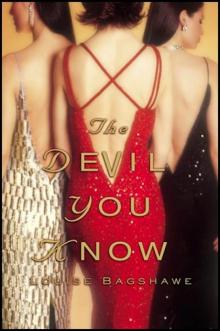
The devil you know, p.50
The Devil You Know,
p.50


“My name is Contessa Rose Parigi,” she said. “Look after my cousin Roberto. We have not finished our business with him.”
Then she stared down at Roberto.
“You’re not getting off that easily,” she said. “Get ready, Roberto. Because we’ll see you in court. But ruining your reputation? That starts right now. We’re going back to our hotel, and we’re going to start giving interviews. And I think you’ll find the press will be fascinated. Because, after all—”
Daisy smiled, and finished her sister’s thought.
“It’s such a good story,” she said.
Epilogue
Daisy was right; the press loved the story, and not just in Italy. It ran worldwide. It was juicy: a prince, a gypsy, a scandal, billions of dollars … The girls presented their evidence, and handed out pictures of themselves next to pictures of Contessa Mozel.
“Maybe he’ll shoot himself,” Poppy said.
Rose shook her head. “He’s a bully, and a coward. He wouldn’t have the guts.”
Roberto Parigi was utterly disgraced. He hired lawyers, but nobody gave him a chance. Society in Rome wouldn’t receive him, while the three sisters were feted. The girls milked it for all it was worth; they announced themselves as Contessas Rose, Daisy, and Poppy, and they were accepted as such. Roberto’s lawyers threatened with libel any magazine that called them by their titles, but nobody was listening. The glossies told him to prove it; the whole world knew that the court case would end with the Prince in jail, and the girls as billionairesses. The story made the Gucci family intrigues look dull. It was broadcast everywhere, and Roberto’s girlfriends couldn’t wait to come forward with their tales of his poor performance in bed, his cruelty and egomania.
The case was sealed when an old servant of Luigi’s came forward. She had a locket containing a lock of Mozel’s hair, and a letter from Luigi, signed, to prove it. The three sisters took DNA tests; they matched. Roberto di Parigi, who had buried three small empty coffins, was arrested for murder. But the girls did not comment on that. Justice would take its course, and he was beneath them.
They flew home after six weeks. Being aristocrats and instant celebrities was all very well, but they had to prepare for running the family company, and for other, more important things; such as weddings.
“Do you realize you’ll be richer than me?” Magnus Soren asked Daisy.
“Do you care?” she responded.
“Not particularly,” he said. “And anyway, you won’t be for long.”
“You’re a competitive, type-A bastard, Magnus,” Daisy smiled.
“That’s me,” he admitted, kissing her lightly on the lips.
* * *
Poppy was the first to get married. She had two weddings, one Jewish, one Episcopalian. The Episcopalian one was small and discreet. The Jewish one had five hundred guests, and lasted almost twenty-four hours. Daisy and Rose were her bridesmaids.
“How long’s the honeymoon, Senator?” Daisy teased her new brother-in-law, Henry LeClerc, who was celebrating his recent win in the polls.
“A month, I hope,” Poppy groaned. “He said it was a surprise, but I need to recover.”
Henry looked sheepish and drew Daisy aside. “It’s a weekend in Paris,” he said. “We both have to get back to work.”
“Ugh,” Poppy grunted. “I heard that.”
“You know it’s true,” Henry said, a little pleadingly. “Come on now, sugar.”
“As long as we can stay in the George Cinque,” Poppy said.
“The horse-drawn carriage, the trip to the Folies Bergère, walking along the Left Bank…” Henry said, temptingly.
Poppy’s grimace blossomed into a smile. “Sounds perfect. I hate time off, anyway.”
“Me too,” Henry said, kissing her on the lips.
* * *
Rose went back home to her mother, and brought Jacob with her. Mrs. Fiorello doted on him. They set the wedding for the fall, in St. Joseph’s, in the Bronx. Already thrilled that there were two duplicate Roses out there, that her Rose had found some more family, Mrs. Fiorello went into transports of fresh joy over Jacob Rothstein. Her daughter was successful, and rich, and had finally got herself a life outside her job. She had more family than just Daniella, and even more crucially, she was going to be a wife …
“Such a nice boy, such a handsome boy,” she said, tweaking Jacob’s cheek. “Now, you won’t be trying to move in with my Rose before her wedding day?”
“Mom,” Rose protested, coloring violently.
Jacob smothered a grin. “No, ma’am. I waited this long for her, what’s a little bit more?”
“Such a good boy, oh, he’s adorable, Rose,” Mrs. Fiorello said, hugging Jacob violently. “And tell me, your parents, Jacob, are they coming to the wedding? Mr. and Mrs. Rothstein? When do I get to meet them?”
Rose and Jacob exchanged glances; Jacob winked at her.
“Uh, Mom,” Rose said. “That’s something Jacob and I are gonna deal with later.”
And she smiled.
Read on for an excerpt from
Louise Bagshawe’s next book
The Go-To Girl
Available now from
St. Martin’s Griffin Trade Paperbacks
“And so movies, now more than ever, represent the UK’s creativity. And its rich cultural diversity…”
I stare at the MC, trying not to seem too bored. It’s hard going. I’m tired. It’s been a long day at work, and it’s not going to end anytime soon. My boss, Kitty Simpson, has been invited to this bash, and naturally she has to show off by taking an assistant. Because it costs two thousand pounds a head. It’s a film industry night for “charidee,” where overpaid actors, directors, agents, and producers supposedly raise money for AIDS awareness, but actually just want to see and be seen. The opulence is everywhere: mounds of caviar, circus performers walking around swallowing fire, expensive appetizers, women in dazzling gowns, men with watches that cost six figures. There’s at least twenty grand’s worth of out-of-season floral arrangements. You wonder why they don’t just write a cheque to the Terrence Higgins Trust and save the overhead, but of course that would be no fun.
“Anna,” Kitty hisses at me. “I said to go fetch my bag.”
“Sorry,” I whisper back.
“You’re here to assist me. You should be paying attention,” she says, tossing her immaculately styled hair. Tonight she is wearing a long-sleeved, opaque dress with a mandarin collar to hide the wrinkles on her neck; I think it’s Armani. She has teamed this with diamond chandelier earrings and an AIDS ribbon, but naturally her AIDS ribbon is a platinum brooch studded with rubies.
“You don’t need to just stand there like a huge great sack of potatoes,” she snaps, obviously annoyed. “Really, you could have at least made an effort. At least tried to find a flattering dress.”
My face falls. I thought I’d done OK with this dress. It’s navy velvet with sheer sleeves. Comes right down to my flats.
“But I suppose there’s not much point, is there?” Kitty sighs, losing interest.
I am five-eleven. I have a bit of a tummy, strong arms and hands, and an unfortunate beak of a nose. There are some things I like about myself; I’ve got a decent bottom, not too flabby, and good legs, but I have to cover those up because I’m so tall.
I thought I didn’t look too bad tonight, but evidently I was wrong. Kitty is wasp-waisted, a woman of a certain age, with a great plastic surgeon so nobody knows what that age is.
“I thought it was an all right dress,” I mutter.
Kitty ignores me. “My bag? Before I die, please.”
“OK,” I sigh. “Do you have the cloakroom ticket?”
She shrugs. “Lost it. Just describe it to them.”
“But that’ll take them forever to find it,” I protest. There are at least a thousand people here. “And Mark Swan’s going to be speaking soon!”
Watching him was going to be the one bright spot in this nightmare of an evening. Somehow they’d actually managed to get Swan, England’s hottest director, to give the speech. Mark Swan has won three Oscars for best picture and he’s still in his thirties. He’s so talented he makes Sam Mendes seem like an amateur. But he’s also reclusive, never appears in the press, no parties in Cannes, no photo shoots in Hello! I’m a producer, and I don’t understand the fuss they make about directors. But even I want to hear what Mark Swan has to say. (Well, OK, I’m not technically a producer. All I do is read scripts and act as Kitty’s general dogsbody. But I work for producers, which is almost the same thing.)
“Just describe it to them,” Kitty says again. “You know my handbag. It’s the black one.”
The black one. Great.
“Could you be a little more—”
“Ssh!” hisses Kitty, her beady eyes fixed slavishly on the stage. “They’re introducing him.”
So they are.
“… third Academy Award for King Harald … Ladies and gentlemen, Mr. Mark Swan.”
I crane my neck towards the stage too. But Kitty has the good seat. My view is obscured by a fat bloke with a huge bald head. I daren’t ask him to move. He paid two grand for his seat which makes him a lot more important than me.
“Thanks,” Mark Swan says. He’s got a rich, sexy baritone and he’s very tall. But I still can’t see what he looks like. “When you put it like that it sounds impressive.”
A ripple of sycophantic laughter from the crowd.
“You know, the first thing I think when I see these affairs is why couldn’t we all just write a cheque,” Swan says. “How much do those fire-swallowers go for, anyway?”
More laughter, a bit more uncomfortable. I grin and shift in my seat, trying to see. I love the guy already.
“Anna,” Kitty hisses, eyes narrowing. “Are you deaf?”
I get up reluctantly. “I’m going, I’m going…”
I thread my way through the tables, getting tsk-tsked at when I impede somebody’s view of Swan for a second (he is now telling a very politically incorrect joke about a studio head’s wife and a pool cleaner) and rush as quickly as I can out to the lobby. Hurry! I really would like to hear this speech. It’s a huge opportunity. He doesn’t speak, doesn’t give interviews …
“Yes? Can I help you?” inquires the cloakroom attendant with a plastic smile.
“Um, yes. I need to retrieve my boss’s handbag.”
“Ticket?”
“She lost it.”
“Then I can’t help you.”
“It’s a black one,” I say pathetically. She treats this with the scorn it deserves. “Mine was number three sixty. It might be near that.”
“There are about fifty thousand black bags near three sixty, love.”
“Look,” I say desperately. “I’m missing Mark Swan’s speech—”
“He came by here earlier,” she says, softening. “Isn’t he handsome?”
“I wouldn’t know. I’m missing the speech.”
“He is,” she says dreamily. “Handsome. Tall, dark, and handsome. He said he liked me hair,” she adds, primping a bit.
“He sounds gorgeous,” I say. “And I really don’t want to miss him. D’you think I could go in there and have a look? I know what it looks like, roughly.”
“Suit yourself,” she says, shrugging.
I plunge into the vast cloakroom, hopelessly rooting through fur coats (real ones) and leather jackets, trying to spot Kitty’s nondescript Prada clutch. All the bags look identical. I understand why the cloakroom attendant was so insistent on the ticket. It’s no use. I spend a good twenty minutes searching hopelessly, all the while imagining Swan being so warm and funny and teasing all the overblown executives.
There aren’t that many really good film guys in Britain and I’m missing the best one out there. And, naturally, Kitty will do nothing but yell at me and tell me I’ve “lost” her stupid bloody bag.
“Excuse me.”
I turn round in the gloom of the closet to see a tall, bearded man in black tie trying to squeeze past me.
“I didn’t expect to see anyone else in here,” he says.
“Oh. I hope it’s OK, the other attendant said I could look for my bag.”
“I’m not the attendant, I’m doing the same thing,” he says sympathetically. “Lost your ticket?”
“My boss lost hers.”
“Millions of black coats,” he says, sighing. “Why did I choose black?”
“It’s a bugger, isn’t it?”
“Sure is,” he says, looking down at me, amused. He’s very attractive, from what I can see in the gloom. Rugged, muscular. “How long have you been here?”
“Almost half an hour.” I sigh. “I’ve totally missed Mark Swan’s speech now.”
He pauses. “I’m afraid you have. Wasn’t worth hearing, anyway.”
“He sounded pretty funny when I left,” I tell him. “Not all puffed up and luvvie like you’d expect. Not even pretentious.”
“Really.”
“Which is strange, considering he’s a recluse.”
“Why’s that?” he asks, thumbing through the coats.
“Well,” I say, warming to my subject, “being a recluse is a bit wanky, isn’t it? Like you’re so important, you have to hide all the time. It’s the sign of an unhealthy self-preoccupation. Look at Stanley Kubrick.”
“Maybe he just doesn’t want to be hounded,” he says mildly. “He came here tonight, after all.”
I snort. “Someone should tell him he’s not Tom Cruise.”
“I expect he knows,” he says, stroking his beard thoughtfully.
“He sounded funny though. I liked him,” I say. “But I’ll never get to hear him now. I wanted to see what he was like, you know. And now I won’t.”
“Found it,” he says triumphantly, pulling a huge and beautifully made black wool coat from the racks. “What’s the bag you’re looking for like?”
“It’s a Prada clutch. Should be somewhere in the three hundreds. But you get going,” I say. “No reason both of us should be stuck in this hole.”
“My ex-girlfriend had one of those,” he says. “Is this it, by any chance?”
It’s a miracle. He reached into a pile of bags and unerringly pulled out Kitty’s. I quickly open it. Yep, it’s hers all right. There are the business cards, the fags, the Eve Lom appointment card.
“Oh, you are brilliant,” I say. “Thanks so much.”
“Anything to help out a pretty girl,” he says, with a slight bow.
Pretty girl! That’s a good one. It must be gloomier in here than I thought.
“Who’s in here? You can’t all come in here!”
It’s the cloakroom attendant. She storms in towards us.
“I take a five-minute break and everybody’s—oh,” she says, stopping dead. “Excuse me! You didn’t have to come in here, I’d have found it for you,” she says to him, simpering.
“I lost my ticket,” he apologizes.
“I remember your coat, Mr. Swan,” she says.
I’m so surprised I lose my balance and fall over backwards, upsetting an entire rail of coats.
“Bloody hell!” she roars.
“There now, no harm done,” says Swan, reaching down and pulling me to my feet. I thank God for the gloom now. He can’t see my flushed red cheeks. “That’s easily fixed.” He reaches over and pulls up the entire rail, coats and all, with one hand.
“Oh, well,” she says, de-fanged. “Well.”
“I’m sorry,” I say.
“Be more careful next time,” she snaps. But I’m looking at Swan.
“Relax, it was fun,” he says. “More fun than the speech.” And he winks at me.
I lift the clutch. Yes, I believe that even I have had smoother evenings than this.
“I’d better be going,” I say. “Take care.” Ugh. Why did that come out of my mouth? Take care? Take care?
“Nice to meet you,” he says. “What’s your name?”
“Anna. Anna Brown,” I say. “OK, well, goodbye, Mr. Swan.”
“It’s Mark,” he says, grinning. “Bye, Anna.”
“Where the bloody hell have you been?” Kitty asks, snatching her bag from my flustered hand. “You missed Mark Swan, you know.”
“Ahm—yes.”
“Too bad for you. Fetch me another champagne,” she says, dismissively.
“Sure,” I say, glad of the opportunity to escape.
Oh well. At least she’ll never know. Right?
* * *
My flatmate Lily is sitting hunched over her computer. Her long legs are revealed in a short, sleek skirt in buttercup leather, showing off her deep golden tan. Her top is a white halter neck in clingy jersey that drapes her perfectly formed, perfectly fake boobs, and shimmering blond hair tumbles down her back.
I’m wearing my best summer outfit too. Black jeans, black T-shirt, Doc Martens. Apparently going monochrome is “really slimming,” or so Lily always tells me.
So far I don’t seem to have shrunk very much.
Horizontally or vertically.
My flatmates are both models. Not catwalk, mostly just photo shoots. Lily’s five six, and Janet’s five seven, but they are both so slim and petite, especially Lily, that they just seem tiny. And I’m just the right height to be a catwalk model and out-do both of them, but that’s only going to happen in an alternative universe. When people are feeling kind, they describe me as “strapping.” I’m a big girl. All over. I’m very tall, and not thin and gangly; I have useful, farm-labourer hands, a bit of a tummy, huge boobs, not much of a waist, my bum isn’t bad—it’s a nice size—but it’s sort of flat and squashy from sitting down all day, and my legs are no help. I can’t show them off, can I? You look like me, you don’t want to draw attention to yourself. I wear flat heels and baggy jeans, mostly. Camouflage.
And then there’s my face. I’m the daughter of a handsome father, with masculine Yorkshire features, and a beautiful mother. She’s still beautiful now, at fifty. She has those Michelle Pfeiffer cheekbones you can hang towels on. She’s also petite, five five, with an elfin bone structure, huge blue eyes and gorgeous, naturally raven hair. She looks as if she should be Janet’s mother, not mine.