She survived, p.10
She Survived,
p.10


“I cannot identify the first [memory],” he said many years later, talking about that moment in childhood when these different visions and thoughts inside his head began, “and you must understand that one of the aspects of psychosis is an inability to distinguish ‘reality’ from ‘fantasy.’ ”
To him, that chaos going on inside his adolescent mind—the dreams, hallucinations, and voices—were his absolute reality. It all seemed “perfectly natural . . . even if they weren’t.”
It did not take long for Kyle to become aware that he thought differently than the other kids around him and “there was something wrong” inside him. He knew that if he approached the other kids, talked to them about what he saw and heard, he would be shunned and ostracized, bullied, and likely beaten up, definitely laughed at. So he kept most of these things to himself, at least at first.
The voices and visions did not scare him, he said later. Some kids might be frightened by what he saw; but to him, it was a world he embraced. A secret he came to love.
There was one day—Kyle was six years old—when he had what he recalled was his first “hallucination.” It is a term Kyle needed to put in quotes, he said later, because hallucination was not the best way to describe what he saw. Hallucination was merely “the quickest and most efficient way” of explaining what happened. People could comprehend what a hallucination is—yet he considered what happened to him to be real—even to this day.
Another way to describe it, he reconciled, was to use the word “magic.”
Inside his head, Kyle lived within a world of his own, literally. This was his world. He didn’t create it, he claimed. Or ask for it to appear before him. It wasn’t like that at all. It just happened. One day it wasn’t there and then the next, well, it was—and the most important part of this for Kyle as he talked through it years later was that to him it wasn’t a fantasy, or some type of dream. It wasn’t something that came and went: The bogeyman underneath the bed. The monster in the closet. The imaginary friend you sit with and share tea with as a child.
This was his life. His world.
There was one major issue—of the many that would begin to accumulate—for Kyle as he sat years later and looked back on everything that had happened.
“The biggest problem I have encountered—and one we will have to address—is that I have a great deal of memory that conflicts with things I know to be true.... Consider everything I tell you to be as ‘true’ as I ‘know’ it all to be, and any inconsistencies are entirely unintended.”
This statement, so incredibly honest and sincere, would come back to haunt Kyle Hulbert as he grew into an adult, and some of what he “saw” and “heard” would indeed become reality, however interspersed with brutal violence, blood, murder, and carnage it would soon be.
CHAPTER 3
In October 2001, after a month of not doing much of anything, with the exception, he explained, “of spending a lot of time alone with my girlfriend,” Kyle Hulbert got an invitation to the Maryland Renaissance Festival. Accepting this invitation would change his life.
The Maryland version of what is a nationwide celebration, generally called the Renaissance Faire, runs every August through October. It is an event set up to re-create a 16th-century English village with crafts, food, live performances. . . a jousting arena and lots of games, according to a website dedicated to the festival. It’s billed as a “fun family event” and held at a location about thirty miles outside of Washington, DC. The festival attracts people from all over the world, all walks of life. For sixteenth-century history buffs, it’s the ideal occasion. Families can go and have a blast. The same things that the Civil War reenactment events do for Civil War enthusiasts, the Renaissance festivals do for fans of sixteenth-century knights in shining armor, maidens and belly dancers, fire eaters, acrobats, and musicians. The allure for Kyle was that it fit with the chosen era of fantasy and the role-playing games (RPGs) he had fallen into and embraced while growing up. Here was a chance to dress up, wear a costume, and be somebody else—live out some of those more elaborate and epic fantasies Kyle had had all his life.
Kyle wore a latex cat mask that covered the top half of his face, which he had painted completely black underneath. He wore black clothes.
As he walked around the festival, Kyle noticed he was getting lots of looks from the girls.
“I liked that,” he said.
What eighteen-year-old boy, cooped up all his life inside one institution after the other, moving from one foster home to the next when not institutionalized, wouldn’t enjoy all the attention? Kyle had a girlfriend (he did not bring her to the festival). But being noticed by others, it felt good. It fed his ego—his enormous sense of self. For Kyle, he had to be somebody all the time. Mostly, it was because he was so uncomfortable in his own skin or, more important, his own mind. Being someone else, or something else, allowed him to develop and satisfy his fantasies. It allowed Kyle the opportunity to express those strange feelings he had—not to mention the visions and hallucinations—and live them out in the physical world around him. At the festival, the type of people Kyle met and hung around stayed in character throughout most of the day. He understood this and exemplified it.
Something caught Kyle’s attention as he walked around. There were dozens of various types of booths spread throughout the festival. Vendors were selling food, clothing, weapons, and props—all sorts of items connected to the Renaissance that might be appealing to festivalgoers. So Kyle walked up to one particular tent. There was a girl behind the booth. A pretty girl. Young. Nice figure. She smiled at him.
“Brandy,” the girl said after he asked her name.
“Nice name,” Kyle responded.
They chatted. Small talk, mostly. She seemed interested. They had things in common. They seemed to like each other.
“Can I get your number?” Kyle asked.
Brandy didn’t hesitate, Kyle said later. She got a piece of paper and wrote it down.
“Call me soon,” Brandy said. They’d hang now, but she was working.
From there, Kyle found his way into the weapons tent on the grounds of the festival. If there was one subject within the era that Kyle was infatuated with the most, it had to be weapons. He collected knives and swords. He fashioned himself an expert knife and sword handler. He knew all there was to know about medieval weapons, especially knives and swords. And wherever Kyle Hulbert landed, he rarely went there without his trusty twenty-seven-inch ninja-style sword he liked to keep as sharp as a razor blade.
About the Authors
Crime writer, serial-killer expert, and investigative journalist M. William Phelps is the New York Times bestselling author of twenty-six nonfiction books. Winner of the 2008 New England Book Festival Award for I’ll Be Watching You, Phelps has appeared on nearly one hundred television shows, including CBS’s Early Show, ABC’s Good Morning America, The Today Show, The View, TLC, BIO Channel, and History Channel. Phelps also created, produces, and stars in the hit Investigation Discovery series Dark Minds, now heading into its fourth season; and he is one of the stars of ID’s Deadly Women. Radio America calls him “the nation’s leading authority on the mind of the female murderer.”
Profiled in such noted publications as Writer’s Digest, Connecticut Magazine, NY Daily News, NY Post, Newsday, Suspense Magazine, and The Hartford Courant, Phelps has also consulted for the Showtime cable television series Dexter and written for Connecticut Magazine. Touched by tragedy himself, due to the unsolved murder of his sister-in-law, Phelps is able to enter the hearts and minds of his subjects like no one else. He lives in a small Connecticut farming community and can be reached at his author website, www.mwilliamphelps.com.
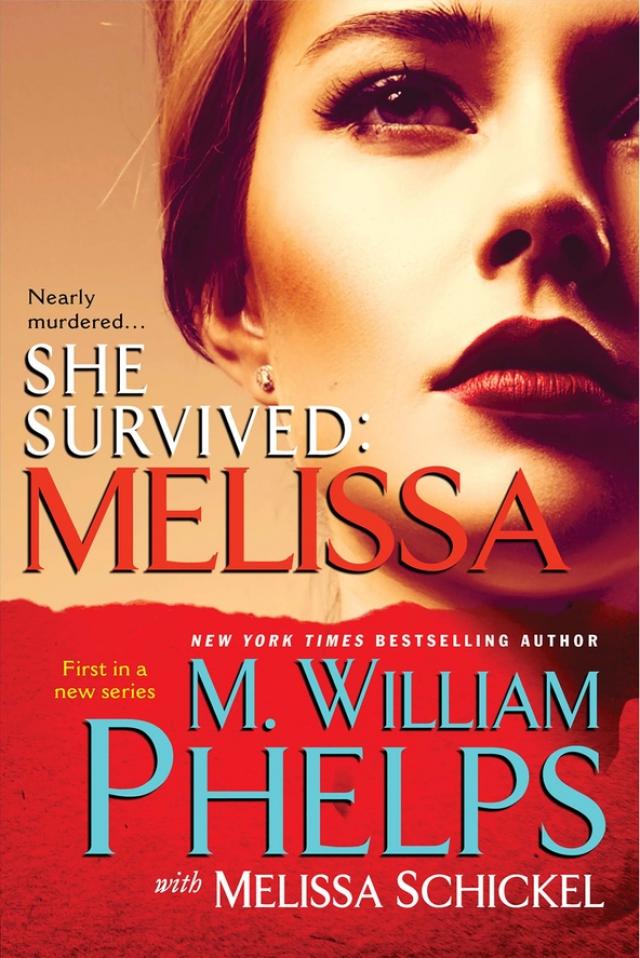
Melissa Schickel was just twenty-five when she survived a near-fatal attack by a violent criminal. Today she works as a paralegal. She enjoys attending hockey games, comedy shows, and taking her Dalmatian mix and gray-and-black Catahoula Leopard/Blue Heeler mix for walks. She lives in the Midwest and hopes one day to become a full-time comedy writer.
Some names have been changed to protect the privacy of individuals connected to this story.
PINNACLE BOOKS are published by
Kensington Publishing Corp.
119 West 40th Street
New York, NY 10018
Copyright © 2015 by M. William Phelps
All rights reserved. No part of this book may be reproduced in any form or by any means without the prior written consent of the Publisher, excepting brief quotes used in reviews.
Pinnacle and the P logo Reg. U.S. Pat. & TM Off.
ISBN: 978-0-7860-3456-7
First Kensington Electronic Edition: January 2015
M. William Phelps, She Survived