Suzume, p.13
Suzume,
p.13


“……”
I can’t do it; the strength leaves my hands. My raised arms grow heavy and drop. I open my fingers and let the kitten go. It drops with a splash by my feet. Standing on four legs, it stares up at me as if trying to gauge how angry I am.
“…Go away,” I say. My eyes are unpleasantly hot. I’m crying. “Don’t talk to me ever again.”
“Suzume…”
Daijin does a little shake and suddenly shrivels; the plump form becomes bony before my eyes, like the air has been let out of it. Its eyes sink into their sockets. Now it looks like a miserable old cat at the end of its life.
“Suzume didn’t like Daijin…,” it croaks, then totters off. Its little footsteps fade behind me.
I’m left alone in front of the Gate.
Now what do I do?
I’m angry, but I’m also worried, sad, upset, and lonely. I don’t know what to do next. I don’t even have a clue. What should I be thinking or doing one minute from now, or five? I can’t come up with anything. Tears are still streaming down my cheeks. I stand there, waiting for the tears to stop. My feet are turning numb in the cold water.
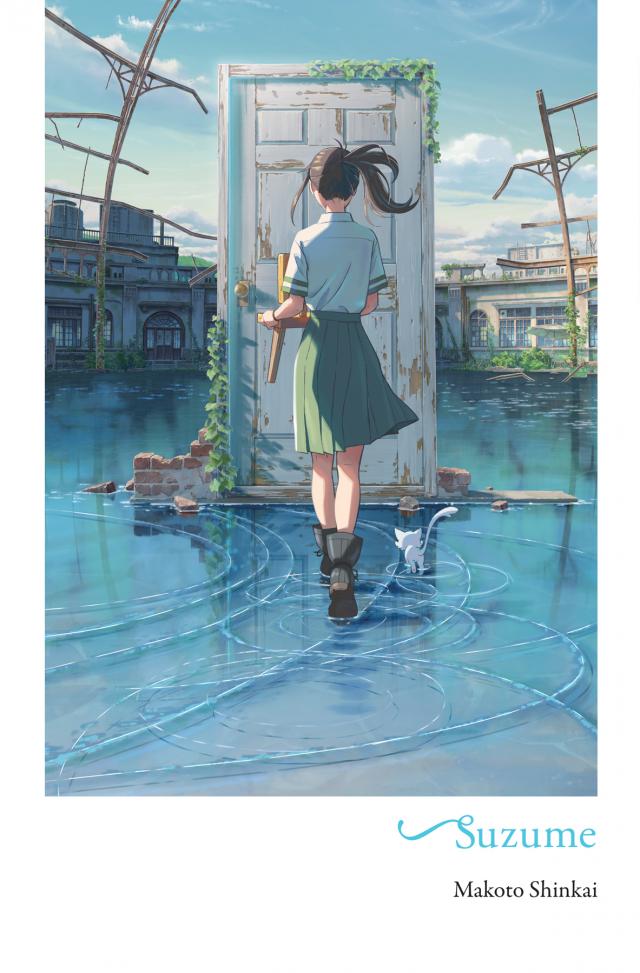
When I look closely at the big doors in the castle gate, I notice vestiges of the worm stuck to the wood. There are several long, thin smears of what looks like smooshed rice on the doors, still faintly glowing reddish black. The worm must have emerged and returned through here.
I realize I need to close them.
I push one of the thick wooden doors with both hands. At first it doesn’t budge, but eventually, it creaks and starts to move very slowly. When I let up even a little, it stops, like I’m pushing on a stone wall. I have to push with all my might to move it. I press both elbows against the door, bend my head, and push with my whole body. I break out in a sweat, and the soles of my feet start bleeding. I watch, detached, as my blood tints the water around my feet.
I think it takes me around half an hour to close both doors. My legs and arms are tingling, and my whole body feels spent. I’m exhausted. If I’m not careful, I might topple over into the water.
I take some deep breaths, plant my legs firmly, and grasp the key around my neck. I close my eyes and imagine what these ruins used to be like.
Eventually, the key grows warm, like it’s breathing, and I hear whispers in the distance. But the memory of those voices, both male and female, is so distant, it’s like a faint breeze blowing between the buildings. All the same, the light radiating from the key draws a faintly shimmering keyhole on the door, shaped like a rounded clover. I push in the key and promise myself once more that I will return to save him.
“We respectfully return them to you!” I say as I turn the key. The sensation of something clicking firmly into place lingers in my hand.
Following a current of air, I walk down a different passage from the one I entered. The draft is faint but steady, blowing up a gentle slope. The damp ground soon turns to dry rock. I’m clearly in a man-made cavern. On the ceiling and walls are many long, straight marks left by the tools used to carve it. Here and there on the walls and floor are what appear to be faded words written in ink. Faint light seeps in from a thin crack near the ceiling, dimly illuminating my surroundings like moonlight. I don’t know if it’s morning or afternoon. My feet, which had been numb from the cold water, now burn with pain. The white socks Chika gave me are brown with dried blood.
As I walk, I notice that the walls are gradually changing. Brick begins to appear between chiseled stone and eventually, gives way to banked concrete. The sound of my footsteps changes. Rusted iron railings appear, leading to concrete stairs.
I climb the stairs through a narrow tunnel. It continues straight for a while, with large landings every so often followed by another straight stretch. Small pipes are attached to the roof. Sometimes I rest on the landings, gaze absently at the random patterns formed by the pipes, and start walking again when my feet stop throbbing. I can’t think about anything. I don’t want to think. I just mindlessly climb the stairs.
Eventually, an odd smell wafts in on a current of cold air. It’s familiar, and I should know what it is, but I can’t remember. At last, I realize it’s car exhaust. That’s about when I see a small door above my head.
I turn the round iron handle, and the steel door opens. Cars are whizzing past right in front of me. I lean out from the wall and look timidly around. I’m in a tunnel with dim orange lighting. The walls are dotted with green guidance lamps and emergency telephones with the letters SOS written on them. About two hundred meters away, white light shines at the mouth of the tunnel. I put my hand on the wall and start walking quickly down what must be a corridor for safety inspections. Every time a car passes, the driver stares at me in surprise. When they see me here, where no one is supposed to be, some of them gape, others squint suspiciously, and still others stare with disapproval. Someone snaps a picture. When I get close to the light, my eyes, accustomed to the dark, start to sting. But I only walk faster. My feet don’t hurt anymore.
There’s a gray steel staircase for workers at the end of the tunnel, and I climb it. As my feet step off the steel platform onto weeds, morning sun hits my eyes. I’m in a small vacant lot piled with construction materials. My eyes tear up from the brightness as I try to take stock of where I am. Past a steel fence, the horizon is packed with rectangular skyscrapers. Apparently, the sun has just risen above them.
“Is this…?” I mumble, looking around.
Directly below me is a huge moat full of emerald-green water. The banks are covered with giant stones, like castle walls, and above them is dense forest. Low castle-like buildings with white walls and black tile roofs poke up from the trees here and there. The ancient forest seems to have been left behind by time, surrounded on all sides by modern buildings shining in the morning sun. Even someone like me who’s never been to Tokyo before knows this place.
“The Imperial Palace.”
I finally realize what has been above me this whole time.
The sharp call of a bulbul rips through the morning air. I look up. It’s another pointlessly, ridiculously clear blue day.
The Only Door You Can Enter
I’m slightly shocked by my own appearance in the morning light. I’m covered in mud and scrapes, my clothes are torn, and the shoulder seam has come undone on my jean jacket so that the arm is falling off. My socks are stained a color I’ve never seen before, thanks to all the blood and dirt. But there’s nothing I can do about any of it. I can’t afford to buy new clothes, and the battery is dead on my phone. Besides, the stores won’t have opened yet, and I don’t know Tokyo, so I have no idea where I am in relation to anything else.
In an attempt to achieve the bare minimum of personal grooming, I hide behind the piles of construction materials to brush the dirt off my clothes and run my fingers through my hair. After that, I climb over the iron gate on the opposite side of the lot from the moat and step onto the sidewalk. A businessman who happens to be passing by looks at me in shock. He doesn’t say anything, though. He glances back a few times, but he keeps walking.
The sidewalk runs along a perfectly average street. According to a sign, it’s called Uchibori Road. I go into a convenience store nearby and plug my phone into a free charging station. While I’m waiting for it to turn on, a young male employee makes eye contact. He frowns at me for a while but ultimately says nothing and goes to the back of the store. A few minutes later, two high school girls around my age come in. When they see me, they stop a few meters away and whisper to each other. I can hear them saying, “Look, she’s not wearing shoes!” “That looks like blood!” “I wonder if she’s been abused. Should we talk to her?” They seem genuinely worried, so I start thinking up excuses in case they approach me.
Just then, my screen turns on with an electronic ding. I unplug the cable, stride over to a shelf with disposable batteries, and take one compatible with my phone. Then I use my phone to pay for it at the register. I speed-walk past the two girls, bowing to them as I go. I’m grateful for their concern, but I don’t want to talk to them.
I know where I’m going next.
After hooking it up to the portable battery, I pull up a map on my phone and plot my route to Ochanomizu Station.
The hospital closest to Souta’s apartment is a university hospital inside a building so tall I have to crane my neck to see the top. A broad, sloping approach leads inside from the sidewalk, and even this early in the morning, it’s dotted with people who appear to be hospital staff going to work. I wait for a moment when the guard isn’t nearby to jog inside.
I enter into a hall with a high ceiling and a café that isn’t open yet, then take the escalator to the second floor. No one is around, and the shutter is down on the outpatient reception window. I check a building map for my destination, then take the stairs to avoid running into anyone. I crouch down and walk quickly through a hallway with patient rooms on either side, reading nameplates as I go.
I finish checking the first floor of patient rooms and have just started on the second when I find a nameplate reading HITSUJIROU MUNAKATA. I try out the name in a whisper: “Munakata.” Then I place my hand on the bar of the sliding door. There’s only a momentary resistance before the door slides open.
The room is dim, and the hospital smell is even stronger than in the hallway. It’s a combination of disinfectant, freshly washed sheets, obligatory bouquets, and human bodies that have been in the same place for a long time. The vital-signs monitor is emitting a regular string of low, quiet electronic beeps.
It’s a double room, but the bed closer to the door is empty. A large form is sleeping in the bed by the window. I can tell at a glance that this is Mr. Munakata—Souta’s grandfather.
The resemblance is striking. The steep, beautiful line of the nose, the prominent forehead, the long eyelashes resting on his cheeks. Souta’s handsome face is still seared in my memory, and the old man’s face is an exact copy of it. But the powerful life force that animated Souta has drained away completely from his grandfather. Deep wrinkles line every part of his face, and his skin is like a sheet of paper. The long hair fanned out on his pillow is white as snow, as are his eyebrows and eyelashes. A small device is clipped onto his left pointer finger, and the fine veins on the back of his hand are nearly colorless. The indentations around his neck and collarbone are so deeply sunken they could hold little pools of water. Sleeping quietly on his bed, he reminds me of some large but gravely wounded wild animal on the verge of death.
“Souta failed, didn’t he?” a low, hoarse voice abruptly asks.
I stare in surprise. Mr. Munakata is talking with his eyes closed.
“I’m s-sorry—I came in without knocking!” I say, flustered. He hadn’t been sleeping. Or maybe my presence woke him. “Um, Souta told me you were in the hospital, and—”
“Ahhh…”
I can’t tell if he’s answering me or sighing. He opens his eyes. After staring at the ceiling for a minute, he slowly shifts his gaze to me.
“Did you get roped into this?”
His voice is another reminder of Souta—quiet and calm—and his eyes are the same vaguely bluish shade. The red veins on the whites stand out brightly.
“What happened to my grandson?” he asks.
“Um…,” I say, looking down. “He turned into a Keystone. He’s in Ever-After…”
“…I see,” his grandfather whispers like a sigh. His voice is emotionless. He turns his head toward the half-open curtains. “I saw the worm from this window yesterday. I wanted to go to it, but this old body doesn’t do what I want it to anymore.”
“That’s why—!” I say, stepping close to his pillow and asking the thing I’ve been desperate to know for so long. “Please tell me how to get into Ever-After!”
“…Why?”
“Uh…”
Why?
“Because I have to save Souta!”
“He doesn’t need your help.”
“Huh?”
“Souta will spend the next decades becoming a Keystone imbued with a god. We can no longer reach him in our realm.”
His words are like a verdict. A chill runs down my spine.
“You may not understand this, but it is an honor that most people can never hope for. Souta was a poor apprentice, but in the end, he seems to have demonstrated his dedication…”
Mr. Munakata squints as if the ceiling has suddenly grown too bright to look at.
“I can’t believe that…!” I blurt out, bending over. “There must be some way!”
“Would you disregard Souta’s feelings?” he asks slowly, like he wants to be sure I understand. His face is blank.
“Huh?”
“Who put in the Keystone?”
“Uh, well…”
“Was it you?”
“Um, but…”
“Answer me!” he suddenly shouts.
“Yes!” I say, the words forced out from me.
“I see. That’s good! If you hadn’t, a million people would have died last night. You prevented that. So keep your mouth shut, be proud of what you’ve done for the rest of your life, and…”
His voice is growing more insistent. The air quivers as he speaks.
“…go back to where you came from!”
His words overpower me like a strong wind. I step back, and he lets out a long, deep breath. As if exhausted from speaking, he closes his eyes, his face still turned toward the ceiling.
“…This matter does not concern people like you. You must forget everything.”
I stand rooted to the ground, my heart pounding. My cheeks are burning. I take a deep breath.
“…I can’t forget,” I choke out in a whisper. I’m furious. “…I’m going to reopen that underground door.” I turn toward the room’s exit.
The old man’s eyes are still closed. It was stupid of me to try to rely on anyone else. This is our battle—mine and Souta’s.
“What are you saying? Wait!” his grandfather shouts at my back. “What will you do after you open it?!”
“I’ll get inside, somehow.”
“Impossible. You can’t go in that way!”
I’m about to step out of the room, and I put my hand on the doorknob.
“You must not open the Gate!” he thunders at my back.
As soon as he finishes speaking, a coughing fit overtakes him. The phlegmy sound is awful, like he’s choking.
I look back in surprise and find that his body is convulsing painfully. Moving on instinct, I run to his side. But I don’t know what to do, and I freeze in front of the bed. His torso shakes violently as he pushes a button on the remote in his hand. With a low whir, the top half of the bed rises. His coughing dies down, and the hurried beeping of the monitor slows back down to its original tempo.
Still sitting up, he lets out a long, slow breath. Beads of sweat dot his face. His eyes are closed. That’s when I notice the way his hospital gown drapes from his right shoulder—his arm is missing.
“…Ever-After is beautiful, but it’s the land of the dead.”
His chest heaves like bellows as he speaks. A quiet dignity has returned to his voice. He opens his bloodshot eyes and stares at me.
“Aren’t you scared?”
The question reminds me of Souta. He asked me the same thing. Back then, in Ehime and Kobe, we were fighting side by side. I felt like we were invincible. We had done something important that only we could do, and we’d done it without anyone knowing. We’d even left a mark at the top of the sky.
“…Not at all,” I say, glaring at him. “Ever since I was little, I’ve thought that life and death were just up to fate. But—”
But now.
“I’m more afraid of a world without Souta!”
My eyes are hot. I think I’m going to start crying again. But I don’t want to, so I squeeze my eyes shut.
Just then, Souta’s grandfather coughs loudly. No—he’s laughing, a loud, deeply amused laugh. I’m surprised to hear something so loud gush from such a shriveled old body. I gape at him, wondering what’s so funny.
He chuckles for a long time until his voice dies down, like the laughter has worn him out. On his face, however, a smile lingers as he tells me, “There is only one Gate a person can go through in their life.”
“Um—”
“You saw the world inside, didn’t you? What did you see?”
“Um, I saw—”
I search for the memory, caught off guard by his question. The harder I try to recall it, the further it recedes, like a mirage. But… That meadow under the starry sky I’ve seen so many times… The person walking through the grass… The one I found there…
“I saw myself as a little girl…and my mother, who should be dead…”
The man gives a small nod.
“Ever-After looks different to each person. There are as many Ever-Afters as there are human souls, but at the same time, they are all one.”
He pauses, waiting for the words to sink in.
“Perhaps you strayed there once when you were young. Do you remember anything like that?”
A scene bursts into my mind. A snowy night—I’m walking alone through cold slush. A door stands among the snow-dusted rubble. My little hand pushes the knob. Inside is a sky full of blinding stars.
Souta’s grandfather searches my face, then says in a deep voice that reminds me of Souta’s, “That is the only Gate you can enter. You must search for that door.”
The old man closes his eyes and shuts his wrinkled mouth tight. Go now, he is saying without words. His mouth does not open again. But I think I see the corners of his lips turn up very slightly, no more than a few millimeters, into a smile.
I stand facing him, my back straight, and offer him a long, deep bow. Then I wordlessly leave his room.