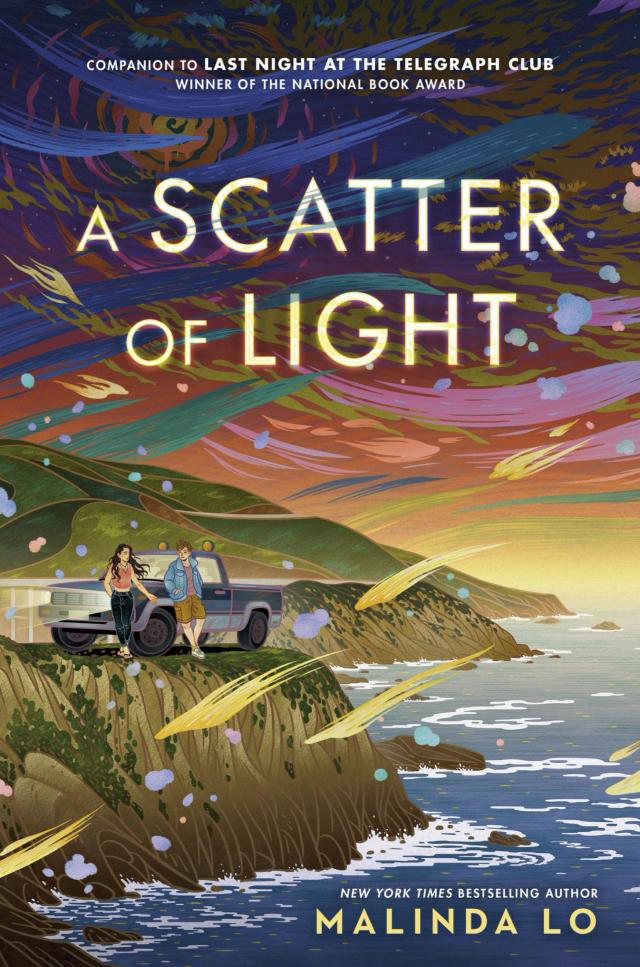
A scatter of light, p.11
A Scatter of Light,
p.11


“It’s more poems.” Steph gestured to Diving into the Wreck. “Like these, but gayer. She was a lesbian.”
“Oh.” I had assumed she was straight.
“I tried to write some songs inspired by her poems. One of them turned out okay. When I was with Madchen, we recorded it on our EP.”
I could tell by the way she was downplaying the song that she was proud of it. “I’d love to hear it,” I said. “Is it online?”
“No. We burned a bunch of CDs at Roxy’s apartment and sold them after gigs. But tell me about your grandpa’s work. This is it?”
I plucked the top folder off the notes stack and opened it to show Steph, who came over to stand next to me.
“He was researching protostars. They’re stars in an early stage of formation,” I explained. “Joan wanted me to separate out his research from his letters. I like seeing his handwriting.”
“Do you understand all this?” Steph asked, gesturing at the math.
“Only sort of. I’ve taken calculus, so I can kind of see where it’s going, but I haven’t studied this. It’s pretty advanced.”
“Is that what you’re most interested in? Protostars?”
“I’m actually more interested in planets than star formation. I’d love to study Earthlike planets.”
“Like places we can travel to?”
“That’s the first thing everyone thinks of,” I said, smiling. “But we have to invent a way to travel a lot faster before we can do that.”
“Warp speed?”
I figured she was joking, but I said seriously, “Maybe, but it’s unlikely.”
She leaned against the edge of the table and looked at me curiously. “Let’s say we could go there—to these planets. Do you think there’s life on them?”
“Absolutely! We’ve already found thousands of planets—and only from a really tiny part of the Milky Way. There are so many possibilities for life out there—and life out there might not be anything like what we know on Earth. There are a bunch of telescope missions in the pipeline at NASA that are going to make it practically guaranteed that we can find an Earthlike planet with life on it in our lifetime. I want to be part of that discovery.” I stopped, realizing self-consciously that I sounded like a total nerd.
“You’re really into this stuff,” Steph said, smiling.
I shrugged. “Sorry not sorry?”
She laughed. “I bet you’d be interested in this movie we’re watching this weekend. I can’t remember the title but Lisa picked it out. It’s a 1950s science-fiction movie. Lisa was almost a film major, so she likes to plan out little film festivals for us—I mean for me and Mel. We get together on Sunday nights and watch movies.” Steph paused, then said, “You should come over. I bet I have an extra Madchen CD I could give you, and you could borrow my favorite Adrienne Rich.”
It was a perfectly safe invitation—Lisa would be there, as well as Mel—but to me it felt, if not dangerous, then significant. “Are you sure? I don’t want to crash your party.”
“It’s not a party; it’s just a movie. It would be great to have you.” She grinned. “And I know Mel would love to see you.”
I was never going to say no, but I hesitated as if I had to think about it. If Steph were a boy, would my hesitation make her try harder? But she wasn’t a boy, and she didn’t look as if she doubted my decision. She simply looked at me, and I said, “Okay. Sure, I’d love to come.”
“Cool. Give me your number and I’ll text you my address.” She pulled out her phone and handed it me to type in my number. “We usually start around seven and make pizza with Mel.”
“Should I bring anything?”
“No, it’s really low-key.” She wrote a quick text message and a moment later I heard my own phone chime.
I pulled out my phone to read her message. It was just her address, no name. “Got it.” When I looked up, she was looking at me with an odd expression on her face. “What?”
“You have a leaf in your hair.”
“Where?” I ran my fingers through my hair, trying to dislodge it.
“Other side.” Steph reached out with her left hand, her fingers sweeping through my hair behind my right ear, and even though she barely touched me, it felt as though she had stroked my skin from head to toe in one smooth motion. When she stepped back, she was holding a dry fragment of an oak leaf, and her face had a tentative expression on it, as if she wasn’t sure if she should have done that. She carefully set the leaf on the worktable, and I wanted to pick it up and preserve it between the pages of a book, like evidence. Exhibit number one: The first time Steph touched me was because of this.
When I was a kid, my grandmother set up a makeshift studio for me in her backyard in Berkeley. She tacked up a piece of black roofing paper on the fence and gave me an enameled tray to use as a palette. She offered me brushes, but I liked to use my fingers. I remember the feel of smearing the bright paints across the rough surface of the paper. I never wanted to paint pictures of people or flowers or houses; I just loved sweeping different colors across the black background, as vivid and contrasting as possible.
Now I kept imagining the ocean in the Adrienne Rich poem. I was taken with the idea of trying to paint it.
Joan told me there were acrylic paints in the studio, left over from the last art class she had taught at the local community center. There was a roll of roofing paper, too, she said, stashed in the gardening shed. She still used it for classes because it was so cheap, and it held the paint well.
I went to the studio first, where I opened the cabinets to hunt for the paints. I found brushes and palette knives, trays with dried paint in the corners, jars of rubber cement and matte medium. I found a heavy, rectangular leather case with the word Rolleiflex stamped across the top, and realized this must be Joan’s camera. At the very back of the cabinet was a jumble of plastic bottles and squeeze tubes filled with acrylic paint. I pulled them out and lined them up on the counter: ultramarine blue, raw umber, alizarin crimson, chrome yellow, titanium white, mars black. The bottles were covered in multicolored smudges and fingerprints.
I put away the stuff I didn’t need, but kept out the camera to show Joan. Then I went to the shed, where I found the roll of tar paper wedged into a back corner. It was about three feet wide and seemed to weigh a million pounds. Once I maneuvered it outside, I found it was easier to roll it over the ground like a log than to carry it. I was rolling it into the studio when Joan called me from the deck.
I glanced over my shoulder and saw her waving the house cordless phone at me. “Your dad’s on the phone!” she called.
I dusted off my hands—the paper still smelled a bit like asphalt—and went up the stairs to the deck. Joan handed me the phone and went back inside, while I sat down on the lounger. “Hi, Dad,” I said.
He didn’t have cell reception at the colony, so every Sunday he would go to the main lodge and call using their landline.
“Hi,” he said. “How are things?”
“They’re fine. How are you?”
“Same. I’m making progress. Are you still watching my dad’s astronomy lectures?”
“Yeah. In the one I watched yesterday he was talking about analemmas—the path of the sun across the sky throughout the year. I forgot that’s what Ana was named for.”
“Oh, right. He would’ve loved Analemma. How is she?”
“She’s good. Joan’s neighbor Tony took her out for a hike with his dog this morning. Do you know Tony?”
“He’s the one who did their built-ins, right?”
“Right.” I wondered if Dad had any suspicions about Tony’s feelings for Joan, but it seemed too weird to ask.
“I talked to your mother recently.”
I tensed up. “You did?”
“She said she’s coming to San Francisco to see you.”
“She’ll be on a layover to Hong Kong. She’s not really coming to visit me.”
He exhaled. “Give her a chance.”
He was always asking me to give her a chance. I wondered how many chances he gave her before they divorced.
When I was about twelve, I found a folder of newspaper clippings about my mom in the bookcase in my dad’s office. In one article, she was on the front page of the Boston Globe’s arts section in an off-the-shoulder black dress, her shiny black hair hanging down in a long straight sheet. Her lips were dark red, her eyes dramatically lined, and the headline read “Alexis Tang Gives ‘Carmen’ an Asian Twist.” She had played Carmen when I was seven years old. I hadn’t been allowed to see her performance, but I remembered it had been a big deal.
Inset in the article was a smaller photo from the production itself, with my mother in costume onstage. She wore a red bustier and a ruffled red skirt, and she held up the hem with one hand while she sang, bare legs on display.
I stared at those two photos for a long time: In the larger one she was all elegance; in the second she was all sex appeal. It was disconcerting to see her in the bustier, her cleavage and skin exposed, but she was arresting in both images. I wondered if I could ever look like her. My hair wasn’t as black as hers, and it wasn’t as straight. My features were softer, as if someone had taken a photo of her face and blurred the lines.
I read the article several times. She told the Boston Globe it was long past time for color-blind casting in operas; there was nothing stopping her from playing Carmen if she could sing in French as well as any other soprano. “Why should being Chinese exclude me from taking this role?” she said to the Globe reporter. “The language of music, like the language of love, is universal.”
The day I found that article I had been angry at my mom for something she’d said to me over the phone. Dad asked me, after the call, to give her a chance to explain, but I was too mad to listen. When I read the Globe interview, though, I was so proud of her it hurt.
I put the article back into the folder, and I put the folder, with its worn edges, back where I’d found it. I never asked my dad why he was keeping press clippings about my mom, but it made me suspect that he still loved her.
Over the phone Dad asked, “Are you there?”
“Yes.”
“Are you still angry about the summer?” He sounded resigned.
I realized that I wasn’t anymore. “No, I’m over it,” I said. Maybe that video from Tasha had cemented it. It hadn’t made me wish I was on the Vineyard at all. And tonight I was going over to Steph’s apartment, and the thought of it made my heart race.
“I’m glad. Your grandmother told me you’ve been making some new friends in the area?”
“Yeah.”
“Want to tell me about them?”
“One of them does yard work for Joan—you met her, actually. The others are her friends.”
“They’re older?”
“Maybe by a couple years,” I hedged.
“These are girls, right?” Dad asked, sounding suspicious.
“Yeah, Dad. They’re girls.”
“Okay. Sorry,” he said sheepishly.
“Don’t worry about it.” I wasn’t about to tell him they were lesbians.
“I’d better get going. I’m in a good spot in the book. I think I’m on track now.”
“Okay. Good luck.”
“I’ll talk to you next week. I love you, Ari.”
“Love you too, Dad.”
* * *
—
Later that afternoon, I brought the Rolleiflex into the house. Joan was in the living room reading a book when she saw it. “Where’d you find that?” she asked.
“It was in the studio. Is this your old camera?” I sat down beside her on the couch and handed it to her.
“Yes. I’d forgotten where it was. It’s been so long since I’ve used it.”
She unsnapped the cover to reveal a black box with silver knobs and levers, and two lenses stacked on top of each other. It wasn’t that large and fit comfortably in two hands, but its weight and square corners made me think of those giant old cameras where photographers would cover themselves with a cloth to look through the hood.
“How does it work?” I asked.
She removed the lens covers and pushed up the top of the box, then pressed something that caused a circular glass piece to pop out. “You look down through the top of it,” she said, showing me. “This is the viewfinder. Hold it in your lap and look through it. You can focus it with this knob here.”
I bent over the top of the camera and realized the glass piece was a magnifier. As I turned the focusing knob, I saw the blurry shapes of the living room come into focus the same way Mars or Venus would sharpen when I’d focus on them through a telescope. A refracting telescope would invert the image, and similarly, the Rolleiflex flipped it horizontally. The woodstove was on the other side of the living room when I looked at it through the viewfinder.
“Does it still take pictures?” I asked.
“It might need some cleaning, but probably. I don’t have any film, though.”
The camera—with its knobs and levers, its focusing hood and twin lenses—felt like a time machine. I carefully placed it on the coffee table. “Can I ask you something?”
“Of course.”
“Why’d you stop using the studio outside?”
She looked surprised by the question. “I didn’t mean to. After your grandpa died, I missed him so much. For a long time, I couldn’t work. And then when I wanted to work again, the studio felt so far from him. I used to go out there to be alone. He never came out there. He wanted to give me my space.” She had a distant expression on her face. “I started using your grandpa’s office because I was going through his files, and it just stuck. I like being in his space. I like being able to see what he saw when he worked there. It gives me a different perspective.” She looked at me and said, “I’m glad you’re using the studio now.”
“Don’t you want to ask me what I’m doing out there?”
A smile. “Would you like to tell me?”
I thought I did, but as soon as she asked, I felt a kind of defensive constricting inside me. “Actually, I don’t know if I do.”
Joan nodded. “It’s good to keep it to yourself until it’s ready. Give it time to incubate on its own, without other people’s opinions.”
“When will I know if it’s ready?”
“You’ll learn. Sometimes I’ve said things too soon, and it’s been ruined. I could always tell Russ, though. His knowing never ruins anything. He never judges. He just listens.”
I didn’t know whether Joan’s use of the present tense meant anything. Sometimes it seemed as if Grandpa were right there beside her, just out of sight. I glanced over at the stairs that led to Grandpa’s office. I almost expected to see him standing there.
Steph and Lisa lived in a two-story apartment building that looked like a 1950s-era motel. It was on a block lined with older cars and bungalows in San Rafael. I parked next to a manicured hedge in front of the building, checked my phone again for the apartment number, and gave myself one last glance in the rearview mirror. I’d pulled my hair back in a ponytail and put on a smear of neutral lip gloss, aiming for casual, and now I worried my lips were too shiny. I grabbed a tissue from my purse and rubbed some of the gloss off, which only made my lips seem pinker and more swollen. I looked like the girl in the pictures Jacob had taken.
I crumpled up the tissue and got out of the car.
Steph and Lisa’s apartment was on the ground floor in the corner, where the building bent like an L around a courtyard with a dry fountain. The windows were covered with half-closed blinds, and through them I could see the flickering of a TV. I pressed the buzzer and didn’t wait long before the door was opened.
“Hey,” Lisa said. She was holding a PBR in one hand. “You found us.”
The door opened into the living room, where an overlarge blue-and-white sectional, across from the TV, took up the majority of the space. A couple of movie posters were tacked up on the wall over the sofa: The Wild One, with Marlon Brando on a motorcycle, and Mädchen in Uniform, with two women looking pensively past each other. A breakfast bar separated the living room from the kitchen, where I saw Steph and Mel bending over something on the counter. They looked up as I came in and waved at me, but didn’t leave the kitchen. Their hands were white with flour.
“Aria!” Mel called. “How’ve you been?”
“Good. How about you?”
“Even better now that you’re here,” Mel said.
“You want something to drink?” Lisa asked.
“Sure.” I followed her toward the kitchen. It was U-shaped, with the breakfast bar on one arm, the sink and refrigerator across from it, and the stove and a narrow dishwasher crammed into the short side. Lisa edged into the small space and opened the fridge.
“Diet Coke or beer?” Lisa asked.
“Diet Coke, thanks.”
Lisa held a can out to me and then went around to lean against the front of the breakfast bar. I joined her, sliding onto one of the two stools.
“Did you get pepperoni?” Mel was saying. “We were out of it last time.”
“Yeah,” Steph said. “I’ll get it.” She went to the fridge while Mel began to stretch the dough on the floured counter.
“Can I do anything to help?” I asked.
“No, we got it,” Steph said. “Mel and I have been making pizza since when? High school?”
“Since we used Boboli crusts,” Mel said.
“So glad we evolved,” Steph said.
“We? You mean me?” Mel looked at me. “I make the dough now.”
“I can’t cook,” Lisa said. “I let them take care of it.”
“You make a mean Kraft macaroni and cheese,” Steph said.
Lisa smiled at Steph. “That’s right, baby.”
She was pretty with that smile, but even as I thought that, I felt a prickling of jealousy. I opened the Diet Coke and realized she hadn’t given me a glass or any ice, and then I realized I’d sound like a princess if I asked for some. I drank it straight from the can, the bubbles fizzing so sharply on my tongue that I could taste the chemicals.