Burning questions, p.34
Burning Questions,
p.34


Here are Gavin and Reynolds going to a production of Richard III—an outdoor production, in a park—Reynolds with optimism and practicality, Gavin with grumpiness:
The park was pullulating with activity. Kids played Frisbee in the background, babies yowled, dogs barked. Gavin pored over the program notes. Pretentious crap, as usual. The play was late starting: some spasm in the lighting system, they were told. The mosquitoes were gathering; Gavin swatted at them; Reynolds produced the Deep Woods Off. Some fool in a scarlet unitard and pig’s ears blew a trumpet to get them all to shut up, and after a minor explosion and a figure in a ruff sprinting off in the direction of the refreshment kiosk—in search of what? What had they forgotten?—the play began.
There was a prelude showing a film clip of Richard the Third’s skeleton being dug up from underneath a parking lot—an event that had in fact taken place, Gavin saw it on the television news. It was Richard all right, complete with DNA evidence and many injuries to the skull. The prelude was projected onto a piece of white fabric that looked like a bedsheet, and probably was one—arts budgets being what they were, as Gavin commented to Reynolds, sotto voce. Reynolds dug him with her elbow. “Your voice is louder than you think,” she whispered.
The sound track led them to understand—over a crackling loudspeaker and in lousy iambic pentameter Elizabethan pastiche—that the entire drama they were about to see was unfolding post mortem from inside Richard’s battered skull. Zoom to a hole in the skull, and then right on through it to the inside of the cranium. And blackout.
Whereupon the bedsheet was whisked away and there was Richard in the floodlights, all set to caper and posture, to flounce and denounce. On his back was a preposterously large hump, decorated in a jester’s red and yellow stripes….The largeness of the hump was deliberate: the inner core of the play (“As opposed to the outer core,” Gavin had snorted to himself) was all about the props. These were symbols of Richard’s unconscious, which accounted for their enlargement. The director’s thinking must have been that if the audience members were staring at outsized thrones and humps and whatnot and wondering what the fuck they were doing in this play, it wouldn’t bother them so much that they couldn’t hear the words.
So in addition to his gigantic, varicoloured, metonymous hump, Richard had a kingly robe with a sixteen-foot-long train attached to it, carried by two pageboys wearing outsized boar’s heads because Richard’s coat of arms had a boar on it. There was a huge butt of malmsey for Clarence to be drowned in, and a couple of swords that were as tall as the actors. For the smothering of the princes in the Tower, performed in dumbshow like the play within the play in Hamlet, two enormous pillows were borne in on stretchers like corpses or roasted suckling pigs, with pillowcases that matched the motley of Richard’s hump, just in case the audience missed the point.
I’ve never seen exactly that production, but if it were on offer I’d go like a shot.
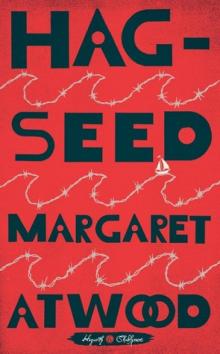
Now, finally, my contribution to the Hogarth Shakespeare project. Jo Nesbø is doing Macbeth, Jeanette Winterson has done The Winter’s Tale, Anne Tyler has taken on The Taming of the Shrew, and Howard Jacobson has tackled The Merchant of Venice. And I grabbed The Tempest. It was my first choice, by miles.
Having grabbed it, I had misgivings. Revisiting a Shakespeare play in the form of a novel is a daunting challenge: Shakespeare is a giant, and without question has made the greatest contribution to the English language, to theatre, and to English literature of any writer, ever. He is also mercurial, many-layered, universal in his empathies, slippery as an eel, and a notorious shape-shifter, taking on fresh forms and variations and interpretations with every new production and in every new age. Grasping Shakespeare is like nailing jelly to a wall. As for rewriting Shakespeare: What sacrilege! Anyone attempting that is bound to get a load of buckshot in the nether regions from outraged Shakespeare purists.
Nonetheless, it would not be Shakespearean not to try—Shakespeare himself having been a well-known re-formulator of previous stories and plots.
I’d thought about The Tempest before, and written about it as well. In my book about writers and writing—called, oddly enough, A Writer on Writing—there’s a chapter on the artist as magician and/or imposter called “Temptation: Prospero, the Wizard of Oz, Mephisto & Co.” All of them are illusionists, as artists are.
Of Prospero—a good magician, more or less—like the Wizard of Oz, but not, like him, a fraud—I say, in part:
Prospero uses his arts—magic arts, arts of illusion—not just for entertainment, though he does some of that as well, but for the purposes of moral and social improvement.
That being said, it must also be said that Prospero plays God. If you don’t happen to agree with him—as Caliban doesn’t—you’d call him a tyrant, as Caliban does. With just a slight twist, Prospero might be the Grand Inquisitor, torturing people for their own good. You might also call him a usurper—he’s stolen the island from Caliban, just as his own brother has stolen the dukedom from him; and you might call him a sorcerer, as Caliban also terms him. We—the audience—are inclined to give him the benefit of the doubt, and to see him as a benevolent despot. Or we are inclined most of the time. But Caliban is not without insight:
Without his arc, Prospero would be unable to rule. It’s this that gives him his power. As Caliban points out, minus his books he’s nothing. So an element of fraud is present in this magician figure, right from the beginning: altogether, he’s an ambiguous gentleman. Well, of course he’s ambiguous—he’s an artist, after all. At the end of the play Prospero speaks the Epilogue, both in his own character and in that of the actor that plays him; and also in that of the author who has created him, yet another behind-the-scenes tyrannical controller of the action. Consider the words in which Prospero, alias the actor who plays him, alias Shakespeare who wrote his lines, begs the indulgence of the audience: “As you from crimes would pardoned be, / Let your indulgence set me free.” It wasn’t the last time that arc and crime were ever equated. Prospero knows he’s been up to something, and that something is a little guilt-making.
That epilogue has always bothered me. What does Prospero feel so guilty about?
The first thing I did when starting this project was to reread the play. Then I read it again. Then I got my hands on all the films and filmed productions of it that I could, and watched them. Then I read the footnotes in the very helpful Oxford Classics version, because there were some things I really needed to know. About food, to begin with. What, for instance, is a pig-nut?
* * *
—
This year being the four hundredth anniversary of Shakespeare’s death, I’m sure someone will come out with a Playbook Cookbook. What did the Macbeths serve at the feast interrupted by Banquo’s ghost? What were Sir John Falstaff’s favourite foods? (Many. Starchy.) When Sir Toby Belch, in Twelfth Night, refers to “cakes and ale,” what did he have in mind?
Perhaps the cakes were “Maids of Honour,” a kind of Tudor cheesecake. As for the ale, it would have been made from barley, and brewed by an “ale-wife”: everything was micro-brewery then.
I always like to know what the characters eat—if anything—in fiction and plays. There’s quite a lot of food mentioned in The Tempest, though it’s mostly food that would require some very creative cooking.
Caliban, whom the other characters treat as a slave or monster, has grown up on the island. He pursues a foraging lifestyle, relying on—according to him—fish, crabs, berries, pig-nuts (a kind of plant with underground nodules on it, I discovered), jays’ nests—possibly for the eggs—filberts, marmosets—a sort of monkey, which one can assume he ate, though maybe he also made hats out of them—and scamels, though we aren’t sure exactly what “scamels” were. So that is what the deposed Duke of Milan, Prospero, and his daughter, Miranda, have been eating during the twelve years they’ve spent on the island. It’s very basic: no pepper or butter, for instance. Or bread. You can see why Prospero would want to get back to Milan as soon as possible.
There’s more food in The Tempest, though it’s a magic illusion. It’s in the scene where the miscreants—Prospero’s usurping brother, Antonio; Alonso, the King of Naples; and Alonso’s brother, Sebastian, who wants to kill him—are accosted by “several strange shapes bringing in a banquet,” who invite them to eat.
We think of a “banquet” as what the Tudors would have recognized as a “feast”—a lavish, formal sit-down affair. But as Ruth Goodman’s How to Be a Tudor informs us, a banquet was originally more like a cocktail reception: light fare, eaten while strolling around. If you were very up-to-date, you’d carry your own little monogrammed fork for snack-spearing.
As Shakespeare’s characters prepare to tuck in, the elemental spirit, Ariel, disguised as a winged harpy, appears to the sound of thunder and the banquet vanishes. Ariel berates the sinners for their misdeeds, and they are then be-spelled by Prospero and go mad.
We’ve all been to parties like that. You’ve got the smoked salmon canapé halfway to your mouth when someone from your past appears, chews you out about your awfulness, and proceeds to drive you crazy. Keep that in mind about banquets.
Meanwhile, you can amuse yourself with this question: What did Shakespeare’s Tempest “banquet” look like? Remember: No tiny potatoes yet. Also, no tomatoes, so mini-pizzas are out. Oh, and no coffee. Sorry. You’re stuck with the cakes and ale.
Having done some elementary research, I had to make a few primary decisions. Where would my novel be set? The play is about illusions, as we know. And it’s about vengeance versus mercy, like so many moments in Shakespeare. But it’s also about prisons. When you come to think of it, just about everyone in the play is imprisoned one way or another at some moment in time. So that is why I set it in a prison.
The Tempest is the story of a magician and former Duke of Milan, set afloat with his infant daughter, Miranda, after a coup by his treacherous brother and the King of Naples. When an auspicious star brings his enemies within his reach twelve years later, he raises an illusory tempest with the aid of the air-spirit, Ariel. His enemies, his old helper Gonzalo, and Ferdinand, son of Alonso, end up onshore and are manipulated in various magical ways by Prospero via Ariel, with the upshot that Ferdinand and Miranda fall in love and the enemies are entranced, tortured, and at length forgiven. Meanwhile, Caliban has joined two lowlifes—a drunken butler and a jester—and the three of them plan to murder Prospero, but are punished by Prospero’s goblins. At the end, Ariel is set free, everyone sails off to Naples, and Prospero steps out of his own play and asks to be released from it: perhaps the most puzzling ending to any Shakespeare play.
The Tempest is fiendishly complex, with several holes in the plot and some of the most gorgeous blank verse Shakespeare ever wrote. Over time, it’s had wildly varying interpretations. Is the island magical in itself? Is it a prison? Is it a place of trial? Is Prospero wise and kind, or a tetchy old crank? Is Miranda sweet and pure, or a more savvy, tougher girl who knows about wombs and abuses and vilifies Caliban? Is Caliban himself the Freudian Id? Is he bad by nature? Is he Prospero’s dark shadow? Is he Natural Man? Is he a victim of colonial powers? We’ve had all those Calibans, and more.
The Tempest is also a musical: it has more songs and dances and music in it than any other Shakespeare play. The main musician is Ariel, but Caliban also has musical talents.
But above all, The Tempest is a play about a producer/director/playwright putting on a play—namely, the action that takes place on the island, complete with special effects—that contains another play, the masque of the goddesses. Of all Shakespeare’s plays, this one is most obviously about plays, directing, and acting.
How to do justice to all these elements in a modern novel? Is it even possible? That’s what I attempted to find out.
Hag-Seed is set in the year 2013, in Canada, in a region somewhat close to the actual Stratford Shakespeare Festival. It opens with Act 1, Scene 1 of a video of The Tempest that’s been made in a prison and is being watched onscreen by an unseen audience inside the prison. Suddenly there are sounds of a prison riot. Lockdown!
Cut to the backstory. Twelve years earlier, Felix Phillips, artistic director of the Makeshiweg Theatre Festival, was ousted from his position by Tony, his second-in-command, and Tony’s pal Sal O’Nally, a politician. Felix has been living in exile in a countryside shanty. He half believes that the spirit of his only beloved child, Miranda—who died at the age of three—is with him, and is now fifteen. To ease his solitude, he’s taken a position as a drama teacher at the Fletcher Correctional Institute, and has been putting on Shakespeare plays there. (Note: Similar prison programs do in fact exist.)
When an “auspicious star”—here, a twinkly female character with a lot of influence—brings his enemies within his reach, Felix stages The Tempest in his prison, thereby hoping to entrap them, enchant them, and get both his revenge and his old position back. He has the aid of a young hacker inmate, who uses digital technology to great effect. As no prisoner wants to play a girl, Felix hires a real actress to play Miranda. Meanwhile, the spirit-girl Miranda, fascinated with the play, decides to join in on it.
As with The Tempest, at the end the action is projected into the future, as the inmate student actors submit their reports about what they think will happen to the main characters once they’re aboard the ship to Naples. Hint: It’s not all good.
There you have it, in a pig-nut shell.
Marie-Claire Blais
THE ONE WHO BLEW EVERYTHING UP
(2016)
I read my first book by Marie-Claire Blais in 1961. I was twenty-one; it was my fourth and final year at Victoria College, University of Toronto. I was in a course called “English Language and Literature,” which took the student from Anglo-Saxon to T.S. Eliot, covering everything in between. At the very end, as a sort of dessert, we were allowed a course in the modern novel, and at the very end of that, as a sort of double espresso, we were given two books by Canadians: The Double Hook by Sheila Watson and Mad Shadows, which was the English-translation title of La Belle Bête by Marie-Claire Blais.
We didn’t study Canadian literature as such in Eng Lang and Lit, so these books weren’t on the course because they were specifically Canadian. I think they were chosen because of their unconventional forms. In the case of The Double Hook, with its terse intercut short sequences, you might say “modernist.” But what label could possibly be applied to Mad Shadows? It escaped definition. It, too, had short sequences that were intercut, but the tone was very different. Instead of the laconic plainsong of Sheila Watson, it gave us a superheated baroque in which every emotion and every adjective was cranked up to maximum volume.
It had a cover design in which a beautiful face with something wrong with the eyes was shown with red paint or possibly blood dripping down all over it. This book didn’t have love, it had love love love! It didn’t have hate, it had hate hate hate! Above all, it had obsessive jealousy, intense narcissism on the part of everyone in it, and a crazed wish to destroy on the part of its female protagonist. Strong stuff for the fourth year of Eng Lang and Lit!
How to describe the plot? Now that I have seen Jean Cocteau’s film La Belle et La Bête, I have more context for its heightened surrealism; but in any case, it was a demonic riff on the old Perrault tale Beauty and the Beast. In that story, Beauty is as attractive as her name, and the ugly Beast almost dies for love of her, but love finally triumphs when Beauty says she will marry the Beast. Fireworks are set off, and the Beast is transformed into a handsome prince.
No such luck in La Belle Bête, where beauty and beastliness are one. A beautiful but idiotic son called Patrice (from patrician, incorporating the root word for “father,” thus allied to male privilege) and an intelligent but ugly and enraged daughter, Isabelle-Marie (incorporating the word belle), live with a self-regarding mother who dotes only on the son. Jealousy motivates the daughter; stupidity blinds the mother.
These people don’t think: they feel, and the daughter with a white-hot intensity. The epigraph is from Baudelaire’s Les Fleurs du Mal; the theme, insofar as there is one, is about the futility of desire, the impossibility of ever having what you long for. The doomed heroine longs to be beautiful so that other people will love her, but the closest she comes is a romance with a blind man: she can be beautiful as long as she is unseen. (Could the author have read Frankenstein?) But when the blind man miraculously regains his sight, he runs away from her in horror. Love does not redeem.
At the end, as in La Belle et La Bête, fireworks are set off, but they take the form of a fire started by Isabelle-Marie. The house burns, the mother is incinerated, the heroine heads for the train tracks—intending, we assume, to do herself in—and the beautiful boy, now ugly because his sister has stuck his head into a vat of boiling water, drowns seeking his own once-beautiful reflection; like Narcissus, it’s the only thing he’s ever loved.