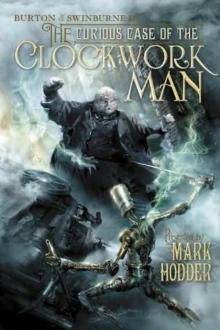
The curious case of the.., p.35
The Curious Case of the Clockwork Man,
p.35


“Aaah,” he sighed, and when he pulled the dripping red arm back out, the philosopher's still-beating heart was gripped in his fingers. He tore it free of stretching arteries and flesh, raised it to his mouth, and licked it.
“Why won't you fucking die?” Swinburne raged, tears streaming down his cheeks.
The Claimant turned and regarded the poet. He grinned and chewed on the twitching organ.
Swinburne raised the cactus gun and, without aiming, touched the trigger nodule.
Spines sank into Orton's right eye.
The butcher flinched, shook his head, and waddled slowly toward the tiny man.
“More meat! I like meat!”
Swinburne turned to run but suddenly found himself gripped by vaporous hands. Two wraiths had swooped upon him and now, just as they had dragged Sir Alfred Tichborne through Tichborne House to his doom, so they began to pull Swinburne to his.
“Get off me! Get off me!”
Orton gave a bloody smile and said: “Come to me. I eat you up!”
Closer and closer Swinburne was drawn, until the gigantic butcher towered over him, dripping blood onto his flame-red hair.
“Yum yum,” Orton drawled, through a mouthful of Herbert Spencer's heart.
He reached out and caught the poet by the lapels. He lifted him into the air. The wraiths floated beside Swinburne, holding his arms, preventing him from using the cactus pistol.
Orton spat the lump of flesh from his mouth. His lips peeled back from the big green incisor teeth. His jaws opened. He leaned forward, his mouth approaching the poet's skinny neck.
Swinburne suddenly felt completely calm.
“Two things,” he said, looking straight into the little piggy eyes. “Firstly, I concede defeat.”
Orton stopped and regarded the small man.
“You've won. So why not rein yourself in a little? After all, London is on its knees. The Houses of Parliament are half destroyed. Buckingham Palace is under siege. The working classes are in control. My friends have been beaten into submission or killed. I mean to say, there's no need to dine on an insignificant little poet like me just to prove a point, is there?”
Orton gave a bubbling chuckle and licked his lips.
“Meat!” he hissed.
“Yes,” the poet continued. “I thought you might say that, which brings me to my second point, which is this: your manners are truly appalling. Have you not read A Manual of Etiquette for Young Ladies?”
Emitting an animal growl, the Claimant opened his mouth wide and placed his teeth against Swinburne's throat.
There was a sound—thunk!—and the poet suddenly fell to the ground, the wraiths swirling away from him.
He looked up.
Arthur Orton's head was transfixed by a huge African spear, which had pierced his skull above the right ear and exited beneath the left. Blood and grey brain matter oozed from its point.
The man who'd called himself Roger Tichborne toppled backward, hit the road with a tremendous thud, and lay still.
Algernon Swinburne sat bemused. Then he looked to his left at number 14 Montagu Place. In the gaping hole where the study window had once been, Sir Richard Francis Burton stood, his Dervish robes fluttering slightly in the breeze.
“May Allah bless thee and grant thee peace,” Al-Masloub murmured.
“And peace and blessings upon thee,” Burton replied. “You are certain you do not require an escort?”
“Allah is our escort.”
“Then I am assured of your safety. Until next time, my friend.”
Al-Masloub smiled and bowed and he and his fellow musicians departed, slipping into the thickening atmosphere of Montagu Place.
“You, on the other hand,” Burton said, turning to Mrs. Angell, “most definitely will be escorted.”
“I should stay, Sir Richard,” his housekeeper protested. “Look at the state of the house! It's a terrible mess!”
“And one that I shall see to. Your carriage awaits, Mother Angell. A constable will drive you to the station and stay with you on the train all the way to Herne Bay. A few days in a bed and breakfast enjoying some fresh sea air will work wonders on your nerves.”
“There's nothing wrong with my nerves.”
“Well, there jolly well ought to be after what you've been through today! Now off with you, and I promise to have this place as good as new by the time you get back.”
Reluctantly, the old lady descended the front steps, accepted a helping hand from a policeman, and climbed into the brougham parked just in front of the prime minister's mobile castle. With a quick blast of its steam-horse's whistle, the carriage chugged away, heading to the Queen Victoria Memorial Railway Station.
Detective Inspector Trounce emerged from the mist.
“Your local postmaster is a stubborn ass!” he complained. “He absolutely refused to open up shop. I had to threaten him with arrest.”
“Can you blame him, after this?” Burton responded, indicating the debris-filled road.
“Humph! I suppose not. Anyway, I sent off a parakeet to Scotland Yard. More men will be here in due course.” He hesitated. “And a mortuary van is on its way.”
Burton gave a curt jerk of his head in acknowledgement and the two men entered the house.
The king's agent said: “Pox found Constable Bhatti, who says he's on his way. The bird has since been racing back and forth between here and Battersea Power Station. Brunel has agreed to assist us.”
Trounce reached up and gingerly felt the big bump on his head. “Ouch! So the Steam Man will fight alongside us rather than against us on this occasion?”
“Yes, although not literally. There are a lot of springs in that lumbering life-maintaining contraption of his. If the mechanism ceased to function, he'd die. Best to keep him out of the enemy's range.”
They passed Admiral Lord Nelson, who, rewound, and with the cactus pistol in one hand and a rapier in the other, was standing guard in the hallway.
“Same applies to him, then,” Trounce said, indicating the valet.
“No,” Burton replied.
“No? But he's chock-a-block full of springs!”
“Yes.”
“So our opponent will stop him with ease.”
“I'm counting on it.”
“What? By Jove, what the blazes are you up to?”
“All in due course, Trounce, old man. All in due course.”
Algernon Swinburne came down the stairs. His eyes were hooded and his jaw set hard. Herbert Spencer's death had affected the poet greatly.
“I've locked the Choir Stones in the safe in your library, Richard. They were giving us headaches.”
“Thank you, Algy.”
The three of them entered the seldom-used dining room. Lord Palmerston, Burke and Hare, and the prime minister's driver were seated around the large table.
“Gentlemen, we have very little time to spare,” Burton announced. He, Swinburne, and Trounce sat down. “Our riposte must be immediate and devastating. Before we put the wheels into motion, though, I feel I should apologise to you all. Our enemy incapacitated me. She exploited a certain flaw in my character, causing it to echo back on itself over and over until it became amplified beyond all endurance. Fortunately, I retained enough of my wits to put myself through the Dervish meditation ritual. It enabled me to transfer my mind's focus from guilt, disappointments, and regrets to something I said to Charles Babbage right at the start of this whole affair, to wit: ‘The mistakes we make give us the impetus to change, to improve, to evolve.’ I should have been regarding my own errors of judgement in that light all along, but I wasn't. Now I am. It's a statement, I believe, that can be applied not only to individuals but also to wider society, and is the philosophy that must guide us now, for whatever the rights or wrongs of a workers’ revolution, the crisis currently afflicting London does not have its origin in lessons we, as a nation, have learned. Rather, it has been forced upon us by an external agency, and in relation to a mediumistic divination. We cannot allow it. The woman must be stopped.”
“Our enemy is female?” Palmerston asked.
“Yes. Her name is Helena Petrovna Blavatsky. She is a Russian, and she intends nothing less than the wholesale destruction of the British Empire.”
“The devil she does!” the prime minister exclaimed. “What's her motive? What's this about divination?”
“She claims to be clairvoyant. She has seen a future where Britain engages in a great war against a united German Empire allied with Russia.”
He went on to describe the prophecy Blavatsky had shared with him. As he talked, Palmerston's pale, inexpressive face seemed to grow even whiter, his manicured fingers gripped the edge of the table, and his eyes became fixed, as if he'd gone into shock.
“Her intention,” Burton finished, “is to cause such internal strife that Britain is severely weakened in the lead-up to the war. She wants Germany to defeat us without Russia's assistance, so that, once the victory is won, Russia might swoop upon the conquering nation.”
“But why make us the target?” Palmerston protested. “Why doesn't she work her voodoo against the Germans directly?”
“If she does that, she will ensure the continuation of the British Empire. She wants all the Western powers on their knees so that Russia might subjugate them in their entirety.”
“Gad!” Trounce murmured. “Another lunatic interfering with time! Only on this occasion, instead of someone from the future interfering with the present, it's the reverse!”
“Perhaps,” Burton murmured, noncommittally.
Trounce looked at him quizzically. “Is there something you're not telling us?”
Burton ignored the question and lit one of his Manila cheroots. He glanced at Palmerston. The prime minister was sitting stock-still, staring straight ahead.
“We came into this affair, gentlemen,” the king's agent continued, “at the point when Blavatsky gained possession of the Choir Stones, which are fragments of a larger diamond, one of the three legendary Eyes of Naga. She then took advantage of the Tichbornes, both to wrest control of a second, unbroken diamond from them, and to use them as a means to disseminate her call to insurrection.”
Detective Inspector Trounce frowned and scratched his head. “Theft and impersonation I can understand,” he said, “but this black diamond business has me flummoxed. What's the connection between the stones and the public disorder?”
“The Eyes project a subtle electrical field that can influence a person's mind, causing, in certain types, a profound sense of dissatisfaction. They can also magnify a mesmeric directive. Blavatsky used the Choir Stones to control Arthur Orton, to enhance his natural ability to sway opinion, and to entrance people into believing that he was Roger Tichborne. Once the crowds who came to see him were captivated, she used the greater power of the unbroken diamond to incite them to riot.”
“And the wraiths?” asked Trounce.
“A stroke of genius on her part. You know how obsessed the Rakes are with spiritualism and the occult. With her credentials, there was no difficulty in gaining leadership of the faction. She took control and soon had them all walking abroad in their etheric bodies.”
Palmerston took a deep breath, as if coming out of a trance, and said: “Their what?”
“The etheric body, Prime Minister, is that part of you which exactly matches your physical dimensions and characteristics but is comprised of rarefied matter. It connects your corporeal self to the spiritual realm.”
“The soul?”
“No, it is more a component of material existence. It exactly duplicates your bodily self-perception, even down to the clothes you are wearing.”
“Twaddle!”
“Many, especially those of a scientific bent, believe so. Nevertheless, there are wraiths roaming London, and they are doing so because through them Blavatsky can amplify the black diamond's emanations.”
There came a knock at the door and Constable Bhatti stepped in. He gaped when he saw Palmerston, and gave a clumsy salute.
“I—I understand you requested my presence, sir?” he stuttered, looking first at Trounce, then at the famous explorer.
“Yes, come in, Constable,” Burton said.
“Thank you, but—um—there's a rather extraordinary-looking chap outside. A Technologist. He says he's here on behalf of Isambard Kingdom Brunel.”
“Ah, good! That was quick! Would you usher him in, please?”
Bhatti nodded, stepped out of sight, and returned moments later with a short, plump, blond-haired individual who introduced himself as Daniel Gooch.
“Ah ha!” Bhatti cried. “I thought I recognised you! You're the rotorship engineer!”
Gooch bowed his head in acknowledgment. Though dressed conservatively in pale-brown trousers, white shirt, dark waistcoat, and a top hat—which he'd removed and was holding—he was also wearing a bizarre contraption slung around his shoulders and buckled over his chest and around his waist. It was nothing less than an extra pair of arms, mechanical and intricate, multijointed and with a number of different tools arranged at their ends—very similar, in fact, to Brunel's limbs. Two thin cables ran from the harness up to either side of Gooch's neck and were plugged directly into his skull, just behind his ears.
The metal arms moved as naturally as his fleshy ones.
“Mr. Brunel sends his regards, gentlemen,” he said. His voice was deep and gravelly. “He apologises for not attending in person, but his size rather limits his access to dwellings such as this. Besides, he's overseeing the manufacture of the item you requested, so felt it best to send me as his lieutenant.”
“You're very welcome, Mr. Gooch,” the king's agent said. “And thank you for getting here so swiftly. Please, pull up a chair and join us. You too, Constable.”
As the new arrivals settled, Burton gave a brief recap.
Palmerston then said: “So our enemy's motive is to change the course of the future war, and she shared with you a vision of the conflict. Just how clear was the—er—hallucination, Captain Burton?”
“If anything, it was too clear, sir. My brain is still struggling to process all the information. It was as if I saw events from the perspective of a person who'd lived through them.”
“And you say the war will be fought with Technologist weapons on our side and Eugenicist weapons on the other?”
“Yes.”
“Hmm. And this Blavatsky woman has the ability to pull one solid object through another?”
“That's correct. She did it with Brundleweed's diamonds and with Sir Alfred Tichborne. What have you in mind, sir?”
Palmerston's hands curled into fists. “The night before last, the traitor Richard Spruce vanished from his prison cell. Its door was still locked. Its one small, barred window—which was too small for him to crawl through anyway—had not been tampered with. There were no escape tunnels or any other means of egress. He simply vanished.”
“You suggest that Blavatsky yanked him out through the wall?”
“It's likely, don't you think? If the Germans are going to employ eugenically altered plants as weapons, then, in light of the current situation in Ireland, Spruce seems the obvious source of their future scientific knowledge.”
Burton ground his cheroot into an ashtray. He nodded.
“Yes, you're probably right. Do you think he's made it out of the country?”
“I fear so,” the prime minister grumbled.
“We have Eugenicists disappearing left, right, and centre, too,” Gooch added. “There seems to be an exodus under way. The Technologists have lost a lot of extremely skilled scientists.”
“Then it's begun,” Palmerston hissed. “Christ almighty, the war against Lincoln's Union we can just about deal with, but a war against the Germans and Russians—!” The prime minister held a hand to his forehead and sighed. “Anyway, one thing at a time. The country is on the brink. Our labourers are running rampant and the dissent is spreading fast. I've called in the army to protect the palace and Whitehall, but a large number of troops are absconding or becoming openly mutinous.”
“It's the same at the Yard,” Trounce murmured. “Lord knows how many men are AWOL at the moment.”
“So what are we going to do about it, Captain Burton?” Palmerston asked. “How do we nip this atrocity in the bud?”
Burton rested his elbows on the table and interlaced his fingers. He tapped his knuckles against his chin and said nothing for a beat. Then: “As dire as they may be, I think we can take advantage of our current circumstances. Firstly, Trounce, take one of my velocipedes and race it over to Scotland Yard. Speak to the chief commissioner and muster as many men as you're able. They need to be in place by midnight—”
He spoke for a few minutes more. Trounce nodded, gave Palmerston a halfhearted salute, and departed.
After Burton heard the front door slam shut, he turned to Burke and Hare.
“I require something that you two have in your possession. I need you to fetch it now, without delay.”
He told them what it was.
Burke turned to Palmerston and said: “With your permission, sir?”
“Absolutely. Go.”
“And bring back another carriage for the prime minister,” Burton called after the two men as they departed.
He turned to Palmerston's driver, who'd been sitting through the discussion with a bemused expression on his face.
“What's your name, sir?”
“John Phelps.”
“Tell me, Mr. Phelps, can the mobile castle outside be driven with just one steam-horse?”
“Aye, sir. No trouble, she'll just eat up coal twice as fast.”
“Then, if your employer permits it, I'd like you to drive Mr. Swinburne, Constable Bhatti, my valet, and I to Battersea Power Station this evening.”
Phelps looked at Palmerston, who nodded.
“Very well, sir.”
Burton next addressed the Technologist: “Presumably, you have your own vehicle, Mr. Gooch?”
“I drove here in my Folks’ Wagon. I'll return the same way.”
“Very well. Before you depart, can I call upon you to assist Constable Bhatti?”