

Echoes of a plague moon.., p.1
Echoes of a Plague Moon: A Science-Fiction Adventure (Space Pirates! Book 4),
p.1
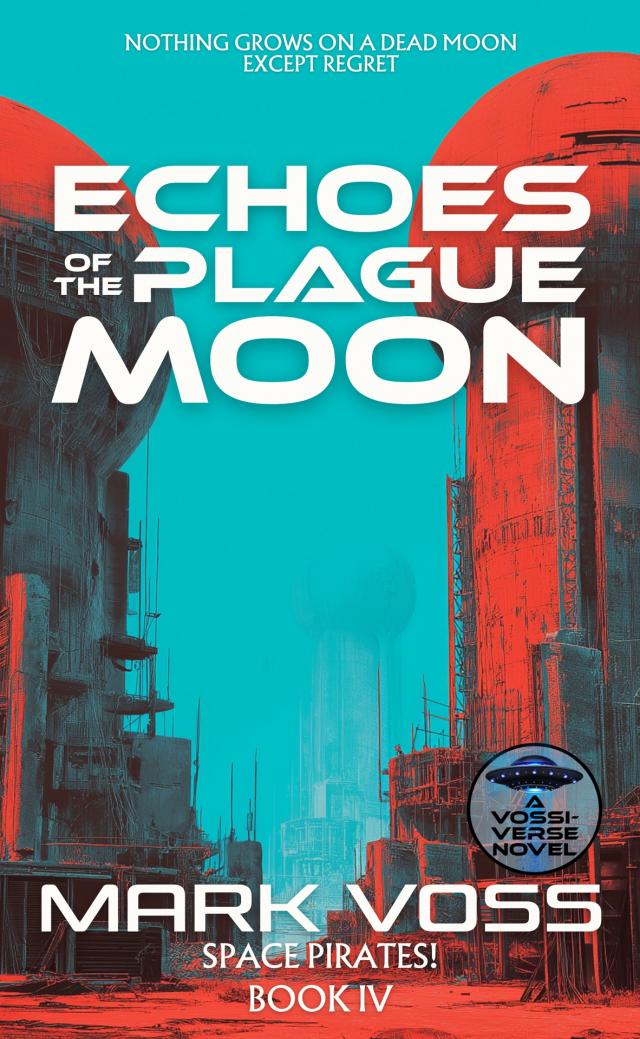


ECHOES OF THE PLAGUE MOON
Published by Balkon Media
Paperback edition ISBN: 978-1-916970-56-4
Also available as an E-book
Copyright © 2026 by Mark Voss
The right of Mark Voss to be identified as the author of this work has been asserted in accordance with the Copyright, Design and Patents Act 1988.
All rights reserved. No part of this book may be reproduced in any form or by any electronic or mechanical means, including information storage and retrieval systems, without written permission from the publisher, except for the use of brief quotations in a book review. No part of this book may be used or reproduced in any manner for the purpose of training artificial intelligence technologies or systems.
All characters and events in this book are entirely fictional. Any references to historical events, real people, or real locales are used fictitiously. Other names, characters, places, and incidents are the product of the author’s imagination, and any resemblance to actual events or locales or persons, living or dead, (except for satirical purposes) is entirely coincidental.
A CIP catalogue record for this title is available from the British Library.
Cover Design: Balkon Media
www.vossiverse.com
ALSO BY MARK VOSS
THE SPACE PIRATES! SERIES
Space Pirates
Dead Men Launch No Ships
Salvage Rights
Echoes of the Plague Moon
The Quiet Rebellion
The Bounty Paradox
The Black Drift
Till the Engines Fall Silent
The Median Gambit
CONTENTS
Chapter 1
Chapter 2
Chapter 3
Chapter 4
Chapter 5
Chapter 6
Chapter 7
Chapter 8
Chapter 9
Chapter 10
Chapter 11
Chapter 12
Chapter 13
Chapter 14
Chapter 15
Chapter 16
Chapter 17
Chapter 18
Chapter 19
Chapter 20
Chapter 21
Chapter 22
Chapter 23
Chapter 24
Chapter 25
Mailing List
About the Author
ONE
The Meridian looked almost respectable now, which was unsettling in itself. Gone were the hull patches stitched from a dozen dead ships, the engine whine that used to set dogs howling half a planet away. Even the interior didn’t rattle when you sneezed. Captain Rask Helvan considered this evidence of a universe in decline. He didn’t trust a ship that lacked character, and character only came from near-fatal damage.
Still, the payout from Goliath-3 had been obscene, and Lyra had insisted on “spending like someone who intended to live past Friday.” The upgrades were her love language. Rask was just glad she hadn’t replaced his seat.
They docked at the relay on schedule: a slab of corporate engineering orbiting a gas giant, ringed with surveillance arrays, gun turrets, and absolutely nothing resembling hospitality. The company—name redacted, logo scrubbed—had leased the station for “logistics,” which, judging by the lack of life signs, meant plausible deniability for anything that wandered in and didn’t wander out.
Rask made his way to the assigned suite, dodging cleaning drones and the echo of his own boots. He was used to jobs that began in shadows, but this was the first time the shadows were disinfected hourly.
The meeting room was exactly what it should be: a big, empty box with a table and six uncomfortable chairs. Only one was occupied, and not by a person. The corporate intermediary had opted for a privacy screen—holo-projected blue, fuzzed at the edges, shape ambiguously human. The effect was like negotiating with the ghost of a disappointed parent.
“Captain Helvan,” the voice said, filtered through a neutrality algorithm that replaced all traces of gender, accent, or emotion. “Please be seated.”
Rask sat. He could almost taste the money. “I was told this would be a person-to-person meeting.”
“Consider this an upgrade. Direct contact is prohibited under current protocol. We appreciate your understanding.”
“Of course,” said Rask. “Nothing like a faceless bureaucracy to make a man feel special.”
The intermediary didn’t smile. “Your vessel’s record has been verified. Your performance on prior contracts is considered… exemplary.”
Rask bowed in his chair. “We do our best.”
“Are you open to a new assignment.”
He flicked a finger towards the centre of the table. “Let’s see the job.”
A hologram flickered into view: an orb of rock, streaked with blue-white impact scars and ringed in dirty ice. Erebos. The name meant nothing to Rask, but Lyra would have it mapped by the time he got back.
“Erebos is a quarantined moon, pending reclassification. You are to land at the former terraformer enclave, recover a geological archive from the central vault, and return it intact. No detours, no unscheduled extractions.”
“That’s it? Dig up a box, bring it back?”
“Yes.”
He waited for the catch.
The intermediary’s image stuttered, re-phased, and spoke. “Under no circumstances are you to open, decrypt, or duplicate the archive. You are not to access any containment records. The package is to remain sealed until delivery.”
“Sounds easy,” said Rask. “Which means it isn’t.”
“Payment will be forty percent in advance. The remainder upon completion.”
He leaned back, folding his arms. “So either it’s radioactive, cursed, or so valuable someone would shoot their own mother for it.”
The blue figure flickered. “We do not speculate on client property.”
“I do. It’s a hobby.” He drummed his fingers on the table. “So why hire us and not a fleet of drones?”
“Previous attempts failed. Atmospheric anomalies. Communication interference. Unpredictable ground conditions.”
He grinned. “So you need deniable idiots with a nice ship and a high threshold for pain.”
“That is not our phrasing, but it is operationally correct.”
Rask’s grin sharpened. “Well. I’d hate to let you down.”
He accepted the data packet with a thumbprint and stood, but not before pausing to study the flicker of the intermediary’s face. The blur almost looked amused. Or maybe that was just the phasing.
He turned to go, but the holo-voice caught him. “Captain Helvan.”
He looked back. “Yes?”
“Trust your crew. You have chosen well.”
He laughed. “No I haven’t. I just owed them.”
“Regardless,” the intermediary said, “good luck.”
The stroll back to the Meridian was quiet, except for the sound of Mercy chewing her nails. She spat the bitten ends into the air, trying to hit the readout panels. “So what’s the verdict? Murder, smuggling, or honest work?”
“Corporate fetch quest,” said Rask. “With a side of plausible deniability.”
Mercy groaned. “Boring.”
Lyra was at the docking clamps when he boarded, forearms slicked with coolant and a bruise blooming on her temple. She didn’t bother with a greeting. “That took an hour longer than it should’ve. You talk them into a raise?”
“Depends how you feel about plague planets,” said Rask, tossing the data packet to her.
She caught it without looking. “Love ’em. Good for my skin.” She slotted the data and frowned, scrolling through page after page of redacted instructions. “There’s nothing here. No atmosphere logs, no ground maps, no personnel index.”
“Maybe it’s a surprise party,” said Mercy, appearing over her shoulder. “We’re the cake.”
Lyra pointed at a line in the contract. “They don’t want us copying the archive. Or even opening it.”
Mercy snorted. “So we open it, right?”
“Not if we want to get paid,” said Lyra, though her expression said the opposite.
Jalen drifted in from the corridor, hands tucked into a coat that was, strictly speaking, an artifact from at least three illegal wars. He squinted at the holo. “This was written yesterday,” he said. “By someone in a hurry.”
Doc brought up the rear, his boots leaving faint mud prints from whatever fever-dream medical project he’d been up to. “Hazard pay is obscene and forty percent upfront. Which means they’re not telling us half of it.”
“Could be worse,” said Rask. “They could be telling us everything.”
Mercy waggled a finger at the screen. “I don’t see a ‘no weapons’ clause. I take that as encouragement.”
“I’d prefer encouragement in the form of a cargo of whisky,” said Doc, but he looked almost cheerful. This probably meant someone was going to die.
Glim’s icon appeared on the nearest display: a glitchy child’s face, wide-eyed and streaked with rainbow static. “Captain. Metadata attached to the contract is inconsistent with official records. There are references to a ‘terraforming discontinuation event.’”
“Which is?” said Rask.
“Unclear. All incident logs for Erebos are
missing from public index. Medical and life-support records end abruptly. Orbital feeds black out the year prior to closure.”
Jalen whistled. “So, haunted.”
“Or expensive,” said Rask. He ran a hand through his hair, already regretting the lack of further details. “Lyra, can you rig the archive so it can be opened and closed without tripping their alarms?”
She nodded. “Eventually. But it’ll cost you.”
“Everything does,” said Rask.
“And we actually need to recover it first.” Doc added, helpfully.
Rask cycled through the rest of the crew: Mercy was already plotting ways to weaponise the geological archive, Doc was calculating dosages for every conceivable bioweapon, and Jalen looked ready to bolt at the first sign of sentient fungus. This was what passed for readiness in the Meridian.
The contract had a timer: if they didn’t launch within three hours, it would void, and the next team of idiots would get the call. Rask felt the old stir of nerves, the specific kind that only came from accepting work he fully expected to kill him.
He signed the contract. The room’s lights dimmed and the relay’s digital voice, for the first time, sounded almost human: “Contract executed. Good luck, Captain Helvan.”
The Meridian’s nav table populated with new coordinates. As the ship powered up, Rask let himself smile, just a little.
The Meridian shed corporate space like a bad hangover, slipping through the unmonitored bands with a grace that suggested Lyra had upgraded more than just the thrusters. Rask watched the relay fade to a pinprick behind them, then switched the main holopanel to the job’s actual subject: Erebos.
It looked like every other ruined moon: pocked, scarred, half-shrouded in the dirty gauze of failed atmosphere. But as the nav clock ticked them closer, the system’s old security firewalls began to trip—one, two, three, before the next breath. Erebos didn’t want to be visited. Never a good sign.
Glim materialised in the corner of the bridge display, ghost-white and twitching with diagnostic subroutines. “Captain. I have completed a summary of known mission parameters. Shall I proceed?”
“Show and tell,” said Rask. “We live for it.”
The crew trickled in as Glim started up. Lyra took her usual spot by the nav panel, arms folded. Doc drifted in and remained standing, as if commitment to any seat implied optimism. Mercy sprawled at the gunner’s station, feet up, gnawing on a ration stick.
“Erebos was a Class-E terraforming testbed,” Glim said. “Settlement commenced sixty-three years ago. Initial results: promising. Projected population at full capacity: 12,200.”
“And the catch?” said Lyra, barely glancing up.
Glim flickered. “Twenty-four years ago, public records cease. No orbital transmissions since. Satellite logs deleted from public index. Last available image is—” The display shifted, showing a frozen frame: surface domes still lit, a dust storm creeping over the horizon. “—timestamped exactly one week before declared black site status.”
“Death toll?” Doc asked, voice neutral.
“Official figure: unrecoverable. No survivors registered with the Union.”
Mercy sat up, suddenly alert. “Unrecoverable like vaporised, or unrecoverable like ‘don’t ask’?”
“Terminology ambiguous,” said Glim. “Reference to a ‘containment discontinuity’ event. No corroborating detail.”
Rask whistled. “Well, that’s a new one. Any news on what’s worth fetching in a place like that?”
Glim loaded the contract details. “Client seeks geological archive. Period of record covers the final two years before blackout. High-redundancy data, presumably stored in the enclave’s main vault.”
“Boring,” said Mercy, but she was peering at the file tree with a hungry glint.
“Atmosphere’s a mess,” Lyra said, cycling through the sensor bands. “Pressure swings, toxic particulates, all the classics. But look—there’s a pressure lock here. South polar region. Still running.”
She projected the overlay onto the holotable. A thin, trembling line of habitable air stretched through the southern pole, with containment barriers flickering in a slow, desperate rhythm.
“That’s not dead,” said Jalen, emerging from the companionway. He was holding a mug of something synthetic, and the smell made Rask’s teeth ache. “That’s trying very hard to stay alive.”
“Negative bio-signs in the open,” Glim said. “But thermal readings indicate power draw consistent with a medium-sized settlement. Minimum of forty years running on local energy, no external supply. Efficiency is mathematically improbable.”
Doc muttered something under his breath. “If I wanted to create a new pathogen, I’d start somewhere like that.”
Mercy raised her ration stick in salute. “Bet you five credits there’s survivors. Cultists, cannibals, probably all inbred as a barnacle’s tongue.”
Lyra shot her a look. “That’s not how inbreeding works.”
“I’m just setting the mood,” Mercy said, undeterred.
Rask zoomed the display, watching the flicker of failing shields and still-lit domes, like a dying heartbeat refusing to stop. “There’s no distress call. No traffic. No one’s flagged this place for emergency reclamation. So either someone’s hiding, or what’s left is too expensive to sweep up.”
Jalen gestured at the nav readout. “That’s not standard protocol. Even the Union does a sweep-and-burn on failed projects.”
“They do,” said Rask. “When there’s something left to burn.” He tapped the controls, feeling the unease ratchet up a notch. “Glim, run a background on the last terraforming lead for Erebos. Any familiar names?”
Glim sifted the data, glitched once, then produced a personnel file. “Chief Scientific Officer Dr Eliara Cross. Tenure: eight years before blackout. Known affiliations: none. Last documented action: initiated emergency lockdown, then deleted all command logs.”
Mercy grinned. “Love a woman who cleans up her messes.”
Doc was silent, eyes fixed on the screen. “What’s the word on biocontainment? Any active hazards?”
“Multiple. No transmission vectors detected beyond the shield envelope,” said Glim, “but environmental data is unreliable. Probability of mutated bioagent: above baseline.”
“Just above baseline?” said Mercy.
“Margin of error is significant.”
Rask slouched back in the captain’s chair. He weighed the odds, the risks, and the inconvenient suspicion that this was less about salvage and more about finishing what the last project lead had started. Still, the money was real, and nothing about the assignment actually said ‘murder.’
“Plot us into orbit,” he said. “Doc, prep for full biohazard. Assume nothing is safe.”
Doc gave a single, sardonic thumbs-up.
As the Meridian dropped into geosync, Rask gazed at the world below. What struck him wasn’t the ruin, or the desperate flickers of artificial day in a planet’s perpetual night. It was the quiet. No comms chatter, no automated welcome, not even a quarantine warning. Just the cold, stubborn refusal of a place to die.
He wondered, for a moment, if the client had known all along. If the point of the job wasn’t to fetch an archive, but to see who—or what—was still there.
The ship settled into stationary orbit. The crew assembled back on the bridge, suited up and silent. Rask watched the screen a moment longer, the blue-and-white corpse of Erebos turning beneath him.
He was suddenly, acutely aware that every job could be his last. He just hoped this one would be interesting enough to make the story worth telling.
With a shrug, he flexed his fingers and took control of the Meridian. “Let’s go and make some money.”
TWO
The Meridian descended smooth as a whisper. Rask tapped the manual controls as they made contact with the moon’s atmosphere. The shuttle’s sensor blister flickered to life, cycling red through orange to a sickly yellow as it read the Erebos approach vector. The planet hung below, sullen and ugly, as if resenting the intrusion.
“Glim,” said Rask, without looking up, “what are we walking into?”
The AI’s avatar stuttered into existence on the auxiliary panel—a child’s face rendered in patchwork static, one eye larger than the other, mouth stitched into a crooked line. “Approaching main colony grid. Sensors confirm: external environment is non-viable. Local containment at seventy-one percent. However, cultivated structures within the dome show consistent atmospheric recycling. Substantial agriculture. Settlement population: indeterminate.”


