The hidden dragon, p.1
The Hidden Dragon,
p.1


Also by Melissa Marr
Young Adult Fantasy
Wicked Lovely series
Made for You
Seven Black Diamonds
One Blood Ruby
Middle Grade Fantasy
The Blackwell Pages trilogy (with Kelley Armstrong)
The Hidden Knife
Picture Books
Bunny Roo, I Love You
Bunny Roo and Duckling Too
Wild Horses
NANCY PAULSEN BOOKS
An imprint of Penguin Random House LLC, New York
First published in the United States of America by Nancy Paulsen Books,
an imprint of Penguin Random House LLC, 2023
Copyright © 2023 by Melissa Marr
Penguin supports copyright. Copyright fuels creativity, encourages diverse voices, promotes free speech, and creates a vibrant culture. Thank you for buying an authorized edition of this book and for complying with copyright laws by not reproducing, scanning, or distributing any part of it in any form without permission. You are supporting writers and allowing Penguin to continue to publish books for every reader.
Nancy Paulsen Books & colophon are trademarks of Penguin Random House LLC.
The Penguin colophon is a registered trademark of Penguin Books Limited.
Visit us online at penguinrandomhouse.com.
Library of Congress Cataloging-in-Publication Data
Names: Marr, Melissa, author. | Title: The hidden dragon / Melissa Marr.
Description: New York: Nancy Paulsen Books, 2023. | Summary: “A sea-faring girl and her friends take on pirates and grown-ups and bond with dragons as they work to make the world a better place”—Provided by publisher.
Identifiers: LCCN 2022036104 | ISBN 9780525518556 (hardcover) | ISBN 9780525518563 (ebook)
Subjects: CYAC: Magic—Fiction. | Dragons—Fiction. | Gargoyles—Fiction. | Pirates—Fiction. | Friendship—Fiction. | Sea stories. | Fantasy. | LCGFT: Fantasy fiction. | Novels.
Classification: LCC PZ7.M34788 Hi 2023 | DDC [Fic]—dc23
LC record available at https://lccn.loc.gov/2022036104
Ebook ISBN 9780525518563
Edited by Nancy Paulsen
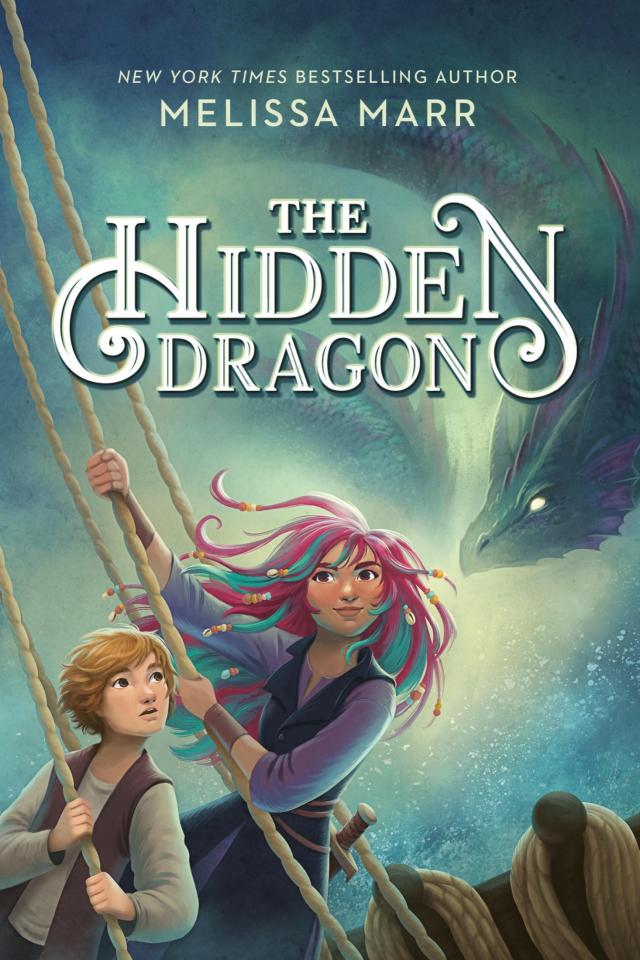
Cover art © 2023 by Vivienne To
Cover design by Kaitlin Yang
Design by Eileen Savage | Adapted for ebook by Michelle Quintero
This book is a work of fiction. Any references to historical events, real people, or real places are used fictitiously. Other names, characters, places, and events are products of the author’s imagination, and any resemblance to actual events or places or persons, living or dead, is entirely coincidental.
The publisher does not have any control over and does not assume any responsibility for author or third-party websites or their content.
pid_prh_6.0_142459014_c0_r0
CONTENTS
Cover
Also by Melissa Marr
Title Page
Copyright
Dedication
Prologue
Chapter 1: London
Chapter 2: Otter
Chapter 3: Sofia
Chapter 4: London
Chapter 5: Otter
Chapter 6: London
Chapter 7: Sofia
Chapter 8: Otter
Chapter 9: London
Chapter 10: Marian
Chapter 11: Sofia
Chapter 12: Otter
Chapter 13: London
Chapter 14: Sofia
Chapter 15: Otter
Chapter 16: London
Chapter 17: Sofia
Chapter 18: Otter
Chapter 19: London
Chapter 20: Sofia
Chapter 21: Otter
Chapter 22: London
Chapter 23: Sofia
Chapter 24: Otter
Epilogue
Acknowledgments
About the Author
_142459014_
To all the kids (young and old) who dream of exploring the sea, of meeting dragons, or of changing the world.
PROLOGUE
At first when the door between worlds opened, it was mostly the creatures that flew who went. Gargoyles crossed. Faeries crossed. Even a few dragonets crossed. The water things couldn’t pass as easily—except for the kelpies. They needed only a teaspoon of water at a time to slip from world to world.
No logic to kelpies, shrinking themselves into a million droplets all hither and dither.
Marian did not shrink. She was what she was—no larger, no smaller. And she wasn’t willing to scrape a single shimmering dragon scale against the doorway. It was simply not suitable for anyone with dignity to behave as the kelpies did, or for that matter, as dragonets did. They were both embarrassments in their way.
But then a few of the smaller ones went through the opening. And when Marian watched the flicker and flash of a hatchling darting through the door, she had to follow! None of her kind’s hatchlings would be left alone in that new world. Marian would make sure of it.
The children were everything, and if they were not taken care of and adored, what was the point of anything else? Some types of creatures had nests they didn’t tend. Other kinds of beings hovered over their own young but were hostile to young that weren’t theirs. Marian, however, was certain that all young were precious—not only dragons. She took it upon herself to collect any hatchlings without parents. Her wings were large enough to shelter more than herself.
So Marian jabbed her claws into the door, and she tugged. A screech rippled through the sea. It was loud enough to embarrass Marian, but she kept moving.
Opening the door so very wide meant that many more sea creatures would pass through to the other side.
Dragon hatchlings tumbled through the gate in a great whoosh. Marian watched them stretch and grow in their new home, but she reminded herself that there were fish aplenty. There was also sea grass that grew in underwater forests. Plants reached as tall as the land dwellers’ trees—and then grew higher still. Her kind would not want for food or space, despite the size they reached in this new water.
The only rule she set was that they must all be careful of the creatures of the land. One never knew what they were like. Dangerous things lived on land.
Soon many sea creatures frolicked and thrived in the deep, where they had food and safety. And in the very bottom of that deep dark water were sparkling, glimmering things that Marian began to gather. Sometimes they had to topple a ship to get the golden sparklies or the stone sparklies. That was easy enough. She was, after all, a dragon.
The only problem left for Marian was the Otter.
The sea dragons all heard the Otter’s voice, and sometimes they couldn’t resist going splashing to the surface to seek her out. It was dangerous, but Marian understood the impulse. She desperately wanted to be near the Otter again, too.
TWELVE YEARS LATER
CHAPTER 1
London
London had every intention of buying passage out of Glass City. He carried his savings—gold coins and silver ones, a few bits of copper, and assorted gems—as well as a small bundle of clothes, as he set off toward the docks. London had been there often enough that his feet could find it even if his eyes were closed. Ships meant freedom, a new start, adventure. Who wouldn’t dream of setting sail?
“This is the day!” London stepped to the edge of the dock, scanning quickly for kelpies. Getting eaten because he was careless would be a terrible start—and end—to his future.
Seeing no water horses rising to nibble passersby, London relaxed.
Birds’ cries and people’s voices mixed with the sounds of water lapping against hulls. Ships of all kinds cluttered the harbor. Personal boats and tall ships mixed with barges and tugs.
But when London spotted a relocation ship on the far end of the dock—not the kind of ship he was hoping to board—he shivered. People who were a “burden on the empire” got shipped away, packed like fish in a barrel, to work in one of the wild lands the empire now owned. London remembered watching his mum being taken away on one of those. He liked to imagine her in a better place, teaching other kids in some foreign land, but he wasn’t even sure if she’d survived the journey.
He’d stayed here at the docks that long-ago day, alone and hungry, until some kids found him. They took him with them, and that’s how he ended up living underground.
Now a man’s voice rang out: “You there, lad!”
It was one of the kingdom’s patrol officers. They seemed to be all over lately, gathering up kids.
“If there’s room, grab up three more.”
London hoped the soldier didn’t mean him, but just in case, he ducked behind a barrel and crept along the ground, using more barrels and giant crates as cover.
It would be awful to get captured now. London had spent years avoiding being sent to a workhouse, a fate that was the usual choice for orphans these days. The crown had replaced schools with workhouses, arguing that the children of good families had at-home learning and the ones who couldn’t learn at home ought to be put to work as soon as possible, since it was their future.
It was nonsense.
His mum had been a teacher, but there was no work for teachers once there were no more city schools. The crown simply hadn’t
cared about teachers—or kids—for years.
London thought back to that day his mother had been shoved onto the ship.
Run, love. Run and hide.
Mum!
Go on. I’ll find you. Only take what you need. I’ll find you someday, she said, shoving him toward a pile of cargo and running.
He heard her cry. He saw them capture her.
That was five years ago, and London still came to the docks, hoping she’d be here one of these days. He watched ships carry away other moms and dads, big brothers and sisters, too. He’d looked at a lot of faces, and never saw any of them come back.
“No one comes back,” he muttered.
His footsteps sounded too loud as he slipped between crates to try to find the passenger ship that would take him to Northland City. He’d been eyeing the sailing options for weeks, and finally there was one leaving today.
He stopped at the bottom of the walkway and noticed a girl about his age shimmying up a tall pole—or whatever the thing that held the sails was called. This ship appeared to be a cargo vessel, though. No cabins for passengers here!
“You, lad!” shouted a tall, bony fellow. “You one of the new ones?”
What if he slipped on board this ship and saved the money he was planning to spend on a ticket?
“I am,” London said, deciding quickly that it was best to get on this ship while officers were circling. In the distance he could see the one who’d been pursuing him.
“Help get these crates on board, and then you can go get settled into quarters,” the older boy said.
London grabbed one of the largest crates and lifted. “Lead the way.”
“Save a bit of energy in case there’s no wind and we need to row!” The boy smiled and grabbed another wooden box.
London laughed and shared a joke of his own. “Nah. Get it all on the ship so we can have a kip.”
The boy paused. “A kip? You a Northlander, then?”
“Heading home,” London said, which was sort of true. He did intend to make Northland his home.
They loaded the rest of the cargo, and then, as they were walking away from the cargo hold, the other boy said, “Be sure to check in with Tanner if you haven’t already, Northy.”
When they separated, London headed back to the ship’s cargo area and squeezed into a space he’d left between crates, pulled a tarp down, and went to sleep under it. He hadn’t had a chance to buy any food, but he’d find food in the hold. He patted the bag of money deep in his pocket—stowing away on the ship meant it was all still there.
The thought of the gold he carried gave him a momentary twinge. No one took gold to sea. It was bad luck. That’s why London had only enough gold coins to buy his ticket, and the rest of his savings was in silver, copper, and jewels.
He debated tossing the gold overboard.
Wasn’t it just a superstition, though? What danger could there possibly be in carrying gold to sea? The only things in the sea—other than fish—were kelpies, and if the water horses cared about gold, they’d bother the nobs walking along the canals in Glass City.
London wasn’t going to let superstition steal his money. He kept his gold coins.
CHAPTER 2
Otter
Ottilie Jo Maul wasn’t sure she’d ever feel right on land. Her family and friends called her Otter, since she was only at home in or on water. Her fathers claimed they used to have to tether her to her family’s ship, the H.M.S. Tempest, to keep her from leaping overboard.
Today, though, she was on land, which had the peculiar tendency to not sway like the deck of her ship. She wasn’t good at being on a surface that didn’t move.
Glass City wasn’t the absolute worst place. The canals, at least, stretched along the streets. Within them were dark waters that would work like roads if one sailed inland. No one was allowed to do so in the royal city, though. Boats must dock. Sailors must walk on land.
It was absurd. That’s what it was.
“Sick already, lass?” Her father glanced at her, worry in his eyes.
Captain Maul looked too big for the narrow city streets. Although if you asked Otter, he was as polished as the finest man in the royal court—but not as mean. On Otter’s last visit to land, she’d spewed her lunch all over the shoes of a man at court and gotten no sympathy.
Hopefully, there would be no vomiting this visit!
“Not too bad,” Otter hedged.
“Glad your stomach’s cooperating. Got to keep all your vittles inside!” As Captain Maul nodded, his enormous beard made a soft clattering sound. He kept his beard braided, and each braid ended with tiny beads or clips. Otter had liked the effect so much that she copied it on her own multihued hair; she had also woven in bits of shells and sparkling stones.
“Yes, but I belong on the ship,” Otter grumbled, trying not to wince from the dizzy way she always felt when the land wasn’t moving.
“Ottilie Jo Maul.”
She glanced at him.
“Do you need to go back to the ship?”
She sighed. “Da . . .”
“You said you could do it this time,” he reminded her. Gruff as he was, he sounded worried. “Do you need help?”
Otter looked away. “I was hoping I could do without.”
Her father unslung a bag from his shoulder, and from within it, he pulled a cloak. When he settled it around her shoulders, she breathed a sigh of relief. Only one material countered her land sickness: dragon hide.
Most people didn’t even know dragons existed, and the Glass Queen was determined to keep it that way. The H.M.S. Tempest was the only vessel that sought them out, sailing into seas that Her Majesty had declared unnavigable in order to keep all other ships out. And to make their cover story work, the Tempest also carried cargo to the north for the queen. In that regard, they functioned like any other ship. It was the cargo they brought home that made all the difference.
Only the captain and crew had the queen’s papers to sail the Crimson Sea, and only the H.M.S. Tempest could collect dragon hide.
Sometimes Otter wondered about how easily the queen lied, but these lies kept the dragons safe. Otter would feel worse if people hunted the dragons.
Captain Maul and his crew were the only ones who knew the truth—the Crimson Sea could be treacherous, not because of rocks or currents, but because of thrashing dragons. This was a risk they took, though, to carry some of the most valuable cargo in the Glass Empire. Dragon skin, the layer they shed, was the stuff the queen needed for her guards’ armor and it was the stuff that every gown the queen wore contained. It was impervious to fire, difficult to pierce, and water repelling. Every member of the crew of the Tempest also got a set of skins to wear as a cloak or an underlayer. Besides the Queen’s Ravens, they were the only ones allowed to wear it.
If they sold the skin, they’d be wealthy—or maybe dead. Crossing the Glass Queen sounded terribly dangerous, even though she’d seemed nice enough when Otter first met her. Although their actual meeting was cut short on account of Otter’s sick stomach, the queen didn’t seem upset.
And she’d invited Otter back.
Otter and her father walked in silence toward the Glass Castle, and as Otter looked up at the towers piercing the sky, she found it hard to understand how anyone could like a building so tall that flying buttresses were essential to keep the structure from collapsing. Living in a place like the castle meant being far from the ground, and that was way too far from the water.
When they arrived, the captain told a guard, “The Glass Queen is expecting us.”
The Raven nodded. Every Raven knew that the H.M.S. Tempest sailed to the reaches of the map in order to bring that “fabric” back. Even when it was dyed black, it kept the iridescence of dragons, so their armor looked like the sheen of raven feathers.
“Captain Maul.” The Raven nodded. “Little Maul.”
Otter rolled her eyes. “It’s Otter, if you please.”