John 3, p.16
John 3,
p.16


“Maya . . . what did you do?”
“I didn’t break the law. It wasn’t as bad as that.”
“Break the law?”
Why had she said that? “I just pushed. Too hard. That’s all.”
He wasn’t buying it. “It said ‘ethics.’ You were unethical?”
“To some. One. Just one guy.”
“You were unethical enough to get yourself fired?” He shoved his plate away. It bumped into his coffee, spilling it. “Out with it. All of it.”
Maya looked to the now-cold muffin. It mocked her with its promise of a normal morning. Things would never be normal again.
“I’m waiting.”
“I took the customers of one of my coworkers.”
“You stole their business?”
“I . . .” She was too weary to couch her answer. “Yes, I guess I did—though at the time, it didn’t seem as bad as it does now.”
“How could you do that?”
“I was desperate. We needed money, so I—”
“Why didn’t you just rob a bank? That would have gotten you money.”
She didn’t know what to say.
“If you were fired yesterday, why didn’t you tell me last night?”
Oh dear. “Actually, I was fired Tuesday.”
He did the math. “That was four days ago.”
She shrugged.
His head shook back and forth in small movements. Then he said, “Your office didn’t give you permission to work from home. You were already fired when you told me that.”
“I was tired of finding something to do all day, away from home.”
A bitter laugh escaped. “Four days. Four days of sneaking around and lying. To me.”
“I wanted to tell you, but . . .” She remembered the news from Dr. Ruffin. Maybe if she told him about that he would feel sorry for her, sorry for them. Maybe that sorrow would override his anger. “There’s something else I should tell—”
He pushed away from the table. “No. No more. I’ve had more than enough. You are not the woman I thought you were.” He went to the back door and took his keys off the hook. “I need to think.”
“Where are you going?”
The door shut behind him.
| | | | | | | | | | |
Maya sat at the kitchen table, staring at the English muffin. She couldn’t believe what had just happened. An innocent weekend breakfast had transformed into a setting for accusation, confession, and abandonment.
If only I’d left yesterday. If only I hadn’t been here when the newspaper came, when he read all about my . . . my . . .
Sin.
Maya blinked at the term. Sin? She never thought in such terms. Sin was a word used by obsessive religious fanatics. It applied to murderers, rapists, and other horrible, detestable people.
“I made a mistake.”
Sin.
She had to go. She couldn’t be there when Sal came home.
If he comes home.
She ran upstairs and put on jeans and a T-shirt. She drew her hair into a ponytail and ignored any thought of makeup. She put on her left shoe but couldn’t find its mate.
She lifted the dust ruffle, looking for it. She spotted the shoe, but when she reached, she managed to push it just out of her grasp.
With a groan, she got to her hands and knees to retrieve it. “Not now. Please not—”
The doorbell rang.
Sal?
She grabbed the shoe to her chest and held her breath. Then it hit her. Sal wouldn’t ring the doorbell. Who would be coming to her house on a Saturday morning? She tiptoed to the window. And gasped.
Her parents’ ancient Volvo was parked in the driveway—behind her car.
She ducked behind the curtain. Her parents never stopped by unannounced. Not unless they had good reason.
Such as . . . reading a scathing article about their daughter? She might as well lie down and die right now. The judge, jury, and executioner had arrived.
The doorbell rang again, accompanied by the deep resonance of knocking. She heard the murmur of her parents talking to each other on the stoop below. Go away, go away, go away.
Then, the unthinkable.
The sound of a key in the door.
The door opening.
Her mother’s voice: “Maya?”
“She’s not here,” her father said.
“Her car’s here.”
“But Sal’s truck is gone.”
“Her car is here. She is here. Maya?”
Maya looked longingly at the closet, but when she heard footfalls on the stairs, she knew that—save jumping out the window—she couldn’t escape.
She took a deep breath and walked into the hall.
“Oh,” her mother said, halfway up the stairs. “You are here. Why didn’t you answer?”
Maya realized she was holding a shoe to her chest. She balanced herself against the wall and put it on. “I was getting dressed.”
“Well, come down here. We want to talk to you.”
Her parents descended the stairs and moved to the living room. Her mother took a place in the very center of the couch, and her father stood near the front door, motioning for Maya to sit in Sal’s recliner.
The thought, Hey, this is my house, don’t tell me where to sit, was quashed by their serious expressions, and even more so by the fact they were her parents and at age thirty-three she still did as she was told.
But then, as if on cue, her worst fear was revealed. Her father pulled a newspaper from the inside pocket of his jacket. He held it in the space between them. “What do you have to say about this?”
Maya knew there was absolutely nothing she could say that would be an acceptable explanation or appease her parents. They had the power. She . . .
She took a deep breath, then said, “I got nothing.”
“That is not a proper answer,” her mother said.
Maya shrugged and felt an absurd satisfaction in the tack she had taken, and even in her use of bad grammar. She was not up for another confession this morning or trying to prove she was worthy of their love. She simply could not do it.
Her father opened the folded paper to reference her shame. “It says you got fired on Tuesday. That means when you were at our house for dinner Wednesday, you had already lost your job.”
She shrugged again.
“Why didn’t you tell us?”
“It was Marta’s birthday. And you were upset about not getting the grant.”
Her mother pegged her index finger into her thigh. “Your omission was cowardly.”
Maya took a breath, let it out, then said, “Why don’t you just add that to my list of bad character traits.”
“Don’t be flippant,” Father said. “It’s extremely unbecoming.”
A small laugh escaped before Maya could press a hand against it.
Her mother shook her head. “You don’t seem to be taking this very seriously.”
I beg to differ. My life is ruined. Is that serious enough for you? Yet in spite of her thoughts, Maya found herself continuing with the blasé attitude. “What can I do? It’s done.”
“It’s done?” Her father moved directly in front of her, holding the article as Exhibit A. “‘Unethical.’ Our daughter, unethical?”
“Don’t worry, Dad. I’m married now. The Castilla name isn’t mentioned, so your impeccable reputation is still intact.” As soon as the words left her mouth, Maya wanted to grab them back.
Her father stared down at her. “How can you be so dismissive?”
“And disrespectful?” her mother asked. “What have we ever done to deserve such an attitude?”
Maya felt an unfamiliar anger rise, and with it, a foreign boldness. She pushed the article aside and stood, moving away from her father’s presence. “You want to know what you’ve done? You’ve pressured Sal and me unmercifully to have a baby. You’ve made it clear that a baby is essential to our purpose and to finding any kind of respect or approval.” She pressed her hands against her chest. “I can’t get pregnant every time I want to, like Marta and Marcela. There’s something wrong with my system. I’m flawed, all right? Do you get it? I’m broken!”
“You are not broken. You’ll have a baby once that . . . that procedure takes hold.”
Their reaction was typical. Everything was fixable and anything could be attained through logic, determination, and hard work.
“That procedure takes money,” Maya said. “We’re already in debt over twenty thousand.” She pointed at the article. “I did that so I could give you a grandchild. So you would be proud of me.”
“So this is our fault?” Mother asked.
“We never forced you to be so desperate that you’d do . . .” Her father scanned the article for something, then quoted, “‘I’d do anything to have a baby. Anything.’”
Unfortunately, the quote was accurate. Maya lowered her chin to her chest and covered her face with a hand. Each minute was playing out worse than the last. If only she could make it all go away.
Her father continued. “The article makes you sound deranged, Maya. Like one of those crazies who steal other women’s babies or—”
Suddenly, an inner timer went off. The meeting was over. Maya faced her father and grabbed chunks of her hair. “Crazies, you say? You made me crazy! All the pressure to have a child with the precious Castilla genes. I want a child to love and care for, but you . . . you want a child to be a trophy, an exhibit of your own greatness.”
Her parents froze, dumbstruck. Staring.
Maya was in a daze, hardly believing the words that had just been hurled across the room had come from her mouth.
After a measure of moments that dripped with uneasy tension, her father said, “Come, Margaret. We’re done here.”
Without another word they left, leaving Maya standing alone.
What had just happened? She had never—ever—talked to her parents like that. It was as though another person had entered her body and taken over her thoughts.
She heard their car pull away, the tires screeching.
Away. Yes. Away.
It was her only choice.
| | | | | | | | | | |
The Castilla family lake cabin was not fancy—by anyone’s standards. It didn’t even have indoor plumbing, though her parents had fancied up the outhouse with a carpeted seat and painted walls.
It was a place of memories—pleasant memories—of weekends swinging over the water on a rope, lying on blow-up rafts, and fishing from the dock.
Today it was a place of escape.
The day was as overcast as Maya’s mood. The first leaves of autumn sprinkled her car as she pulled up in front. She got her suitcase out of the trunk and used her key to open the door. The air was stuffy. The cabin wasn’t used every weekend.
Thankfully.
Maya wasn’t sure what she would have done if she had seen one of her sisters’ cars in the drive.
She would have kept going.
Somewhere.
Away.
Maya surveyed the cabin. It hadn’t changed much since she was a child—which was probably the reason it held such appeal. The cabin never changed. It was the keeper of all good things from her past. It took the responsibility very seriously and never forced her parents to fix the furnace or change the kitchen or redecorate in any way. It was the one place in the entire world where time stood still. There was no thought of the future there, only pleasant memories of the past eliciting a calming comfort in the present.
Yet Maya wasn’t sure what to do here, alone. Voices and laughter were as much a part of this place as s’mores in the fire pit and games of pitch and canasta around the kitchen table.
Yet feeling as she did at that moment, there was only one thing to do.
She went into the red bedroom (as opposed to the master bedroom or the loft or the green bedroom) and pulled the red and white quilt back. She shucked off her shoes and got in bed.
She pulled the covers over her head, blocking out the light. Darkness was good. Darkness was what she deserved. Lots and lots of darkness.
| | | | | | | | | | |
Roman was roused from his dreams by a knocking on the door.
The memory Billy is dead rushed into his consciousness with fresh teeth, its strong arms pulling him down, down, down into the dark waters. . . .
The strength of that horrible monster prohibited him from reacting to the door. Barred him from it. You cannot escape. You will drown here.
But then he heard another knock and female sobs and a plaintive, “Please, please be home. . . .”
The young voice, crying . . .
Roman propelled himself upward and broke through the surface, into the air and the light. He struggled out of the afghan, nearly tripping when it got wound around his legs. “Coming,” he told the door. His voice sounded foreign, as though it didn’t quite belong in this moment. And he was rather surprised when his hand found the doorknob, was able to make it turn, and had the strength to pull the door open.
The girl was college-age and pretty. Wholesome. Yet her eyes were red and puffy, any makeup long gone.
“Are you William’s father?”
Am I? Oh . . . yes. The words he managed to say aloud came out separately, as if one was not necessarily related to the other. “I. Am.”
“I’m Carrie.”
Roman did not possess the strength to scan his list of acquaintances to find a Carrie.
“Donigan?”
The conversation was too taxing, too difficult. He glanced over his shoulder at the couch. He shivered at the thought of the monster who lived there, and yet . . .
“I’m William’s girlfriend. Was William’s gir—” She began to cry again.
The sound and sight of her tears lifted the veil that had shrouded his senses. He cleared his throat, hoping his words would cooperate and string themselves together properly. “I . . . I didn’t know Billy had a girl—” It was as much as he could manage. Vaguely, he realized his ignorance revealed too much.
“Can I come in, Mr. Paulson?”
In? Inside? Here? And yet Roman stepped aside. As she crossed the threshold, brushing his arm as she passed, he found himself made fully awake. Awake was an alien sensation, yet somehow familiar. Yes, he’d felt this awake before. Once.
Before.
His awakened eyes saw the girl as a tiny thing, only coming up to his shoulders. The too-long sleeves of her shirt were pulled halfway over her hands, which had formed fists over her mouth.
He wasn’t sure what to do with her.
“Can I sit down?” she asked.
Yes. Sitting. “Of course,” he said.
She perched by the window on the edge of an antique chair that no one ever used. Roman picked the afghan off the floor and tossed it in the recliner. He sat on the couch.
And waited.
“Can I have a tissue?” she finally asked.
He went to the bathroom and brought her the entire box. She used two, crammed their remains into the pocket of her jeans, then cradled the tissue box as if it were precious. “I still can’t believe he’s gone.” Another sob threatened, but she managed to pull it back.
The murky world of the monster called to him, but Roman closed his eyes and tried to hang on to the moment that was now. “How long have you been—were you—Billy’s girlfriend?”
“Three months, but it seemed like forever.” Her voice caught. “What are we going to do without him?”
A surge of annoyance caused his blood to fully flow, his heart to fully beat, his lungs to fully breathe. We? Certainly she couldn’t lump her short-lived college fling into the same category as his fatherhood?
“When’s the . . . funeral?” she asked.
He stroked the couch cushion, assuring it—and being assured—that he would once again be its captive soon. “Monday afternoon,” he said. Oddly, Roman couldn’t remember what time. AJ had taken care of the arrangements.
She nodded. “I’ll be there. We’ll all be there.”
The concept of all had little meaning. He just wanted her to leave.
Then stand, he told himself. Somehow, he complied. “Thanks for coming by, Cassie.”
“Carrie. It’s Carrie.”
He took a step toward the door.
She did not move.
Roman felt panic slide into place. He didn’t want to be rude, but . . . “If you don’t mind I—”
“Today was supposed to be William’s first game as a starter.”
She might as well have hit Roman in the chest with a two-by-four. He staggered back to the couch. “It’s Saturday,” he said meekly.
She nodded. “The game’s just starting.”
I’ve got to go collided with There’s no reason to go.
“William told me how much you supported his football. He said that without you he never would have become good enough to play college ball. He was so excited about starting. He wanted you to be proud of him.”
Roman’s throat tightened and once again threatened to strangle him.
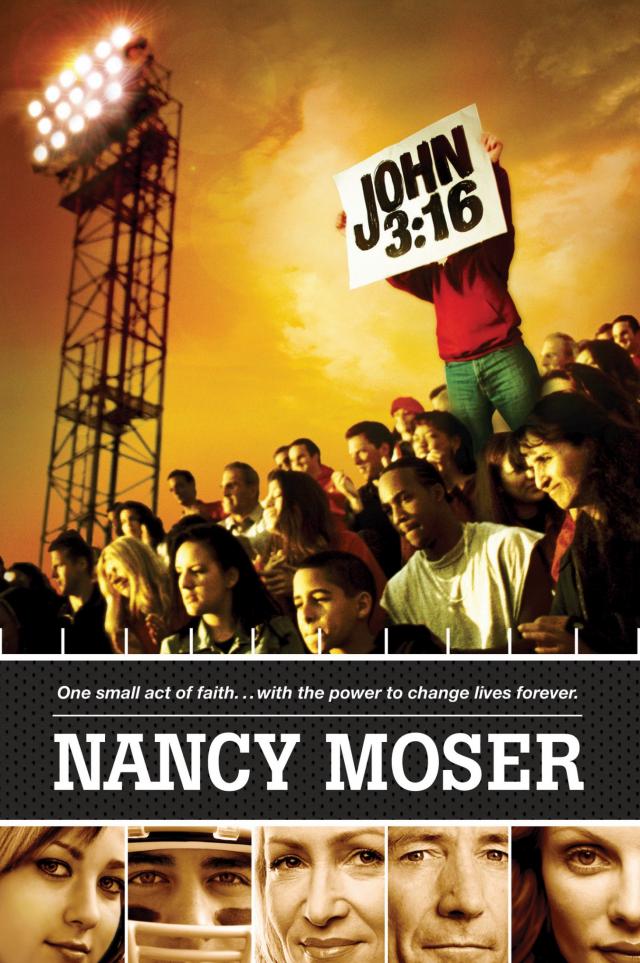
“His first starting game . . . That’s one reason I came today,” Carrie said. “Today at the game I was supposed to hold up a sign William made.”
A sign? She’d lost him.
“I can’t do it. I can’t go. I’m not sure I’ll ever be able to go to a game again.”
Not holding up a sign was like a tiny nick in the mountain of life. Roman was dealing with a deep, dark crevasse. He didn’t have time for this. “Don’t worry about it,” he told her. “There are plenty of signs at the game.”
“Not like this one.”
He didn’t want to ask but sensed she would never leave if he didn’t. “Why?”
“I’ll show you. It’s in my car.”
She went outside, and he mourned the extended time this was taking. Some stupid sign wasn’t his problem. His eyes caught hold of the dead bolt. One flick and—
Too late. She came back in, carrying a rolled-up sign made of a vinyl-type fabric. She began to unroll it, face out, talking as she did. “William made it himself.”
The sign was not large, perhaps two feet by three. And the words were nicely lettered. Bold. Easily readable. Yet what they said could have been Greek to Roman.
“‘John 3:16’?”
“It was William’s favorite.”