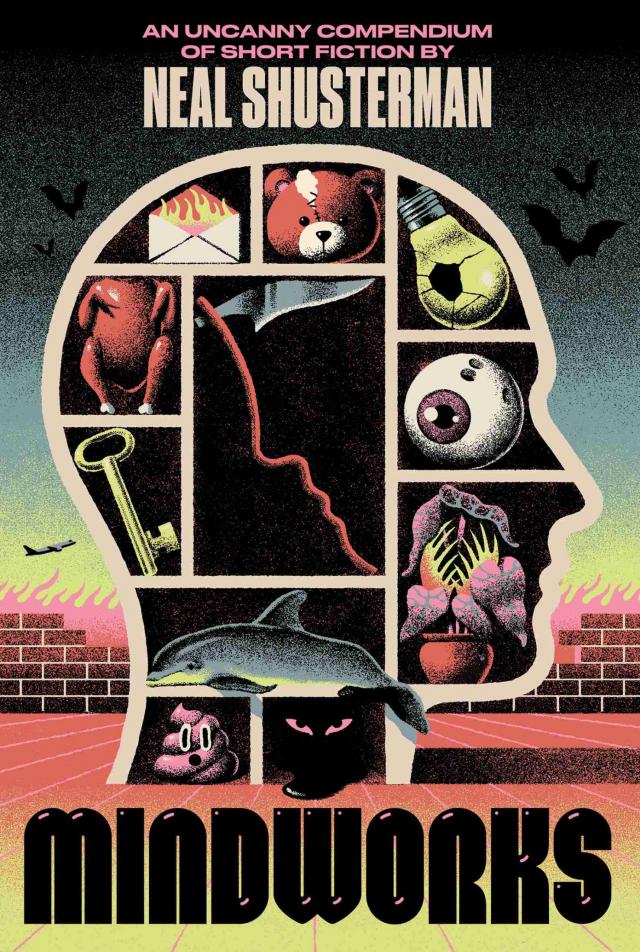
Mindworks, p.23
MindWorks,
p.23


“Why are you telling me this?” Seth asked. “Why does any of this matter?”
“Now, there’s a question you’ll soon be able to answer for yourself,” she said, throwing him a flash of that terrible grin. “I see you’ve been spending some time with your roommate, Wyatt. Are you two getting along?”
“No,” said Seth. “I don’t like him. I don’t like any of them. They’re freaks.”
This affected Dr. Stillwell more than anything else he’d said. She sat up slightly straighter in her chair. He could feel her bristling like a static charge.
“Tolerance is a virtue, Seth,” she said, her voice just a tiny bit louder than before. “Heaven knows, many people have gone to great pains to tolerate you. A phobia does not make a person a ‘freak.’ I have more respect for the kids here than any others—and you should too.”
“Do I get to go home, or not?”
“If that’s what you want, then you shall go home,” Dr. Stillwell said simply. “But first, there’s something I wish to show you.”
Then she reached into a lower drawer and pulled out a small cardboard box, just large enough to fit in the palm of her hand. “Our science lab has some very interesting specimens. Have you been down there yet?”
Seth shook his head. “What’s in the box?” he asked.
“A gift,” said Dr. Stillwell. “Something special, something just for you.” She opened the lid of the box.
At first it appeared empty, and then two tiny antennas wiggled into view, followed by the body of a beetle, shiny and green—
—and Seth was struck by a sensation so foreign, so unexpected, it stole the very air from his lungs. He felt himself moving backward, and he hadn’t told his feet to move. His eyes were locked on the bug, like somehow it controlled him. His chest tightened. His throat swelled so that he couldn’t breathe, and he heard himself squeaking out rasping gasps as he tried to get air.
What was this? What was this feeling? His mind reeled, trying to comprehend its intensity. It was ruthless. It was vicious, like a thousand knives slicing through his brain, his heart, his guts. And still the beetle peered at him from the lip of the box, wiggling its horrible antennas.
Seth found himself in the very corner of the room, squeezing into that corner, trying to disappear. And Dr. Stillwell approached with the beetle in the palm of her hand. As she did, the feeling only grew worse.
“Make it stop,” squealed Seth. “Please, make it stop.”
“When you came to my office on your first day,” she said in that calm, calm voice of hers, “you told me you wanted to understand. Now do you understand?”
It took all of Seth’s will to make his head nod up and down. This was fear, he knew that now. This was what others felt. It was like a gash across his soul, making the very essence of his life vulnerable. How could anyone live with this?
“Please,” he said, his voice just a whisper. “Please, stop it.”
In one smooth motion Dr. Stillwell dropped the bug to the floor and crushed it beneath her shiny black shoe, grinding the beetle back and forth until there was nothing left of it. In a moment the fear was gone. The sensation that flowed through Seth now was as powerful and as unexpected as the first. He felt his throat opening, the pores of his body opening. Air flooded into his lungs. Satisfied relief numbed his brain like a drug.
“Thank you…,” was all he could say. “Thank you…”
He sat there in the corner, regaining his strength, relishing the depth of his own relief.
“Now then,” said Dr. Stillwell, “tell me: What is the opposite of fear?”
And he gave her the answer that everyone else who attended Oakheart Academy already knew.
“Peace,” he told her. “The opposite of fear is peace.”
The headmistress offered him a satisfied grin. “Very, very good! Now it’s time for you to go. There is a special assembly this evening, and you must get yourself ready.”
Seth slowly lifted his head, as if it weighed more than his neck could sustain. “Assembly?”
“Yes. You mustn’t miss it.”
“I want to go home. You said I could go home.”
“Of course,” she said, with a calmness to her voice meant to soothe, but it only rinsed coldly over Seth like ice water, “but first the assembly. Your roommate is here to accompany you back to your room.”
Seth turned to see Wyatt waiting at the door. He had no idea how long Wyatt had been there, or how much he had seen.
Wyatt looked at him oddly—Seth could not remember anyone ever looking at him in this particular way. Was it pity? No, that wasn’t it.
“C’mon, Seth,” Wyatt said.
Seth fought a battle to pull his emotions together and won, although when he stood, his legs felt weak, as if he were on the verge of fever. He could barely even feel his feet as he moved through the door and down the dark cherrywood hallways of the school. All the while Wyatt kept sneaking sideways glances at Seth, like one might do when escorting a celebrity—and it finally occurred to Seth exactly the way Wyatt had been looking at him back in Dr. Stillwell’s office. It was awe. Wyatt had been awestruck.
“I… I don’t know how to thank you,” Wyatt said.
“For what?”
Wyatt didn’t answer. Instead he said, “I went outside this afternoon. I took a walk through the rose garden.”
“How nice for you,” snapped Seth. “Did you pick a bouquet for your football coach?”
He expected some rude comment back from Wyatt, but Wyatt didn’t take the bait.
“You don’t understand,” he said. “The rose garden is full of bees. There are spiderwebs stretched between the bushes. I don’t go to the rose garden. But now I can.” He hesitated for a moment. “I don’t know how to thank you.”
“Then don’t,” said Seth, trying his best to block the image of an insect-filled garden from his mind.
As they turned the corner toward the dormitories, several kids who had been chattering and laughing in the hall stopped and looked at him with that same strange gaze of awe. Then they began whispering to one another. “That’s him!” “He’s the one.” “Go shake his hand.” “I won’t do it—you do it!”
Then a boy stepped forward. He wore a surgical mask—like people wore during the pandemic—and above the blue edge of the mask floated a pair of bulging eyes that pleaded with such intensity, Seth could swear those eyes were about ready to pop out of his face. The boy wore latex surgical gloves on his hands, too. With a deep breath the boy reached to his right wrist, peeled the glove off with a snap, and thrust his trembling fingers forward.
“I’m Theo. Pleased to meet you.”
Seth had no intention of shaking his hand, but Wyatt grabbed Seth’s wrist and guided his hand into Theo’s until they met, clasping like train couplers. That strange flash of something not quite electrical shot from Theo to Seth, up his arm, to his spine. Synapses fired along his central nervous system, shooting up through the base of Seth’s neck into the deepest, most primitive part of his brain. Seth gasped.
“Germs! You’re afraid of germs!”
But Theo pulled off his surgical mask and dropped it, along with both gloves, to the floor. “Not anymore.”
Seth could feel the walls of the hallway begin to squirm. Germs were everywhere. There in the corners. There on the hands and in the breath of all the kids around him. Everything, everyone was so unclean. He looked at his own hands. He would have to scrub and scrub and scrub them until every last germ was gone. How could anyone stand it?
Seth had to get away from there. Away from them. He bolted, and although Wyatt tried to stop him, Seth pushed past him, moving with the adrenaline speed of someone fighting for their life, not knowing where he could possibly go, but knowing that he had to leave. He found himself in a stairwell, and, hearing voices beneath him, he climbed up and up, until the stairs were gone, and a ladder went up through a small hole. He took the ladder and found himself in the school’s bell tower. The school’s massive bells hung above him; the immense bronze shells, blackened from age, held just a hint of their former metallic sheen.
As a fear of heights was not one of his newly adopted terrors, he had no problem going to the edge of the open-air belfry and collapsing on the ledge. He turned his face into the stone pillar beside him, refusing to look out over a world that suddenly seemed so choked with unknown terrors.
He felt sure someone would follow him, to drag him back down to the school, but no one came at first. Then finally he heard a voice. Ice water. But this time, with his thoughts so furiously aflame, that voice was soothing.
“I know what you feel,” Dr. Stillwell said. “I understand, but I can never share it. There are many terrors that have passed through these halls, but they live within the students who come here. I can sympathize with their pain, but never share it. No one can. No one but you.”
“Home,” Seth hissed. “You promised.”
And with that she dropped some pages before him. It was a legal document bearing his name and signed by several people. Two of the signatures he recognized as those of his parents.
“As you know, we offered you a full scholarship, worth more money than your parents could ever possibly afford… but the scholarship required that they surrender their legal rights.”
Seth raised his eyes to look at her.
“You have been legally adopted by Oakheart Academy.” She pulled back the document from him. “So you see… you are home.”
“No…”
Then she did something Seth did not expect. She sat beside him on the ledge and took him in her arms. And he allowed it, for in this awful moment, even the embrace of a spider was better than no embrace at all.
“The bells have not rung here for more than ten years,” she told him, her voice no longer ice to him, for he had grown accustomed to its chill. “Do you know why?”
Seth shook his head.
“They haven’t rung, because we haven’t had someone like you for ten years. There are few in the world like you, and we are honored to count you among our own.”
Few like me, he thought. What did that mean? All his life he’d felt he was somehow different from others around him. The steeled fearlessness that dominated his life, the apparent cruelty with which he treated others. He had longed to be like others—to feel what they felt. Yet even now, as he was truly feeling their innermost pains, he was not becoming like them. He was becoming something else. “What’s happening to me?”
Dr. Stillwell answered with ease, as if the answer was obvious. “You are becoming fear,” she said. “Their fear. You have a solemn duty here. A holy duty. Your panophobia shall be a blessing.”
“I don’t understand.”
“I think you do.”
She was right. No matter how much he tried to deny it, he understood. He was a sponge for the terrors that filled every corner of Oakheart. A sponge begins hard and abrasive, as he had been all his life. Without even knowing it, he had been waiting his whole life for this dark purpose.
Tears now poured from his eyes with such intensity his head began to pound. “I can’t do this. I can’t be this. It’s more than I can stand.”
“Oh, you’ll stand it,” said Dr. Stillwell with complete confidence, “because you are strong. And soon you will come to know how much you truly want it.”
“Want it?”
“We are never given a gift without the passion to use it.”
Seth reached down into himself to see if this was true, but his thoughts and emotions were so shredded by the storm within him, he had no way of telling.
“I’m scared.” It was the one emotion he was sure of. Until arriving here he hadn’t known what that meant.
“I know,” Dr. Stillwell said, still embracing him. “So many of us spend our lives trying to find our place in the world… but I envy you, Seth, because you know yours. There is nothing more fulfilling than knowing what you are.”
“I… I am… I am fear,” he said, trying it on like a strange set of clothes, only to find that it fit. Perfectly. “I am fear for all.” His voice felt a bit stronger now. Sturdier. Hearing the strength come back to his own voice brought some strength to the rest of him as well. “They need me,” he said, realizing that it was true. “More than anything else in the world, they need me.”
“Yes!” Dr. Stillwell said, stroking his hair like a mother. “Thanks to you, they will overcome the fears that hold them back. They will make a difference in this troubled world, because of you.”
“They will remember me.”
“They will love you.”
“Because I matter.”
“More than you know.”
Seth stood, looking out over the grounds, and the fields beyond the school. Insects, and germs, and sharp objects—all these things were out there, striking painfully against his soul, but Dr. Stillwell was right. No matter how awful the phobias felt, he was strong. He could bear it. Because it was his purpose.
The bells above slowly began to swing, until the clappers hit their mark. The powerful tolls, deafening and resonant, rattled him to the bone, and when they were done, he turned to Dr. Stillwell, his ears still ringing long after the bells had fallen silent. “The special assembly?”
“The bells have called the students to the great hall. You are the honored guest,” she said. “Are you ready?”
I’ll never be ready, thought Seth, but then, who is ever ready to accept their fate? “Yes,” he said.
I have a purpose, he kept telling himself as he descended from the bell tower. It is noble. It is good. Imagine me, chosen for something good!
Two students, who barely had the courage to look upon him, swung open the doors of the great hall for Seth as he and Dr. Stillwell approached. The vaulted ceiling of the great hall towered before him, full of stained-glass windows and Gothic arches. The rows of seats were packed with students. A single aisle ran down the center of the hall, toward the stage. There was no podium on that stage, for what was to occur here would happen in the aisle. Even now the crowds of students were standing in the rows, pressing toward that center aisle, ready to reach out their hands toward him.
There was a sanctity to this mission. A holiness that would wash him clean, even in the face of his newfound terrors. Panophobia. The fear of all things. It would soon be his cross to bear, and the knowledge that somehow he would bear it gave him the strength he needed to take that first step toward his desperate schoolmates.
With his hands held out wide on either side of him, he began his journey down the aisle like a bridegroom toward the altar, embracing the knowledge that soon he would be very, very afraid.
Bad Fortune at Richard Yee’s
The Greenblatts settled down for another dinner at Richard Yee’s, perhaps the most famous Chinese restaurant in all of Brooklyn. They dined at Richard Yee’s every Saturday night. It was a family tradition that everyone loved. Greenblatts loved their Chinese food with a passion.
Everyone, that is, except for Robin.
Her parents and brothers could have lived on lo mein, and don’t even mention the kung pao situation. They could have had hot and sour soup pumped into their bloodstream intravenously, and they would have been as happy as sweet and pungent clams (Number 26 on the dinner menu). But Robin prayed that one day their tastes would change, and maybe she wouldn’t be forced to suffer through yet another endless multicourse meal. It wasn’t the food she objected to; actually, she enjoyed that part of it.
The problem was the cookies.
It started back when Robin was seven.
Aunt Sonia was visiting from Buffalo. She rarely came down to Brooklyn, but when she did, the traditional meal at Richard Yee’s was always the first order of business. And so, the whole Greenblatt family had piled into the minivan and headed to Richard Yee’s: Mom, Dad, Aunt Sonia, Michael, Seth, and Robin—who, even at the age of seven, knew her way around a pair of chopsticks.
The meal was delicious. Six courses spun around the lazy Susan in the center of the big round table until everyone was so stuffed they could hardly breathe. Next came the tiny scoops of green tea ice cream in the little silver cups.
And then the cookies.
Oh, how Robin used to love the cookies! Sweet vanilla and almond flavors carefully folded into that familiar crescent shape, with a surprise inside its shell. Never mind that they hadn’t even been invented in China—they were still a part of the Greenblatts’ dining experience. Since she had learned to read, fortune cookies were a special, delightful challenge, because they always contained big words. Everyone selected their cookie.
“Robin starts today,” her mom said, which made Robin feel special. She cracked the cookie and read the little slip of paper.
“ ‘You are generous of spirit and will move mountains.’ ”
“I believe it!” said her father. Then the reading went clockwise around the table.
“ ‘Today is the tomorrow you worried about yesterday.’ ”
“ ‘You haven’t come this far to only come this far.’ ”
“ ‘What good are wings without the courage to fly?’ ”
“ ‘Showing up is the first and hardest step in anything worth doing.’ ”
Through the readings, Robin’s brothers Seth and Michael were snickering and sharing glances. Robin could tell they were up to something but wasn’t sure what.
Then came Aunt Sonia’s turn. She broke the cookie in half with a loud snap and peeled out the tiny piece of paper, holding it at arm’s length so that her farsighted eyes could read it. “ ‘You will be taken on Wednesday by freak accident.’ ”
Mom gasped and Dad’s spoon clattered to his silver ice-cream cup.
Seth and Michael, who had been ready to burst out laughing a moment ago, suddenly dropped their jaws and sank into their seats. If they could have disappeared into a hole in the floor, they would have.
“Let me see that.” Dad snatched the little piece of paper from Aunt Sonia, then glared at Seth and Michael without saying a word. The twins cracked like an eggshell.