Polostan, p.1
Polostan,
p.1


POLOSTAN
Neal Stephenson
Copyright
The Borough Press an imprint of
HarperCollinsPublishers Ltd
1 London Bridge Street
London SE1 9GF
www.harpercollins.co.uk
First published by HarperCollinsPublishers Ltd 2024
Copyright © Neal Stephenson 2024
Neal Stephenson asserts the moral right to be identified as the author of this work
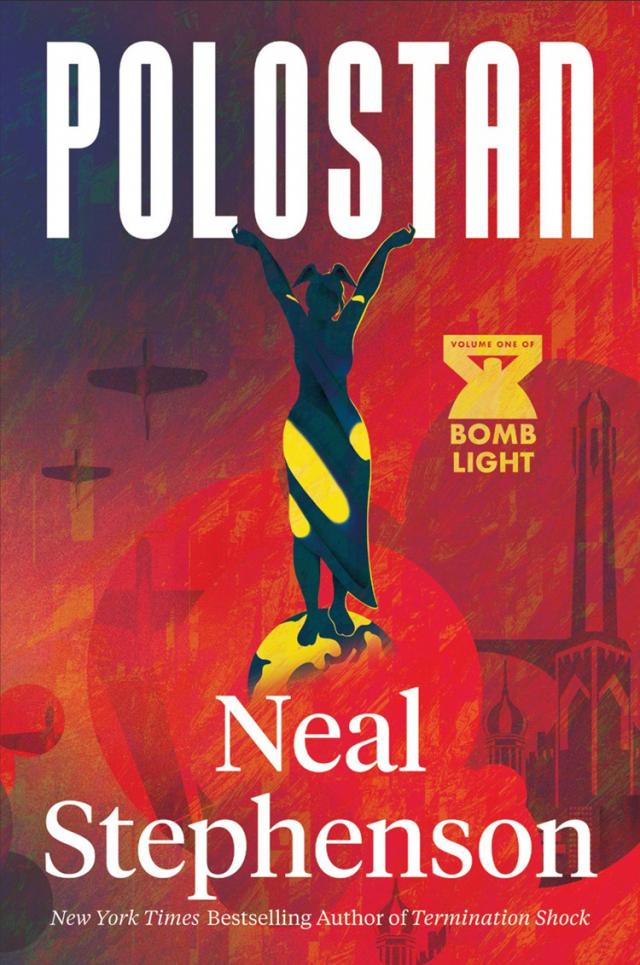
Jacket design by Owen Corrigan
Jacket illustration by Ola Jasionowska
A catalogue copy of this book is available from the British Library.
This novel is entirely a work of fiction. The names, characters and incidents portrayed in it are the work of the author’s imagination. Any resemblance to actual persons, living or dead, events or localities is entirely coincidental.
All rights reserved under International and Pan-American Copyright Conventions. By payment of the required fees, you have been granted the non-exclusive, non-transferable right to access and read the text of this e-book on screen. No part of this text may be reproduced, transmitted, down-loaded, decompiled, reverse engineered, or stored in or introduced into any information storage and retrieval system, in any form or by any means, whether electronic or mechanical, now known or hereinafter invented, without the express written permission of HarperCollins.
Source ISBN: 9780008262594
eBook Edition © September 2024 ISBN: 9780008262617
Version: 2024-08-23
Dedication
To Susanna
Epigraph
What men are poets who can speak of Jupiter if he were a man, but if he is an immense spinning sphere of methane and ammonia must be silent?
—Richard Feynman
Contents
Cover
Title Page
Copyright
Dedication
Epigraph
Prologue: The Golden Gate
1. Magnitogorsk, Soviet Union
2. Petrograd
3. Magnitogorsk
4. Seattle
5. Magnitogorsk
6. Chicago
7. Magnitogorsk
8. Chicago
9. Magnitogorsk
10. North Dakota
11. Magnitogorsk
12. Chicago
13. Magnitogorsk
14. Chicago
15. Magnitogorsk
16. Chicago
17. Magnitogorsk
18. Fort Sickles, North Dakota
19. Magnitogorsk
20. Moscow
21. Polostan
Acknowledgments
Also by Neal Stephenson
About the Publisher
PROLOGUE
THE GOLDEN GATE
OCTOBER 1933
The engineer hadn’t ridden the rails hobo-style since his getaway from the massacre in D.C. more than a year ago. Back east, he’d hopped freights from time to time just to show that wearing a suit and tie hadn’t put him on the wrong side of the class struggle. Out west, though, the distances were just too vast, the trains too few and far between. Getting stranded in the middle of nowhere could be fatal. So on the long-haul trips between Gary and the Golden Gate, he was happy to let the steel company buy him passage in a Pullman coach.
Consequently he lacked a hobo’s ingrained knowledge of how California’s railway lines were hooked up. He’d looked at maps. The steel company had plenty of those. The lines—twin filaments of metal, a ton of steel in every eight yards of track—drained down from the high wild reaches of Oroville, Calistoga, Fruto, Thrall, Bray, Weed, Raisin City, and Mount Diablo.
There was no guessing what such places might be harboring some offshoot of Dawn’s weird, difficult kin. She could be coming from practically any direction. Eventually, though, the railways did converge on a few trunk lines that groped around the bay and tried to get as close to San Francisco as geography would allow. One swung through Vallejo in the north, sliced down through Marin, and terminated at Sausalito. From there, you had to take a ferry to Oakland or San Francisco.
The engineer was presently engaged in trying to put those boats out of business by constructing a mighty bridge across the Golden Gate. His work took him over to the Sausalito side all the time. He had agreed to meet Dawn there this morning. She’d got a telegram to him mentioning a time.
When he was a boy, he’d been kicked in the face while milking a cow. They’d put his head in a new kind of machine and shot a thing they called an X-ray, side-on. Looking at the film in the doctor’s office through the one eye that wasn’t swollen shut, he had been struck by the soft convolutions of the oral cavity, defended from the dirty world by wrapping systems of lips, jaws, and gums. Where it really mattered, though, teeth erupted from the flesh. People thought of them as the centerpieces of smiles. But the X-ray had made it obvious that they were weapons. Expensive and complicated ones at that.
So it was at the entrance to the bay. Scrub-covered hills, pleasant enough to look at, were the outward form of the bay’s converging jaws. But humans had studded them with fangs: forts, bunkers, and gun emplacements embedded in the extremities of the Presidio and the Marin Headlands, zeroed on the Gate, ready to bite and crush any foreign fleet seeking to force the passage.
Other than that, those cold and wind-lashed points had attracted very little human activity until recently. But as the engineer walked down the slope and around the sweeping curve of Lombard Street, he came in view of a materials depot and a logistical complex that had sprung up around the old fort since January of this year. The country as a whole might be bogged down in depression, but it had somehow resolved to send a lot of steel and a lot of men to this one place to get a thing done. And as much as he hated the country and the people who ran it, his engineer’s heart thrilled to see it.
Once you got past the army hospital and the little airfield, Lombard’s pavement had simply been pulverized by the wheels of heavy trucks. It frayed into dirt tracks and fanned out into an earthen ramp that plunged into a crowd of jostling barges in the lee of the point where the old fort squatted.
He did not have to wait for ferries. In his billfold was a pass that empowered him to go through any gate, to climb aboard any of the small craft that continually shuttled across the Golden Gate on bridge business, darting between the heavy steamships bound for Yokohama, Manila, Anchorage, and Peru, and the smaller fishing vessels headed for wherever the black cod schooled.
He found space aboard one boat, crowded with workers. It stopped almost immediately at the site, just off the point, where they were working on the foundations for the south tower. At this stage that was all just underwater blasting and dredging. The men who disembarked here were mostly divers. In a couple of hours when the tide went slack they’d put on their big spherical helmets and go down to plant dynamite.
Beyond that, the boat ventured out into open water. Wind and tide were both coming in off the Pacific, so the ride was choppy, but nothing that would put any kind of scare into these daredevils—mostly riveters working the high steel of the north tower. All summer the perverse weather of San Francisco had given them cold, foggy days, but now that autumn was here it was glorious sunshine. So the workers happily sat abovedecks, smoking, bullshitting, enjoying the sunshine and the views. The engineer took shelter in the lee of the pilothouse so that the wind wouldn’t peel his hat off. Alcatraz was a couple of miles off to starboard. This came in for more discussion than usual. It was a disciplinary barracks for the army prison, but the announcement had gone out, only a few days ago, that it had been acquired by the federal government. They were going to turn it into a penitentiary for the very worst sort of inmates.
Riveters disembarked at the foot of the north tower, slowly rising above its submerged foundation in a vertiginous three-dimensional maze of scaffolding and hollow steel structural pieces. Even from down here the cacophony of the pneumatic rivet guns was maddening. The last stop, only a short distance farther, was where the cable anchorage was rising out of the bedrock of the Marin Headlands. The engineer, in no hurry, waited for the carpenters to stream off the boat. They clambered up a mess of stairs surrounding the gray ziggurat of reinforced concrete that would one day haul back against the tension on the bridge’s yard-thick cables. Their job was to dismantle the wooden forms from the last pour, wrench the nails out of the boards, and rebuild them a little higher. Holding back the pressure of all that wet cement required such structural might that forests had been felled farther up the coast just to supply the timbers.
No respecters of hierarchies, the carpenters would give him a tongue-lashing if he got in their way. So he skirted the work site by following the shore, then scrambled up-slope and strolled between the gun emplacements and through little neighborhoods of army housing until he found a path that descended into Sausalito. There, between the railway terminal and the ferry dock, he found a diner. He sat in a booth, drinking coffee and eating a slice of cherry pie—this being the season for cherries—and waited for Dawn.
Distinctive as she was, he didn’t recognize her until she was almost at his table. She’d grown another inch or two and now, even in flats, was taller than the average man. But it wasn’t just that. She’d been through things that had changed the way she held herself, the way she moved. And not for the worse. The coltish farm-girl enthusiasm of 1932 Dawn had been replaced by a cool self-possession, wary without being afraid.
They both knew there’d be no hugging or any other such display of mutual feeling. There were o
nly so many circumstances in which a thirty-year-old bachelor engineer could be seen conversing with a girl who was still young enough to attend high school. The cover story they’d used in Indiana—that she was his country cousin in town for a few days’ visit—wouldn’t fly here. And the truth of the matter—that he had no interest at all in women—couldn’t be spoken aloud, even in San Francisco. He rose to shake her hand, then gestured to the opposite bench. If anyone connected with the steel company happened to see them and asked questions, he’d say he was interviewing her for a secretarial position.
“Dawn’s dead,” she announced.
“I saw an article in the paper. From North Dakota. Fancied it might be you.”
She raised an eyebrow at that. She was learning how to use her face—saying things without words.
“As soon as they figured out it wasn’t Bonnie Parker, they lost interest,” he added.
She nodded, then reached for the menu.
“So, what should I call you, young lady?”
“Av—Aurora.” She stumbled over the first syllable, unaccustomed to saying her own name.
“Your dad used to call you that when you were speaking together in Russian,” he recalled. “Pronounced it with that ‘v’—‘Avrora.’ But Aurora it is.” He shrugged and grinned. “I’m still just Bob.”
The waitress came over and sized her up, giving Bob an excuse to do likewise. That summer in D.C. he’d watched her “bootstrap,” as she called it. Starting out little better than a hobo, she’d scavenged, or hand-sewn, enough decent clothes that she wouldn’t get thrown out of a beauty parlor. Eventually she’d climbed the ladder to the point where she’d been able to go full Cinderella at a ball with army generals and society matrons. Since then she’d been through a few cycles of boom and bust. Bob estimated she was about halfway to recovering from the latest crash. Midmorning sun coming in the diner’s window revealed a streak of heavy foundation on one side of her face, covering something she didn’t want seen.
She looked tired, stretched out, older than she was. But the eggs and hash she ordered would help her fill out that dress if she kept at it. He considered asking her when she’d last eaten a square meal but decided against it.
“Still have your violin?” It was a bit of a silly question, since all she’d brought in was a little suitcase.
“Lost it in the fire. Probably for the best.”
“You’re a real chip off the old block.” Even as he said this Bob winced, thinking it was a little close to the bone. But she just gave him a wry look. He had to keep reminding himself that she was just eighteen.
She’d glanced toward the cash register a couple of times. Bob now understood she was looking at the newspaper rack. “I’ve been a little out of touch these last couple of weeks. Visiting family. No newspapers where they live. Any news about Bonnie and Clyde?”
He shook his head. “I’m afraid the Barrow Gang has been knocked off the front page by competitors. Dillinger escaped. Machine Gun Kelly got sent away for life. He’ll probably end his days on Alcatraz.”
“What’s that?”
The food had started to show up. Bob understood that Aurora was, between bites, prompting him to talk so that she could shovel food into her mouth. So he explained the new management of Alcatraz, and what they planned to do with the place. He went on to fill time with reminiscing about what had happened in D.C. He filled her in on contacts he’d made with the International in these parts, mostly across the bay in Berkeley.
A man came in and sat down in the next booth. After that, Bob just talked about the bridge project. When Aurora was finished eating, which didn’t take long, she showed no hesitation in letting him pay for her meal and then buy her a ferry ticket. These were prerogatives of womanhood that would never have crossed the mind of girl-Dawn in blue jeans but that she now accepted as her due.
The ferry wasn’t crowded, so they were able to go abovedecks and talk more freely. Alcatraz was practically dead ahead. Now that Aurora understood what it was going to become, she kept a wary eye on it. A bank of fog was beginning to extrude through the Golden Gate, promising to turn the day gray and clammy.
“It’s beautiful here,” she said. “How do you like it?”
“It’s better for … someone like me than Gary. Put my house on the market there, but no one’s buying.”
“Thinking of settling here?”
“Maybe. You?”
She shook her head. “I need to get out of this country.”
He nodded. “Back to Russia, then.”
“The Soviet Union,” she corrected him. “From here you can get to Yokohama. From there to Vladivostok.”
“My geography’s a little rusty, but that’s in the far east.”
“Of course. The end of the Trans-Siberian Railway. So from there it’s just a long ride on a train.”
“To where? Where are you planning to get off that train, Aurora?”
The hard light of the sun sank into the looming cliff of the incoming fog bank and scattered back, making it seem more substantial than it would to an outbound mariner steaming into it. But Bob’s eye snagged on a hard, straight edge, barely discernible. Then another, exactly parallel to the first, not as long. Then a third, shorter yet. All of the edges proceeded to a common end, where they turned a crisp right angle and went on until the fog swallowed them again. Something in the arrangement of those edges called to a memory. He’d seen them on paper. He’d drafted them on paper.
The blast of a horn came out of the fog and he saw that the whole construct was resting on a barge that was being towed in from the Pacific by a tugboat. He knew what this was: one of the hollow steel cells of the north tower, the parallel lines and crisp edges all obedient to the bridge’s Art Deco aesthetic. It had been made in Pennsylvania and shipped through the Panama Canal.
“I did the structural calculations for that,” he told Aurora. “They’re taking it over to Alameda. It’ll sit there until the workers are ready to hoist it into place and drive in the rivets.”
She was more interested in him than in the rivets. “You love it,” she said. “Designing a thing. Planning it. Then seeing it made real.”
“That’s what engineers do!”
“What if you could work on something bigger, though?”
“Bigger than the Golden Gate Bridge?!”
“Yeah. And build socialism while you’re at it.”
“What are you talking about?”
“You already know, because you told me about it!” she exclaimed, mock-scolding. “When I saw you last, you mentioned that your company had landed a contract with the Soviets. To build a new steel mill there. Bigger than Gary.”
“The biggest in the world,” Bob said with a nod.
He wasn’t making the connection. Didn’t get it until she looked him in the eye and held out her hands, palms up, as if to say, How about it?
“Oh no,” he said.
“I’m totally fluent,” she said. “I’ll be your translator.”
1
MAGNITOGORSK, SOVIET UNION
CHRISTMAS EVE, 1933 (ELEVEN WEEKS LATER)
When she closed her eyes, Aurora could almost believe she was back in Montana. Deep, dry snow snuffed out all sound, save the squeaking footfalls of thick felt valenki. Stung by the coldness and dryness of the air, her numb nose smelled nothing. The clenching of her empty stomach was familiar enough from her days spent roaming America. Only the swaying of the scaffold beneath her feet proved she was not on the hard-frozen earth of the High Plains.
She couldn’t keep her eyes closed for more than a few seconds, though, lest they freeze shut. The steam escaping from her lungs—for clambering up the scaffold was hard work—puffed up out of the scarf wrapped around her neck and face to solidify on her lashes and brows. She had more in the way of the former and less in the way of the latter than the other members of the Workers’ Shock Brigade, all of whom were men. In the quarter of an hour since they’d filed out of the warming shed and begun scaling the bird’s nest of twine, lumber, and baling wire wrapped around the two-hundred-foot tower of Blast Furnace #4, those men’s brows had become thick with white frost. The effect was mildly inconvenient and mostly comical.