A bullet for fidel km 00.., p.1
A Bullet for Fidel (KM 007),
p.1
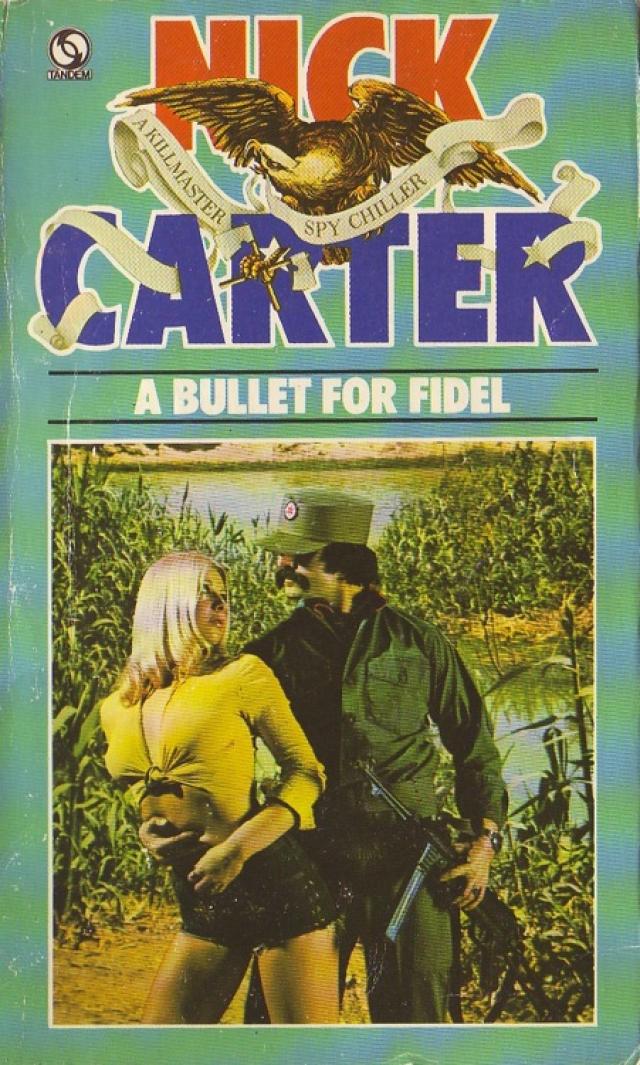


A Bullet for Fidel (1965)
(The seventh book in the Killmaster series)
Version 0.9
Dedicated to The Men of the Secret Services of the United States of America
CHAPTER 1
THE MOVING FINGER WRITES
IT bobbed aimlessly in the deep blue waters a little more than two miles from the Key, a nameless fishing boat with nothing on its decks but blood and sunlight and the body of a bearded man.
The loudspeaker summons grated stridently across the sunlit calmness and brought nothing in return.
Lieutenant Hansard of the Coast Guard cutter Intrepid put aside the megaphone. “Jackson, I’ll want you and Dean. If he can’t hear that he’s stone deaf, dead drunk, or just plain dead. Let’s go.”
Within minutes the bearded man had company. His previous guests had left perhaps an hour before.
No name, Hansard noted. Number painted out. New paint. Old boat. Smell of fish. And something else.
The silent fishing boat listed slightly as they climbed aboard.
“Jesus God Awmighty!” Dean sucked in his breath and stared down at the deck.
“Keep back,” Hansard commanded sharply. “Jackson, you take a look below. Don’t touch anything unless you absolutely have to. Make sure there’s no one else around— and if there is, you be sure to see him first! Dean. Stay where you are and keep your eyes open. I don’t want you putting your feet into this.”
The boat was a shambles. Everything breakable was broken, including the body of the big bearded man. He had fought savagely; fought and lost and died. The acrid odour mingling with the smell of sea and fish came from the smears and splashes and pools of blood that stained the deck.
Hansard stepped forward gingerly. It would be a miracle if this man were still alive. There was too much blood; death was heavy in the air. But he made himself lean over and touch the bloodied shape.
Whoever the man was, he had been stabbed repeatedly and without finesse. There were wounds in the gut and the back and the head, Hansard noted as he choked back a wave of nausea, and the man had felt the agony of them before he died. The bearded face, itself encrusted with blood, was a tortured mask of pain. Even the outstretched hand, particularly the forefinger, seemed to have been dipped in blood.
Hansard stared. It had been dipped in blood. Deliberately, as if it had been a penpoint dunked into an inkwell. So maybe it had written something.
Well. That was not his business. That was for the Marine Inspection Office to discover. Or Coast Guard Intelligence. There was nothing for him to do but make sure that the man was past helping, and then radio for instructions.
Gently, very carefully, Hansard moved the sprawling limbs and placed his hand against the silent heart. He was not surprised that it was silent. But his careful movement had shown him two things that he found very interesting. One was on the outflung, short-sleeved arm of the murdered man. The other was a smeared and bloody tracing on the deck, still half-hidden by the body.
“No one below, sir.” Jackson was back on deck, picking his way lightly through the shambles. “But everything’s a mess. Upside down, like it’s been searched. Say—what’s that?”
Dean bent his huge body forward without moving from his position at the rail.
“Looks like writing,” he rumbled. “See that, Lieutenant? Like with his finger he could of wrote it. S— something.”
“I see it,” said Hansard quietly. “Here, Jackson. Give me a hand. Careful, now. Dean, keep those big feet of yours where they are. There may be prints around, and we don’t want to scuff them up. Easy, boy. That’s it.”
Now they could all see what Hansard had glimpsed.
On the deck, traced out with a bloody finger, were the ragged letters S-T-A-R. And on the man’s outflung right forearm was a tiny, blue tattoo in the shape of an axe.
“‘Star,’” Hansard repeated thoughtfully. “His killer, maybe. The name mean anything to either of you?”
Dean rumbled a negative. Jackson shook his head. “No. But he obviously meant it as some kind of clue. The tattoo, though “
“Yeah, the tattoo.” Hansard nodded, the memory of a legend or a rumour stirring in his mind. “How’s with the motor, Jackson?”
“Dead. Dead as he is.”
“Uh-huh. Okay, you two stay aboard until further orders. I’m going to radio.”
It was going to be some radio message. A dead boat, a dead man, a “Star” in blood, and a tattooed axe. I would not be at all surprised, Hansard thought as he swung back aboard the cutter, if this were the man we were looking out for. Only he wasn’t supposed to be dead.
“I hope,” said Hawk, chewing at the end of his evil-smelling cigar, “that your visit to London was sufficiently fruitful to justify the length of your stay.”
“Oh, it was, indeed it was.” Nick Carter said earnestly. And it certainly had been. The wonderful hours with his lovely Robyn were sufficient justification for any trip. Hawk, of course, would not agree, and therefore there was no point in telling him what his top agent did with his spare time.
The two men faced each other across Hawk’s desk in the Washington offices of the Amalgamated Press and Wire Service. A casual onlooker would have assumed at once that Hawk was a typical news editor and that Carter was his prize reporter. In a way, the onlooker would have been right. Hawk and Carter did gather news. But they did not report it to the world at large. They gathered it through secret sources, culled it, analysed it, shared it only with top governmental agencies, acted upon it, changed it, and often made news of their own that never reached the press.
The head of AXE, America’s super-secret intelligence agency, looked across at the tall, steely-eyed man whose fellow agents called him Killmaster.
“Well?” Hawk said, and waited.
“Well,” said Nick. “I should have thought you’d have noticed the cultured purity of my accent, the neat unobtrusiveness of my Savile Row suit, the package of fine cigars that I have placed on your desk in a vain attempt to lure you away from the frightful weeds you persist in do we suspect a missile base ?”
Hawk gave him a hard look and opened the file that lay on his desk. It was marked, Nick saw, Trainor—Condition Red—Cuba.
“What I think doesn’t matter. What you find out does. Now. First of all, here is a map of Cuba. Kindly note the area indicated in the south-eastern sector.” Nick took the map, groaning inwardly. His respect for Hawk was enormous, but he could do without the lecture-room manner. He studied the map obediently.
“Oriente Province. Sierra Maestras. Duly noted.”
“Right. Now. I have here a set of eight photographs. The first four—these—were all taken more than a month ago. The second batch have all been taken during the last month. All eight photographs are of the same general area. Height and angle vary slightly, but you will see that all are enlargements of the area designated grid seven point four. We can pinpoint this place to within a fraction of a mile— even to yards. But we don’t know what’s there. These of course are Air Rec pictures. There’s something about ‘em we don’t like. Last time we looked, there was nothing out of the way. There’s still nothing. But it’s a different sort of nothing. I might tell you, while you’re looking at them, that they came from the Chief of Naval Intelligence with a request for our assistance. It seems he didn’t feel right about asking our boys at Guantanamo to conduct their own investigation, close though they are to the suspect area.” Hawk’s tone was dry. “Subsequent to the first query —a bare two hours later, in fact—the request from ONI became an order from the top. Immediate action. Thus, Trainor into Cuba, and you preparing on the sidelines.”
Nick nodded, feeling something like a second-string quarterback, and studied the pictures.
The first four looked like dozens of other long-range reconnaissance photographs of the Sierra Maestra range. Nick had studied plenty of them in his time, as part of his homework for AXE, and what he saw now was a familiar pattern of trees and rock. He spread out the second batch.
At first glance they looked exactly the same.
Nick frowned.
“Here,” said Hawk. “Try this.”
Nick took the proffered magnifying glass and scrutinized the photographs one by one.
“There are others,” said Hawk. “You can see them all before you leave. But these are representative. Notice anything?”
“Um. But I can’t quite put my finger on it.”
“No. Neither could the Navy. But there is a difference, something that only their very latest lenses and most sensitive infra-red film could begin to detect. And I mean ‘begin.’ We don’t have very much to go on.”
“Shadows,” said Nick thoughtfully. The second batch of pictures was different, so very subtly different that even a point by point comparison revealed no definite discrepancies. “It seems to be a matter of perspective. Or is it dimension? Could it have something to do with the time of day, or season, or weather conditions?”
Hawk shook his head emphatically. “There again, I can show you other pictures to match against these. Don’t forget, we’ve been conducting surveillance flights throughout the seasons for a good long time, and we know what those mountains look like under virtually every condition except of course thick fog or haze. Neither of which we have here. Season, day, time, weather condition of these shots match perfectly the condition of—these.” He flicked three more photographs from the folder and slid them across to Nick. “You’ll have a chance to see them on the sc
reen in a while. At the moment I simply want to familiarize you with the problem and get your preliminary thoughts.”
“Shadows,” Nick said again, still scrutinizing the pictures. “There seems to be a difference somehow in the … in the depth. Everything’s in the right place; everything seems to be the right size and shape. But in this section there appears to be a kind of flattening out—as if the trees here are one-dimensional.”
“Ah. You see it, then. Good. Now, let’s plot out a course for you before we go into the screening room. A crew of COMSEC men—experts on Cuban terrain and surveillance photography and so on—will be meeting us there in forty-five minutes. Right now I want you to look at the file on Trainor.”
Nick looked. It was pitifully brief. David Trainor had been the son of a Cuban mother and an American father.
Big, bearded, and heavily tanned, he had decided to go to Cuba via small craft in the guise of a disillusioned Cuban refugee returning to the land he was sorry he had ever abandoned. He had chosen the name of Jose Manuel Cabrera and had gone on his way armed with nothing but false papers, some pesos and dollars, his excellent command of Cuban Spanish, a gun and a knife. When last seen alive by AXE agent P-3, on a dark night two weeks before, he had been nosing his small boat out into the open sea beyond the Florida Keys, His intention had been to land at a fishing village near Havana and make his way cross-country to “relatives” in Santiago.
It could have worked. Trainor was a good man, at his best when working alone. All Axemen were used to operating on their own. But Trainor had been too much on his own on the Cuban mission.
“I suppose he did get there?” Nick raised a querying eyebrow. “‘Star’ could’ve been the name of a boat that intercepted him on the way.”
Hawk re-lit his dead cigar. “It’s possible. We’re checking registrations. But maybe he didn’t get there. We don’t even know that. Now. About your cover. You’re right, of course, about the tobacco-growing region being rather far from where you want to go. However, as a British businessman—and don’t forget you chose your cover yourself— I think you’ll find you have considerable freedom of movement all over the island. And you’ll be able to take in a certain amount of equipment that was not available to Trainor. For instance …”
When Nick Carter left Hawk’s Washington office some hours later for his own apartment in New York, his mind was full of knowledge crammed into it by various experts from Combined Security and his overnight case was bulging with maps and equipment supplied by special departments of AXE. He knew that his orders to find out what was going on in the Sierra Maestra came from the very highest branch of the United States Government. And he felt in his bones that somewhere along the line he would run into a vicious killer.
But all that he had to go on was a strange shallowness in an aerial photograph… and the word “Star” written in a dead man’s blood.
CHAPTER 2
STRANGERS ON A PLANE
ONE moment she was walking down the aeroplane aisle towards him and the next moment she was in his arms. It was as simple as that. Or almost.
Nothing like it had happened on the well-ordered BOAC flight from London to Madrid. But maybe they did things differently on CUBANA. On the other hand, it wasn’t really anybody’s fault.
There they were, turbo-jetting quite peacefully through the night sky towards Havana, some of them sleeping, some of them reading, quite a few of them chattering cheerfully, when the girl got up from her seat near the front and started making her way down the aisle. Instinct made Nick look up from his book, that heaven-sent instinct that acted like a geiger counter whenever danger or a pretty girl was near. But “pretty” was not the word for this one. She was a knockout, a golden-haired curvaceous armful of fresh young womanhood.
Nick pushed aside the steaming coffee brought to him moments before by the stewardess—a merry-eyed brunette whose name, he had soon found out, was Juana—and put his book down beside it. The blonde deserved his undivided attention. Lords of the nobolity, he told himself, had as much right to be lecherous as anyone else.
He watched the gracefully waggling hips with pleased approval. Nice. Just enough roundness and just enough waggle, nothing obvious. Subtle. Natural. Dainty high heels, neat ankles, exquisitely curved calves. Gliding thighs. The waggle again. Flat, trim belly—girdle? None of your business, Carter. Still, it would be interesting to know. Slim waist, two delicious mounds of firm femininity bobbing just barely perceptibly …
And then it happened, whatever it was that happened. Maybe there was a spot of turbulence and maybe the plane lurched slightly. He didn’t feel it, but he was inured to the occasional discomforts of air travel so it could have been that. Anyway, one moment she was a foot or two away from him down the aisle and the next moment she had lurched against him and one arm was clutched around his neck. The other slammed down on the tray and sent his coffee cup flying.
“Gar!” he yelped inelegantly. Hot coffee dripped down his shirtfront. The flimsy tray ground into what he politely called his lap and her full weight came down on top of it. He clutched at her reflexively, feeling the soft firmness of her bosom against his coffee-sodden chest and scenting the fragrance of her yellow-gold hair. She leapt back like a startled cat and slammed her head against the back of the seat in front of him.
“I say,” he said anxiously, watching the glazed look creep across her face. “Are you all right?”
The blonde shook her head like a puppy emerging from a wave.
“All right!” she wailed. “Am I all right! Look what I’ve done to you! I’m so terribly sorry. I don’t know what to say. I just don’t know what happened.” Her slender hands made feeble little brushing motions against his chest. “I’m—I’m humiliated. Are you burned? Are you hurt? You must let me help to clean it off. Oh, I am so sorry! I feel so terrible—well why don’t you say something!” The last came out in a rush of angry words, and suddenly she was back in the aisle staring down at him so accusingly that for one wild moment he felt that he must have stuck out his foot and tripped her up. Then he saw the suspicious brightness of her eyes.
“I was trying to,” he said mildly, “but you didn’t give me a chance.” He disengaged himself from the broken tray and uncoiled his tall length from the seat. “Look. Believe me. It was a glorious moment, and I feel nothing but gratitude and a little damp under the collar. It’s not everyday I have lovely ladies landing in my lap.” Actually, it was a poor day when one didn’t, but to have admitted that would have been ungallant. “Now suppose we order some fresh coffee and have it together, and we’ll forgive each other.”
She looked up at him, and he saw that her eyes were very big and very blue.
“That’s very kind of you,” she said stiffly. “You’re most understanding. But if you don’t mind, I won’t have coffee with you. I’d rather just go sit in my corner and curse myself. Please, though—let me do something about your suit. I feel so bad, I—”
“Forget the suit,” said Nick, putting his hands on her shoulders. “I’ll exact my price, and then we’ll call it quits.” He smiled down at her and bent his head.
“You’ll—what?” she said faintly.
He kissed her. Her lips were soft and tasted like strawberries.
“There,” he said. “We’re even.”
She drew back sharply. For a moment he thought she was going to slap him. Then she smiled.
“Bravo!” There was a ripple of laughter, and the clapping began. Somebody cheered loudly.
And that was all that happened.
One might have thought that Nick Carter, alias Lord Straven, would have spent the rest of the flight chatting away or being otherwise entertaining to his. new blonde, curvaceous, blue-eyed friend. But he didn’t. There was a little flurry of activity, and Juana came dashing up to do her duty as an efficient stewardess, and then—nothing. The blonde spent some time behind a door at the rear of the plane and then returned to her seat, sparing a cool smile for Nick as she passed. Carter himself accepted Juana’s ministrations, ordered fresh coffee, and went back to his book.
But as Flight 207 from Madrid to Havana droned on through the night, he wondered. He looked at the carpeting between the rows of seats and saw no flaw that could have caught a lady’s heel and caused her to fly, somewhat clumsily—to say the least—into a gentleman’s arms. Nor could he recall the slightest bump in the smooth flow of their flight that might have made her lose her balance. Could she have left something on his seat? on his person? on the floor near him? He checked discreetly. She had not. He even went to the lavatory she had recently occupied and looked around for he knew not what. Again, nothing.