Oliver sacks, p.4
Oliver Sacks,
p.4


SACKS: And all sorts of convulsive movements and noises and sometimes thoughts as well, and people who have it seem sort of accelerated and sudden. And this was certainly so with this man Bennett whom I had seen at a meeting actually in Boston, and some of his tics were very extraordinary. One of them consisted of suddenly putting his foot on top of people’s heads. It was a very, very agile, and one somehow felt affectionate, tic.
TERKEL: He was a highly respected surgeon, lecturing to some of the young medical students. But as he’s lecturing—it’s funny, by the way, you don’t mind. And I imagine Tourette’s people wouldn’t mind too much, if people laughed too, because they know sometimes what they do is funny.
SACKS: Yes.
TERKEL: Don’t they?
SACKS: Oh, oh, absolutely.
TERKEL: Yeah. And so what he’s doing is he’s kicking his feet in the air, I think, as he’s lecturing and, the students are listening, deadpan, seriously, to his very excellent lectures … as he’s kicking his feet!
SACKS: Well, when he told me he was a teacher and a surgeon, I couldn’t believe it, but then, as you say, when I visited him in Canada, I saw him talking with his colleagues, sort of lying on his back, sort of kicking his foot in the air. And, you know, but with a sort of perfectly composed discourse.
TERKEL: So there’s a split here. He is able to concentrate so much on his work as a surgeon that the Tourette’s Syndrome tics all disappear, don’t they? At that moment, when he’s doing that operation.
SACKS: Well, I scrubbed with him for a long operation, it was two and a half hours, and there was no hint of Tourette’s in it, and he wasn’t controlling it. There was just no impulse to tic at that time, and all his whole mind, he said he just was thinking of his work and thinking of the operation. And one can see this in other ways, sometimes with Tourettic artists or musicians, that when they’re in the mode of art or whatever, they may not have any tics.
TERKEL: Well one of your patients earlier, in an earlier work, you describe this guy who, on weekends, was a great jazz drummer and he had wild Tourette’s symptoms. Explain that. What happened.
SACKS: Well, you know, this is the man I call Witty Ticcy Ray in the Hat book. Well, in his excited state, he was a very good jazz drummer. He might suddenly convulsively hit the drums and then very rapidly he would improvise on this and he was famous for these improvisations which were actually partly—
TERKEL: Well, he had Tourette’s!
SACKS: Partly Tourettic, yeah, and when he was on medication to tamp things down, in fact, he lost the ability to improvise, or even play decently.
TERKEL: So, when he lost the Tourette’s symptoms with the medication, he could be whatever he was, a good accountant or something. I don’t mean to put down accountants, but I mean that, well, a great jazz drummer with Tourette’s!
SACKS: And, you know, with Bennett the surgeon, I don’t know whether he lost his Tourette’s when he was operating, or whether, as it were, the Tourettic energy was somehow cohered into a creative—
TERKEL: Is it fair to say, I may be jumping, may be assuming, that Tourette’s is really a symptom of … creative people? Not all are, but there’s a creative aspect. Or is that assuming too much?
SACKS: Well, no, anyone can have Tourette’s. You can be a genius, you can be a moron, it sort of makes no distinctions. But it does have a sort of energy of its own. Indeed, there’s been a recent book about Tourette’s called A Mind of Its Own. And something like Tourette’s, with its sort of strange energy, and its swerves and its fancies, I think can connect with the mind, and if it’s present with the creativity of the person, to produce an intriguing sort of compound.
TERKEL: So the word here you brought up, the word “energy”—there’s an energy here. As you were describing a woman—this might again be from the Hat book, or The Man Who Mistook His Wife for a Hat—this woman who has Tourette’s, somewhere along Forty-second Street, goes into the alley and starts mimicking all the passersby. They recognize themselves! She’s so good that they’re furious.
SACKS: Although, although this wasn’t a conscious mimicry: it was a sort of convulsive taking in of other people’s gestures and faces, even in split seconds. But, no, there’s a huge energy in Tourette’s. And it can tear people apart, it can be very disabling, but it can also be focused in a very positive way.
TERKEL: So, this is Dr. Bennett, then, and the operations. And he’s highly respected, and as you leave him, you’re with him of course, he has you wash up with him and watch the operation. In another case, you take part in some adventures with some of your patients, so he flies a plane, an airplane, Dr. Bennett, the Tourette’s guy, and you’re his passenger.
SACKS: Yeah, I was a bit taken aback. I thought I was just going to take a commercial airline back to Calgary and he suddenly said that he’d fly me in his little plane. He said, “I’m the world’s only flying Tourettic surgeon!” And I was a bit alarmed. But he did have sort of little tics in the plane—he would sort of touch his eyes, his nose, the cockpit—I kept having fantasies that he would have big tics and sort of spin the plane or loop the loop or he’d suddenly leap out and touch the propeller. And, you know, people with Tourette’s are often fascinated by spinning objects and they like sometimes playing with danger or playing with boundaries. But in fact none of this happened and he was a superb pilot, as he was a superb surgeon.
TERKEL: So as you left him last, he’s a surgeon with Tourette’s. Simple as that.
SACKS: Right. And you know after I’d originally written the piece, five more surgeons with Tourette’s came out of the closet as well as some other medical men, and I think, Studs, you told me that you yourself had once known a psychiatrist—
TERKEL: This guy who was a remarkably very well-respected one, but he would bark like a dog. He barked continuously, in the middle of conversations, and you’d hear that sound: WOMP! But when he got up to lecture, and I heard him a couple of times, just like Dr. Bennett: he was remarkable. Easy, cool, controlled, eloquent. Not a bark, you know. And so there was that aspect. So adaptation or … what? I guess the word is “concentration” on what you’re doing at that moment.
SACKS: I don’t know what happens, but whatever it is I think the whole sort of, you know, nervous system is reconfigured.
TERKEL: We’re talking to Oliver Sacks. You realize, like with Joe Louis, there’s more where that came from. Always, it seems, because your books continue with your stories, your case histories, that of course are theatrical and not accidentally so. Many of your works have been adapted. The Man Who Mistook His Wife for a Hat: The Man Who, now a play enthusiastically received in New York, directed by Peter Brooke, also to become the basis of an opera.
SACKS: Right, yeah.
TERKEL: And then the movie in which Robin Williams played you. Was that a pretty good interpretation of yourself?
SACKS: It was disconcertingly close at times!
TERKEL: But it’s true though, that your work then is by the very nature theatrical, isn’t it? Because what we’re describing is theater.
SACKS: Yeah, I know. I think there is a sort of living theater when, you know, in the clinical life people open themselves, they tell you these stories of how life has, you know, how a strange sort of neurology has wounded them, or pushed them in various ways and their responses. But I think there’s a sort of bad theater, I think it would be awful to portray people as a sort of freak show. But I think with respect, one can convey the drama.
TERKEL: But also to me it’s overcoming. The idea that you overcome. I don’t mean a sentimental overcome. I mean the fact that you, again, and that surgery on your right hand, and your left gets to work. You know, you see, the right hand is the doer, the left hand is the dreamer. Some of the jazzmen say. And so, the dream! So how to describe you? You’re a neurologist, yet you know you’re a wonderful writer. But you’re also a chronicler, and, in fact, there’s a poetic touch. But it can’t be helped—that’s what you are, and that’s the work you do. And so there is this artist. His name is Magnani.
SACKS: Franco!
TERKEL: Franco Magnani.
SACKS: Here again it was sort of a happy accident that we met. The museum in San Francisco, the Exploratorium, had an exhibit on memory, and he was billed as “The Memory Artist.” They had fifty of his paintings there, of the little village where he’d been born in Italy, Pontito, and, next to these, photos taken by the Exploratorium’s photographer in exactly the same places, wherever possible, as the paintings were done from. Now the resemblance was uncanny. But Franco had not seen his village for thirty years or more, and this in fact was entirely the village as it was before he was nine years old. And so he was somehow retrieving apparently very, very, early memories, and was haunted and obsessed by them, but putting them down very accurately. And this whole business struck me as very strange. I wanted to learn more about it.
TERKEL: It’s a Remembrance of Things Past, as Proust does, but there’s something else here. It’s not inward, as you point out; it’s outward.
SACKS: Well, I found myself wondering whether he was a sort of visual Proust. Although there were no events and no people in his paintings, it was just the stones and the masonry. Almost like a stage set. This strange sort of motionless Pontito, ready to be populated, but never actually populated. But things had come on him suddenly, actually, when he was in his early thirties when he decided to start life in America. And then he had an illness, and he had a high fever, seizures, convulsions, and strange dreams in which he would dream of Pontito every night. And when he woke in the morning, these dreams were solid like three dimensional hallucinations or visions in front of him, and though he’d never drawn before, he felt he could take a pen and trace the outlines. Now, I think it’s very odd and complex. I think Franco has a sort of epilepsy, as it were, an epilepsy of memory.
TERKEL: An epilepsy of memory because it takes a jump, sudden starts. You say he had details, almost photographic, and yet it’s not. And yet, for example, I’m looking at one right now of his, it looks like a Magritte for some reason. It’s not real! It’s dreamlike.
SACKS: Well these, I think, seizures, which used to be described as literal memories, also have all sorts of dreamlike qualities. And certainly he himself, if he has an organic malady here, a strange sort of epilepsy, he’s certainly using it in a way both obsessive and creative to recreate a vision of this village.
TERKEL: You know, it’s funny, throughout these tales, a creativity appears, except perhaps in the case of the lost, “The Last Hippie.” But in almost every other case the creativity comes out of the disease.
SACKS: Here again with temporal lobe epilepsy, in a strange way, this can sometimes incline people in a sort of mystical direction, or can incline them to verbosity, or compulsive drawing. It can sometimes ruin a life, as Tourette’s can, but also, sometimes, it can be held together in a creative way and heighten the life, which I think it’s certainly done with Franco, although it’s complex because his life is also impoverished in the present, because his mind is a result from the past.
TERKEL: A paradoxical tale. We haven’t come to autism. “Autism” immediately is a frightening word, as it is a frightening, uh … burden. We know young people of autism and a couple of people in it who are remarkable; not though autistic, but autistic and remarkable. I would start with Stephen Wiltshire, a West Indian kid of thirteen, fourteen. The artist, the painter.
SACKS: Well, again, I first heard of Stephen because a publisher sent me some of his drawings, along with some history of him. And I was staggered by these exquisite drawings of London, and puzzled. When I was next in London, I spoke to my brother, who was a physician there, and strangely he said, “Stephen?” He says, “He’s a patient of mine!”
TERKEL: He was your brother’s patient! You come from a family of medical people, neurologists.
SACKS: And so my brother David filled me in with the early history that Stephen had been manifestly autistic at the age of two, rocking and screaming. Everything had become much worse with the death of his father when he was three. He was sent to a special school, but he was really regarded as hopeless and ineducable. And then when he was six, a teacher had discovered him doing exquisite tiny drawings of the Tower of London, and the Houses of Parliament. And Stephen hadn’t gone through any of the usual stages of doodling and drawings, which other children do, just suddenly with these exquisite drawings. And very rapidly, these won an exhibit, they were sent in. And so when I heard about things, Stephen had become nationally famous in England, there’d been a television program, and he was about to have a book published. So, he was certainly a prodigy, an autistic and retarded boy, with a so-called savant gift for drawing. And I was very curious to meet him. And I got a chance to do so for the first time the following year when he came to New York. At that time, his language was very poor. He would nod his head and smile and he had a few words. We went outside. He glanced at my house, and then he went back and did a beautiful little drawing of it. Actually, I felt he could have done the entire street. I think in that single, indifferent but all-comprehensive glance, I think he’d taken in the whole street. I was puzzled. On the one hand, one couldn’t interrupt him, there was a tremendous sort of concentration, in a sense, and then, in another way, he seemed to be looking around and whistling and listening to a tape recorder. So it was as if only a part of him was doing this drawing, and the rest of him sort of seemed unconnected.
TERKEL: So it was concentration on the drawing, but his ability was such that even though he may not have been fully concentrating on it, because there were distractions, he would come through with remarkable works, like one he was doing a take off on Matisse. But the fact that you have illustrations here. This is Matisse! I mean he caught the spirit, or what you called “Matisseness.” He could not simply read, was not simply imitating. It’s more than that.
SACKS: Well, I’m not sure what it is. And, incidentally, I know of one autistic artist who became a great menace as a forger. He is now employed in one of the great auction houses. And he’s very good at telling other people’s forgeries.
TERKEL: Really? This is interesting, so this guy became … A creative autist can go two ways: I can’t do well, can dupe people good, and dupe people good.
SACKS: Absolutely. Well, Stephen seems able to catch anything, whether it’s a Matisse, whether it’s the Grand Canyon, whether it’s a cathedral, or whether it’s an elephant. And, you know, so brilliantly, I mean his drawings are quite wonderful and they brought joy to millions of people.
TERKEL: You know, I’m thinking of one Dr. Bettelheim, head of the Orthogenic School in Chicago, in The Empty Fortress, his book, he speaks of Joey the Mechanical Boy. And Joey the Mechanical Boy was so good, he was an autistic, that people would, there were no wires, but he said there were wires, and he acted as though there actually were all kinds of wires. People, visitors would step over the imaginary wires or walk around, because they believed Joey. So, one day Dr. Bettelheim asked if he could come to WFMT studios, he’s interested in being a radio engineer. And I met him. And he is quite remarkable. I couldn’t tell one thing or another, he seemed quite normal. He was Joey the Mechanical Boy and learning things from our engineer listening and I think he became a sound engineer somewhere else. But it’s that constant, but it’s making others believe it’s actually so.
SACKS: Well, a good number, something like at least ten percent, and sometimes I think it may be much more than that, of autistic people have these strange gifts and concentrations, sometimes visual, sometimes musical, Stephen was very musical as well, although sometimes these seem to be unconnected with, you know, with personality or the mind as a whole. Very isolated, strange gifts, but of a prodigious order.
TERKEL: So we have these strengths. I don’t mean to be Pollyanna, not this tragic stuff. But we have these strengths that come through as a result of the disease. What is it, you’re quoting the celebrated Osler here at the beginning in one of your epigraphs. What is it you say? “Ask not what disease the person has, rather what person the disease has.” You were about to say …
SACKS: Well, it’s never just the disease, there’s always this conjunction. So, how much has autism brought to Stephen, but how much has Stephen brought to autism.
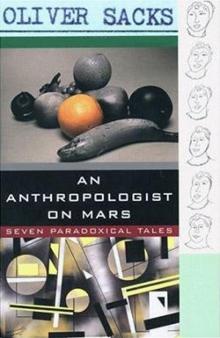
TERKEL: Oliver Sacks. This recent book is called An Anthropologist on Mars: Seven Paradoxical Tales, and it’s almost a continuation of all your others. But more and more and more we find out about this crazy thing called the human, what, psyche, but possibilities within that which is definitely a disease.
SACKS: Right. And the different ways in which people can make their worlds and how paradoxically disease can almost force one to make another world in a different sort of world.
TERKEL: And so with Oliver Sacks, it’s amazing how quickly I feel I’d do another hour with you but we shall meet him again and again and again. And certainly, when your play based upon The Man Who, it’s called The Man Who, will be coming to Chicago. Perhaps you will be here with your next book too. And also your book on the world of the deaf. What is it called again?
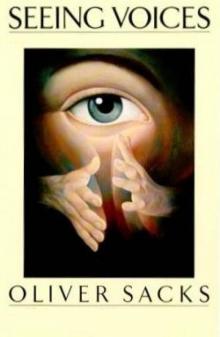
SACKS: Seeing Voices.
TERKEL: Seeing Voices. And then, just to name some of the books, of course. Migraine, that’s one of your earliest ones. Awakenings, of course we know, A Leg to Stand On—your own adventure, The Man Who Mistook His Wife for a Hat. And then the new one called—this one—An Anthropologist on Mars.