I strahd the war again.., p.4
I, Strahd - The War Against Azalin,
p.4
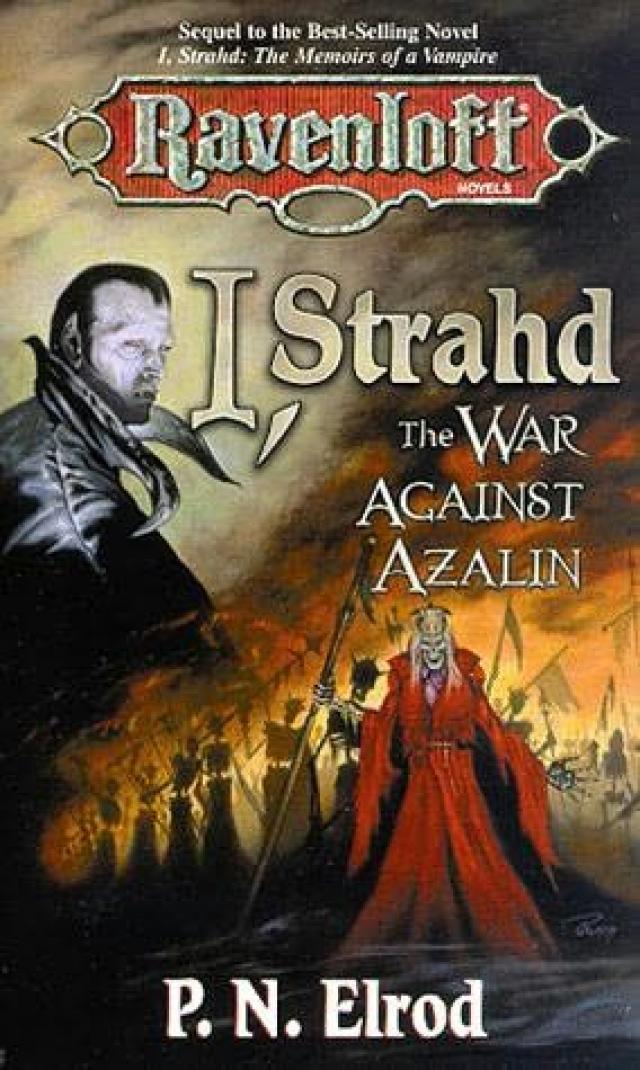


I heard a shout behind me and turned in time to see the second man. He looked quite mad: wild-eyed, sword out, and ready to chop me in half.
He had the one chance.
The curved blade sliced right through my body, barely meeting any resistance at all. I felt a decided tugging as it ruined my clothes, but nothing more harmful than that. Unfortunately—for him—I am not so vulnerable to sword cuts as I once was.
Where he expected me to fall over in a bloody mess I still stood unharmed, quite dumbfounding him, until I compelled him to take a nap next his friend.
Three remained, huddled in the little croft. Though what had specifically happened to their friends would be beyond their ken, they would understand that whatever prowled here was more than capable of attacking them with the same success. They were trapped in a small and frail shelter against the whole of the night embodied in something that they had not even glimpsed, something that had, in a remarkably short time, disposed of a dozen well armed men. I could not expect them to be anything less than utterly desperate, which might prove troublesome. Desperate men generally do not think clearly, making them unpredictable and considerably more dangerous.
Since my clothing was in shreds thanks to my delayed reaction, I discarded the cloak, outer coat, embroidered vest, and what had once been a very fine black linen shirt. My gold neck chain with the Von Zarovich ruby on its pendant was undamaged. It would take much more than a sword stroke to remove it from my person. My pale torso, still bearing scars I had acquired before my change, would be an easier-to-see target at night, though my personal safety was of little concern to me. I wanted only to make sure the remaining men did not injure themselves when I went for them.
The croft was sealed shut now, with no glimmer of light from any chink in the door or shutters. The men were crouched in the dark, probably tensed and ready for anything. I crept close, braced myself, and gave the brittle wood a mighty kick, then moved to dodge clear.
I did not get that far. Some tangible—at first I thought it an arrow—but unseen force hurled from the opening and caught me squarely, pinning me in place.
The stale air shot forth from my dormant lungs and my legs turned to water. A vast hand seemed to hold me in place an instant, then slammed me flat to the ground. I lay stunned, both by the force of it and the sheer surprise of anything being powerful enough to affect me.
The brigands were chanting. Their deep voices rose and fell in a strange, oddly rhythmic tongue. The words pounded at me like hammer blows. Some kind of spell…
Not a spell… prayer. A plea to one of their alien gods. Whether their deity from beyond the Mists was able to hear them mattered little; their faith alone was strong enough to render me helpless. When swords fail, men turn to their gods, and this lot had the kind of true faith I hadn't faced in a very long time. It battened me down like a hunting hawk, its talons ripping into my shoulders and back. I tried to scrabble free, but was utterly trapped in its grasp.
The leader led the chant, his rasping voice knifing through my skull. I writhed from the pain, the sound alone seemed to burn my flesh. One of the men stepped forward, his sword raised. I saw the faint green glow of magic streaming from its cruel blade. As I had done to his comrade so he would do to me and cut off my head.
Desperate men generally do not think clearly, making them unpredictable and considerably more dangerous. I was desperate enough to blurt out a spell for my defense, the first to pop into my head. Had I been thinking I would have conjured something much less destructive. As it was, a flash of lightning completely obliterated the dark for a long moment and the deafening crack of its passage blotted out the leader's voice. I took that blessed respite to roll clear before the blade came down to deliver me to death.
No need.
By the time my eyes recovered from the flare it was all over except for the smoke, much of which steamed from three charred corpses. I was unharmed, but the three brigands were flat on their backs in three different directions. The leader had been thrown right through the rear wall of the croft.
The bolt had impacted the earth exactly in their midst, leaving a crater a foot deep. The grass was singed away, of course, and the exposed earth had irregular veins of cooling glass running out from the center where the heat had been very great. As for the men… well, the eleven I had would have to suffice for my needs; these fellows were quite beyond any use in the culinary sense. It was probably for the better. The last thing I needed in my dungeons was some wretched holy man working away at me with his foul prayers. I knew his sort: the worse the conditions in which he found himself the greater power he would be able to call forth.
A waste, but not one I would mourn over much. I could still find some use for the dead ones as servants. Once I had recovered a bit and put the proper spells into effect, the whole lot of them could walk themselves to Castle Ravenloft. The living would be compelled down into the dungeons, and the dead to one of my work areas where I could make a proper and permanent change in them so they would be suitable guards.
Their path of travel would take them right through the village of Barovia at the foot of the castle, a sight to cause the population some little stir. By this would they know their lord was keeping the peace in the land and perhaps be better inspired to maintain it themselves.
I put myself in order and retrieved the lot of them to commence the work, being quite recovered now from the chanting attack. Before another hour passed, they were all under my control and slowly marching west, even the one without the head—he carried that in his lifeless hands—and the three with blackened and cracked skin. By dawn they would all be in their proper places, serving me in such a way as they could never have otherwise hoped—or remotely imagined—to achieve.
***
An excerpt from the private commentary notebooks of Azalin, salvaged and translated by Lord Strahd after the necromancer's disappearance in the year 579.
543 Barovian Calendar, Barovia
Here Von Zarovich exhibits a sampling of his ongoing obsession with the woman Tatyana. She is his blind spot and is certainly something that might be exploited in my intention to supplant him. He has noticed the pattern of her continuing birth, death, and re-birth in his land, so the idea of introducing a false Tatyana at a time inconvenient to him and advantageous to me is worth consideration. The difficulty is finding a substitute convincing enough to deceive him. Though gullible on some points, he is keenly attuned to the workings of magic and sensitive to all manner of spellwork. A simple illusion will not suffice. Something far more subtle is required for such a subterfuge to succeed.
At her loss his wish for his own death, such as it is, should not be given much credence. He acknowledges himself that it is but a temporary, passing state with him. However, it is again a point that may be exploited should the timing be correct. In these short periods he actually allows himself to be vulnerable. An intelligent agent, by taking advantage of the moment, might then dispose of Von Zarovich's troublesome presence altogether.
At this point in time in the writing Von Zarovich did not completely fathom the nature of the plane of existence into which Barovia had slipped. He refers to the misty boundary enclosing his land without really understanding it. I can only assume that he was so distracted by his emotional ties to the woman that his curiosity was atrophied in some way. Again, her distracting influence on him seems to be encompassing. He has many weaknesses, but this one is the most consistent in his nature.
In his overly colorful, self-aggrandizing narrative, he has made scant reference to the Mists, the single most important element that has to do with our mutual imprisonment.
Some one hundred years prior to this incident, so far as I can discern, he made what he called a "pact with Death" so that he could remove all barriers between himself and this woman, the barriers being a rival for her love (his own brother Sergei) and the annoyance of aging. On the night in question, he was so occupied with the execution of the necessary ritual that he had no inkling of the far reaching consequences of his actions and was completely unaware of them until they had entrenched themselves beyond all chance of removal by his own unassisted hand.
The initial manifestation of his act was the establishment of the Mists themselves. According to the few references he has deigned to share with me (despite their obvious importance to my research) it began in the garden near the castle overlook just prior to the woman flinging herself from its edge. He mentioned that the Mists originally surrounded them moments before while she was having some sort of intense emotional reaction to the death of his brother. We have both come to believe that strong emotions or negative acts may have a powerful connection to the Mists or whatever force may drive or control them—if they are indeed intelligent. From our limited perspective, it is quite impossible to judge either way on the point. Does an insect about to be trod upon consider whether the foot descending upon it is intelligent?
What I can infer with some certainty is that the Mists rose that night—the result of Strahd's murderous lusts—and spread to the borders of Barovia and there remained. No one—himself not excepted—is able to cross through the Mists to leave, and very few are able to enter from the outside.
This sudden isolation of Barovia marks where it entered what I term a demiplane of existence and only under very extraordinary circumstances does anyone slip from the prime plane of the Oerth that I came from and arrive in this one. The brigands he dealt with here are a typical example.
Despite his patchy research habits, Von Zarovich did trouble himself to question the shepherd and shared what he learned with me. The outlanders had come riding through a thick mist which had suddenly arisen shortly before the setting of the moon. Unlike myself, they had been thieves and murderers and were apparently intent on committing more mischief once they got used to their new surroundings. Von Zarovich backtracked their path and discovered the hoofprints of their horses appearing in the middle of an otherwise empty and unmatched patch of earth, as though they had appeared out of nowhere. He maintained that is very likely what happened, but this is not so, since they obviously came from somewhere.
The shepherd reported the men as being unused to the sight of mountains and they frequently made a type of warding gesture against them. From the description of their clothing, artifacts, and attitudes one might deduce they were from a flat, grassy country, their culture primitive in their devotion to random violence and strong superstitious beliefs. Von Zarovich's vulnerability to religious faith is yet another powerful tool that could be employed against him, but Barovia's isolation has diminished that as a feasible ploy at this time. His adverse reaction is worthy of note, though I find anything to do with religion to be distasteful and can agree with his reactions.
Von Zarovich was quite right to dispose of the invaders, but he should have more closely questioned them. Perhaps he did and has simply not snared that information with me. Not wise, since the smallest detail might be able to aid me in my escape.
He had done some minor research into the nature of the Mists soon after the isolation event. He recounted one occasion of taking the obvious ploy of tying a string to a tree just outside the misty barrier and walking in, trailing the string out behind him, keeping it stretched tight so as to hold a straight path. He continued to walk, slowly playing out the line until the Mists parted. He discovered that he had emerged but a few yards from his starting point, one end of the string leading in still tied to the tree and taut, the other in his hand coming out of the Mists… and taut.
The fool then said after this entirely minor setback that he gave up in disgust for the greater part of a decade, thus losing valuable research time. He did manage to make up for the lack in some small way by scouring his land for any and all books on magic that might contain even a kernel of usable knowledge on Barovia's unique isolation.
Though that quest did increase the contents of his library, it did not substantially improve his situation. The chief result of his exploration was an extensive familiarity with the geography of his land. Not that this was so difficult a thing to master, for the country is little more than twenty-five leagues in length at its farthest points and but ten leagues in width. He knows every stone and has bolt holes from the ravaging effects of the sun everywhere, another detail not to be underestimated in any plan for his assassination.
In summation, he knows much about his land, but little about the true nature of the Mists that brought him to this pass. His chief concern with newcomers is to question them about the circumstances of their departure point and be satisfied with that information. He then quickly loses interest in them except as nourishment. I wonder if the Mists themselves have anything to do with this other apparent blind spot or if this is one of his childish deceptions.
The newcomers did get in, and if I could understand how that was accomplished, perhaps I could discover a way to get out.
End of excerpt.
CHAPTER TWO
Winter Solstice Night, 469 Barovian Calendar, Barovia
All others mark the death of the year in midsummer, when the longest day passes and the slow slide of ever-shortening days ends in midwinter when they celebrate the return of the light. Not so for me. The death of the year occurs when the longest night is done, giving me less and less time to walk in its protecting shadows.
Not that a shortage of time was a burden—eternity was before me, it seemed, but broken up into such brief increments between the sun's setting and rising that I greatly resented having to stop my studies to retreat to my crypt every few hours. Those studies consumed me completely, like the fever that had taken Tatyana nearly a quarter-century ago.
Because of it no book in my library was unread, and many I pored over again and again for weeks at a time, particularly the ones on magic. I catalogued their various ideas, trying to index everything into a recognizable pattern that could be exploited to help me escape my prison.
One portion of the pattern had to do with the occasional trespassers who entered the country at irregular intervals. As the newcomers were universally a bad lot, I used to kill them as I found them, but I'd since learned the wisdom of taking them alive so that I might closely question my prisoners on their lives beyond the Mists, trying to build a picture of the lands and peoples there. This was oftentimes easier said than done. Occasionally such trespassers spoke a similar tongue to my own—often startlingly similar—and communication was relatively easy. Other times trespassers had languages so unintelligible that I was forced to cast an appropriate spell in order to communicate even the most basic questions. By these interrogations I learned of many wonders, adding each piece of information to my index, though some of it was contradictory.
Two prisoners had arrived separately at different times, but—and this had not happened before—they were apparently from the same country. They each claimed it to be the same year as time was reckoned there, but each acknowledged a completely different liege lord ruling the place. By this I could deduce that there might be far more worlds out there than I had ever imagined, perhaps piled on top of one another in some manner that left them unaware of their nearly identical neighbors. It was intriguing to think on, though I was not quite ready to believe it yet, not until I obtained more proof than the word of two argumentative murderers, but perhaps there were multiple worlds beyond my borders. I wanted to reach those worlds, break through the Mists to the other side. Perhaps if these other worlds did indeed exist, then it was not inconceivable that in one of those worlds my dear Tatyana yet lived. The Barovia I knew had come about because of my own violent acts, the imprisoning Mists rising high and spreading far from its center at Castle Ravenloft. How then was I to reverse it and escape? Commit something unutterably altruistic and self-sacrificing and hope for the best?
I doubted it would be that simple.
Magical books were far too few, though, and none, save one, appeared to have any information in regard to my plight. The exception was the book Alek Gwilym, my long dead second-in-command, brought me that final year before everything changed. He had never approved of my studies in the Art, probably a wise foresight of his since it had later indirectly led to his death at my hands.
In that book I'd finally found what I had been searching so long for: A Spell For Obtaining the Heart's Desire. Ideal—except I wasn't far enough along in my studies to be able to read it. That had come to me when Death, summoned by my anger, frustration, and despair, made its visitation and offer, and we sealed our hellish pact. I'd gotten everything I'd wanted, but each desire had its own terrible price.
Age ceased to be a problem for me—though I often had to feed off gutter leavings and luckless peasants to stay alive. Sergei ceased to be my rival—after I had murdered him with the blade of a Ba'al Verzi assassin. And Tatyana became mine—for a few moments of bliss until she…
It is indeed true that one should be very careful with one's wishes, as they are likely to manifest themselves in a most unpleasant manner.
Since then I hadn't opened that particular book.
Common sense told me it was now no different from any of the other magic books in my possession; it had only been used as a tool to lure me into this velvet-barred cage. I was a prisoner with nothing left to offer Death. Possibly I did have one thing of value to bargain with: myself, my life, or the emptiness that was my life. I was reluctant to ask, lest I end up in a worse situation than the one I presently endured.
Was I afraid? I would be a fool not to be.