

The small bachelor, p.1
The Small Bachelor,
p.1
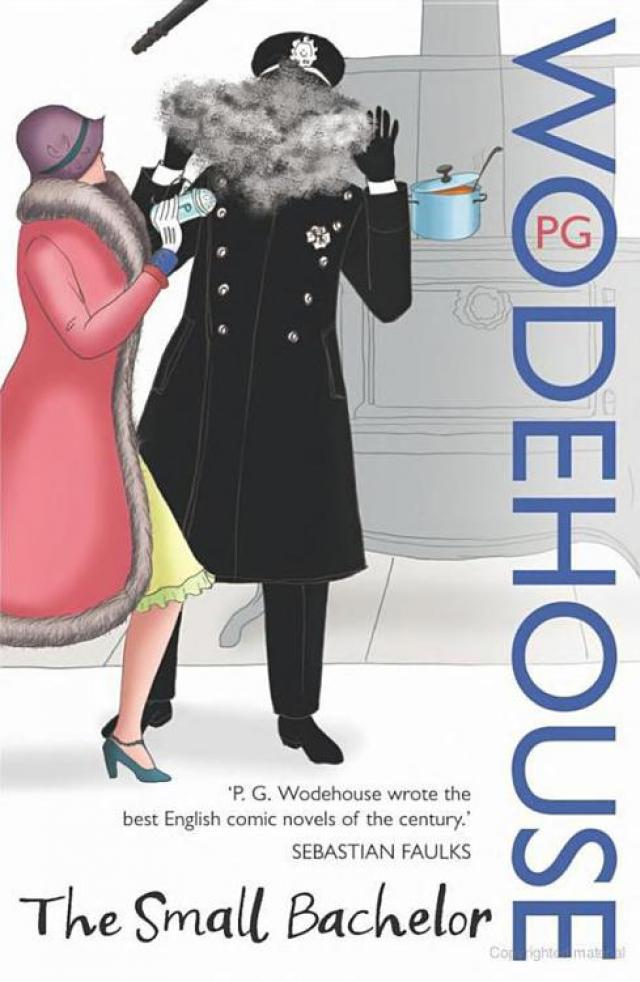


Table of Contents
Cover
Copyright
About the Author
Also by P G Wodehouse
Preface
The Small Bachelor
Chapter One
Chapter Two
Chapter Three
Chapter Four
Chapter Five
Chapter Six
Chapter Seven
Chapter Eight
Chapter Nine
Chapter Ten
Chapter Eleven
Chapter Twelve
Chapter Thirteen
Chapter Fourteen
Chapter Fifteen
Chapter Sixteen
Chapter Seventeen
Chapter Eightteen
Other Books by P G Wodehouse
Also available in Arrow
This eBook is copyright material and must not be copied, reproduced, transferred, distributed, leased, licensed or publicly performed or used in any way except as specifically permitted in writing by the publishers, as allowed under the terms and conditions under which it was purchased or as strictly permitted by applicable copyright law. Any unauthorised distribution or use of this text may be a direct infringement of the author’s and publisher’s rights and those responsible may be liable in law accordingly.
Epub ISBN: 9781409064367
Version 1.0
www.randomhouse.co.uk
Published by Arrow Books 2008
13579108642
Copyright by The Trustees of the Wodehouse Estate
All rights reserved
This book is sold subject to the condition that it shall not, by way of trade or otherwise, be lent, resold, hired out, or otherwise circulated without the publisher’s prior consent in any form of binding or cover other than that in which it is published and without a similar condition including this condition being imposed on the subsequent purchaser
First published in the United Kingdom in 1927 by Methuen & Co.
Arrow Books
The Random House Group Limited20 Vauxhall Bridge Road, London, SW 1V 2 SA
www.rbooks.co.uk
www.wodehouse.co.uk
Addresses for companies within The Random House Group Limited can be found at: www.randomhouse.co.uk/offices.htm
The Random House Group Limited Reg. No. 954009
A CIP catalogue record for this book is available from the British Library
ISBN 9780099514145
The Random House Group Limited supports The Forest Stewardship Council (FSC), the leading international forest certification organisation. All our titles that are printed on Greenpeace approved FSC certified paper carry the FSC logo. Our paper procurement policy can be found atwww.rbooks.co.uk/environment
Typeset by SX Composing DTP, Rayleigh, EssexPrinted and bound in the United Kingdom by
CPI Bookmarque, Croydon, CRO 4TD
‘The ultimate in comfort reading because nothing bad ever happens in P.G. Wodehouse land. Or even if it does, it’s always sorted out by the end of the book. For as long as I’m immersed in a P.G. Wodehouse book, it’s possible to keep the real world at bay and live in a far, far nicer, funnier one where happy endings are the order of the day’ Marian Keyes
‘You should read Wodehouse when you’re well and when you’re poorly; when you’re travelling, and when you’re not; when you’re feeling clever, and when you’re feeling utterly dim. Wodehouse always lifts your spirits, no matter how high they happen to be already’ Lynne Truss
‘P.G. Wodehouse remains the greatest chronicler of a certain kind of Englishness, that no one else has ever captured quite so sharply, or with quite as much wit and affection’ Julian Fellowes
‘Not only the funniest English novelist who ever wrote but one of our finest stylists. His world is perfect, his stories are perfect, his writing is perfect. What more is there to be said?’ Susan Hill
‘One of my (few) proud boasts is that I once spent a day interviewing P.G. Wodehouse at his home in America. He was exactly as I’d expected: a lovely, modest man. He could have walked out of one of his own novels. It’s dangerous to use the word genius to describe a writer, but I’ll risk it with him’ John Humphrys
‘A genius . . . Elusive, delicate but lasting. He created such a credible world that, sadly, I suppose, never really existed but what a delight it always is to enter it and the temptation to linger there is sometimes almost overwhelming’ Alan Ayckboum
‘Wodehouse was quite simply the Bee’s Knees. And then some’ Joseph Connolly
‘Compulsory reading for anyone who has a pig, an aunt–or a sense of humour!’ Lindsey Davis
‘I constantly find myself drooling with admiration at the sublime way Wodehouse plays with the English language’ Simon Brett
‘I’ve recorded all the Jeeves books, and I can tell you this: it’s like singing Mozart. The perfection of the phrasing is a physical pleasure. I doubt if any writer in the English language has more perfect music’ Simon Callow
‘Quite simply, the master of comic writing at work’ Jane Moore
‘To pick up a Wodehouse novel is to find oneself in the presence of genius – no writer has ever given me so much pure enjoyment’ John Julius Norwich
‘P.G. Wodehouse is the gold standard of English wit’ Christopher Hitchens
‘Wodehouse is so utterly, properly, simply funny’ Adele Parks
‘To dive into a Wodehouse novel is to swim in some of the most elegantly turned phrases in the English language’ Ben Schott
‘P.G. Wodehouse should be prescribed to treat depression. Cheaper, more effective than valium and far, far more addictive’ Olivia Williams
‘My only problem with Wodehouse is deciding which of his enchanting books to take tomy desert island’ Ruth Dudley Edwards
The author of almost a hundred books and the creator of Jeeves, Blandings Castle, Psmith, Ukridge, Uncle Fred and Mr Mulliner, P.G. Wodehouse was born in 1881 and educated at Dulwich College. After two years with the Hong Kong and Shanghai Bank he became a full-time writer, contributing to a variety of periodicals including Punch and the Globe. He married in 1914. As well as his novels and short stories, he wrote lyrics for musical comedies with Guy Bolton and Jerome Kern, and at one time had five musicals running simultaneously on Broadway. His time in Hollywood also provided much source material for fiction.
At the age of 93, in the New Year’s Honours List of 1975, he received a long-overdue knighthood, only to die on St Valentine’s Day some 45 days later.
Some of the P.G. Wodehouse titles to he published hy Arrow in 2008
JEEVES
The Inimitable Jeeves
Carry On, Jeeves
Very Good, Jeeves
Thank You, Jeeves
Right Ho, Jeeves
The Code of the Woosters
Joy in the Morning
The Mating Season
Ring for Jeeves
Jeeves and the Feudal Spirit
Jeeves in the Offing
Stiff Upper Lip, Jeeves
Much Obliged, Jeeves
Aunts Aren’t Gentlemen
UNCLE FRED
Cocktail Time
Uncle Dynamite
BLANDINGS
Something Fresh
Leave it to Psmith
Summer Lightning
Blandings Castle
Uncle Fred in the Springtime
Full Moon
Pigs Have Wings
Service with a Smile
A Pelican at Blandings
MULLINER
Meet Mr Mulliner
Mulliner Nights
Mr Mulliner Speaking
GOLF
The Clicking of Cuthbert
The Heart of a Goof
OTHERS
Piccadilly Jim
Ukridge
The Luck of the Bodkins
Laughing Gas
A Damsel in Distress
The Small Bachelor
Hot Water
Summer Moonshine
The Adventures of Sally
Money for Nothing
The Girl in Blue
Big Money
PREFACE
I have three reasons for being particularly fond of The Small Bachelor.
I suppose authors generally have a special affection for those of their books which come out easily. It is not that we mind work – we are always ready to give our all for our Art – but it is nice when we are occasionally spared the blood, sweat and tears, and there are few things more agonizing than the realization, after one has written 50,000 words of a novel, that as a theatrical manager I knew used to say of a play which seemed to him to fall short of perfection ‘it don’t add up right’.
Few people, for instance, liked Thank You, Jeeves as much as I do, but I love it because it came out as smooth as treacle gurgling out of a jug and never gave me a moment’s anguish from the opening paragraph of Chapter One. I actually wrote the last twenty-six pages – about 5,500 words – in a single day between breakfast and dinner, and felt fine when I had done it.
The Small Bachelor one of the easy ones. I wrote most of it in a punt on a lake at a country house in Norfolk with gentle breezes blowing and ducks quacking and all Nature, as you might say, pitching in to make my task more pleasant.
My second reason for being fond of the book is nostalgic. So much of the action takes place in the Greenwich Village sector of New York, where I lived between 1909 and 1914. I have not visited it for fifty years and everybody tells me it has been ruined by hippies and d
rug addicts, but when I was there it was a charming spot entirely different from anywhere else in New York. I was very hard up in my Greenwich Village days, but I was always very happy. There were trees and grass and, if you wanted to celebrate the sale of a story, two wonderful old restaurants, the Brevoort and the Lafayette, which might have been invented by O. Henry. Prohibition, which killed them both, was unheard of then, though it enters largely into The Small Bachelor: everything such as food and hotel bills was inexpensive: one could live on practically nothing, which was fortunate for me because I had to.
The third reason for my affection for this book is that it is based on a musical comedy I have always had a weakness for, a thing called Oh, Lady, the second of the shows which Guy Bolton, Jerome Kern and I did for the Princess Theatre on 39th Street.
Making a novel out of a play is not the simple job it might seem to be. You can’t just take the dialogue and put in an occasional ‘he said’ and ‘she said’. Oh, Lady, for instance, ran – exclusive of musical numbers – to about 15,000 words. A novel has to be between seventy and eighty thousand. I wrote 50,000 words of The Small Bachelor before I came to the start of Oh, Lady. When I did, I admit that things eased up a lot, though even then the fact that I had added so many threads to the plot made it impossible to use the dialogue as it stood. Sigsbee Waddington, the false necklace, Officer Garroway and the oil shares were not in the play, and Mrs Sigsbee Waddington was an entirely different character.
For the record, Oh, Lady was produced during a printers’ strike, so we got no newspaper notices, but in spite of that it was such a success that while it was running at the Princess Theatre another company was formed to play it at another New York theatre simultaneously, with four companies out on the road. And when it was done at Sing-Sing with a cast of convicts, it was, so I am told, a riot.
The only thing missing from it was a real song hit. Jerry’s music, as always, was enchanting, but what we felt we needed was an outstanding song hit. There was a number for the heroine in the second act called ‘Bill’, but we all thought it was too slow, so it was cut out. It was not till it was done in Show Boat six years later that we realized that, like Othello’s base Indian, we had thrown away a pearl richer than all our tribe. As the fellow said, that’s show biz.
P. G. WODEHOUSE
CHAPTER ONE
I
T
he roof of the Sheridan Apartment House, near Washington Square, New York. Let us examine it. There will be stirring happenings on this roof in due season, and it is as well to know the ground.
The Sheridan stands in the heart of New York’s Bohemian and artistic quarter. If you threw a brick from any of its windows, you would be certain to brain some rising young interior decorator, some Vorticist sculptor or a writer of revolutionary vers libre. And a very good thing, too. Its roof, cosy, compact and ten storeys above the street, is flat, paved with tiles and surrounded by a low wall, jutting up at one end of which is an iron structure – the fire-escape. Climbing down this, should the emergency occur, you would find yourself in the open-air premises of the Purple Chicken restaurant – one of those numerous oases in this great city where, in spite of the law of Prohibition, you can still, so the cognoscenti whisper, ‘always get it if they know you’. A useful thing to remember.
On the other side of the roof, opposite the fire-escape, stands what is technically known as a ‘small bachelor apartment, penthouse style’. It is a white-walled, red-tiled bungalow, and the small bachelor who owns it is a very estimable young man named George Finch, originally from East Gilead, Idaho, but now, owing to a substantial legacy from an uncle, a unit of New York’s Latin Quarter. For George, no longer being obliged to earn a living, has given his suppressed desires play by coming to the metropolis and trying his hand at painting. From boyhood up he had always wanted to be an artist: and now he is an artist: and what is more, probably the worst artist who ever put brush to canvas.
For the rest, that large round thing that looks like a captive ballon is the water-tank. That small oblong thing that looks like a summer-house is George Finch’s outdoor sleeping-porch. Those things that look like potted shrubs are potted shrubs. That stoutish man sweeping with a broom is George’s valet, cook, and man-of-all-work, Mullett.
And this imposing figure with the square chin and the horn-rimmed spectacles which, as he comes out from the door leading to the stairs, flash like jewels in the sun, is no less a person than J. Hamilton Beamish, author of the famous Beamish Booklets (‘Read Them And Make The World Your Oyster’) which have done so much to teach the populace of the United States observation, perception, judgment, initiative, will-power, decision, business acumen, resourcefulness, organization, directive ability, self-confidence, driving-power, originality – and, in fact, practically everything else from Poultry-Farming to Poetry.
The first emotion which any student of the Booklets would have felt on seeing his mentor in the flesh – apart from that natural awe which falls upon us when we behold the great – would probably have been surprise at finding him so young. Hamilton Beamish was still in the early thirties. But the brain of Genius ripens quickly: and those who had the privilege of acquaintance with Mr Beamish at the beginning of his career say that he knew everything there was to be known – or behaved as if he did – at the age of ten.
Hamilton Beamish’s first act on reaching the roof of the Sheridan was to draw several deep breaths – through the nose, of course. Then, adjusting his glasses, he cast a flashing glance at Mullett: and, having inspected him for a moment, pursed his lips and shook his head.
‘All wrong!’ he said.
The words, delivered at a distance of two feet in the man’s immediate rear, were spoken in the sharp, resonant voice of one who Gets Things Done – which, in its essentials, is rather like the note of a seal barking for fish. The result was that Mullett, who was highly strung, sprang some eighteen inches into the air and swallowed his chewing-gum. Owing to that great thinker’s practice of wearing No-Jar Rubber Soles (‘They Save The Spine’), he had had no warning of Mr Beamish’s approach.
‘All wrong!’ repeated Mr Beamish.
And when Hamilton Beamish said ‘All wrong!’ it meant ‘All wrong!’ He was a man who thought clearly and judged boldly, without hedging or vacillation. He called a Ford a Ford.
‘Wrong, sir?’ faltered Mullett, when, realizing that there had been no bomb-outrage after all, he was able to speak.
‘Wrong. Inefficient. Too much waste motion. From the muscular exertion which you are using on that broom you are obtaining a bare sixty-three or sixty-four per cent of result-value. Correct this. Adjust your methods. Have you seen a policeman about here?’
‘A policeman, sir?’
Hamilton Beamish clicked his tongue in annoyance. It was waste motion, but even efficiency experts have their feelings.
‘A policeman. I said a policeman and I meant a policeman.’
‘Were you expecting one, sir?’
‘I was and am.’
Mullett cleared his throat.
‘Would he be wanting anything, sir?’ he asked a little nervously.
‘He wants to become a poet. And I am going to make him one.’
‘A poet, sir?’
‘Why not? I could make a poet out of far less promising material. I could make a poet out of two sticks and a piece of orange-peel, if they studied my booklet carefully. This fellow wrote to me, explaining his circumstances and expressing a wish to develop his higher self, and I became interested in his case and am giving him special tuition. He is coming up here today to look at the view and write a description of it in his own words. This I shall correct and criticize. A simple exercise in elementary composition.’


