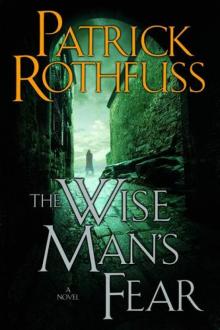
The wise mans fear tkc 2, p.85
The Wise Man's Fear tkc-2,
p.85


Kvothe relaxed visibly. “Good Lord, Bast, is that all? You had me all in a sweat. I’ve faced down things far worse than—”
“There isn’t anything worse than the Cthaeh!” Bast shouted, bringing his clenched fist down on the tabletop again. This time there was the sharp sound of tearing wood as one of the thick timbers bowed and cracked. “Reshi, shut up and listen. Really listen.” Bast looked down for a moment, choosing his words carefully. “You know who the Sithe are?”
Kvothe shrugged. “They’re a faction among the Fae. Powerful, with good intentions—”
Bast waved his hands. “You don’t understand them if you use the term ‘good intentions.’ But if any of the Fae can be said to work for the good, it’s them. Their oldest and most important charge is to keep the Cthaeh from having any contact with anyone. With anyone.”
“I didn’t see any guards,” Kvothe said in the tones a man might use to soothe a skittish animal.
Bast ran his hands through his hair, leaving it in disarray. “I can’t for all the salt in me guess how you slipped past them, Reshi. If anyone manages to come in contact with the Cthaeh, the Sithe kill them. They kill them from a half-mile off with their long horn bows. Then they leave the body to rot. If a crow so much as lands on the body, they kill it too.”
Chronicler cleared his throat gently, then spoke up. “If what you’re saying is true,” he asked, “why would anyone go to the Cthaeh?”
Bast looked for a moment as if he would snap at the scribe, then gave a bitter sigh instead. “In all fairness, my people are not known for making good decisions,” he said. “Every Fae girl and boy knows the Cthaeh’s nature, but there’s always someone eager to seek it out. Folk go to it for answers or a glimpse of the future. Or they hope to come away with a flower.”
“A flower?” Kvothe asked.
Bast gave him another startled look. “The Rhinna?” Not seeing any recognition in the innkeeper’s face he shook his head in dismay. “The flowers are a panacea, Reshi. They can heal any illness. Cure any poison. Mend any wound.”
Kvothe raised his eyebrows at that. “Ah,” he said, looking down at his folded hands on the tabletop. “I see. I can understand how that might draw a person in, though they knew better.”
The innkeeper looked up. “I have to admit I don’t see the trouble,” he said apologetically. “I’ve seen monsters, Bast. The Cthaeh falls short of that.”
“That was the wrong word for me to use, Reshi,” Bast admitted. “But I can’t think of a better one. If there was a word that meant poisonous and hateful and contagious, I’d use that.”
Bast drew a deep breath and leaned forward in his chair. “Reshi, the Cthaeh can see the future. Not in some vague, oracular way. It sees all the future. Clearly. Perfectly. Everything that can possibly come to pass, branching out endlessly from the current moment.”
Kvothe raised an eyebrow. “It can, can it?”
“It can,” Bast said gravely. “And it is purely, perfectly malicious. This isn’t a problem for the most part, as it can’t leave the tree. But when someone comes to visit . . .”
Kvothe’s eyes went distant as he nodded to himself. “If it knows the future perfectly,” he said slowly, “then it must know exactly how a person will react to anything it says.”
Bast nodded. “And it is vicious, Reshi.”
Kvothe continued in a musing tone. “That means anyone influenced by the Cthaeh would be like an arrow shot into the future.”
“An arrow only hits one person, Reshi.” Bast’s dark eyes were hollow and hopeless. “Anyone influenced by the Cthaeh is like a plague ship sailing for a harbor.” Bast pointed at the half-filled sheet Chronicler held in his lap. “If the Sithe knew that existed, they would spare no effort to destroy it. They would kill us for having heard what the Cthaeh said.”
“Because anything carrying the Cthaeh’s influence away from the tree . . .” Kvothe said, looking down at his hands. He sat silently for a long moment, nodding thoughtfully. “So a young man seeking his fortune goes to the Cthaeh and takes away a flower. The daughter of the king is deathly ill, and he takes the flower to heal her. They fall in love despite the fact that she’s betrothed to the neighboring prince . . .”
Bast stared at Kvothe, watching blankly as he spoke.
“They attempt a daring moonlight escape,” Kvothe continued. “But he falls from the rooftops and they’re caught. The princess is married against her will and stabs the neighboring prince on their wedding night. The prince dies. Civil war. Fields burned and salted. Famine. Plague . . .”
“That’s the story of the Fastingsway War,” Bast said faintly.
Kvothe nodded. “It’s one of the stories Felurian told. I never understood the part about the flower until now. She never mentioned the Cthaeh.”
“She wouldn’t have, Reshi. It’s considered bad luck.” He shook his head. “No, not bad luck. It’s like spitting poison in someone’s ear. It simply isn’t done.”
Chronicler recovered some of his composure and slid his chair back toward the table, still holding the sheet carefully. He frowned at the table, broken and streaked with beer and ink. “It seems like this creature has quite a reputation,” he said. “But I find it hard to believe it’s quite as dangerous as all that. . . .”
Bast looked at Chronicler incredulously. “Iron and bile,” he said, his voice quiet. “Do you think I’m a child? You think I don’t know the difference between a campfire story and the truth?”
Chronicler made a mollifying gesture with one hand. “That’s not what I . . .”
Without taking his eyes from Chronicler, Bast laid his bloody palm flat on the table. The wood groaned and the broken timbers snapped back into place with a sudden crackling sound. Bast lifted his hand, then brought it down sharply on the table, and the dark runnels of ink and beer suddenly twisted and shaped themselves into a jet-black crow that burst into flight, circling the taproom once.
Bast caught it with both hands and tore the bird carelessly in half, casting the pieces into the air where they exploded into great washes of flame the color of blood.
It all happened in the space of a single breath. “Everything you know about the Fae could fit inside a thimble,” Bast said, looking at the scribe with no expression at all, his voice flat and even. “How dare you doubt me? You have no idea who I am.”
Chronicler sat very still, but he did not look away.
“I swear it by my tongue and teeth,” Bast said crisply. “I swear it on the doors of stone. I am telling you three thousand times. There is nothing in my world or yours more dangerous than the Cthaeh.”
“There’s no need for that, Bast,” Kvothe said softly. “I believe you.”
Bast turned to look at Kvothe, then sagged miserably in his chair. “I wish you didn’t, Reshi.”
Kvothe gave a wry smile. “So after a person meets the Cthaeh, all their choices will be the wrong ones.”
Bast shook his head, his face pale and drawn. “Not wrong, Reshi, catastrophic. Jax spoke to the Cthaeh before he stole the moon, and that sparked the entire creation war. Lanre spoke to the Cthaeh before he orchestrated the betrayal of Myr Tariniel. The creation of the Nameless. The Scaendyne. They can all be traced back to the Cthaeh.”
Kvothe’s expression went blank. “Well, that certainly puts me in interesting company, doesn’t it?” he said dryly.
“It does more than that, Reshi,” Bast said. “In our plays, if the Cthaeh’s tree is shown in the distance in the backdrop, you know the story is going to be the worst kind of tragedy. It’s put there so the audience knows what to expect. So they know everything will go terribly wrong in the end.”
Kvothe looked at Bast for a long moment. “Oh Bast,” he said softly to his student. His smile was gentle and sad. “I know what sort of story I’m telling. This is no comedy.”
Bast looked up at him with hollow, hopeless eyes. “But Reshi . . .” His mouth moved, trying to find words and failing.
The red-haired innkeeper gestured at the empty taproom. “This is the end of the story, Bast. We all know that.” Kvothe’s voice was matter-of-fact, as casual as if he were describing yesterday’s weather. “I have led an interesting life, and this reminiscence has a certain sweetness to it. But . . .”
Kvothe drew a deep breath and let it out gently. “. . . but this is not a dashing romance. This is no fable where folk come back from the dead. It’s not a rousing epic meant to stir the blood. No. We all know what kind of story this is.”
It seemed for a moment that he would continue, but instead his eyes wandered idly around the empty taproom. His face was calm, without a trace of anger or bitterness.
Bast darted a look at Chronicler, but this time there was no fire in it. No anger. No fury or command. Bast’s eyes were desperate, pleading.
“It’s not over if you’re still here,” Chronicler said. “It’s not a tragedy if you’re still alive.”
Bast nodded eagerly at this, looking back at Kvothe.
Kvothe looked at both of them for a moment, then smiled and chuckled low in his chest. “Oh,” he said fondly. “You’re both so young.”
CHAPTER ONE HUNDRED SIX
Returning
After my encounter with the Cthaeh, it was a long time before I was my right self again.
I slept a great deal, but only fitfully as I was endlessly set upon by terrible dreams. Some of them were vivid and impossible to forget. These were mostly of my mother, my father, my troupe. Worse were the ones where I woke weeping with no memory of what I’d dreamed, only an aching chest and an emptiness in my head like the bloody gap left by a missing tooth.
The first time I awoke like this, Felurian was there, watching me. Her expression was so gentle and worried that I expected her to murmur softly to me and stroke my hair, as Auri had done in my room months ago.
But Felurian did nothing of the sort. “are you well?” she asked.
I had no answer for this. I was blurry with memory, confusion, and grief. Not trusting myself to speak without bursting into tears again, I merely shook my head.
Felurian bent down and kissed me on the corner of my mouth, looked at me for a long moment, and sat back up. Then she went to the pool and brought me back a drink of water in her cupped hands.
Over the following days Felurian did not press me with questions or try to draw me out. She occasionally tried to tell me stories, but I couldn’t focus on them, so they made less sense than ever. Some parts made me weep uncontrollably, though the stories themselves had nothing in them that was sad.
Once I woke to find her gone, only to have her return hours later carrying a strange green fruit bigger than my head. She smiled shyly and handed it to me, showing me how to peel off the thin leathery skin to reveal the orange meat inside. Pulpy and tangy-sweet, it pulled apart in spiraling segments.
We ate these silently, until nothing was left but a round, hard, slippery seed. It was dark brown and so big I could not close my hand around it. With a slight flourish, Felurian cracked this open against a rock and showed me that the inside was dry, like a roasted nut. We ate this too. It tasted dark and peppery, vaguely reminiscent of smoked salmon.
Nestled inside that was another seed, white as bone and the size of a marble. This Felurian gave to me. It was candy-sweet and slightly gummy, like a caramel.
One time she left me alone for endless hours, only to return with two brown birds, one carefully cupped in each hand. They were smaller than sparrows, with striking, leaf-green eyes. She set them down next to where I lay on the cushions, and when she whistled, they began to sing. Not snippets of birdsong, they sang an actual song. Four verses with a chorus between. First they sang together, then in a simple harmony.
Once I woke and she gave me a drink in a leather cup. It smelled of violets and tasted of nothing at all, but it was clear and warm and clean in my mouth, like I was drinking summer sunlight.
Another time she gave me a smooth red stone that was warm in my hand. After several hours it hatched like an egg, revealing a creature like a tiny squirrel that chittered angrily at me before running away.
Once I woke and she was not nearby. Looking around I saw her sitting on the edge of the water, arms wrapped around her knees. I could barely hear the gentle song of her sobbing quietly to herself.
I slept and I woke. She gave me a ring made from a leaf, a cluster of golden berries, a flower that opened and closed at the stroking of a finger. . . .
And once, when I startled awake with my face wet and my chest aching, she reached out to lay her hand on top of mine. The gesture was so tentative, her expression so anxious, you would think she had never touched a man before. As if she was worried I might break or burn or bite. Her cool hand lay on mine for a moment, gentle as a moth. She squeezed my hand softly, waited, then pulled away.
It struck me as odd at the time. But I was too clouded with confusion and grief to think clearly. Only now, looking back, do I realize the truth of things. With all the awkwardness of a young lover, she was trying to comfort me, and she didn’t have the slightest idea how.
Still, all things mend with time. My dreams receded. My appetite returned. I grew clearheaded enough to banter with Felurian a bit. Shortly after that, I recovered enough to flirt. When this happened, her relief was palpable, as if she couldn’t relate to a creature that did not want to kiss her.
Last came my curiosity, the surest sign I was my own true self again. “I never asked you how went your final workings with the shaed,” I said.
Her face lit. “it is done!” I could see the pride in her eyes. She took my hand and pulled me to the edge of the pavilion. “the iron was not an easy thing, but it is done.” She started forward, then stopped herself. “can you find it?”
I took a long, careful look around. Even though she’d taught me what to look for, it was a long moment before I spotted a subtle depth in the darkness of a nearby tree. I reached out and drew my shaed from the concealing shadow.
Felurian skipped to my side, laughing as if I had just won a game. She caught me around the neck and kissed me with the wildness of a dozen children.
She had never let me wear the shaed before, and I marveled as she spread it over my naked shoulders. It was nearly weightless and softer than the richest velvet. It felt like wearing a warm breeze, the same breeze that had brushed me in the darkened forest glade where Felurian had taken me to gather the shadows.
I thought of going to the forest pool to see how I looked in the water’s reflection, but Felurian threw herself onto me. Bearing me to the ground, she landed astride me, my shaed spread beneath us like a thick blanket. She gathered the edges of it around us, then kissed my chest, my neck. Her tongue was hot against my skin.
“this way,” she said against my ear, “whenever your shaed wraps you, you will think of me. when it touches you it will seem like my touch.” She moved slowly against me, rubbing the length of her naked body along mine. “through all the other women you will remember Felurian, and you will return.”
After that I knew my time in the Fae was drawing to a close. The Cthaeh’s words stuck in my mind like burrs, goading me out into the world. The fact that I had been within a stone’s throw of the man who had killed my parents and not realized it left a bitter taste in my mouth that even Felurian’s kisses could not erase. And what the Cthaeh had said of Denna kept playing over and over in my head.
Eventually I awoke and knew the time had come. I rose, put my travelsack in order, and dressed for the first time in ages. The feeling of clothes against my skin felt odd after all this time. How long had I been gone? I brushed my fingers through my beard and shrugged the thought away. Guessing was pointless when I would know the answer soon enough.
Turning, I saw Felurian standing in the center of the pavilion, her expression sad. For a moment I thought she might protest my leaving, but she did nothing of the sort. Moving to my side, she fastened the shaed around my shoulders, reminding me of a mother dressing her child against the cold. Even the butterflies that followed her seemed melancholy.
She led me through the forest for hours until we came to a pair of tall greystones. She drew up the hood of my shaed and bid me close my eyes. Then she led me in a brief circle and I felt a subtle change in the air. When I opened my eyes I could tell this forest was not the same one I had been walking through a moment before. The strange tension in the air was gone. This was the mortal world.
I turned to Felurian. “My lady,” I said. “I have nothing to give you before I go.”
“except your promise to return.” Her voice was lily soft, with a whisper of a warning.
I smiled. “I mean I have nothing to leave you with, lady.”
“except remembrance.” She leaned close.
Closing my eyes, I bid her farewell with few words and many kisses.
Then I left. I would like to say I did not look back, but that would not be the truth. The sight of her almost broke my heart. She seemed so very small beside the huge grey stones. I almost went back to give one final kiss, one last good-bye.
But I knew if I went back, I would never manage to leave again. Somehow I kept walking.
When I looked back the second time, she was gone.
CHAPTER ONE HUNDRED SEVEN
Fire
I came to the Pennysworth Inn long after the sun had set. The huge inn’s windows swelled with lamplight and there were a dozen horses tethered outside, champing into their feed bags. The door was open, casting a slant square of light into the dark street.
But something was wrong. There was none of the pleasant rousing clamor that should be coming from a busy inn at night. Not a whisper. Not a word.
Anxious, I crept closer. Every faerie tale I’d ever heard was running through my head. Had I been gone years? Decades?