Rosebud, p.7
Rosebud,
p.7


“Oh dear,” says Diana, “I do hope we’re not going to go and see—”
They’re in an open square, among the sort of architecture that said this was during the weather changes, with big roofs jutting out to provide shade everywhere, and that sky familiar from the last time Haunt saw direct footage from Earth, that signature sky of uniform grey with a sort of red tainting the clouds. One can almost feel the UV. Actually, the skin of this body can, and of course Dracula doesn’t like it. Haunt takes a very theatrical step back into the shadows, but so do all the others. There’s a crowd ahead, yelling and very focussed on whatever that is on the steps of the building. Which is a good thing, or they’d have noticed the cosplay bystanders over here, and depending on what this era’s tolerance was for virtuality, might have been perturbed by the dirty great wasp.
Haunt decides there’s no point being here unless they can see what’s going on. He heads over to the crowd and the others follow. And maybe it’s going to be okay, because the crowd contains quite a few augmented appearances, people who look like flags and patriotic symbols and characters from whatever version of . . . Haunt thinks this must be Britain. That, of all the old countries, always had its own special flavour of oppression. People are glancing back at them now, and seem puzzled by their appearance, but they aren’t screaming and pointing. They’re reserving that for what’s ahead. On a flight of steps is standing a large man in the sort of suit normally reserved for the court appearances of sporting personalities. He has a shaved head and he’s smiling broadly. Behind him has been erected a screen, barely more than a sheet, held aloft by drones. That clash of old and new tech speaks of these times as much as the weather does. On the screen is a terrified but defiant-looking young person, in traditionally male clothes, a suit and tie, but on them it looks incongruous, especially considering what’s going on. The figure is being forced into a chair with a sort of metal frame on it, a crown of electronics hanging down above it. The sheer number of people holding onto this person can’t be fought. That’s what it takes to force someone to sit in a chair and have some sort of apparatus affixed to their head against their will.
“That was me,” says Diana quietly. She’s got a very calm look on her face. “They put me in a suit and gave me a male haircut. Such theatrics. Considering.”
“I bet you’re regretting a few of your choices right now, aren’t you?” cries the man on the steps. “Not too late to choose the healthier path. Well, actually ladies and gentlemen, it is now!”
Because on the screen, a switch has been thrown, and the body they now know is Diana’s has suddenly stiffened. She falls back in the chair, lifeless, all the light gone from her eyes.
The crowd erupt in laughter and applause. The man on the steps checks something in the air in front of him, then takes a tiny black stick from his pocket. “And there we are.” He theatrically puts his mouth close to the data storage device and talks to it. “We get to decide your ‘identity’ now.”
“And they did,” says Diana. “After some torture, all very dull. They gave me a virtual male body and put my mind on display in some sort of justice exhibit. Children got to ask me questions. They stopped that after a few months because they still didn’t like my answers. After a while they had no idea what to do with me, and the climate changed, as it were, and people like me were still not the thing, but using us for sport wasn’t the thing either. Probably because it still put a spotlight on us. So in the end I got shipped off to the Rosebud. Where I discovered that, while my coding insisted my digital body was male, I could hack the customisation protocols just enough to give me clothing and cheekbones appropriate to my gender. Finally. She doesn’t look much like the old me, and I don’t act much like the old me either, but that’s because I had to choose from such a narrow range of appearances. I would have chosen studious, but I was only offered glamourous. From one binary box to another. So I picked a glamour that was also strong and learned and . . . rather grew into the part.”
“What a lot of shit about fuck all,” said Bob.
“Oddly,” said Diana, “I agree.”
“The Company saved you,” points out Quin. “They allowed you space.”
“Indeed,” says Diana. “I am very lucky.” She looks to the others. “So, the ship’s mind must be getting a clear idea of what happened to us. We were persecuted. Then the Company saved us. I don’t see why it would still be confused as to our loyalties.”
There’s a moment of silence. They all look at each other, perhaps a little accusingly, perhaps just wondering. What has this craft intuited about them, and which of them is responsible for that intuition?
“Perhaps it is because of me,” says Haunt. “I do not have an origin story as the rest of you do. I can’t think where the mind would send me. I’m made of a lot of moments, and they’re not . . . bad. Exactly. Or my suffering is more poetic. Yes, I think perhaps this is indeed all about me.”
There’s another moment of silence, one which Haunt doesn’t quite understand. He was expecting more of a reaction. More agreement.
“Well, there’s still me,” says Huge. “I mean, what happened to me was something similar to this.” Huge is looking up, Haunt realises, addressing the ship’s mind like Bob did, in the same way humans have always addressed assumed higher powers, which says a lot about where humans have always assumed they are on the food chain, when actually they’re on top. “We don’t really need to see—”
Suddenly, they’re in some sort of waiting room, an official place with actual wood furniture and a big table. The sunshine through the window is artificial, speaking of those times when things had gotten so dark on Earth, in every sense, that enormous lights were turned on to allow the workers some sense of the cycle their biology was heir to. An enormous crucifix has been put up in that window, so the shadow of the cross falls over the room. The cross looks brand new. On the wall is a screen. And there on the screen are the people in the image that Haunt refused to have near his heart. There on the screen are the thin, happy young man, who Haunt takes to be Huge, the larger man, the trans woman, and the beastperson cushion, all of whom are wearing prison fatigues, all of whom have shaven heads and beaten faces, and the cushion is actually wrapped in bandages with some sort of intubation and seems to be on the edge of life already.
Huge stares at the screen. “This must be an office off the courtroom,” they say. “We’re here. We’re actually here. I can do something about it. I can stop them.”
Haunt looks at the others urgently. He can’t believe Huge is speaking like this. He can’t believe they’ve made themselves free enough to even think those thoughts. “If we are back in time, we do not know what changes might be caused by—”
“I don’t care,” says Huge. “The people who made me into a digital ball of hands did so as a specific cruelty, because they felt I had too many loves in my life, too many to deal with using just the two hands, get it? Yeah, funny. But I chose this body because I didn’t know what we’d be facing and I wanted it to look harmless, but it has some surprises.” They pull one of the knives from their pocket, throw a brush in the air, and cut it in two before it lands. “And after all we’ve seen, after all the possibilities that have always left me freer than I should be, after all the possibilities I’ve seen opened up since, I want to either free them or die here, die for them, for me, so wish me luck.”
And they run for the door.
Haunt and the others look at each other for a moment. Then, if one can rush haltingly, if one can be so conflicted as to urgently hesitate, they do all that, at speed, lumbering in these physical bodies like they’re in a nightmare, after their colleague.
They burst out into a corridor and people in ridiculously normal for the time clothes scream at them. Or, more accurately, at a couple of them. “Aliens!” someone shouts.
“Oh, if only!” calls Diana.
Haunt has seen Huge, turning the corner ahead. “There!” he shouts, and sprints.
Because once he’s decided to do a thing, he’s doing it. He’s not conflicted anymore. He’s going to stop Huge saving their family. If Huge interferes here, they change time randomly, and the Company might not come to be, butterflies and hurricanes and all that. If Huge saves themself and their lovers somehow, then the Company will have lost a valuable resource. If they fail and die, then the result is the same.
That is the dissection of the instinct that is pushing them all along.
Except the cause must be bigger than that, must be more dramatic than that. Okay, so Haunt decides he’s doing it for time, for order, for everyday . . . usualness. Only better. He’s doing it for everything he’s learned from stories, everything that’s important.
Haunt sees ahead that Huge is hesitating at an intersection. They don’t know where they’re going. Huge turns, sees Haunt is closing, and puts up a hand, is going to try to reason with him, persuade him.
Haunt leaps and brings them down. He grabs the wrist of the hand with the knife and suddenly the others arrive, all of them struggling with Huge, all of them trying to prevent them from . . . from this terrible thing which Haunt is still failing to adequately understand inside himself. Humans around them are staring at the painter being restrained by Dracula and a tiger and someone in a spacesuit and a big wasp, and they’re doubtless trying desperately to work out what this moment can possibly mean. “No,” shouts Huge, “please, I’m just trying to find some hope in—”
And then they’re taken away again.
5
“So, what’s the communications blackout about, you fuckers?” says Bob, floating into the shared space of the Rosebud.
Haunt has just arrived, with that very question in mind and a weird sensation in his head that this has all somehow happened before. He heard the alarm, came here in a very dramatic fashion to find Quin unwilling to answer questions, and has discovered the systems failure for himself, entirely independently.
But Diana already has a full schematic on display. “How is it possible for all the links and redundancies to go down at once like that?”
“Aliens?” suggests Huge, rolling in, all their hands fluttering.
“This is Solar Company MoW Moment of Charm, out of Titan, re-establishing communications,” a calm voice cuts into the space. “You were down there for a while, so we diverted to investigate. We have a low-quality line-of-sight transmission line. Please boost your end to inform us of your situation and load updates.”
Quin suddenly springs up, all the thousands of them acting in unison. “We must not,” they say urgently, and they slap the link from the air, breaking it so it’ll take a while for anyone to re-establish it.
“What the fuck?” says Bob.
“We . . . we have a different story in our external memories to the ordinary experiences of our memories here,” says Quin, “but we . . . we think we understand it. Listen. Quickly, before they are here, you must listen.”
And Quin tells them all the most ridiculously implausible narrative Haunt has ever heard. It’s got fairies in it, even. “And the mind of the ship seems to have decided,” they finish, “that we will always side with the Company, that we will always prevent any damage to the Company, and thus that we cannot be trusted to communicate with it, that it must always remain hidden from us, this precious thing. And of course the mind is right, that is what we will do, because it is right to do so. Is it not?”
That actually seems to be a serious question. It must be, because Quin is risking a lot in cutting off communications with the Man of War.
But while listening to Quin’s story, while swiftly coming to realise it may be all true, Haunt has understood something enormous. He steps away from the others for a moment, considering. He’s had an idea that could change everything. If what Quin is saying is true, then the mind of that ship was just reacting, and kept reacting, and if one could only put to it the right concept, something that would get the biggest possible reaction out of it . . . and the sheer amount of inherited and ancestral and genetic memory of the human species which everyone has already donated to the mind would give it the ability to go back and back in those timelines and . . . yes, that’s a fine thought for a competent man to have, a twist ending, a solution, but . . . but he absolutely must not voice it out loud. Or—
“So this fairy ship thing, it’s out there, somewhere nearby, only now we’ve never met it?” says Huge.
“Why, yes—” begins Quin.
Huge rolls faster than Haunt has ever seen them roll. They’re off up a wall and flinging themself into midair in the shared space, pulling out a hundred instructions at once. “Mystery vessel,” Huge calls, broadcasting on all frequencies, the song in his voice full of emotions Haunt has never heard from any of this crew, “you know our stories now. You’re surrounded by a solar system full of the Company. Here are their bases and craft and weapons systems and expanding areas of influence. The Company will find you, they will keep on finding you, until the resources you use in your defence are all expended. You can never be safe! Not with things as they are!”
Haunt has a single moment to realise that Huge also had the idea he had thought was so precious and personal to himself. Huge has said out loud that which Haunt had decided to keep secret.
And then—
* * *
The crew of the Rosebud are, currently, because these are their current choices, a half-tiger person, a goth, a studious science aristocrat, a body creation artist and his family, and a swarm of insects. Of those, the goth is digital. They’ve been called by the ship itself to gather in their shared space to discuss something unusual which has just been picked up by the ship’s exploratory spectrometers. Whatever it is is sending them oddly friendly and familiar signals. It’s as if it knows them already.
When Haunt gets there, manifesting himself as part of the shared display, his friends are already deep in discussion with the Earth Collective about this, excited about the possibilities of first contact.
But Haunt hesitates to say anything. Haunt is overwhelmed by déjà vu. He’s just come from his personal space full of memorabilia and beloved texts, and yet what’s in front of him seems the most familiar thing of all. Yes, there it is on the screen now, a black sphere. It is utterly familiar while being utterly alien. The others are speaking of it like it’s everything they want, like they can’t wait to offer it friendship and peace and aid. He somehow feels he should be grateful to it, whatever it is.
And yet he also feels, for some reason he can’t grasp, like he will never quite cross the gap between himself and it. That he will be a ghost at this feast.
He finds he has nothing to say.
About the Author
Cat Sparks
PAUL CORNELL has written episodes of Elementary, Doctor Who, Primeval, Robin Hood, and many other TV series. He’s worked for every major comics company, including his creator-owned series I Walk With Monsters for The Vault, The Modern Frankenstein for Magma, Saucer State for IDW, and This Damned Band for Dark Horse. He’s the writer of the Lychford rural fantasy novellas from Tordotcom Publishing. He’s won the BSFA Award for his short fiction, an Eagle Award for his comics, a Hugo Award for his podcast, and shares in a Writer’s Guild Award for his Doctor Who. He’s the co-host of Hammer House of Podcast.
You can sign up for email updates here.
Also by Paul Cornell
the lychford series
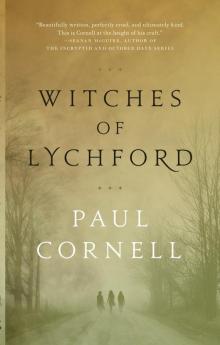
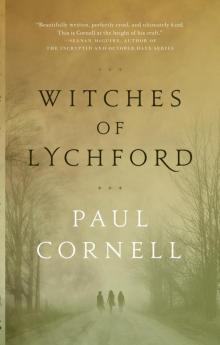
Witches of Lychford
The Lost Child of Lychford
A Long Day in Lychford
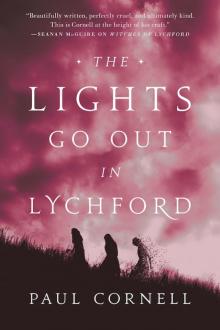
The Lights Go Out in Lychford
Last Stand in Lychford
the shadow police series
London Falling
The Severed Streets
Who Killed Sherlock Holmes?
Chalk
British Summertime
Something More
A Better Way to Die (collection)
Thank you for buying this Tor.com ebook.
To receive special offers, bonus content, and info on new releases and other great reads, sign up for our newsletters.
For email updates on the author, click here.
TOR•COM
Science fiction. Fantasy. The universe. And related subjects.
*
More than just a publisher's website, Tor.com is a venue for original fiction, comics, and discussion of the entire field of SF and fantasy, in all media and from all sources. Visit our site today—and join the conversation yourself.
Table of Contents
Title Page
Copyright Notice
Author’s Note
1
2
3
4
5
About the Author
Also by Paul Cornell
Copyright
This is a work of fiction. All of the characters, organizations, and events portrayed in this novella are either products of the author’s imagination or are used fictitiously.
ROSEBUD
Copyright © 2022 by Paul Cornell
All rights reserved.
Cover art by Jim Tierney
Cover design by Christine Foltzer
Edited by Ellen Datlow
A Tordotcom Book
Published by Tom Doherty Associates
120 Broadway
New York, NY 10271
www.tor.com
Tor® is a registered trademark of Macmillan Publishing Group, LLC.
ISBN 978-1-250-76540-6 (ebook)
ISBN 978 - 1 - 250 - 76539 - 0 (trade paperback)