Light at lavelle, p.1
Light at Lavelle,
p.1
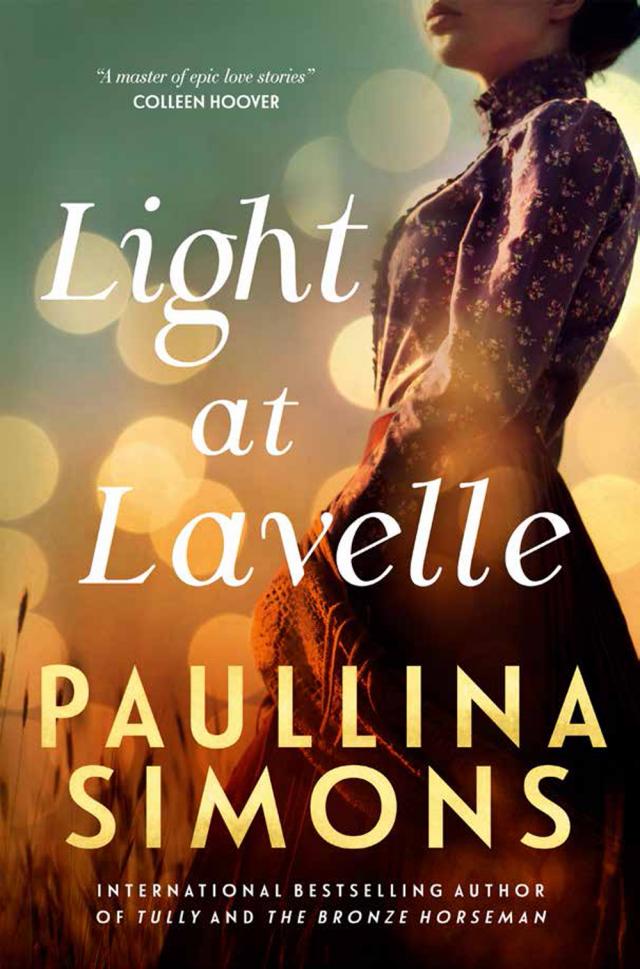


About Light at Lavelle
‘Paullina Simons pulls on every heartstring, she’s a master of epic love stories’ COLLEEN HOOVER
TORN BETWEEN WHAT THEY CANNOT HAVE AND WHAT THEY CANNOT LIVE WITHOUT.
It is 1929. The world is about to change.
Finn Evans is a successful Boston banker harboring a secret that threatens to unravel his carefully constructed idyllic life. Isabelle Lazar, a young Ukrainian farmer, endures unspeakable hardships in her homeland as she fights to save her family from the Soviet Union’s iron grip. Barely escaping the Terror-Famine, she washes up alone on America’s distant shores.
Fate throws Finn and Isabelle together just as the stock market crash causes a devastating collapse of his world. Amid the Great Depression and the trials of their new lives, an undeniable connection grows between them that they both must hide.
As their intertwined destinies hang in the balance, they discover that even those who have lost everything still have something left to lose. Light at Lavelle is the breathtaking epic love story from the worldwide bestselling author of Tully and The Bronze Horseman. Paullina Simons weaves an unforgettable tapestry of love, hope, and fate, showing us that sometimes the greatest battles are fought within our own hearts.
Contents
Cover
About Light at Lavelle
Title page
Dedication
Prologue
Book One: The Sword of Damocles
Part I: The Vanished
1: Cici Lazar and Her Stories
2: The Banker
3: Lemonade
4: The Borrowed Avtomats
5: The Tailor’s Request
6: Lucas
7: Hampton Farm
8: Lavelle
9: Truro
10: Efros and Zhuk
11: The Devil’s Advocate
12: The Towels
13: The Importance of Radio and Milk
14: Definitions of Words
15: The Lost Hat
Part II: Unto The Breach
16: The Pad Shover
17: Sell at Market
18: Gray Ice Over the Charles
19: The Adams Bank
20: OONK
21: Secret Mission
22: Food for Finn
23: Thanksgiving
24 Naked Short
25: Assets and Liabilities
26: The Teacher
27: Increasing the Productivity of Cows
28: The Order of the Books
29: Fact and Fiction
30: The Black Beast
31: Black Days
32: Red Lantern
33: Four Trips and One Dream
34: Father and Son
35: Crocodile
36: Bullfinch’s Last Church
37: Hard Truths
38: Cici’s Map
39: Say Goodbye
Part III: Troy Has Fallen
40: Pride of the Sea
41: Slayer of Peasants
42: A Hut in the Woods
43: Razorblade
44: Walter
45: A Bad Day on Beacon Hill
46: How Time Flies
47: Oksana
48: Cora
49: The Four Passions
50: Husband and Wife
51: Four Children
52: Mother of Exiles
53: Roman’s Last Advice
54: The Mustard Seed
55: Isabelle and Finn
Book Two: The Crane Wife
Past is Prologue
Part IV: Harvest
56: Loving Lane
57: Mrs. Rochester
58: Memory
59: Waiting
60: Litter of Leaves
61: Unraveling
62: Absence of Seed
63: Acquisition of Seed
64: Sowing
65: Germinating
66: First Fruit
67: Starfire
68: Kolomeyka
69: Raspberry Mash
70: Clams and Stallions
71: Return
72: Live Cover
73: Reaping
74: Plain Sight
75: Revelation
Part V: Cri Du Coeur
76: Austen Riggs
77: Omelian Marchenko
78: Men Died First
79: Crawford
80: Fireman’s Fair
81: A Wife, Her Husband and His Lover
82: Last Stand
83: A Lake Full of Longing
84: Nate
85: Another Life
86: The Box
Epilogue
Acknowledgements
About Paullina Simons
Copyright page
Newsletter
For Alex Lloyd, for his unwavering faith in me from the get-go.
Prologue
ONE WARM SUMMER EVENING, in a tiny hamlet south of civilization, east of the wild mountains, west of the Black Sea, a beautiful young woman named Isabelle cooked and baked and decorated her house for the wedding of her friend Cici to her brother Roman Lazar. When she was done with the house, Isabelle decorated herself. She put on a red dress and five heavy strings of coral beads. She wove silk ribbons through her hair, pink and orange and yellow, and she made a flower wreath of mallow and magnolia and fitted it over her golden mane, the color of a Karabakh mare.
The large family had labored long, toiled from the first hour, and now the work was done, and soon it would be time for a well-earned banquet. The tables were fully laden for the high festival. The harvest had not been good that summer, but that didn’t matter, for nothing was spared to honor the pair about to enter into holy matrimony.
Roman, a spectacular groom in an ultramarine blue shirt and black velvet trousers, rode in on Boyko, his beloved palomino stallion. And Cici, a beaming bride in embroidered white, adorned with peonies and roses, was swept up into Roman’s saddle to circle the village church three times before they were crowned husband and wife.
The korovai had been baked, and the gorilka brew made with extra honey and peppers. The poppyseed cake, the pamplushki, the kutia, the shishkebobs, and the stuffed cabbage were all laid out like offerings.
Isabelle’s husband was on the fiddle, her younger brother accompanied him on the accordion, and her mother played the balalaika. Isabelle’s youngest brother was wrestling with her sons over in the dirt by the trees where the three of them must have thought Isabelle wouldn’t notice.
They drank to life and rejoiced in their good fortune. They bestowed the newly married with their gifts and their pleasure. They danced the Ukrainian Wedding March, the fastest bridal polka in the world, they danced “the Kolomeyka” and “the Hopak.” The music never stopped, and the homemade brew flowed freely. And Боже Мій, it was strong! It was a wonder they made it till morning. The wedding began at eleven and continued through the night and sunrise was like dusk, incandescent indigo and pink.
Four thousand miles away from the Lazars and their all-night worship of the power outside the physical world, separated from Isabelle by space but not by time, Finn Evans hired Paul Whiteman and his fifteen-man orchestra to play live on stage at the exclusive Somerset Club in Boston. Paul’s band drove up from New York for one night only, to serenade Finn and Vanessa’s seventh wedding anniversary. Everyone else in America listened to Whiteman through the little speaker on their living room radio, but here in this room, the king of jazz himself, in a white tux, stood on stage, the gold of his sax glistening, the gold from his sax floating through the air like tenor confetti, while Finn danced with Vanessa.
White linen and lilies covered the tables, and the handsome crowd wore their Friday night best, their hair immaculate, their silk dresses shimmering. The food was exquisite, from the cold lobster to the freshly made bread, from the clam chowder to the cod and scallops; all of it divine. The music drowned out hundreds of sober voices, sober because there was no wine, no moonshine, nothing but bloodless apple cider and virgin mint juleps coursing through the veins of the revelers.
A regretfully sober yet joyous Finn whirled in a waltz with Vanessa, his hand delicate on the small of her back, their guests looking on approvingly. Finn too was approving. His wife was a regal platinum vision, and the world he had built with her so concrete, it was as if he had hammered a perfect David out of a block of shapeless, unforgiving marble.
Such was life—measured by value, by time, by place, by space. It pressed upon them from all sides, and though Finn and Isabelle did not yet know it—feasting sumptuously in their corners of the vast world and spinning to the sax fandango and the fiddle—they were already at the precipice.
BOOK ONE
The Sword of Damocles
PART I
The Vanished
“Conceal me what I am,
and be my aid
For such disguise as haply shall become
the form of my intent.”
William Shakespeare
(Twelfth Night, Act 1, Scene 2)
1
Cici Lazar and Her Stories
Ukraine, February 1929
“THEY KILLED THEM! THEY killed them all!”
Isabelle looked out the window to see the tiny Cici atop the massive Boyko, galloping up the sloping hill. High above her, a sedge of gray cranes, long-necked and mighty-winged, flew in a broken formation.
Jumping off the horse before the mount stopped moving, Cici ran into Isabelle’s house. Not just ran but sprinted as if she had something great and importan
t to announce that couldn’t wait another second. Isabelle wanted to say, tie up Roman’s horse, but before she could speak, Cici flung open the door, cried the words above, and bent over gasping.
Isabelle was almost twenty-nine years old, fair-haired, fair-eyed, fair-skinned. She was lean and strong in the way women are who live on a farm and work all day. There was only one mirror in her house, and she often went weeks without glancing in it. She brushed her teeth, washed her face, smoothed and braided her hair, got dressed, put on her boots, and began her day without once considering what she looked like. She knew. Only on Sundays did she put on a few airs and a pretty dress. Sometimes she left her hair down, in the summer put flowers in it. But often she didn’t catch a glimpse of herself, even on Sundays.
And today was not a summer Sunday. It was a Tuesday in the dead of February.
Isabelle set down her wooden spoon; she had been frying potatoes and eggs. It was seven in the morning. Mirik had come in after loading the milk canisters into the dray. In the winter they made their deliveries right after sunrise. The light was still low, the sky a hulking gray.
Until Cici burst in, the cottage had been quiet. Isabelle’s boisterous boys were down in the barn with Isabelle’s mother. Talk about the blind leading the blind. Oksana was a good teacher, engaging and level-headed, but a terrible dairy farmer. However, Isabelle’s children weren’t allowed in the stables with Roman anymore, not after he allowed the boys to ride two untamed foals without a saddle! Now only the inefficient but safe grandmother was allowed to supervise them.
Isabelle’s husband came to stand next to her as they stared at Cici panting. Mirik Kovalenko was seven years older, a serious man with a stern nose, kind brown eyes and a composed manner. He wasn’t much taller than Isabelle or much bigger than her in build. His light brown hair was thinning, and he needed glasses, but wouldn’t admit it.
Cici was still gasping, but not because she was out of breath.
“Killed who?” asked Isabelle.
“Who is they?” asked Mirik. “And who is them? Cici, speak sense.”
“Stan and Vitaly!” Cici said. Stan and Vitaly Babich were Cici’s cousins.
“Someone killed Stan and Vitaly?!”
“No!” cried Cici. “Stan and Vitya ambushed a squadron of Soviets coming down the road and shot them. I don’t know if they were council members or OGPU. Stan is convinced they were chekists.” OGPU were the Soviet internal security forces. Colloquially they were referred to by their post-Revolution name, chekists, from when the secret police was called CHEKA. “But either way, they killed them all. Maybe four dozen men.”
Isabelle and Mirik half-relaxed. Cici was known Ispas over for her fantastical and far-fetched embellishment of facts. And Stan and Vitaly were not exactly famous for their intrepid military ingenuity. They were potato farmers who liked to drink and get into stupid trouble.
“Our Stan and Vitya shot four dozen soldiers?” Mirik said in his slowest, most skeptical voice.
“That’s right, Mirik.” Cici was adamant.
“And they were walking, these fifty officers?” Mirik said. “Not riding in military vans with loaded automatics?”
“They were walking, yes.”
“In the middle of the night.” It wasn’t a question.
“Yes!” said Cici. “I am witness.”
“You were up in the middle of the night in the middle of the woods and saw Stan and Vitya shoot a company of Soviets?” It was Isabelle’s turn to sound incredulous.
“No! By the time I heard about it and got to the woods, it was over.”
“Ah,” said Mirik.
“I saw the last of them being thrown into a mass grave,” said Cici.
Isabelle and Mirik exchanged a glance, less relaxed but still skeptical.
“What do you mean, by the time you heard about it?” Isabelle said. “How could you possibly hear about it? Weren’t you next door with Roman, sleeping together like husband and wife? I just left Roman at the stables. He mentioned nothing about this.”
Cici waved dismissively at Isabelle, as if to say don’t bother me with nonsense. “Roman slept at home, if you must know everything, and I was at Tamara’s.”
“Why?”
“Why, why. Who cares. We had a fight.”
“About this?”
“Isa, did you not hear what I just told you?”
“Oh, I heard.” Isabelle really hoped Cici was exaggerating because otherwise, their simple life was about to get a lot less simple. When she first saw Cici racing up the hill, the girl had looked so much as if she was bringing good news! Isabelle thought maybe she was pregnant. Now Isabelle knew the truth—not only not pregnant but burying Communists in ditches, apparently.
“Cici, this story of yours is getting more and more marvelous,” said Mirik. He was always calm. “Please—tell us more,” he said. “We have all the time in the world. It’s not like we have work to do or milk to deliver.”
Isabelle elbowed her husband. She was not always calm, but she remained calm now because she didn’t want to believe Cici.
“It’s fine, Isa,” Mirik said. “It didn’t happen, so there’s nothing to worry about. Is my food ready?”
“You don’t believe me?” Cici said. “Go see for yourselves. On the other side of Ispas, on the road to Kammenets, just past the gray rock.” Kammenets was the closest city to their hamlet.
“Now, why would all those Soviets be coming to Ispas all of a sudden?” Mirik said.
“You know why,” Cici said, her voice laden with meaning. The rumbling through the countryside was getting hard to ignore. The Soviet food procurement units had been sent out into the Ukrainian villages since December. The cities didn’t have enough to eat. It had been a fallow summer and an empty winter.
“Look, let’s all pipe down,” said Isabelle. “We don’t know who they were—”
“Or even if they were,” said Mirik.
“We don’t know what they were—soldiers or requisitionists or just propagandists,” Isabelle said. “We don’t know if it was forty men or three.”
“It was zero,” said Mirik.
“It was four dozen!” said Cici. “You don’t think I know the difference between three soldiers and fifty? I saw the bodies with my own eyes!”
“Cici is right about one thing, Mirik,” said Isabelle. “Whoever it was, and however many, if they were walking down the road in darkness, before dawn, that’s not a good sign. No one creeping into a village in the middle of the night can be up to anything good.” But Isabelle knew and didn’t want to say—if Cici was telling the truth and Stan and Vitya actually killed Soviet men, that was even worse.
“The Ukrainian loves a good story,” said Mirik. “Isabelle, is my breakfast burning? Because there’s work to do. The milk will go off before Cici is finished speaking.”
“Please say you’re making it up, Cici,” said Isabelle, peering outside her kitchen window for a glimpse of she didn’t know what.
“I’m not! I know sometimes I like to tell a tall tale or two, but trust me, Isa, this is not one of those times. Look at me. You know I’m telling the truth.” Raven-haired, raven-eyed Cici was a minute, slightly rounded girl, but she carried herself high and mighty, as if on a plinth. Cici had always been a raging ball of fire. Part Romanian, her heart all Gypsy, she was impulse and flame. “Still don’t believe me? Ask my husband. He knows.”
“Oh, now he’s your husband,” Isabelle said. “A minute ago, you weren’t even sleeping in the same bed.”
“Don’t humor her, Isa,” said Mirik at the stove, spooning his own potatoes from the cast iron pan onto a pewter plate.
Cici shook her fists. “Both of you—get your heads out of the ground!”
“Oh, I would,” Isabelle said, “if only the Soviets weren’t supposedly in that ground, rotting in a shallow grave.”
“Who said anything about shallow?” said Cici. “Our boys dug practically to Australia! They dug that hole like it was the most important hole of their lives!”
“And the ground looks freshly dug, like a grave?” asked Isabelle.
“They’re not idiots. They covered it with twigs and leaves.”
“No, of course,” said Mirik. “Not idiots.” He wolfed down his potatoes.
“Mirik, you heard what that kramar from Shatava told us who ran through here last week,” Cici said. “The Soviets arrived uninvited and unannounced, upended his store, and took nearly all his provisions. He had to abandon the village and flee! That’s why Stan and Vitya reacted as they did.”