A gift for the children, p.1
A Gift for the Children,
p.1
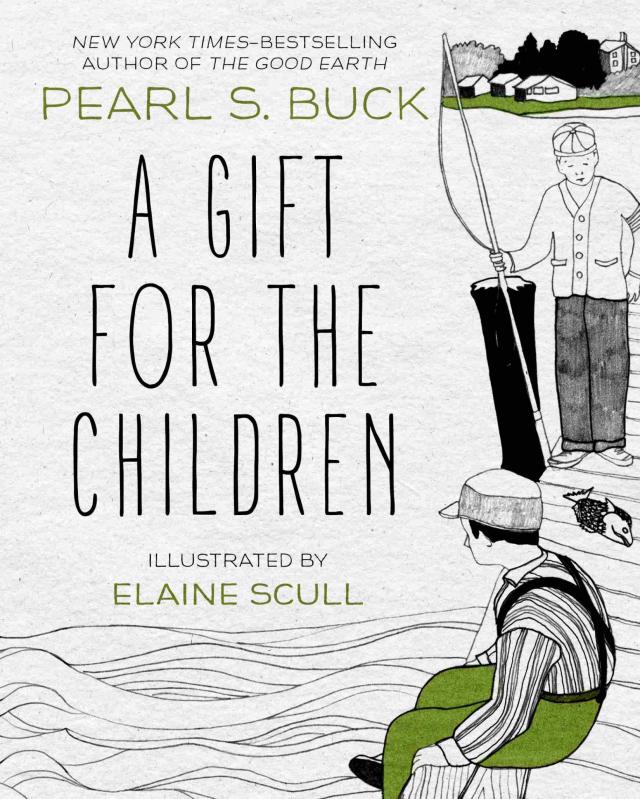


A Gift for the Children
Pearl S. Buck
Illustrations by Elaine Scull
Contents
Introduction
PART ONE: Stories for Little Children
Five Children
When Fun Begins
Thunder
The Sun
The Clouds
What the Children Do in Summer
The Star
The Snow
Tracks in the Snow
What Happens in Spring
Peter and the Squirrel
At Supper
The Moon
The Dark
PART TWO: Stories for Older Children
The Chinese Story Teller
The Christmas Ghost
Christmas Miniature
The Chinese Children Next Door
The Water-Buffalo Children
The Beech Tree
Introduction
Shortly before she died, Pearl Buck and I discussed the form this collection should take. As anyone who has loved her books knows, she approached all her writing with a fine and precise awareness of her reader. This book, however, presented somewhat of a problem, for it was directed to two audiences: First, the grandparent or parent who would acquire it as a gift for a child and who would, in many cases, read the stories aloud. Second, the youngster, who would come to these tales without knowing either the grand lady who wrote them or her very special place in the heart of the giver. Just how well the problem has been solved, I leave to you. We selected stories from across the entire sweep of her work, stories written for children of every age and, not surprisingly, written to warm the hearts of older readers as well. Because Christmas is such a special time for children, two of Miss Buck’s famous Christmas stories are included.
A GIFT FOR THE CHILDREN is a “remembrance” book in the truest sense of the term. It is a part of our past, and hers. It gives the reader a rare opportunity to recall that past and to convey to the young its warmth and beauty. Finally, it is—so fittingly—Pearl Buck’s own gift to the children, lovingly crafted during her last year, by which she, too, will be remembered.
Theodore B. Dolmatch
President
Intext Publishers Group
PART ONE: Stories for Little Children
Five Children
This is the house on the hill.
These are the five children who live in the house with their father and their mother.
Michael is the biggest. He has gray eyes and straight light hair. Michael likes green. He likes to wear a green suit. He likes to eat chocolate ice cream. He likes to play with his truck and his cars. He likes to hitch his cars together.
But he HATES TO PICK UP HIS TOYS.
Peter is next. He has brown eyes and brown hair. Peter likes red. He likes to wear red suits and eat red apples. He likes flowers and the moon and stars. He likes to watch beetles and little goldfish and tiny birds, and to find pretty pebbles.
But he HATES BIG NOISES.
David is next. He has dark blue eyes and curly brown hair. He likes dark blue. He likes to wear a dark blue suit with a white collar. He likes milk. He likes stories. Whenever his father or his mother sits down he runs for a book and says, “Please read me a story.”
But he HATES TO GO TO BED.
Barbara and Judy are next, and they are twins.
Barbara has brown eyes and light hair. She likes pink and she likes to wear her pink coat and hat. She likes to eat eggs. She likes to sweep the floor, and put things away. She likes to clean and to wash.
But she HATES TO DRINK MILK.
Judy has blue eyes and brown curls. She likes pale blue, and she likes to wear her blue coat and hat. She likes to eat apples with Peter. She likes to sing and she likes to hear music. She likes to play with her dolls.
But she HATES TO RUN FAST.
Now you know the five children.
When Fun Begins
The children’s house is not on the top of the hill and it is not at the bottom. It is halfway up the hill, so that when the children go down they come to the lake, and when they go up they come to a big tree.
One day the children came out to play.
“Let’s go up the hill to the big tree,” said Judy.
“No, let’s go down the hill to the lake,” said David.
“No—no,” said Judy.
“Yes—yes,” said David.
And everybody waited and nobody could go anywhere because they could not agree.
When all the five children want to do the same thing, then that means they agree. Sometimes they can agree, and sometimes they want to do different things and they cannot agree.
Then Daddy came out to play, too.
“Where are we going?” he asked the children.
“Up the hill to the big tree,” said Judy.
“Down the hill to the lake,” said David.
“We can’t go anywhere unless we agree,” said Daddy.
So he sat down on the porch and waited. They all sat and waited. And nobody had any fun.
Then Michael thought of something.
“Let’s climb up the hill to the tree and then run fast down the hill to the lake,” he said.
“That’s a good idea,” said Daddy, and he asked Judy, “Do you agree?”
“Yes,” said Judy.
“David, do you agree?” asked Daddy.
“Yes,” said David.
“Does everybody agree?” asked Daddy.
“Yes!” all the children shouted together.
So they all climbed up the hill to the big tree and it was fun.
Then they ran down the hill to the lake. On the lake was the rowboat, and the children got in. Three of the children sat at the back and they were the boys. Two of the children sat in front and they were the girls. In the middle sat Daddy and he rowed the boat. If he rowed up the lake they would go to the woods. If he rowed down the lake they would come to the falls.
“Which way shall we go?” asked Daddy.
“Up the lake,” said the girls.
“Down the lake,” said the boys.
“If I do both at the same time,” said Daddy, “we’ll just go round and round. Which way shall I go first?”
“Up!” said the girls.
“Down!” said the boys.
And again they could not agree and so Daddy rowed the boat round and round in a circle and they went nowhere at all and nobody had any fun.
“But we want to go to the woods,” said Barbara.
“We want to go to the falls,” said Michael.
“You’ll have to agree,” said Daddy, and he just kept going round and round.
The girls looked at the boys and the boys looked at the girls. And Daddy waited and waited and the boat kept going round and round while they waited and still nobody had any fun. Then Peter thought of something.
“Let’s let the wind tell us which way to go first,” he said.
“That’s a good idea,” said Judy.
“Do you agree?” Daddy asked the girls.
“Yes!” they said.
“Do you agree?” Daddy asked the boys.
“Yes!” they said.
“Then look at the clouds,” Daddy said, “and see which way the wind blows.”
They all looked up at the sky. It was blue and there were little soft white clouds hurrying across it, and they were all hurrying up the lake to the woods.
“What does the wind say?” Daddy asked.
“It says, to the woods,” Barbara said.
“To the woods,” they all agreed.
“Now we can begin our fun,” Daddy said. “First we will go to the woods and then we will go to the falls.”
And so they did, and it was fun.
Thunder
One day it was very hot. The children and their mother had taken their lunch to the lake and all day long they played in the water and under the trees. They were so busy having a good time that they did not look at the sky. Suddenly they heard a big noise.
“What’s that?” Michael asked.
“That is thunder,” Mother said. They looked at the sky. It was bright blue over their heads but beyond the house were big clouds like dark mountains with silvery-white edges.
“Those are thunder clouds,” Mother said, “and they will bring us rain.”
“I don’t like thunder,” Judy said, and she wanted to cry, but she didn’t.
“Thunder can’t hurt you,” Mother said, “it’s just a big noise.”
“I don’t like such a big noise,” Peter said.
“I like a big truck noise, but I don’t like this thunder noise,” said Michael.
Just then there was a quick bright light.
“What’s that?” asked David.
“That is lightning,” Mother said. “Listen a minute and you will hear thunder.”
They listened and sure enough, in a minute they heard thunder, and this time it was louder than before.
“It makes me afraid!” Judy said, and now she began to cry a little.
Mother took her hand. “We will go home,” Mother said, “because thunder and lightning usually bring rain. Rain is good for flowers and grass and trees, but children go inside the house until it is over.”
“What is lightning?” asked Michael, who likes to ask “what” questions.
“Lightning is electricity in the clouds,” Mother said. “It makes a light there just as it does in our home when you put on the lights at night. But in the clouds the light cu
ts the clouds like a big bright knife. Then the clouds clap together again and what we hear is the clap and we call it thunder.”
“Why does lightning cut the clouds?” Michael asked, because he likes to ask “why” questions.
“That is just the way it is,” Mother said, “and we don’t know why. Let’s hurry, for here comes the rain.”
The rain was coming down fast.
“How does the rain come?” asked Michael, who likes to ask “how” questions.
“The clouds get so heavy they can’t hold the rain any more and so they let it down,” said Mother. “Hurry, hurry, or we’ll be wet!”
And then they heard Daddy calling, “It’s a big rain. Hurry, hurry, or you’ll all be wet!” and he hurried to meet them and they all took hands and ran home out of the rain.
But the trees and grass and flowers, of course, stayed just where they were and they liked the rain, for it washed them clean and gave them fresh water to drink.
The Sun
The five children were eating supper. While they were eating their junket Peter saw something on the floor.
“Oh, look!” he cried.
They all looked and they all saw something on the floor, too. It was long and bright and shining.
“I will pick it up and see what it is,” said David.
“Try,” said Mother.
So David got down from his chair and tried to pick it up. But he could not do it.
“I will sweep it up for you,” said Barbara.
“Try,” said Mother.
So Barbara went out to the kitchen and found the broom and brought it into the dining room and she swept as hard as she could, but she could not sweep it up. It was still on the floor.
“What is it?” asked Michael.
“Is it a white rope?” Mother asked them.
“No!” they all shouted.
“Is it a silver ribbon?” asked Mother.
“No!” they all shouted.
“Is it bright water?” asked Mother.
“No!” they all shouted.
“Is it shining paper?” asked Mother.
“No!” they all shouted.
“Is it a sunbeam?” asked Mother.
“Yes!” they all shouted.
And a sunbeam is what it was and that is why David could not pick it up in his hand, and Barbara could not sweep it up with her broom.
“Where does it come from?” Michael asked.
“Let’s follow it and see,” said Mother.
Their junket was finished by this time, so they got down and walked in the sunbeam and walked right up to a window.
“Look out of the window, and up the hill,” Mother told them.
They looked, and there was the sun, just going down behind the hill.
“The sunbeam came from the sun,” said Mother. “Now watch to see what happens.”
So they watched, and while they watched the red sun went down behind the hill.
“Oh, where’s the sunbeam?” Peter cried.
They all turned around to find it, but it was gone.
“The sun took it with him,” Mother said.
“Where is the sun going?” David asked.
“He’s going over the hill and down the sky to the other side of the world,” Mother said.
“What will the sun do on the other side of the world?” Michael asked.
“He will give light and sunbeams to other children,” Mother said.
“Why?” asked Michael.
“Because there is only one sun for everybody,” Mother told him, “and so we all take turns with it. While you sleep it is night and the sun gives light for the children on the other side of the world so they can play. It is their turn. Then in the morning the sun comes back to you, and it is your turn to play and that is how the sun makes day and night for everybody.”
“Will the sun be sure to come back tomorrow?” David asked.
“I don’t want those other children to keep my sun, maybe,” Judy said.
“The sun comes back every morning,” Mother said. “No one can keep the sun. If there are no clouds in the sky we will see it again tomorrow when you wake up.”
The Clouds
The next morning when Mother went into the children’s rooms the children were waking up.
“Did the sun come back?” David asked.
“Let’s go to the window and see,” Mother said. “Look over the lake.”
So the children climbed out of their beds and ran to the window.
“But we saw the sun last night behind the hill,” Michael said, “so why do we look over the lake this morning?”
“The sun went down in the west, and that is behind the hill,” Mother said.
“The sun had been all around the earth while you slept, and now it is coming up on the other side over the lake, and that is east,” Mother said.
They all looked over the lake where the east was. But there was no sun. The sky was gray.
“Where is the sun?” Peter cried.
“It didn’t come back,” said David.
“Yes, it is there,” Mother said. “It is just behind the clouds. The light is shining through the clouds.”
“I don’t see the light,” Michael said.
“What can you see?” Mother asked.
“I can see the lake,” Michael said.
“And I can see a robin in the grass,” Peter said.
“And I can see my red wagon I left outside last night,” said David.
“And I can see the swing,” Barbara said.
“I see smoke coming out of the chimney,” Judy said.
“And I see all of you,” Mother said smiling. “We all see, and that’s because there is light, and there is light because the sun has come back and is there, shining behind the clouds. We will wait until the clouds go away, and then we will see the sun, too. Maybe it will send the sunbeam again.”
All morning the children played and had a good time together, and then suddenly when they were riding their red wagons down the hill, something bright was upon the grass.
“The sunbeam!” Peter cried.
And it was the sunbeam. The clouds had moved a little and the sunbeam was shining down from the sun behind the clouds.
What the Children Do in Summer
This is what Michael likes to do in the summer.
Michael likes to put on his bathing suit and jump into the pool. He likes to go down—down—down—until the water is over his head. Then he pops up again and swims all around the pool. “I like to pop up,” Michael says.
This is what Peter likes to do in summer.
Peter likes to go down to the brook and take off his shoes and stockings and wade in the water and look for bright stones. He finds red ones and green ones and brown ones and yellow ones. “They are pretty stones,” Peter says, and he keeps them in a box.
This is what David likes to do in the summer.
David likes to find wild strawberries hiding in the grass. He picks them and eats them. “I like the strawberries,” David says.
This is what Barbara likes to do in the summer.
Barbara likes to take off her shoes and stockings and run in the grass. The grass is cool and soft on her bare feet. She laughs and laughs. “The grass tickles my feet and makes me laugh,” Barbara says.
This is what Judy likes to do in the summer.
Judy likes to walk on the hill and pick all the flowers she can find and put them in her doll house for the dolls. “The dolls like the flowers,” she says.
The Star
Once upon a time the children were at the beach in the summer. Every day they played in the sea and every night they looked at the stars. There were plenty of stars at the beach, and they were the same stars that the children saw in the sky at home over their house on the hill.
But one night there was another star and Peter saw it. It was a special star. It was not over the hill and it was not over the beach, and this is the story of how Peter saw it.
The children were coming home from the beach. First they had to get on a boat, and then they had to get on a train to sleep. When they got off the boat it was already dark. There was a crowd of people and everybody was calling and talking and making a big noise. The train was making a big noise, too. It whistled and puffed out smoke and said, “Hurry—hurry—hurry—”