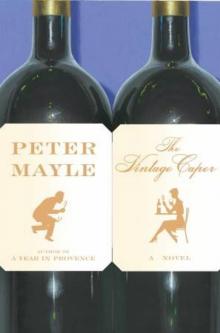
Toujours provence, p.17
Toujours Provence,
p.17



We eat better than we used to, and probably more cheaply. It is impossible to live in France for any length of time and stay immune to the national enthusiasm for food, and who would want to? Why not make a daily pleasure out of a daily necessity? We have slipped into the gastronomic rhythm of Provence, taking advantage of the special offers provided by nature all through the year: asparagus, tiny haricots verts barely thicker than matchsticks, fat feves, cherries, aubergines, courgettes, peppers, peaches and apricots and melons and grapes, blette, wild mushrooms, olives, truffles – every season brings its own treat. With the expensive exception of the truffle, nothing costs more than a few francs a kilo.
Meat is a different matter, and butchers' prices can make the visitor wince. Provence is not cattle country, and so the Englishman in search of his roast beef on Sunday had better take his cheque book and be prepared for disappointment, because the beef is neither cheap nor tender. But lamb, above all from the area round Sisteron where the sheep season themselves with herbs, has a taste that it would be a crime to disguise with mint sauce. And every part of the pig is good.
Even so, we now eat less meat. An occasional appellation contrôlée chicken from Bresse, the wild rabbits that Henriette brings in the winter, a cassoulet when the temperature drops and the Mistral howls round the house – meat from time to time is wonderful. Meat every day is a habit of the past. There is so much else: fish from the Mediterranean, fresh pasta, limitless recipes for all those vegetables, dozens of breads, hundreds of cheeses.
It may be the change in our diet and the way it is cooked, always in olive oil, but we have both lost weight. Only a little, but enough to cause some surprise to friends who expect us to have developed the ballooning embonpoint – the stomach on stilts – that sometimes grows on people with good appetites who have the luck to eat in France.
Through no deliberate intention of our own, we also take more exercise. Not the grim contortions promoted by gaunt women in leotards, but the exercise which comes naturally from living in a climate that allows you to spend eight or nine months of the year outdoors. Discipline has nothing to do with it, apart from the small disciplines of country life – bringing logs in for the fire, keeping the weeds down and the ditches clear, planting, pruning, bending and lifting. And, every day in every kind of weather, walking.
We have had people to stay who refuse to believe that walking can be hard exercise. It's not dramatic effort, not immediately punishing, not fast, not violent. Everybody walks, they say. You can't call that exercise. Eventually, if they insist, we take them out for a stroll with the dogs.
For the first ten minutes the going is flat, along the footpath at the bottom of the mountain, easy and undemanding. Pleasant to get a little fresh air and a view of Mont Ventoux in the distance. But exercise? They're not even short of breath.
Then we turn and go up the track leading to the cedar forest that grows along the spine of the Lubéron. The surface changes from sandy soil cushioned with pine needles to rocks and patches of scree, and we begin to climb. After five minutes, there are no more condescending remarks about walking being an old man's exercise. After ten minutes, there are no remarks at all, only the sound of increasingly heavy breathing, punctuated by coughing. The track twists around boulders and under branches so low you have to bend double. There is no encouraging glimpse of the top; the view is limited to a hundred yards or so of narrow, stony, steeply inclined track before it disappears round the next outcrop of rock. If there is any breath to spare, there might be a curse as an ankle turns on the shifting scree. Legs and lungs are burning.
The dogs pad on ahead, with the rest of us strung out behind them at irregular intervals, the least fit stumbling along with their backs bent and their hands on their thighs. Pride usually prevents them from stopping, and they wheeze away stubbornly, heads down, feeling sick. They will never again dismiss walking as non-exercise.
The prize when you reach the top is to find yourself in a silent, extraordinary landscape, sometimes eerie, always beautiful. The cedars are magnificent, and magical when they are draped with great swags of snow. Beyond them, on the south face of the mountain, the land drops away sharply, grey and jagged, softened by the thyme and box that seem to be able to grow in the most unpromising wrinkle of rock.
On a clear day, when the Mistral has blown and the air shines, the views towards the sea are long and sharply focused, almost as if they have been magnified, and there is a sense of being hundreds of miles away from the rest of the world. I once met a peasant up there, on the road the forest service made through the cedars. He was on an old bicycle, a gun slung across his back, a dog loping beside him. We were both startled to see another human being. It is normally less busy, and the only sound is the wind nagging at the trees.
The days pass slowly but the weeks rush by. We now measure the year in ways that have little to do with diaries and specific dates. There is the almond blossom in February, and a few weeks of pre-spring panic in the garden as we try to do the work we've been talking about doing all winter. Spring is a mixture of cherry blossom and a thousand weeds and the first guests of the year, hoping for sub-tropical weather and often getting nothing but rain and wind. Summer might start in April. It might start in May. We know it's arrived when Bernard calls to help us uncover and clean the pool.
Poppies in June, drought in July, storms in August. The vines begin to turn rusty, the hunters come out of their summer hibernation, the grapes have been picked and the water in the pool nips more and more fiercely until it becomes too cold for anything more than a masochistic plunge in the middle of the day. It must be the end of October.
Winter is filled with good resolutions, and some of them are actually achieved. A dead tree is cut down, a wall is built, the old steel garden chairs are repainted, and whenever there is time to spare we take up the dictionary and resume our struggle with the French language.
Our French has improved, and the thought of spending an evening in totally French company is not as daunting as it used to be. But, to use the words that were so often used in my school reports, there is considerable room for improvement. Must try harder. And so we inch our way through books by Pagnol and Giono and de Maupassant, buy Le Provençal regularly, listen to the machine-gun delivery of radio newsreaders and attempt to unravel the mysteries of what we are constantly being told is a supremely logical language.
I think that is a myth, invented by the French to bewilder foreigners. Where is the logic, for instance, in the genders given to proper names and nouns? Why is the Rhône masculine and the Durance feminine? They are both rivers, and if they must have a sex, why can't it be the same one? When I asked a Frenchman to explain this to me, he delivered a dissertation on sources, streams and floods which, according to him, answered the question conclusively and, of course, logically. Then he went on to the masculine ocean, the feminine sea, the masculine lake and the feminine puddle. Even the water must get confused.
His speech did nothing to change my theory, which is that genders are there for no other reason than to make life difficult. They have been allocated in a whimsical and arbitrary fashion, sometimes with a cavalier disregard for the anatomical niceties. The French for vagina is vagin. Le vagin. Masculine. How can the puzzled student hope to apply logic to a language in which the vagina is masculine?
There is also the androgynous lui waiting to ambush us at the threshold of many a sentence. Normally, lui is him. In some constructions, lui is her. Often, we are left in the dark as to lui's gender until it is made known to us some time after he or she has been introduced, as in: ‘Je lui ai téléphoné’ (I called him), ‘mais elle était occupée’ (but she was busy). A short-lived mystery, possibly, but one which can trip up the novice, particularly when lui's first name is also a mixture of masculine and feminine, such as Jean-Marie or Marie-Pierre.
And that is not the worst of it. Strange and unnatural events take place every day within the formalities of French syntax. A recent newspaper article, reporting on the marriage of the rock singer Johnny Hallyday, paused in its description of the bride's frock to give Johnny a pat on the back. ‘Il est,’ said the article, ‘une grande vedette.’ In the space of a single short sentence, the star had undergone a sex change, and on his wedding day too.
It is perhaps because of these perplexing twists and turns that French was for centuries the language of diplomacy, an occupation in which simplicity and clarity are not regarded as being necessary, or even desirable. Indeed, the guarded statement, made fuzzy by formality and open to several different interpretations, is much less likely to land an ambassador in the soup than plain words which mean what they say. A diplomat, according to Alex Dreier, is ‘anyone who thinks twice before saying nothing’. Nuance and significant vagueness are essential, and French might have been invented to allow these linguistic weeds to flourish in the crevices of every sentence.
But it is a beautiful, supple and romantic language, although it may not quite deserve the reverence that inspires a course of French lessons to be described as a ‘cours de civilisation' by those who regard it as a national treasure and a shining example of how everyone should speak. One can imagine the dismay of these purists at the foreign horrors that are now creeping into everyday French.
The rot probably started when le weekend slipped across the Channel to Paris at about the same time that a night-club owner in Pigalle christened his establishment Le Sexy. Inevitably, this led to the naughty institution of le weekend sexy, to the delight of Parisian hotel owners and the despair of their counterparts in Brighton and other less erotically blessed resorts.
The invasion of the language hasn't stopped in the bedroom. It has also infiltrated the office. The executive now has un job. If the pressure of work becomes too much for him, he will find himself increasingly stressé, perhaps because of the demands of being un leader in the business jungle of le marketing. The poor, overworked wretch doesn't even have time for the traditional three-hour lunch, and has to make do with le fast-food. It is the worst kind of Franglais, and it goads the elders of the Académie Française into fits of outrage. I can't say I blame them. These clumsy intrusions into such a graceful language are scandaleux; or, to put it another way, les pits.
The gradual spread of Franglais is helped by the fact that there are many fewer words in the French vocabulary than in English. This has its own set of problems, because the same word can have more than one meaning. In Paris, for instance, ‘je suis ravi’ will normally be taken to mean ‘I am delighted.’ In the Café du Progrés in Ménerbes, however, ravi has a second, uncomplimentary translation, and the same phrase can mean ‘I am the village idiot.’
In order to disguise my confusion and to avoid at least some of the many verbal booby-traps, I have learned to grunt like a native, to make those short but expressive sounds – those sharp intakes of breath, those understanding clickings of the tongue, those mutters of beh oui – that are used like conversational stepping stones in between one subject and the next.
Of all these, the most flexible and therefore most useful is the short and apparently explicit phrase ah bon, used with or without a question mark. I used to think this meant what it said, but of course it doesn't. A typical exchange, with the right degree of catastrophe and gloom, might go something like this:
‘Young Jean-Pierre is in real trouble this time.’
‘Oui?’
‘Beh oui. He came out of the café, got in his car, ran over a gendarme – completely écrasé – drove into a wall, went through the windscreen, split his head open and broke his leg in fourteen places.’
‘Ah bon.’
Depending on inflection, ah bon can express shock, disbelief, indifference, irritation or joy – a remarkable achievement for two short words.
Similarly, it is possible to conduct the greater part of a brief conversation with two other monosyllables – ça va – which mean literally ‘it goes’. Every day, in every town and village around Provence, acquaintances will meet on the street, perform the ritual handshake and deliver the ritual dialogue:
‘Ça va?’
‘Oui. Ça va, ça va. Et vous?’
‘Bohf, ça va.’
‘Bieng. Ça va alors.’
‘Oui, oui. Ça va.’
‘Allez. Au 'voir.’
‘Au 'voir.’
The words alone do not do justice to the occasion, which is decorated with shrugs and sighs and thoughtful pauses that can stretch to two or three minutes if the sun is shining and there is nothing pressing to do. And, naturally, the same unhurried, pleasant acknowledgement of neighbourhood faces will be repeated several times in the course of the morning's errands.
It is easy to be misled, after a few months of these uncomplicated encounters, into believing that you are beginning to distinguish yourself in colloquial French. You may even have spent long evenings with French people who profess to understand you. They become more than acquaintances; they become friends. And when they judge the moment is ripe, they present you with the gift of friendship in spoken form, which brings with it an entirely new set of opportunities to make a fool of yourself. Instead of using vous, they will start addressing you as tu or toi, a form of intimacy that has its own verb, tutoyer.
The day when a Frenchman switches from the formality of vous to the familiarity of tu is a day to be taken seriously. It is an unmistakable signal that he has decided – after weeks or months or sometimes years – that he likes you. It would be churlish and unfriendly of you not to return the compliment. And so, just when you are at last feeling
reasonably comfortable with vous and all the plurals that go with it, you are thrust headlong into the singular world of tu. (Unless, of course, you follow the example of ex-President Giscard d'Estaing, who apparently addresses even his wife as vous.)
But we stumble along, committing all kinds of sins against grammar and gender, making long and awkward detours to avoid the swamps of the subjunctive and the chasms in our vocabularies, hoping that our friends are not too appalled at the mauling we give their language. They are kind enough to say that our French doesn't make them shudder. I doubt that, but there is no doubting their desire to help us feel at home, and there is a warmth to everyday life that is not just the sun.
That, at least, has been our experience. It obviously isn't universal, and some people either don't believe it, or even seem to resent it. We have been accused of the crime of cheerfulness, of turning a blind eye to minor problems, and of deliberately ignoring what is invariably described as the dark side of the Provençal character. This ominous cliché is wheeled out and festooned with words like dishonest, lazy, bigoted, greedy and brutal. It is as if they are peculiarly local characteristics which the innocent foreigner – honest, industrious, unprejudiced and generally blameless – will be exposed to for the first time in his life.
It is of course true that there are crooks and bigots in Provence, just as there are crooks and bigots everywhere. But we've been lucky, and Provence has been good to us. We will never be more than permanent visitors in someone else's country, but we have been made welcome and happy. There are no regrets, few complaints, many pleasures.
Merci, Provence.
Peter Mayle, Toujours Provence