The ants are coming, p.1
The Ants are Coming,
p.1


03-10-2024
Converted from new scan
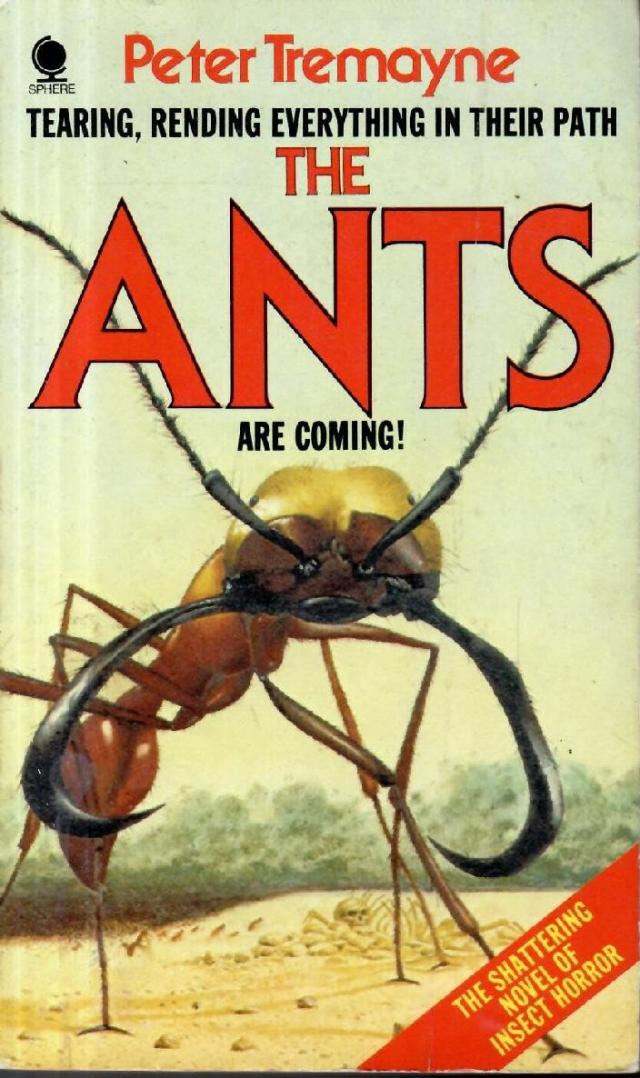
KILLER-ARMY ON THE MOVE .
Jane had to stop the scream that welled in her throat. Martinez was slumped over the wheel. His hands still grasped it, grasped it with such fierceness that the skin was taut enough for the bones of his knuckles to almost pierce through. His eyes were still wide open and on his face was frozen an expression of hideous anguish. His lips had been so chewed that they were lacerated and bloody. But the face was a death mask.
It was then that Jane noticed the lower half of his body. Nausea swept in waves through her body and she had to turn away to give vent to her feelings. The bottom of Martinez’ legs appeared to have been eaten away. The flesh was mangled and bloody and in some places the bones stood through glistening white.
Only some fierce determination had kept the old man at the wheel of his belovedFalcao until he died where he stood …
Also by Peter Tremayne in Sphere Books
THE VENGEANCE OF SHE
The Ants
PETER TREMAYNE
SPHERE BOOKS LIMITED
30/32 Gray’s Inn Road, London WC1X 8JL
First published in Great Britain by Sphere Books Ltd 1979
Copyright © Peter Tremayne 1979
sphere
books
This book is sold subject to the condition that
it shall not, by way of trade or otherwise, be lent,
re-sold, hired out or otherwise circulated without
the publisher’s prior consent in any form of
binding or cover other than that in which it is
published and without a similar condition
including this condition being imposed on the
subsequent purchaser
Set in VIP Plantin
Printed in Great Britain by
Hazell Watson & Viney Ltd
Aylesbury, Bucks
.
.
For Tom and Elsie Charles in gratitude.
How far that little candle throws his beams!
So shines a good dead in a naughty world.
William Shakespeare, Merchant of Venice Act V.
-c. -
* ■ .-V
•;W ; ;> ! , M ’■
‘f 4* i? ? V ‘
■v • ‘ -A” • ■
CHAPTER ONE
The forest was strangely and disturbingly silent.
Tamaia the hunter paused beneath a tall hardwood camioa tree in a small clearing and peered about him suspiciously. To the forest-bred, silence means danger. All the usual background sounds, which the caraibas or European would take for granted or not even notice, were missing. Tamaia could not hear the scampering chatter of the small red-fur howler monkeys which usually screeched warnings of man’s presence and often made a hunter’s life hard to bear; he could not hear the distant bark of some hungry jaguar in search of prey; nor could he hear the varied bird songs or the tell-tale rustle of the undergrowth that would mark the passage of a deer, a capybaras or wild pig or even some smaller animal such as an armadillo or an anteater. Even the very wind itself seemed to have paused in its whispering passage through the topmost boughs of the great primeval rain forest.
The silence was complete.
Tamaia raised one hand to finger his magic charm, a coloured stone that hung on a thong of gut around his neck. His other hand gripped his tacape, a heavy wood cudgel, more tightly.
He was no coward but the forest silence was unnerving. He had only once before heard a silence faintly approaching this completeness. When he was a young boy he had been caught in the path of a forest fire. The animals had fled but the silence which they had left had been broken by the crash and crackling of the approaching flames. No, on reflection, this silence was a new experience for Tamaia.
He drew himself up to his full five feet. Tamaia was of the Trumai tribe and tall by their standards. His body gleamed a coppery bronze and he wore his jet black hair long. He was clad only in an api, a string of vegetable fibre which wrapped around his penis and then continued upward in loose spirals to encircle his neck before returning again in
CHAPTER I
The forest was strangely and disturbingly silent.
Tamãia the hunter paused beneath a tall hardwood camioa tree in a small clearing and peered about him suspiciously. To the forest-bred, silence means danger. All the usual background sounds, which the caraibas or European would take for granted or not even notice, were missing. Tamãia could not hear the scampering chatter of the small red-fur howler monkeys which usually screeched warnings of man’s presence and often made a hunter’s life hard to bear; he could not hear the distant bark of some hungry jaguar in search of prey; nor could he hear the varied bird songs or the tell-tale rustle of the undergrowth that would mark the passage of a deer, a capybaras or wild pig or even some smaller animal such as an armadillo or an anteater. Even the very wind itself seemed to have paused in its whispering passage through the topmost boughs of the great primeval rain forest.
The silence was complete.
Tamãia raised one hand to finger his magic charm, a coloured stone that hung on a thong of gut around his neck. His other hand gripped his tacapex, a heavy wood cudgel, more tightly.
He was no coward but the forest silence was unnerving. He had only once before heard a silence faintly approaching this completeness. When he was a young boy he had been caught in the path of a forest fire. The animals had fled but the silence which they had left had been broken by the crash and crackling of the approaching flames. No, on reflection, this silence was a new experience for Tamãia.
He drew himself up to his full five feet. Tamãia was of the Trumai tribe and tall by their standards. His body gleamed a coppery bronze and he wore his jet black hair long. He was clad only in an api, a string of vegetable fibre which wrapped around his penis and then continued upward in loose spirals to encircle his neck before returning again in loose spirals to its point of departure. His only other adornment was his charm, bought from a pajé, an old witchdoctor, for a small bag of patacat, a variety of round bean much prized among the Trumai. Usually he went abroad in the forest with a short spear, which he cast from a sling, but today he had come from his village bearing only his cudgel for he was not hunting.
Reports had reached the Trumai that the Igaranha, a fearful, malevolent spirit, was loose in the jungle and eating up all before it. The fearful spirit had been roused, it was said, because a great and oddly coloured bird, in whose gigantic body strange men flew, had roared down out of the sky, crashing into the forest and destroying the trees and causing great fires. The great bird lay dead, its body broken into many parts. But the bird had awoken the Igaranha who was now angry with the world. The tribal elders had ordered Tamãia, who was the bravest warrior and greatest hunter of the tribe, to go forth and ascertain whether the reports were true and whether the evil spirit of the Igaranha could be propitiated by suitable sacrifice.
As Tamãia had gone further and further into the great rain forests the sounds of nature had gradually died. Only once had he seen a living creature in the past half hour and that was only Urubu, the bald, black Brazilian vulture.
Now the silence was so complete that Tamãia shuddered in apprehension. Perhaps he was standing in the very presence of the Igaranha himself? He peered about fearfully, gripping both charm and cudgel in tight fists.
Tamãia ran the tip of his tongue around his dry lips and coughed gently to ease the constriction of his throat.
“O Igaranha!” he cried, his voice fading into the gloom of the forest. Tamãia waited a while, all the time peering into the darkness of the trees, at the maze of blue-green undergrowth with its riot of multi-coloured flowers. Still there was an uncanny silence.
“O Igaranha, if your children, the Trumai, have offended you, tell me how we may make amends. I, your servant, Tamãia, will convey your wishes to the council of elders.”
But there was no answer from the Igaranha.
Mentally, Tamãia prayed for protection to the spirit of Jakui, his own personal guardian and the chief of all spirits who live at the bottom of the rivers and lagoons.
What should he do? Go on? Move further into the forest in his search for the Igaranha? Or should he go back to his village and tell them that the Igaranha had not deigned to talk with him? Hesitantly, he moved further into the clearing.
Suddenly he was aware of a sound; a sound that he could not place, that he had never heard before. It was a high pitched sound, like the voices of young girls singing. No, it was pitched on a higher key than that. It was a tinkling sound like the tiny bells that the caraibas’ religious men and women used in their ceremonies. Tamãia frowned. The missionaries had warned the Trumai of terrible consequences if they did not turn from their gods and worship the caraibas’ god Cristo. The Trumai had listened politely to the missionaries, agreed with them, and after they had left had gone on worshipping the gods of the forest as they had done for centuries. Were the caraibas returning with their god Cristo to punish them?
Tamãia had no sooner registered the thought than he was aware of the fact that the high pitched sound was unpleasant in his ears. It was penetrating beyond his ears, eating into his temples, into his head, into his very brain, like a million tiny splinters of wood. Tiny, sharp prickings. He gave a small moan and reached a hand up to massage his brow.
The sound was all round him now, growing louder and louder, hurting his head more and more.
Tamãia was frightened. He was co
nvinced that the caraibas’ god Cristo had come to punish him even as the religious men of the caraibas had foretold. He called loudly on Jukui to come to his protection and, in spite of the pain in his head, he straightened his body and raised his tacape in a defensive attitude.
Around the edges of the clearing the undergrowth swayed and rustled.
Tamãia’s eyes widened in horror. He stepped backward involuntarily and then, after a second’s pause, he turned to flee. But the noise was all around him. Angry! Malevolent! Without pity! He was cut off. In a split second Tamãia the hunter saw the inevitability of his death. He raised his head and gave one long anguished cry…
“Jukui!”
A few moments later there lay in the clearing a glistening white human skeleton. There was nothing to identify who it had been save for a coloured stone hung on a piece of gut around its neck and, by one skeletonal hand, a cudgel.
The clearing was deserted.
The forest was strangely and disturbingly silent.
CHAPTER II
Everyone knew Martinez’ boat, the old Falcão or Falcon. At least all those who lived along the banks of the River Xingu below Von Martius Falls as far south as Morena where the river divided into a multitude of tributaries and lagoons across the flat region of tall treed, primeval rain forests which formed the northern part of the Matto Grosso, the largest of the twenty-two states which made up the Federal Republic of Brazil.
Martinez and his boat were quite an institution. Even the oldest settler could not remember a time when he had not heard the sound of three shrill shrieks from a steam whistle heralding the appearance of the Falcão, wallowing around some bend in the river, loaded with goods for trade or with passengers who would use the boat as the only means of transport through the inaccessible and little explored region. From the indian tribes of the Xingu to the Brazilian settlers, Martinez provided the link with the outside world.
The territory along the Xingu was sparsely populated by white settlers or, indeed, with indigenous indians. Many of the tribes had never even seen a white man. If the rest of Brazil regarded the Matto Grosso as remote, then this was the remotest region of the Matto Grosso; a region of thick inaccessible forests much of which had never been explored at all. A forward thinking Brazilian Government had, in 1961, designated the entire area of eleven thousand five hundred square miles as a national park in which to form a natural reservation as evidence of the state of Brazil at the time of its discovery by Europeans, to protect the fauna and flora of the area and the indigenous tribes of the region, offering them a chance to defend themselves from premature and harmful contact with white Brazilian society.
Apart from the indians who constituted some fourteen known tribes the handful of white residents consisted of government officials, a few traders like Martinez, teachers and missionaries. There were also a few hunters, with special licence and strict instructions on keeping an ecological balance. But dotted sparsely around the territory were several big estates which had been carved out of the jungle years before the Xingu area became a “reserved” territory and for which the Brazilian Government had not been able to decide on a compensation scheme for their white owners. And so these estates had been left, usually producing rubber, cocoa or manganese. It had been easy to ignore them rather than come to grips with the problem.
Once a month, at least, Martinez and the Falcão put in at Morena where the prefeitos office was, which governed the district. Then he would head south towards the more inhospitable regions to trade, to deliver goods to the people crazy enough to live downriver. He worked his boat aided by two Xingu indians whom — unable to pronounce their real names — he called Primus and Secundus.
On this trip Martinez had only two passengers to transport down river…and one of those was a girl. Martinez spat reflectively in the shelter of his wheelhouse. Crazy people, both of them. Louco! Only crazy people would go voluntarily into the forests of the Xingu.
“The forest is beautiful, isn’t it?”
Captain Orlando Villas paused in the act of lighting his cheroot and gazed quizzically at the eager face of the young woman who stood by his side at the rail of the old river boat. He followed the appreciative gaze of her grey-blue eyes as they took in the tall trees of the great, impenetrable rain forests on either bank. Villas let his eyes return to the smiling face of the girl, lit his cheroot and inhaled with a gentle sigh.
“Sim, senhorinha,” he agreed, “It is very beautiful but also very ugly.”
The word “repulsivo” in Portuguese conveyed many things — the brutal savagery of nature as well as its magnificence.
The girl nodded slightly.
“I know what you mean, Captain, but it is beautiful nevertheless.”
The girl spoke Portuguese with an accent that Villas found hard to place. It was certainly not a north American accent and yet the girl spoke English as her mother tongue, of that he was sure.
Physically, she could certainly be an Americanos. She was tall with a graceful figure (Villas breathed a soft “beleza”) although the waist, he reflected, was perhaps low and the hips were rather broad like many of Nordic origin. Her ash-blonde hair and grey-blue eyes contrasted vividly with the deep tan of an unblemished skin. The eyes were very attractive though they were set wide apart and had a knack of staring unblinkingly at you as if with an expression of total innocence. The mouth was a generous one, dimpled in the corners so that any expression other than a smile did not sit well on her features. Her clothes, too, were suggestive of an Americanos. Tight white shorts, displaying well shaped legs, a white safari jacket worn loosely over a similarly coloured blouse. White socks came below her knees and on her feet were sensible boots. Villas found the policeman in him deciding that the girl had been in the jungle before for the boots had obviously seen previous service. Yes, he pondered, she could pass for an Americanos but for the accent.
“The senhorinha is not American?” he enquired politely.
“English,” smiled the girl and added, unnecessarily, “from England.”
“Ah,” a smile of understanding crept round the young captain’s moustachioed lip. “You must be the Senhorinha Sewell.”
Jane Sewell only just recognised her name from Villas’ attempted pronunciation.
“That’s right. But how…?”
“Permit me,” Captain Villas gave a half bow, “I am Captain Orlando Villas of the prefeitos at Morena. This,” he swept a hand towards the forest, “is now my territory. I am the police commander of the area.”
Jane frowned.
“But there was another officer, a lieutenant…”
Villas pulled a face.
“Lieutenant Alfonso de Beja. Yes, he was in charge of the area. Did you know him?”
“Slightly, but what happened to him?”
“He was on a routine patrol in the country of the Trumai about a month ago. He has disappeared.”
“Disappeared? But how?”
Villas shrugged.
“Who can tell, senhorinha? A jaguar? A snake? There are many ways to disappear in the jungles of the Matto Grosso.” The girl bit her lip.
“I only met him twice but he seemed so young for such a responsibility.”
“Now I have taken over the territory and it is my job to try to find him, senhorinha.”
The girl gazed at the captain for a moment.
“But how did you know who I was?”
“I have already met your father, Doctor Sewell, não e, is it not so? He told me that he and his daughter, Jane, had been working among the Trumai tribe for some months and that his daughter had gone to the capital, Cuiaba, to send back the results of their findings to England and that she would be returning to join him again soon. You and your father are…what is the word?…ah, yes, anthropologists, não e?”
Jane nodded.