Blood in eden, p.10
Blood in Eden,
p.10
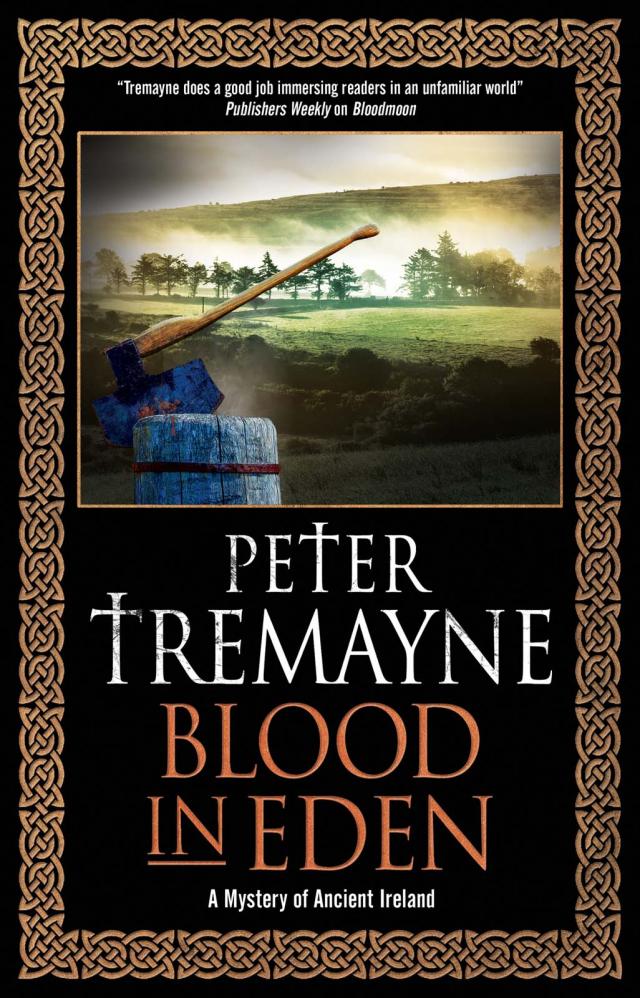


‘Why, the cleaver hidden in the wagon.’
‘Placed under the wagon,’ Fidelma corrected. ‘But by whom?’
‘I understand why you asked whether she had heard anyone near the wagon that night. Unless it was placed there by witchcraft, then she or her husband would have heard it and yet the woman swears she did not hear anything during the night.’
‘Perhaps we will learn more when we question Celgaire.’
Eadulf shrugged. ‘I say that the meat cleaver is the most damning piece of evidence. You saw me even rub a piece of damp cloth over the blade and what came away was traces of blood, showing it had been used recently for cutting into flesh.’
Fidelma hastened to challenge him. ‘Now if I were opposing that evidence I would say – yes, a cleaver was used in the killing of Adnán. Blood was found on this one? Can you prove that the cleaver was used by Celgaire? And if he did use it, why did he kill Cainnech with the reaping hook? And if he did so, why did he not also hide that weapon in his wagon?’
‘Well, one thing is for certain, the itinerants had no meat to butcher,’ replied Eadulf hotly. ‘Therefore, where did the blood on the cleaver come from? Add to that the fact it was hidden in the wagon … well, to my mind – quod erat demonstrandum.’
Fidelma smiled sadly. ‘But Fial denies that they owned a cleaver. I do not think that we have proved anything. You are astute, Eadulf. Think about it: there were better hiding places if one was serious. We now learn that this Celgaire was a man of some intelligence before he was exiled and dropped in social status. I think he would have hidden the weapon with more care.’
‘It is true the recess was open and someone looking, as I was, could have easily found it,’ replied Eadulf. ‘That is not to say it exonerates Celgaire. Don’t forget, we have the evidence of Lúbaigh.’
‘I am not forgetting that,’ Fidelma returned. ‘However, I think you have overlooked something. Let …’
The door burst open with an abruptness which startled them. On the threshold stood the scowling figure of Brother Gadra.
‘Last night you said you wanted to speak to me further. I am not one who is to be placed at the beck and call of anyone. I am a busy servant of the Lord.’
Fidelma gazed at him thoughtfully without responding for a moment. Only Eadulf noticed the humour in the corner of her mouth.
‘I had no idea that you were so busy,’ she said solemnly. ‘What occupies your valuable time this day?’
‘I am to perform the funeral ceremony of the murdered family of Adnán tonight. Taithlech the merchant has asked me to do so. I am more concerned with the fact that you are proving intent on letting the murderer escape just retribution!’
‘I am not sure why the procedures of the law should be of concern to you,’ replied Fidelma evenly. ‘I believe you are a religieux and part of that duty is to perform the rights of the New Faith even though you follow a different path to what is usually followed in the Five Kingdoms. I presume that the surviving family of Adnán, his cousin, has agreed this with you?’
Brother Gadra’s scowl increased. ‘Tadgán? A rude unbeliever. He has not contacted me but I am told by Taithlech that he speaks for his cousin, the farmer. Tadgán is no supporter of mine nor believer in the true God. However, I respect Taithlech and so I will do it.’
‘I am told that you were treated kindly by Adnán when you arrived in this village. That shelter and hospitality were provided by him. I would have thought it was simple courtesy to repay it to the memory of the man and his family.’ As a fuming Brother Gadra was summoning up a reply, Fidelma held up her hand. ‘Finally, Brother Gadra, I am not intent on letting the murderer of Adnán and his family escape … whoever that person may be. Nor am I intent on letting injustice be done. What I am intent on is letting this matter be considered under the law system of the Five Kingdoms.’
‘I demand he be punished under the rules and laws of the True God Whom I represent,’ snapped Brother Gadra.
‘Tell me, Brother Gadra, and I understand you have been absent a long time in Gaul so have probably forgotten the laws of your homeland, what makes you so certain of the facts in this matter? If you have evidence, then it is your duty to present it to me as dálaigh. What makes you demand retribution before someone has been tried? Even the laws you claim to represent do not say “execute first and then have a trial afterwards”!’
‘Apud palet conscidisti … what need of a trial when the case is clear cut?’
‘Because we have a system of laws – and without laws we have no civilisation.’
Brother Gadra made an explosive noise with his lips. ‘The evidence is clear and we should proceed. De minimis non curat lex.’
‘So you think we waste time and that the law should not concern itself with small matters when everyone is so concerned with retribution for the murder of someone they respected? Tell me, what do you know of our laws? Or do you even remember them?’
‘I only know that they are shackles of our pagan past and the sooner they are dispensed with, the better.’
‘I ask again for your authority.’
‘I am an advocate of the New Faith. I am not without qualification and influence.’
Fidelma returned his belligerent gaze without a change of expression.
‘All I know is that you are untutored, or have forgotten the laws of the Five Kingdoms,’ she said mildly. ‘Your behaviour yesterday was a demonstration of that fact. And now you stand before me trying to defend your actions.’
Brother Gadra’s mouth tightened as he attempted to control his anger. ‘I am qualified in the law that supersedes all laws.’
‘You mean the Canon Laws that some misguided followers of the New Faith have rewritten as what they call the Penitentials?’
Brother Gadra made a cutting gesture with the edge of his right hand.
‘In the Five Kingdoms I would hold the sixth grade of the Orders of Wisdom. I am Saoi Canóine and have full knowledge of the Canon wisdom of Rome, of the history of the law and faith in the sacred place where it is to be found – in the holy scriptures for all to read as translated by the Blessed Eusebius Hieronymus!’
Fidelma grimaced. ‘For all to read? I doubt whether you’ll find everyone in the Five Kingdoms able to read the Latin of Eusebius any more than the original Greek texts or even the Aramaic or the Hebrew of the Old Testament. Although those who go to the colleges here are expected to have knowledge of the same.’
Brother Gadra was really angry now.
‘My knowledge is based on that of the greatest book available to us, the Cuilmen, even to the smallest book called the Ten Words, the Commandments which God gave to Moses. That is all we need to know in life,’ he thundered.
Fidelma was now losing patience.
‘I suggest you attend to your religious duties, Brother Gadra, and leave the dispensation of the law to those who are appointed to do so. I remind you that, in spite of the arguments from the various councils of bishops and abbots, you still fall under the laws of the Five Kingdoms, as do all the churches and abbeys in this land, for their rights were granted to the religious under the law of the Brehons and not under the laws of Rome or from wherever it is you claim your authority. The bishops and abbots are answerable to the Provincial Kings and to the High King for their conduct and for the conduct of their followers. And so, as a dálaigh and legal adviser to the King of Muman, my brother, I now tell you to leave well alone or depart from this place, preferably out of this kingdom.’
Eadulf stood amazed as Fidelma delivered this speech in such a cold, incisive way that did not disguise her rising anger. He had never seen her in such a fury. Even Brother Gadra looked shaken. Then, after a moment or two, he composed himself, squaring his shoulders.
‘You will have cause to regret this,’ he threatened. ‘I shall see that your arrogance, lady, is brought to the notice of the Chief Bishop.’
‘And you might also see that it is brought before the notice of the Chief Brehon of the Five Kingdoms,’ she shot back. ‘You will find him at the High King’s palace at Tara where I am sure that he, the Chief Bishop and High King will be more than interested in what you have to say, especially after they hear of the events of yesterday. Eadulf, would you show Brother Gadra how to open the door that is behind him?’
Before Eadulf could move, Brother Gadra turned and stormed out, slamming the door behind him.
Eadulf shook his head reprovingly at Fidelma. ‘I would say he is a vengeful person,’ he commented. ‘So take care.’
‘Vengeful or not, I know the law,’ she replied quietly. ‘And I think, from what he has said that I know more of Eusebius Hieronymus’ translation of the Holy Book and its meanings than he does. He has little of the spirit of our Old Faith and even less of the New Faith.’
‘Let us hope he takes the advice and leaves here,’ sighed Eadulf. ‘I fear he will continue to be a disruptive influence.’
‘Well, let us get back to the matter in hand. We need to continue on and interrogate Celgaire. Has Fethmac returned yet?’
‘I thought I saw him speaking with his wife Ballgel outside. I’ll go to look.’
‘Well, tell them I am now ready to speak with Celgaire.’
When Eadulf returned with Fethmac and the prisoner, Fidelma was seated in her former position on one side of the kitchen table, as she had been when she had interrogated Fial. She indicated for Celgaire to sit in the same chair that his wife had sat in. Eadulf and Fethmac resumed their own seats at the table. There was one difference to Fidelma’s previous interrogation. To one side of the table she had now placed a number of inconsequential items as if they had been shifted there to make space for her to use the rest of it for her interrogation purposes. But Eadulf noticed, lying among them, the piece of cloth in which the cleaver found under Celgaire’s wagon had been wrapped. Also on the table was the flat leather bolg, or satchel, in which were the pieces of parchment they had found.
Eadulf’s eyes flickered to Celgaire. The man appeared to stare at the leather satchel in recognition before returning his gaze to Fidelma.
‘Now, Celgaire,’ she began, ‘you realise that I am asking you questions as a dálaigh and therefore I wish you to take an oath that you will answer the questions truthfully to the best of your knowledge.’
There was no hesitation before the man replied he would do so. He had regained his voice and now spoke in the strong accents that they associated with Ulaidh. So having dispensed with the formality Fidelma invited him, firstly, to tell her who he was and where he came from. Prompted by her now and again, Celgaire repeated, with only slight variation, the story that his wife had told her.
‘I was born and lived my life in Ulaidh and served as a labourer and man-at-arms on the estate of Blathmac, as had my father and his father before him. Being so, I was of the rank of sen-cléithe.’
‘But now you are reduced in rank to that of doir-fuidir. Why?’
‘Because I refused to attend the hosting when Blathmac sought to attack the abbey of Magh-Bhile for not paying tribute to the Dál Fiatach, of which he is prince. I was told by my father that it is a tradition in my family to refuse to fight against a Christian institution – to attack those holding the same Faith as us. My refusal to do so caused the reduction of my status and my exile from the Uí Néill kingdom. So I and my wife became wandering labourers seeking work in other kingdoms.’
‘But what of your origins? You spoke of a tradition not to fight fellow Christians?’
‘My origins?’ Celgaire seemed genuinely puzzled.
‘You have to admit that a person with your colouring, the darkness of your skin, would indicate that your ancestors must have come to this land from another country?’
Celgaire shrugged. ‘The question has been raised before. The story passed down was that my grandfather’s father was a young man come ashore from a trading vessel from Armorica. I only know that we always followed the Faith long before it reached these shores.’
‘Armorica?’ Eadulf could not help but express his surprise. ‘I do not think people with your darkness of skin would be natives to Armorica.’
Fidelma tapped the leather satchel. ‘Do you know of these documents in here?’
‘They were given me by Prince Blathmac’s Brehon when my exile was announced. I have no book learning, so cannot read what is there. All I know is that I am of Ulaidh and that must suffice as to my family’s origin.’
‘Very well. So after your exile was proclaimed, you and your wife journeyed south to this kingdom seeking labouring work. Is that correct?’
‘Correct, lady.’
‘Tell me whom you first approached when you came here.’
He confirmed the same story that Fial had given about the encounter with the farmer Tadgán and the advice of a farmworker to seek out Adnán. He said that Adnán had not been able to offer him work, but had advised him to go north to the area of the Tonnóg. Celgaire spoke of the gifts of milk and small sack of oats. In fact, he told the self-same story as his wife, including the giving of permission to stay in the area by the copse.
When the man had finished, Fidelma sat back in her chair and stared thoughtfully at him for a few moments. Celgaire did not lower his gaze. It was a frank gaze without apparent guile or cunning.
Fidelma sighed and then said, ‘It is all very well, Celgaire, except for one thing.’ She reached to one side, took up the cleaver and placed it before her.
Celgaire stared at it for a moment and then raised his eyes to her face in bewilderment.
‘I don’t understand,’ he said.
‘Have you not seen it before?’ she demanded.
‘I have seen cleavers before. But why do you show me this one?’
Fidelma replied almost flatly, ‘This is the cleaver with which those attacks were carried out. Have you anything further to say about it?’
There was a horrified look on the man’s face as he protested: ‘I have told you, lady, that I did not do this thing that I am accused of. I have told you the truth of what happened. I did not kill anyone, and I have never seen this cleaver before.’
Eadulf had long observed that Fidelma liked to use dramatic pauses to throw witnesses or suspects off-balance. It was a technique she often practised when presenting her cases before the courts. She used the long pause even now.
Then she said: ‘Because, Celgaire of Leth Cathail, the cleaver was found in your wagon; hidden where one was not expected to find it.’
There was a moment’s silence before Celgaire sprang up, knocking his chair over backwards. His face was contorted.
‘Lies! Liar! It is a trick! That cleaver was never mine nor was it ever in my wagon!’
Eadulf and Fethmac had leaped forward and taken a firm grip on his arms, but he was not fighting them. His body was tense but he just stood before Fidelma quivering as if in shock and anger.
‘It is a lie to get me to confess to something I did not do! Lies!’
Fidelma stared at him and then said sharply, ‘Compose yourself, Celgaire.’
Eadulf felt the tension drain from the man’s body and he went suddenly limp. Eadulf just had time to grab the upturned chair and right it, so that the man collapsed back into it rather than dropping to the floor. Even in this state he kept feverishly muttering, ‘Tricks! Lies!’
Fidelma leaned forward and tapped the cleaver with her forefinger.
‘Nevertheless, the fact is that this cleaver was found in the recess under your wagon at the back. We came across it this morning when we were searching the wagon. There is no reason why any of us should lie about this.’
Celgaire tried to regain some composure.
‘No reason except that you want me to take the blame for something I have not done. Just because I am an itinerant, a doir-fuidir without rights, it is easy for you to blame me!’
‘In this matter, Celgaire, you have the same rights as anyone else. You are condemned or exonerated only by the evidence: the evidence alone is the arbiter of your fate. That applies had you been king or bishop; it applies to all from freeman to the fuidir or unfree classes.’
‘But not to me!’ Celgaire replied bitterly. ‘That’s why that religieux tried to hang me yesterday, to get it over with quickly, so that you people would then resume your lives and not be bothered that the real killer has escaped.’
Eadulf felt bound to interrupt. ‘You’ll remember that it was Fidelma here who saved your life yesterday.’
Celgaire reared up. ‘Saved my life for what?’ he said ungratefully. ‘To add this figment of legal authority to my death?’
‘No one is going to die, Celgaire,’ Fidelma said coldly. ‘You are tried by the Fénechus, the laws of the Five Kingdoms.’
‘And you have made up your mind that I am guilty and planted this cleaver in my wagon to satisfy your conscience.’
Fidelma’s eyes were by now a steely blue; all the fiery green seemed to have gone out of them.
‘Believe me, Celgaire of Leth Cathail, my conscience is only satisfied when I know that the evidence which I hear is the truth.’ She sighed, then drummed her fingers on the table for a moment before saying, ‘Fethmac, you and Eadulf may take Celgaire back to Gobánguss’ shed. He will remain there as a prisoner until I have reached a conclusion on this matter.’
As Celgaire rose, he demanded: ‘Where are my wife and baby? What have you done with them? I want to see them.’
‘You will remain separated now until a decision is reached. Be assured that they are being well looked after.’ She gestured for them to remove him, and then sat alone, frowning in thought, turning matters over. It was a while before Eadulf returned and found her. He was alone.
‘I am afraid the magistrate has been intercepted by our friend Brother Gadra.’
Fidelma groaned. ‘If only Enda, or one of my brother’s bodyguards were here, I would have that malicious influence run out of this kingdom forthwith. I am afraid Brother Gadra needs to remember the advice of the Blessed Aurelius Ambrosius, the Bishop of Milan, three centuries ago.’
Eadulf raised his brow in query.
‘Roughly, it translates: when I am in Milan, I do not fast on Saturday; when I am in Rome, I fast on Saturday.’