The preserving machine, p.4
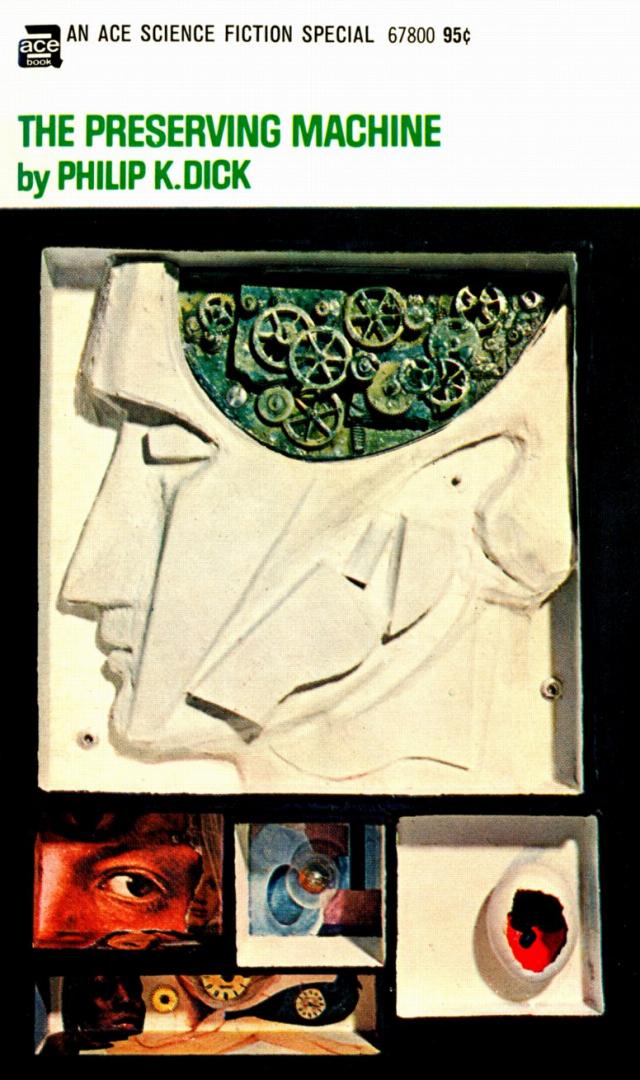
The Preserving Machine,
p.4


Suddenly Wiseman said, “I’m not going to release it.”
“What?” Pinario said. “Why not?”
“I don’t trust it,” Wiseman said. “It’s too complicated for what it actually does.”
“Explain,” Fowler demanded.
“There’s nothing to explain,” Wiseman said. “Here’s this immensely intricate gadget, and all it does is take itself apart and then reassemble itself. There must be more, even if we can’t—”
“It’s therapeutic,” Pinario put in.
Fowler said, “I’ll leave it up to you, Leon. If you have doubts, then don’t release it. We can’t be too careful.” .
“Maybe I’m wrong,” Wiseman said, “but I keep thinking to myself: What did they actually build this for? I feel we still don’t know.”
“And the American Cowboy Suit,” Pinario added. “You don’t want to release that either.”
“Only the game,” Wiseman said. “Syndrome, or whatever it’s called.” Bending down, he watched the soldiers as they hustled toward the citadel. Bursts of smoke, again…activity, feigned attacks, careful withdrawals…
“What are you thinking?” Pinario asked, scrutinizing him.
“Maybe it’s a diversion,” Wiseman said. “To keep our minds involved. So we won’t notice something else.” That was his intuition, but he couldn’t pin it down. “A red herring,” he said. “While something else takes place. That’s why it’s so complicated. We were supposed to suspect it. That’s why they built it.”
Baffled, he put his foot down in front of a soldier. The soldier took refuge behind his shoe, hiding from the monitors of the citadel.
“There must be something right before our eyes,” Fowler said, “that we’re not noticing.”
“Yes.” Wiseman wondered if they would ever find it. “Anyhow,” he said, “were keeping it here, where we can observe it.”
Seating himself nearby, he prepared to watch the soldiers. He made himself comfortable for a long, long wait.
At six o’clock that evening, Joe Hauck, the sales manager for Appeley’s Children’s Store, parked his car before his house, got out, and strode up the stairs.
Under his arm he carried a large flat package, a “sample” that he had appropriated.
“Hey!” his two kids, Bobby and Lora, squealed as he let himself in. “You got something for us, Dad?” They crowded around him, blocking his path. In the kitchen, his wife looked up from the table and put down her magazine.
“A new game I picked up for you,” Hauck said. He unwrapped the package, feeling genial. There was no reason why he shouldn’t help himself to one of the new games; he had been on the phone for weeks, getting the stuff through Import Standards—and after all was said and done, only one of the three items had been cleared.
As the kids went off with the game, his wife said in a low voice, “More corruption in high places.” She had always disapproved of his bringing home items from the store’s stock.
“We’ve got thousands of them,” Hauck said. “A warehouse full. Nobody’ll notice one missing.”
At the dinner table, during the meal, the kids scrupulously studied every word of the instructions that accompanied the game. They were aware of nothing else.
“Don’t read at the table,” Mrs, Hauck said reprovingly.
Leaning back in his chair, Joe Hauck continued his account of the day. “And after all that time, what did they release? One lousy item. We’ll be lucky if we can push enough to make a profit. It was that Shock Troop gimmick that would really have paid off. And that’s tied up indefinitely.”
He lit a cigarette and relaxed, feeling the peacefulness of his home, the presence of his wife and children.
His daughter said, “Dad, do you want to play? It says the more who play, the better.”
“Sure,” Joe Hauck said.
While his wife cleared the table, he and his children spread out the board, counters, dice and paper money and shares of stock. Almost at once he was deep in the game, totally involved; his childhood memories of game-playing swam back, and he acquired shares of stock with cunning and originality, until, toward the conclusion of the game, he had cornered most of the syndromes.
He settled back with a sigh of contentment. “That’s that,” he declared to his children. “Afraid I had a head start. After all, I’m not new to this type of game.” Getting hold of the valuable holdings on the board filled him with a powerful sense of satisfaction. “Sorry to have to win, kids.”
His daughter said, “You didn’t win.”
“You lost,” his son said.
“What?” Joe Hauck exclaimed.
“The person who winds up with the most stock loses,” Lora said.
She showed him the instructions. “See? The idea is to get rid of your stocks. Dad, you’re out of the game.”
“The heck with that,” Hauck said, disappointed. “That’s no kind of game.” His satisfaction vanished. “That’s no fun.”
“Now we two have to play out the game,” Bobby said, “to see who finally wins.”
As he got up from the board, Joe Hauck grumbled, “I don’t get it. What would anybody see in a game where the winner winds up with nothing at all?”
Behind him, his two children continued to play. As stock and money changed hands, the children became more and more animated. When the game entered its final stages, the children were in a state of ecstatic concentration.
“They don’t know Monopoly,” Hauck said to himself, “so this screwball game doesn’t seem strange to them.”
Anyhow, the important thing was that the kids enjoyed playing Syndrome; evidently it would sell, and that was what mattered. Already the two youngsters were learning the naturalness of surrendering their holdings. They gave up their stocks and money avidly, with a land of trembling abandon.
Glancing up, her eyes bright, Lora said, “It’s the best educational toy you ever brought home, Dad!”
UPON THE DULL EARTH
Silvia ran laughing through the night brightness, between the roses and cosmos and Shasta daisies, down the gravel paths and beyond the heaps of sweet-tasting grass swept from the lawns. Stars, caught in pools of water, glittered everywhere, as she brushed through them to the slope beyond the brick wall. Cedars supported the sky and ignored the slim shape squeezing past, her brown hair flying, her eyes flashing.
“Wait for me,” Rick complained, as he cautiously threaded his way after her, along the half familiar path. Silvia danced on without stopping. “Slow down!” he shouted angrily.
“Can’t—we’re late.” Without warning, Silvia appeared in front of him, blocking the path. “Empty your pockets,” she gasped, her gray eyes sparkling. “Throw away all metal. You know they can’t stand metal.”
Rick searched his pockets. In his overcoat were two dimes * and a fifty-cent piece. “Do these count?”
“Yes!” Silvia snatched the coins and threw them into the dark heaps of calla lilies. The bits of metal hissed into the moist depths and were gone. “Anything else?” She caught hold of his arm anxiously. “They’re already on their way. Anything else, Rick?”
“Just my watch.” Rick pulled his wrist away as Silvia’s wild fingers snatched for the watch. “That’s not going in the bushes.”
“Then lay it on the sundial—or the wall. Or in a hollow tree.” Silvia raced off again. Her excited, rapturous voice danced back to him. “Throw away your cigarette case. And your keys, your belt buckle—everything metal. You know how they hate metal. Hurry, we’re late!”
Rick followed sullenly after her. “All right, witch.”
Silvia snapped at him furiously from the darkness. “Don’t say that! It isn’t true. You’ve been listening to my sisters and my mother and—”
Her words were drowned out by the sound. Distant flapping, a long way off, like vast leaves rustling in a winter storm. The night sky was alive with the frantic poundings; they were coming very quickly this time. They were too greedy, too desperately eager to wait. Flickers of fear touched the man and he ran to catch up with Silvia.
Silvia was a tiny column of green skirt and blouse in the center of the thrashing mass. She was pushing them away with one arm and trying to manage the faucet with the other. The churning activity of wings and bodies twisted her like a reed. For a time she was lost from sight.
“Rick!” she called faintly. “Come here and help!” She pushed them away and struggled up. “They’re suffocating me!”
Rick fought his way through the wall of flashing white to the edge of the trough. They were drinking greedily at the blood that spilled from the wooden faucet. He pulled Silvia close against him; she was terrified and trembling. He held her tight until some of the violence and fury around them had died down.
“They’re hungry,” Silvia gasped feebly.
“You’re a little cretin for coming ahead. They can sear you to ash!”
“I know. They can do anything.” She shuddered, excited and frightened. “Look at them,” she whispered, her voice husky with awe. “Look at the size of them—their wingspread. And they’re white, Rick. Spotless—perfect. There’s nothing in our world as spotless as that. Great and clean and wonderful.”
“They certainly wanted the lamb’s blood.”
Silvia’s soft hair blew against his face as the wings fluttered on all sides. They were leaving now, roaring up into the sky. Not up, really—away. Back to their own world whence they had scented the blood. But it was not only the blood—they had come because of Silvia. She had attracted them.
The girl’s gray eyes were wide. She reached up towards the rising white creatures. One of them swooped close. Grass and flowers sizzled as blinding white flames roared in a brief - fountain. Rick scrambled away. The flaming figure hovered momentarily over Silvia and then there was a hollow pop. The last of the white-winged giants was gone. The air, the ground, gradually cooled into darkness and silence.
“I’m sorry,” Silvia whispered.
“Don’t do it again,” Rick managed. He was numb with shock. “It isn’t safe.”
“Sometimes I forget. I’m sorry, Rick. I didn’t mean to draw them so close.” She tried to smile. “I haven’t been that careless in months. Not since that other time, when I first brought you out here.” The avid, wild look slid across her face. “Did you see him? Power and flames! And he didn’t even touch us. He just—looked at us. That was all. And everything’s burned up, all around.”
Rick grabbed hold of her. “Listen,” he grated. “You mustn’t call them again. It’s wrong. This isn’t their world.”
“It’s not wrong—it’s beautiful.”
“It’s not safe!” His fingers dug into her flesh until she gasped. “Stop tempting them down here!”
Silvia laughed hysterically. She pulled away from him, out into the blasted circle that the horde of angels had seared behind them as they rose into the sky. “I can’t help it,” she cried. “I belong with them. They’re my family, my people. Generations of them, back into the past.”
“What do you mean?”
“They’re my ancestors. And some day I’ll join them.”
“You are a little witch!” Rick shouted furiously.
“No,” Silvia answered. “Not a witch, Rick. Don’t you see? I’m a saint.”
The kitchen was warm and bright. Silvia plugged in the Silex and got a big red can of coffee down from the cupboards over the sink. “You mustn’t listen to them,” she said, as she set out plates and cups and got cream from the refrigerator. “You know they don’t understand. Look at them in there.”
Silvia’s mother and her sisters, Betty Lou and Jean, stood huddled together in the living-room, fearful and alert, watching the young couple in the kitchen. Walter Everett was standing by the fireplace, his face blank, remote.
“Listen to me,” Rick said. “You have this power to attract them. You mean you’re not—isn’t Walter your real father?”
“Oh, yes—of course he is. I’m completely human. Don’t I look human?”
“But you’re the only one who has the power.”
“I’m not physically different,” Silvia said thoughtfully. “I have the ability to see, that’s all. Others have had it before me—saints, martyrs. When I was a child, my mother read to me about St. Bernadette. Remember where her cave was? Near a hospital. They were hovering there and she saw one of them.”
“But the blood! It’s grotesque. There never was anything like that.”
“Oh, yes. The blood draws them, lamb’s blood especially. They hover over battlefields. Valkyries—carrying off the dead to Valhalla. That’s why saints and martyrs cut and mutilate themselves. You know where I got the idea?”
Silvia fastened a little apron around her waist and filled the Silex with coffee. “When I was nine years old, I read of. it in Homer, in the Odyssey. Ulysses dug a trench in the ground and filled it with blood to attract the spirits. The shades from the nether world.”
“That’s right,” Rick admitted reluctantly. “I remember.”
“The ghosts of people who died. They had lived once. Everybody lives here, then dies and goes there.” Her face glowed. “We’re all going to have wings! We’re all going to fly. We’ll all be filled with fire and power. We won’t be worms any more.”
“Worms I That’s what you always call me.”
“Of course you’re a worm. We’re all worms—grubby worms creeping over the crust of the Earth, through dust and dirt.”
“Why should blood bring them?”
“Because it’s life and they’re attracted by life. Blood is uisge beatha — the water of life.”
“Blood means death! A trough of spilled blood…”
“It’s not death. When you see a caterpillar crawl into its cocoon, do you think it’s dying?”
Walter Everett was standing in the doorway. He stood listening to his daughter, his face dark. “One day,” he said hoarsely, “they’re going to grab her and carry her off. She wants to go with them. She’s waiting for that day.”
“You see?” Silvia said to Rick. “He doesn’t understand either.” She shut off the Silex and poured coffee. “Coffee for you?” she asked her father.
“No,” Everett said.
“Silvia,” Rick said, as if speaking to a child, “if you went away with them, you know you couldn’t come back to us.”
“We all have to cross sooner or later. It’s all part of our life.”
“But you’re only nineteen,” Rick pleaded. “You’re young and healthy and beautiful. And our marriage—what about our marriage?” He half rose from the table. “Silvia, you’ve got to stop this!”
“I can’t stop it. I was seven when I saw them first.” Silvia stood by the sink, gripping the Silex, a faraway look in her eyes. “Remember, Daddy? We were living back in Chicago. It was winter. I fell, walking home from school.” She held up a slim arm. “See the scar? I fell and cut myself on the gravel and slush. I came home crying—it was sleeting and the wind was howling around me. My arm was bleeding and my mitten was soaked with blood. And then I looked up and saw them.”
There was silence.
“They want you,” Everett said wretchedly. “They’re flies—bluebottles, hovering around, waiting for you. Calling you to come along with them.”
“Why not?” Silvia’s gray eyes were shining and her cheeks radiated joy and anticipation. “You’ve seen them, Daddy. You know what it means. Transfiguration—from clay into gods!”
Rick left the kitchen. In the living-room, the two sisters stood together, curious and uneasy. Mrs. Everett stood by herself, her face granite-hard, eyes bleak behind her steel-rimmed glasses. She turned away as Rick passed them.
“What happened out there?” Betty Lou asked him in a taut whisper. She was fifteen, skinny and plain, hollow cheeked, with mousy, sand-colored hair. “Silvia never lets us come out with her.”
“Nothing happened,” Rick answered.
Anger stirred the girl’s barren face. “That’s not true. You were both out in the garden, in the dark, and—”
“Don’t talk to him!” her mother snapped. She yanked the two girls away and shot Rick a glare of hatred and misery. Then she turned quickly from him.
Rick opened the door to the basement and switched on the light. He descended slowly into the cold, damp room of concrete and dirt, with its unwinking yellow light hanging from dust-covered wires overhead.
In one comer loomed the big floor furnace with its mammoth hot air pipes. Beside it stood the water heater and discarded bundles, boxes of books, newspapers and old furniture, thick with dust, encrusted with strings of spider webs.
At the far end were the washing machine and spin dryer. And Silvia’s pump and refrigeration system.
From the work bench Rick selected a hammer and two heavy pipe wrenches. He was moving towards the elaborate tanks and pipes when Silvia appeared abruptly at the top of the stairs, her coffee cup in one hand.
She hurried quickly down to him. “What are you doing down here?” she asked, studying him intently. “Why that hammer and those two wrenches?”
Rick dropped the tools back onto the bench. “I thought maybe this could be solved on the spot.”
Silvia moved between him and the tanks. “I thought you understood. They’ve always been a part of my life. When I brought you with me the first time, you seemed to see what—”
“I don’t want to lose you,” Rick said harshly, “to anybody or anything—in this world or any other. I’m not going to give you up.”
“It’s not giving me up!” Her eyes narrowed. “You came down here to destroy and break everything. The moment I’m not looking you’ll smash all this, won’t you?”
“That’s right.”
Fear replaced anger on the girl’s face. “Do you want me to be chained here? I have to go on—I’m through with this part of the journey. I’ve stayed here long enough.”