His dark materials lyras.., p.1
His Dark Materials: Lyra's Oxford,
p.1
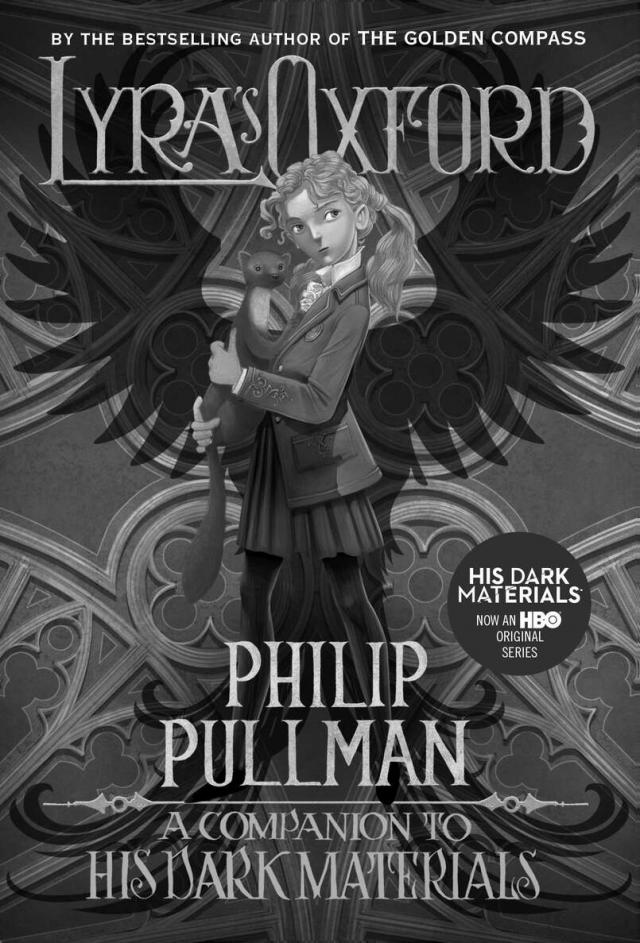


BY PHILIP PULLMAN
HIS DARK MATERIALS
The Golden Compass • Book I
The Subtle Knife • Book II
The Amber Spyglass • Book III
Lyra’s Oxford
Once Upon a Time in the North
The Collectors
The Golden Compass Graphic Novel
THE BOOK OF DUST
La Belle Sauvage • Volume I
The Secret Commonwealth • Volume II
THE SALLY LOCKHART NOVELS
The Ruby in the Smoke
The Shadow in the North
The Tiger in the Well
The Tin Princess
Two Crafty Criminals!
The Scarecrow and His Servant
I Was a Rat!
Spring-Heeled Jack
Count Karlstein
The White Mercedes
The Broken Bridge
This is a work of fiction. Names, characters, places, and incidents either are the product of the author’s imagination or are used fictitiously. Any resemblance to actual persons, living or dead, events, or locales is entirely coincidental.
Text copyright © 2003 by Philip Pullman
Cover art copyright © 2017 by Iacopo Bruno
Interior illustrations and map copyright © 2003 by John Lawrence
“Lantern Slides” text and illustrations copyright © 1995, 1997, 2005, and 2007 by Philip Pullman
All rights reserved. Published in the United States by Yearling, an imprint of Random House Children’s Books, a division of Penguin Random House LLC, New York.
Originally published in hardcover in the United States by Alfred A. Knopf, an imprint of Random House Children’s Books, New York, and simultaneously in Great Britain by David Fickling Books in 2003.
Yearling and the jumping horse design are registered trademarks of Penguin Random House LLC.
Visit us on the Web! rhcbooks.com
Educators and librarians, for a variety of teaching tools, visit us at RHTeachersLibrarians.com
The Library of Congress has cataloged previous editions of this work as follows:
Names: Pullman, Philip, author. | Lawrence, John, illustrator.
Title: Lyra’s Oxford / by Philip Pullman ; engravings by John Lawrence.
Description: First American edition. | New York : Alfred A. Knopf, 2003. | Summary: “Lyra and Pantalaimon (now a pine-marten) are back at Oxford, but their peace is shattered by Ragi, the dæmon of the witch Yelena, who is searching for a healing elixir to cure his witch.”
Identifiers: LCCN 2007282722 | ISBN 978-0-375-84369-3 (pbk.)
Subject: Fantasy—Fiction.
Classification: PZ7.P968 Ly 2003b | DDC [Fic]
ISBN 978-0-399-55545-9 (trade pbk.)
Ebook ISBN 9780307487810
Random House Children’s Books supports the First Amendment and celebrates the right to read.
a_rh_4.1_139123185_c0_r1
“…Oxford, where the real and the unreal jostle in the streets; where North Parade is in the south and South Parade is in the north, where Paradise is lost under a pumping station;* where the river mists have a solvent and vivifying effect on the stone of the ancient buildings, so that the gargoyles of Magdalen College climb down at night and fight with those from Wykeham, or fish under the bridges, or simply change their expressions overnight; Oxford, where windows open into other worlds…”
Oscar Baedecker, The Coasts of Bohemia
* * *
* The old houses of Paradise Square were demolished in order to make an office block, in fact, not a pumping station. But Baedecker, for all his wayward charm, is a notoriously unreliable guide.
Contents
Cover
By Philip Pullman
Title Page
Copyright
Epigraph
Lyra and the Birds
Lantern Slides
About the Author
THIS BOOK contains a story and several other things. The other things might be connected with the story, or they might not; they might be connected to stories that haven’t appeared yet. It’s not easy to tell.
It’s easy to imagine how they might have turned up, though. The world is full of things like that: old postcards, theater programs, leaflets about bomb-proofing your cellar, greeting cards, photograph albums, holiday brochures, instruction booklets for machine tools, maps, catalogs, railway timetables, menu cards from long-gone cruise liners—all kinds of things that once served a real and useful purpose, but have now become cut adrift from the things and the people they relate to.
They might have come from anywhere. They might have come from other worlds. That scribbled-on map, that publisher’s catalog—they might have been put down absentmindedly in another universe, and been blown by a chance wind through an open window, to find themselves after many adventures on a market stall in our world.
All these tattered old bits and pieces have a history and a meaning. A group of them together can seem like the traces left by an ionizing particle in a bubble chamber: they draw the line of a path taken by something too mysterious to see. That path is a story, of course. What scientists do when they look at the line of bubbles on the screen is work out the story of the particle that made them: what sort of particle it must have been, and what caused it to move in that way, and how long it was likely to continue.
Dr. Mary Malone would have been familiar with that sort of story in the course of her search for dark matter. But it might not have occurred to her, for example, when she sent a postcard to an old friend shortly after arriving in Oxford for the first time, that that card itself would trace part of a story that hadn’t yet happened when she wrote it. Perhaps some particles move backward in time; perhaps the future affects the past in some way we don’t understand; or perhaps the universe is simply more aware than we are. There are many things we haven’t yet learned how to read.
The story in this book is partly about that very process.
Lyra and the Birds
LYRA didn’t often climb out of her bedroom window these days. She had a better way onto the roof of Jordan College: the Porter had given her a key that let her onto the roof of the Lodge Tower. He’d let her have it because he was too old to climb the steps and check the stonework and the lead, as was his duty four times a year; so she made a full report to him, and he passed it to the Bursar, and in exchange she was able to get out onto the roof whenever she wanted.
When she lay down on the lead, she was invisible from everywhere except the sky. A little parapet ran all the way around the square roof, and Pantalaimon often draped his pine-marten form over the mock battlements on the corner facing south, and dozed while Lyra sat below with her back against the sun-drenched stone, studying the books she’d brought up with her. Sometimes they’d stop and watch the storks that nested on St. Michael’s Tower, just across Turl Street. Lyra had a plan to tempt them over to Jordan, and she’d even dragged several planks of wood up to the roof and laboriously nailed them together to make a platform, just as they’d done at St. Michael’s; but it hadn’t worked. The storks were loyal to St. Michael’s, and that was that.
“They wouldn’t stay for long if we kept on coming here, anyway,” said Pantalaimon.
“We could tame them. I bet we could. What do they eat?”
“Fish,” he guessed. “Frogs.”
He was lying on top of the stone parapet, lazily grooming his red-gold fur. Lyra stood up to lean on the stone beside him, her limbs full of warmth, and gazed out toward the southeast, where a dusty dark-green line of trees rose above the spires and rooftops in the early evening air.
She was waiting for the starlings. That year an extraordinary number of them had come to roost in the Botanic Garden, and every evening they would rise out of the trees like smoke, and swirl and swoop and dart through the skies above the city in their thousands.
“Millions,” Pan said.
“Maybe, easily. I don’t know who could ever count them….There they are!”
They didn’t seem like individual birds, or even individual dots of black against the blue; it was the flock itself that was the individual. It was like a single piece of cloth, cut in a very complicated way that let it swing through itself and double over and stretch and fold in three dimensions without ever tangling, turning itself inside out and elegantly waving and crossing through and falling and rising and falling again.
“If it was saying something…,” said Lyra.
“Like signaling.”
“No one would know, though. No one could ever understand what it meant.”
“Maybe it means nothing. It just is.”
“Everything means something,” Lyra said severely. “We just have to find out how to read it.”
Pantalaimon leapt across a gap in the parapet to the stone in the corner, and stood on his hind legs, balancing with his tail and gazing more intently at the vast swirling flock over the far side of the city.
“What does that mean, then?” he said.
She knew exactly what he was referring to. She was watching it too. Something was jarring or snagging at the smokelike, flaglike, ceaseless motion of the starlings, as if that miraculous multidimensional cloth had found itself unable to get rid of a knot.
“They’re attacking something,” Lyra said, shading her eyes.
And coming closer. Lyra could hear them now, too: a high-pitched angry mindless shriek. The bird at the center of the swirling anger was darting to right
and left, now speeding upward, now dropping almost to the rooftops, and when it was no closer than the spire of the University Church, and before they could even see what kind of bird it was, Lyra and Pan found themselves shaking with surprise. For it wasn’t a bird, although it was bird-shaped; it was a dæmon. A witch’s dæmon.
“Has anyone else seen it? Is anyone looking?” said Lyra.
Pan’s black eyes swept every rooftop, every window in sight, while Lyra leaned out and looked up and down the street on one side and then darted to the other three sides to look into Jordan’s front quadrangle and along the roof as well. The citizens of Oxford were going about their daily business, and a noise of birds in the sky wasn’t interesting enough to disturb them. Just as well: because a dæmon was instantly recognizable as what he was, and to see one without his human would have caused a sensation, if not an outcry of fear and horror.
“Oh, this way, this way!” Lyra said urgently, unwilling to shout, but jumping up and waving both arms; and Pan too was trying to attract the dæmon’s attention, leaping from stone to stone, flowing across the gaps and spinning around to leap back again.
The birds were closer now, and Lyra could see the dæmon clearly: a dark bird about the size of a thrush, but with long arched wings and a forked tail. Whatever he’d done to anger the starlings, they were possessed by fear and rage, swooping, stabbing, tearing, trying to batter him out of the air.
“This way! Here, here!” Pan cried, and Lyra flung open the trapdoor to give the dæmon a way of escape.
The noise, now that the starlings were nearly overhead, was deafening, and Lyra thought that people below must be looking up to see this war in the sky. And there were so many birds, as thick as flakes in a blizzard of black snow, that Lyra, her arm across her head, lost sight of the dæmon among them.
But Pan had him. As the dæmon-bird dived low toward the tower, Pan stood up on his hind legs, and then leapt up to gather the dæmon in his paws and roll with him over and over toward the trapdoor, and they fell through clumsily as Lyra struck out with her fists to left and right and then tumbled through after the two dæmons, dragging the trapdoor shut behind her.
She crouched on the steps just beneath it, listening to the shrieks and screams outside rapidly lose their urgency. With their provocation out of sight, the starlings soon forgot that they were provoked.
“What now?” whispered Pan, just below her.
These wooden steps led up from a narrow landing, and were closed by a door at the bottom of the flight. Another door on the landing led to the rooms of young Dr. Polstead, who was one of the few Scholars capable of climbing all the way up the tower several times a day. Being young, he had all his faculties in working order, and Lyra was sure he must have heard her tumble through and bang the trapdoor shut.
She put her finger to her lips. Pantalaimon, staring up in the near-dark, saw and turned his head to listen. There was a faint patch of a lighter color on the step next to him, and as Lyra’s eyes adjusted she made out the shape of the dæmon and the V-shaped patch of white feathers on his rump.
Silence. Lyra whispered down:
“Sir, we must keep you hidden. I have a canvas bag—if that would be all right—I could carry you to our room….”
“Yes,” came the answering whisper from below.
Lyra pressed her ear to the trapdoor, and, hearing no more tumult, opened it carefully and then darted out to retrieve her bag and the books she’d been studying. The starlings had left evidence of their last meals on the covers of both books, and Lyra made a face as she thought about explaining it to the Librarian of St. Sophia’s. She picked the books up gingerly and took them and the bag down through the trapdoor, to hear Pan whispering, “Shhh…”
Voices beyond the lower door: two men leaving Dr. Polstead’s room. Visitors—the university term hadn’t begun, and he wouldn’t be holding tutorials yet.
Lyra held open her bag. The strange dæmon hesitated. He was a witch’s dæmon, and he was used to the wide Arctic skies. The narrow canvas darkness was frightening to him.
“Sir, it will only be for five minutes,” she whispered. “We can’t let anyone else see you.”
“You are Lyra Silvertongue?”
“Yes, I am.”
“Very well,” he said, and delicately stepped into the bag that Lyra held open for him.
She picked it up carefully, waiting for the visitors’ voices to recede down the stairs. When they’d gone, she stepped over Pan and opened the door quietly. Pan flowed through like dark water, and Lyra set the bag gently over her shoulder and followed, shutting the door behind her.
“Lyra? What’s going on?”
The voice from the doorway behind her made her heart leap. Pan, a step ahead, hissed quietly.
“Dr. Polstead,” she said, turning. “Did you hear the birds?”
“Was that what it was? I heard a lot of banging,” he said.
He was stout, ginger-haired, affable; more inclined to be friendly to Lyra than she was to return the feeling. But she was always polite.
“I don’t know what was the matter with them. Starlings, from over Magdalen way. They were all going mad. Look!”
She held out her bespattered books. He made a face.
“Better get those cleaned,” he said.
“Well, yes,” she said, “that’s where I was going.”
His dæmon was a cat, as ginger as he was. She purred a greeting from the doorway, and Pan acknowledged her courteously and moved away.
Lyra lived at St. Sophia’s in term time, but her room in the back quad at Jordan was always there when she wanted to use it. The clock was striking half-past six as she hurried there with her living burden—who was much lighter than her own dæmon, as she intended to tell Pantalaimon later.
As soon as the door had closed behind them, she set down the bag on her desk and let the dæmon out. He was frightened, and not only of the dark.
“I had to keep you out of sight—” she began.
“I understand. Lyra Silvertongue, you must guide me to a house in this city—I can’t find the house, I don’t know cities—”
“Stop,” she said, “slow down, wait. What is your name, and your witch’s name?”
“I am Ragi. She is Yelena Pazhets. She sent me—I must find a man who—”
“Please,” Lyra said, “please don’t speak so loudly. I’m safe here—this is my home—but people are curious—if they hear another dæmon’s voice in here, it would be hard to explain, and then you would be in danger.”
The dæmon fluttered anxiously to the windowsill, and then to the back of Lyra’s chair, and then back to the table.
“Yes,” he said. “I must go to a man in this city. Your name is known to us—we heard that you could help. I am frightened this far south, and under a roof.”
“If I can help, I will. Who is this man? Do you know where he lives?”
“His name is Sebastian Makepeace. He lives in Jericho.”
“Just Jericho? That’s all the address you have?”
The dæmon looked bewildered. Lyra didn’t press him; to a witch of the far north, a settlement of more than four or five families was almost unimaginably vast and crowded.
“All right,” she said, “I’ll try and find him. But—”
“Now! It’s urgent!”
“No. Not now. Tonight, after dark. Can you stay here comfortably? Or would you rather come with us to…to my school, which is where I should be now?”
He flew from the table to the open window and perched on the sill for a moment, and then flew out altogether and circled in the air above the quadrangle. Pantalaimon leapt onto the windowsill to watch for him while Lyra searched through the untidy bookshelves for a map of the city.
“Has he gone?” she said over her shoulder.
“He’s coming back.”
The dæmon flew in and beat his wings inward to slow down and perch on the back of the chair.
“Danger outside and suffocation within,” he said unhappily.
Lyra found the map and turned around.
“Sir,” she said, “who was it who told you my name?”