Short fiction collected.., p.139
Short Fiction Collected (2023 Edition),
p.139


Softfoot rode close. She did not speak; she just glanced at him. He knew she had observed his dialogue with Hoverhair. Surely she misunderstood its nature!
He beckoned her. “She has a notion!” he called as she came closer.
Softfoot made a moue.
“Not that one!” he exclaimed. “She—”
But Softfoot’s wolf diverged, and he could not finish. He had hurt her, without meaning to. If only he could send to his own kind as well as he could to animals!
Well, perhaps his action would clarify it. “To the tar pit!” he cried, gesturing in its direction.
At the tar pit they drew up again. There were no allos here, yet.
“If we gather tarballs, and light them, and feed them to the allos, that should kill them,” Prune Pit said.
The elves considered. “How can we feed the monster a tarball?” Dampstar asked. He had come by his name when traveling at night, seeing a star reflected in the river.
“With an arrow,” Prune Pit said. He picked up a stick, dipped it in the thick tar, and got a blob on the end. “We must have the tar-arrows ready, and light them when we approach the allos, then shoot them in when the time is right.”
“But only the wolves know when the time is right,” Softfoot pointed out. “We can not connect to the mind of the reptile.”
“I might do it, if Curlfur warns me,” Hoverhair said. She was an excellent shot with her bow. “But I will need some help in setting up my arrows.”
Several male elves volunteered immediately to help. Prune Pit was left alone for a moment with Softfoot.
“It was a good notion,” she said. “I’m sorry for what I thought.”
“But I don’t understand why she gave it to me,” he said. “She said it was because she could not be chief, but I could. Does that make sense?”
“She wants her child to be the offspring of a chief,” Softfoot said, biting her lip.
“But if no one knows the father—”
“The blood knows.”
He looked at her. “You know I could not resist the Recognition. But my feeling for you—”
She turned away.
“It’s your child I want to have!” he cried.
“I can not give you what she can.”
“How do we know that? Breeding is not limited to Recognition! Maybe—”
She faced him. “I have not denied you,” she said. “I would have your child if I could. But it may not be possible. That may be why the Recognition struck. Who knows.”
“If only—” he began. But then the elves returned with Hoverhair’s arrows, each dipped in tar.
“We must have a firepot, too,” Hoverhair said.
They filled a container with the tar, and the elf who had the fire-talent struck flame, lighting it. The tar burned with guttering vigor, throwing up thick smoke. The wolves shied away from it, apprehensive about the fire, but Prune Pit touched their minds and showed how this fire was their friend. Curlfur even consented to carry the firepot, smoking in its harness, so that Hoverhair could have it ready without delay.
It was now midday. Prune Pit hesitated. Was it wise to tackle the allos again now, when they would be most vigorous? Yet if they waited another day, the reptiles could be almost at the holt. It would be better to do it here, where there was still room to retreat.
They rode slowly back to intercept the allos. It did not take long; the horde was in full motion, on its search for what little prey remained.
“We must strike quickly, and retreat,” Prune Pit warned them. “We don’t know how long it will take the tar to do the job. It doesn’t have to be fast, just sure. Now turn over your wolves to me.”
The elves did so with better grace than before; though they had not succeeded in killing the allo, they had appreciated the perfect coordination of the wolves, and had understood its necessity.
They rode up to meet the first allo. This one was larger than the one they had tackled in the morning, and faster, because of the heat of day. It screamed and charged them with appalling ferocity, its jaws gaping.
Hoverhair stood her ground. Calmly she touched an arrow to the firepot, waiting for its gooey tip to blaze up. Then she fitted it to her bow and took aim.
Prune Pit saw that she was going to be overrun, but he couldn’t even yell; he had to keep the wolves connected.
Hoverhair fired her arrow. The aim was perfect; the missile shot right into the throat of the monster.
Then Curlfur moved, almost slowly, for Hoverhair was not holding on. He carried her just that minimum required to avoid the charge of the reptile, while wolves to either side crowded close, harassing the creature.
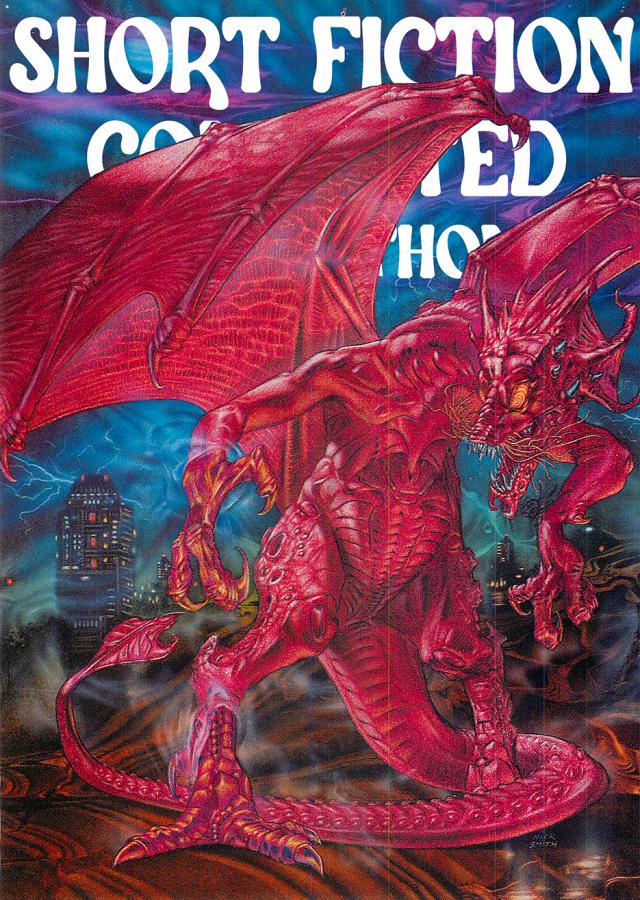
But the allo had abruptly lost interest in the wolves. Smoke was issuing from its nostrils, making it look like the human concept of a dragon. Human beings had a number of odd concepts, which was one reason—hardly the only one!—that elves stayed away from them. It swallowed—then screamed, as the burning material coursed down its throat.
The agony hit Prune Pit like a savage storm. He was burning inside! Quickly he tuned out—and suddenly the wolves were on their own, the connection broken.
But the job had been done. The allo whipped about, trying to free itself of the pain. It rolled on the ground, its tail thrashing wildly.
The commotion alerted another allo. It charged in, intent on the first. Without hesitation it bit, needing no inducement other than helplessness. The elves watched, horrified yet fascinated by the savagery.
“Kill one, distract one,” Softfoot murmured.
“But we have no meat for our wolves,” an elf pointed out. “We need a kill we can butcher.”
“Well, get it,” Prune Pit said. “Now we know how to kill the allos.”
They closed on the feeding reptile. It growled, warning them off, but did not stop feeding. Hoverhair readied another arrow.
Prune Pit linked the minds of the wolves with that of the second allo. They circled close. The allo growled again and made a feint, opening its mouth wide—and Hoverhair dipped her arrow and fired it.
She scored on the inside of the mouth. Now the allo roared, trying to spit out the fiery barb, but only burned its tongue. The tar was stuck in its mouth, blazing.
Unfortunately, this new commotion attracted several other allos. They came in a monstrous wave, big ones and small ones, smelling the blood. The elves had to flee.
“There are so many!” Softfoot exclaimed. “Every time we kill one, more come!”
Prune Pit nodded. The problem was so much more complicated than he had supposed it could be! He had thought that when they killed one allo, that would be the turning point. Instead, the problem had grown with each success.
Hoverhair rode close again. “You know why you’re having so much trouble?” she asked. “It’s because you’re not thinking like a chief.”
“I’m not a chief!” he replied.
“You showed how to deal with the allos,” she reminded him. “That makes you chief. But it will never work unless you believe it yourself.”
“But I can’t just declare myself chief!” he protested.
“Why not?”
“They would laugh!”
“If you don’t, they will die, as the allos overrun our holt.”
He was very much afraid she was right. He had taken on this mission because of the need; he had not thought beyond it. Now he appreciated the greater need: for a continuing leadership, that could handle problems as they came, whatever they might be.
Still, he did not feel competent, because he couldn’t solve the problem of the numbers of allos. What good was it to slay one, or two, or three, or ten, if more always came?
He mulled that over as they rode, outdistancing the reptiles. He felt ashamed, because so much of his thinking had been done for him by the woman who didn’t want to share his life, Hoverhair. A chief didn’t let others do his thinking! For that matter, what chief had a name like Prune Pit?
Then he suffered a major realization.
Stop at the next good resting place, he thought to the wolves. That was the elven version; the actual message was simply a vision of a nice spot, with wolves relaxing.
When they stopped, Prune Pit called out to them to gather around. “We agreed that whoever solved the problem of the allos would be chief,” he said. “I have shown how to solve it, so I am declaring myself chief. I admit that the problem is not over yet, but I will dedicate myself to dealing with it. I am the only one who can unify the minds of the wolves with the mind of the prey, and that is what we need to do this job.”
He paused, but there was no reaction. They were waiting to hear him out before drawing their conclusions.
“To signify this determination, I am taking a new name,” he said. “I enable the wolves to link with the prey, to pace it, moving before it can move. Therefore I will call myself Prey Pacer, and that will be my name as long as I am chief.”
Still they did not speak. He hoped he was not making himself ludicrous. The key element of his assumption was coming up.
“But I do not know all the answers to all the problems. I never expected to be chief, before my mother died, and have had no practice in it. I know I will make mistakes if I try to decide everything myself. So my decision is—to make no significant decision without first getting the best advice I can. For example, I don’t know how to stop the allos from taking meat of whichever ones we kill. Does anyone here know?”
They considered. “Why don’t we kill one and butcher it?” Dampstar asked.
“That sounds good to me,” Prey Pacer said. “Does anyone have an objection?”
“Yes,” Hoverhair said. “Those reptiles track by the smell of blood as much as anything else. They could collect under that tree and never leave.”
“But then we have a way to stop them!” Softfoot pointed out. “We can hang flesh in several trees, and the whole horde will stop right there.”
The elves pursed their lips, thinking about that.
“Well, either they’ll stay by the tree, or they won’t,” Prey Pacer said. “If they stay, they won’t bother us elsewhere. If not, we have a cache we can return to. I think it’s an excellent suggestion, and I’ll do it if a better one doesn’t come along. Thank you, Dampstar.”
Dampstar grinned with pride, just as if a real chief had complimented him.
Hoverhair nodded, gazing at Prey Pacer with new appraisal. He was making it work.
But Softfoot was looking at Hoverhair. What was passing through her mind? She must be suspicious that Hoverhair was reconsidering about keeping the secret, and might decide after all to be the lifemate of a chief. He was suspicious of that too—and knew that as much as he loved Softfoot, he would not be able to deny Hoverhair if she decided to take him. That single mating with her—already he felt the yearning returning. Perhaps it was only the Recognition, asserting its hunger to generate the baby it had chosen. But perhaps it was his own fickle male nature, vulnerable to beauty no matter what his mind said.
There was a roar. Another allo had come across them, and was charging in.
The elves leaped for their wolves. But Hoverhair reached for an arrow first, dipping it in the firepot. She took aim at the monster bearing down on her.
Prey Pacer, astride Halfhowl, looked back, abruptly realizing that she had not mounted. He had never witnessed an act of greater courage! But it was foolish courage, because she had no way to escape the reptile in time. Already the allo’s huge head was orienting on her. Sweeping down as the terrible jaws opened. Curlfur remained close to her, but could not make her mount before she was ready.
Hoverhair fired into that open mouth. The flaming arrow went right into the throat. The allo choked, but its momentum was such that even as it stumbled, it was coming down to crush the woman. It was far too late for Prey Pacer to do anything, even if he had been able to act.
Then a shape shot by, passing almost under the falling monster. It was a wolf and rider, leaping to intercept Hoverhair. The rider launched from the wolf, pushing off to tackle Hoverhair and shove her out of the way as the allo’s head and neck whomped down at her.
The monster struck the ground. Hoverhair stumbled clear, safe by the narrowest margin. But her rescuer had not made it; her legs were pinned under the fallen allo.
Then Prey Pacer realized who it was. Softfoot lay there, unconscious.
Prey Pacer was the first to reach them. “Why did she do it?” he gasped, horrified.
Hoverhair swallowed. She was not so cold as to overlook the narrowness of her escape. “Because she loves you,” she said, awed.
“But you are her rival!”
“And she was protecting your child—whoever carried it,” Hoverhair added. “I think I could not have done that.”
Softfoot groaned. “She’s alive!” Prey Pacer exclaimed.
“But will be lame, I fear,” Hoverhair said. “She never was apt on her feet, and now will be worse. She will need a lot of attention.” She gazed down at Softfoot, and a tear rolled down her cheek. It seemed that her cold heart had at last been touched. Then, as the other elves arrived, she raised her voice. “Get sticks! Lever this monster off the chiefs lifemate! She saved my life!”
Then Prey Pacer knew that no matter who bore his child, no one would try to separate him from Softfoot. One woman had acted with measureless courage, and brought down an allo single-handed. The other had acted with similar courage, and with measureless generosity, and won the respect and gratitude of two who would not forget.
Prey Pacer was indeed chief, and was known as the most superlative of elven hunters despite his seeming inadequacies of weapon and of sending. It took time, but he succeeded in abating the menace of the allos, and they retreated to their former obscurity. He sired not one but two children. The first was Hoverhair’s daughter, to be named Skyfire, inheriting the beauty and nerve of her mother. The second was Softfoot’s son, to be named Two-Spear, trained in his mother’s weapon. But for a long time, only the second was known as Prey Pacer’s offspring, until the secret no longer mattered.
1987
Life
A tale of skullduggery at Exotic Disposals, Inc.
THE VIEWPHONE LIT. Yola opened the line before Fisk could stop her, as she always did. Sometimes it caught him eating, and sometimes cleaning up in the former. This time, fortunately, he was fed and clothed, so for once he avoided the embarrassment of a stranger’s scrutiny.
A fat man stared into the room. “Yola Centers?” he inquired.
“You mean it’s for me?” she cried, girlishly flattered.
“For you and your father,” the man said, smiling. “I’m Brown of the Death Insurance Agency. Mr. Black of Deep Space Memorial Chapel recommended you and your father as suitable operatives for our Claims Department.”
“Us?” Yola exclaimed. “Not just him?”
Fisk, about to take over the dialogue, paused. He had been anticipating a call from DIA. but he hadn’t known what to expect. He certainly hadn’t been expecting this! Maybe Yola would be able to get more pertinent information out of Brown than he could. She was certainly more forward.
“What does it pay?” she asked, true to form.
“Five hundred credits a week to start,” Brown said. “No upper limit for really qualified personnel. But our standards of competence are stringent, and you may find it difficult to—”
“Well, okay,” she said, her brown face deceptively straight. “And how much for him?”
Fisk choked, but Brown wasn’t fazed. “Excellent. This is exactly the type of nerve we require. But in this case the figure is for the team. I know it isn’t much, but we can’t use you alone, unfortunately.”
“I knew there was a catch,” she muttered. “There’d better be a big raise pretty fast.”
“Then it’s agreed? Good,” Brown said. “Here is the prospectus on your first assignment.” And the mailfax issued a sheet.
Fisk made ready to formulate an objection, but his fifty-year-old brain couldn’t marshal his thoughts rapidly enough. Once again his bright, impertinent adoptive daughter had plunged him into something devious.
“But I don’t know anything about whatever it is!” Fisk cried belatedly.
“So hit their lit, silly,” Yola said, heading for the fooder.
Fisk sighed and started in on the material. Slowly he began to understand. He wasn’t sure he liked it, but it was at least a job.
“Life” insurance was a death benefit payable to the survivors of the insuree, so that they might exist despite the loss of income brought about by the deceased’s demise. The insuree had to die to collect, usually.
“Death” insurance was the opposite. In this age it was possible—and, indeed, commercially feasible—to reanimate the dead. The insuree was, by this policy, guaranteed the right to stay dead, in whole or in part, once his mortal term was over. The certainty of death had become one of man’s most important rights. DIA would spare no expense, up to the face value of the policy, to see that no insuree lived again against his will.
“Morbid,’ Yola said appreciatively. “I’ll work for ’em, but you’ll never catch me taking out a policy on my death!”
“I don’t know,” Fisk said. “Consider the ghosts of the past. Human spirits who were not allowed to rest, and had to exist in misery after their decease. Their dearest wish was to be allowed to die completely. If I were in such a situation—”
“Ghosts!” she said witheringly. “Have you taken your anti-senility pill this month, Fisky?”
“The only medication I take is for my circulatory condition—” he began, but gave it up. She was forever teasing him about his infirmities, chief of which was his age. Four and a half times hers. Next to that, she rebuked his slight obesity, which she claimed made him weigh four and half times as much as she. She liked to imply that he was also stupid, and should have retired from active life two decades ago. She was, in short, a typical daughter, despite her recent assimilation into his household, and in his most secret heart, he rather appreciated her little concerns. They were her way of telling him she loved him.