Flying mountains the com.., p.11
Flying Mountains: The Complete Tales,
p.11


You don’t scramble into a full suit of space armor, no matter what the hurry. You wriggle and grunt your way in. Helping Storrs secure a knee joint, Golescu remarked, “And to think, when I was a kid, I figured it would’ve been real romantic being one of King Arthur’s knights.”
“Shut up and keep going,” Storrs answered.
Maybe I am, though, in a way, Golescu’s mind continued. Or at least it’s a line to feed the ladies. That dragon outside is fixing to spew some mighty hot fire.
The intercom speaker in the locker room resounded with West’s voice from the bridge: “Merlin calling International Space Control Central. Come in, Central.”
The reply was abrupt. “International Space Control Central acknowledging call from Merlin. Stand by for relay from Earthside office.”
“So they finally woke Bailey up from his nice nap,” Storrs said.
“Nah.” Golescu finished assisting and went back to clamping his own boots. “He finally came out of conference. Formulation of policy directive in re Cigars, Standard Officers’ Issue of and Correct Angle in Mouth of.”
“Relax, you chaps,” West said. “You ought to know how hard it is to raise a spaceship of some given type on short notice.”
“You mean they don’t keep Rescue Service craft in orbit, with full crews?” Golescu asked, astonished.
“Oh, they do that much,” Storrs admitted grudgingly. “But—”
“Bailey here,” said the speaker. “That you, Merlin?”
“No, just us chickens,” Golescu muttered.
“West speaking, now in command,” said the Englishman. “We’re near rendezvous with 128. I haven’t picked up anything else on the radar. You do have tugs here, don’t you?”
This close to Earth, there was no time lag that human senses could register. “I’m sorry, no,” Bailey said. It was hard to tell whether his tone was curt or merely defensive. “Unfeasible.”
“What?” Storrs cried. Golescu watched the sallow face turn quite bloodless. His own heart skipped a beat or two. He got violently busy with his armor. Above the clatter of metal, he heard West:
“But the Rescue Service has tugs.”
“I know,” Bailey said. “Believe me, Captain West, this decision was not arrived at lightly. The unfortunate fact is, as I told you before, every ship that could tow your load on a cable at a high enough acceleration to give us any chance, is out on maneuvers. You must be aware that a standard rescue tug does not use cables and is not built for them. Just like your own vessel. A cable would add a great deal of dead weight, for no purpose when it is so easy to clamp on directly with a gyrogravitic grapnel. Nor do the tugs have more power than your type. It isn’t necessary, in any foreseeable situation. A disabled ship need only be gotten into a stable orbit to wait for a repair crew. This merely happens to be so improbable a situation that it could not be foreseen.”
“But three or four to help us—”
“How will you attach more than one hauler by geegee to a load as small in volume as this? If we had a ship available, so big it could take the container aboard, there would be no problem. Its radiation screen would protect the cargo. But we don’t. The Navy transports are gone. So is the Lunar Queen.” Bailey’s voice turned cold. “With the asterites taking over so much interplanetary shipping, and with so much Terrestrial bottom destroyed during the war, those are the only such craft left to us.”
Silence extended itself. Golescu could imagine West, alone before the pilot board, his sad eyes resting on the stars and unreachable Earth, methodically trying to think his way out of the trap.
“Build a frame around the gasbag, you Oedipal clotbrain!” Storrs snarled.
“Sam, please,” West begged. To Bailey: “Forgive us. We are rather overwrought here, you understand. Er . . . what about it, though? A skeleton of girders around the bag, giving a large effective surface to which several tugs could grapple.”
“How long would it take to build?” the man on the ground countered. “You know how ticklish and specialized a job construction in orbit is. The sun would flare hours before any such project could be finished.” Something like eagerness came into his speech. “The Rescue Service is prepared to take you aboard one of its own units. You need only detach the sail and other excess mass, hook onto the cargo section, and operate your ship by remote control from ours. Quite safe.”
“ ’Fraid not.” West said. “Herdships don’t include equipment for unforeseeable cases either. All we could do by remote control is turn the Emetts on and off. Which is insufficient. A ship coupled to an outside mass makes a highly unstable system. We’ll need a pilot on deck, to correct every time it starts hunting.”
He sighed. “Bring your ship around, though. Only one of us has to be aboard.”
Storrs’ face had gone from white to red. “Why one of us?” he shouted. “It’s your problem, Earthling!”
There was a thump that might have been Bailey’s fist striking his desk. “Yours, sir, yours,” he threw back. “Read the Interplanetary Navigation Treaty, or your own franchise. Beltline sent that cargo here, and until delivery has been made, Beltline is responsible for the consequences. If someone has to risk a ship and, yes, a life, why should it be this Earth you despise so loudly?”
“Gentlemen—” West expostulated.
Bailey’s tone smoothed over. “I agree. This is no time for recriminations. Do understand that our decision was a hard one. I sympathize with your feelings. We shall all pray for you. And don’t forget, if the, um, the outcome is unfortunate, my own position will be seriously jeopardized.”
Storrs swallowed something and clanged his faceplate shut.
“Very well, then,” West said tiredly. “We’ll proceed as best we can. Dispatch that ship of yours. Maintain contact with us. Let us know if you come up with any better ideas.”
“Certainly. Good luck, Merlin. Over.”
“Over and out, Earth.”
Golescu’s earplugs registered Storrs’ suit radio: “I don’t want that one’s good wishes.”
“Me, I’ll take every scrap of luck that’s offered me,” Golescu said. “I’m not proud.” To the intercom: “How long till rendezvous, Ed?”
“About ten minutes,” West answered. “Better run off your suit checks fast.”
“A checked suit . . . in space?” Golescu closed his own faceplate.
By the time he and Storrs had verified that everything was in order and had clumped their way to the air lock, deceleration was ended. They stood unspeaking while the chamber exhausted for them. The outer door opened, a cup that brimmed with stars.
Golescu touched the controls of his geegee unit and went forth. Suddenly he was no longer encased in clumsiness, he flitted free as an Earthdweller can only be in dreams. Merlin dwindled to a toy torpedo. Blackness surrounded him, lit by twelve thousand visible suns.
He did not look at his own sun. It could have struck him blind before it struck him dead. And Luna was occulted from here. But Earth lay enormous to one side, a dark ball with one dazzling thin edge and a rim of refracted light. There was not much poetry in his makeup, but he found it hard to remove his gaze from the planet.
Storrs’ broadcast voice sounded in his receiver. “We’re clear, Ed. Stay where you are till we finish.”
“Right-o,” said West. “Your velocity relative to target is—” He reeled off the figures.
There was scant need. As Golescu swung about, the sailship, which had been at his back, loomed like another Earth.
He had snapped down his glare filter. The stars vanished; he could now have stared Sol in the eye. The disk of the sail reflected with nearly the same brilliance. Protected, he saw it as a great white moon, growing as be sped across the few miles between. The suit radar controlled a series of beeps to inform him of vectors and distance. It made a dry, crickety music for his flight. Not exactly the Ride of the Valkyries, he thought—scarier. He found himself whistling soundlessly, the words running defiant through his head.
“Chuck Lindbergh was a transporteer, he was, he was.
Chuck Lindbergh was a transporteer, he was, he was.
His lonesome song was in the news:
The Spirit of St. Louis Blues.
Bravo, bravo, hurrah for the transporteers!”
“Hey, Ed,” Storrs called. As an afterthought: “You, too, Andy.”
“Yes?” West replied.
“I’ve been considering. The way this job has developed, it’s most likely an impossible one.”
“We must try.”
“Sure, sure, sure. But listen. It won’t do us any good to watch telescopically for the commencement of that flare. The highest energy protons don’t travel at much under the speed of light. And there’s that whopping probable error in the time prediction. One hour in advance, let’s cast off, and to hell with those precious satellites.”
“Sorry, old chap, no. Merlin’s going to stay coupled and hauling till the end of the run . . . or her. I’ll pilot. We can dispense with the engine watch. You and Andy wait aboard the rescue ship.”
“Stow that,” Golescu said. “What kind of guts do you think we have?”
“You’re both young men,” West said dully.
“And you’re a married man. And I got a reputation to keep up.”
“Ease off on the heroics, you two,” Storrs said. “If it comes to that, maybe we can cut cards. Meanwhile, every mile we can drag that canned stink spaceward will help some, I suppose—so let’s get on with it.”
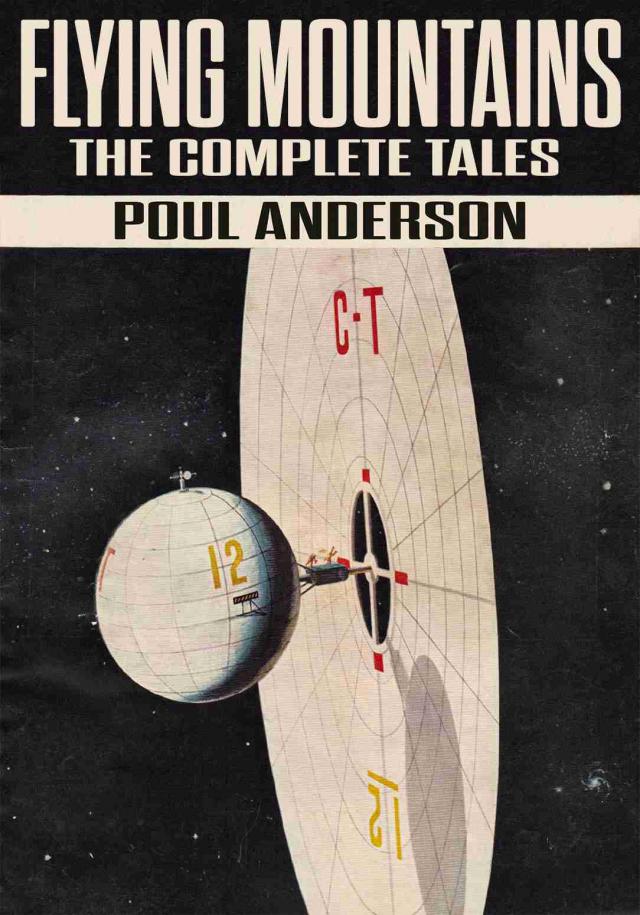
The sail now nearly bisected the sky. Four and a half miles across, the foam-filled members that stiffened it marching across the field of view like Brobdingnagian spokes with its slow rotation, that disk massed close to a hundred tons. And yet it was ghostly thin, a micron’s breadth of tough aluminized plastic, the spin as necessary as the ribs to keep it from collapsing backward under the torque at its edge.
For while the pressure of sunlight in Earth’s neighborhood is only some eighty microdynes per square centimeter, this adds up unbelievably when dimensions stretch out into miles. The sunjammers were slow, their shortest passages measured in months, but that vast steady wind never ended for them; it weakened as they drove starward, but so did solar gravity, and in exact proportion. They cost money to build, out in free space, yet far less than a powered ship; for they required no engines, no crews, simply a metal coating sputtered onto a sheet of carbon compounds, a configuration of sensors and automata, and a means to signal their whereabouts and their occasional needs. Those needs rarely amounted to more than repair of some mechanical malfunction. Otherwise little happened on the long blind voyages. Micrometeorites eroded the sails, which must eventually be replaced; cosmic rays sleeted through the carrier sections, unheeded by unalive cargoes—
Or solar flares blew them to hellangone, Golescu thought.
First time it’s ever happened, he reminded himself. Probably the last time too. Unique event. I’m privileged to be on hand for it. What’m I offered, ladies and gentlemen, for my share of this unique privilege?
He noticed, with a slight surprise, that he wasn’t afraid. Well, nothing very dreadful was going to take place for several hours yet. Except a lot of hard work. Dreadful enough. I should’a tried for scoopship pilot. Still, you got to make your money somehow, and the pay here is good, to compensate for having nothing to spend it on. A few more cruises, and I’ll have me that stake to go prospecting. Now there’s the life!
Passing near the middle of the disk, he noticed the hub in which the sunjammer kept its transmitter and its navigational sensors. Then he had slipped around behind. The monstrous moon turned black for him. He raised his filter and saw it become dim blue with reflected starlight.
Carefully, he moved with Storrs toward the opposite hub. It was linked by a universal joint to a large, dully gleaming cylinder which held the motors. Those drew their power—they didn’t need much—from solar batteries in the sunward hub, and used it to control rotation and precession of the sail according to instructions from the pilot computer. For the sunjammer must tack from orbit to orbit, across the ever-radial energy wind. Gravitation helped only on a trip from the outer to the inner System; and even then the reduction vector was a continuously changing thing.
Golescu felt the slight jar as his boots made contact with the precessor hull. They clung, and he rested weightless. The motors beneath had been turned off on radio command from Merlin. He stood for a moment letting his eyes complete their adjustment to the wan illumination.
Storrs landed beside him. “Come on,” said the impatient voice. “Get the lead out of your rectifier. We’ll need every bit of two hours to unhitch the cargo section as is.”
“Yes, sure.” Golescu began unstrapping the collapsible tool rack from his shoulders. He and his companion were hung about with equipment like a robot family’s Christmas tree.
“I haven’t worked on one of this type very often,” he admitted. “You’d better be straw boss.” He grinned. “I’ll be the straw.”
Storrs made a sour noise.
The gas carriers were a pretty special model at that. Their cargoes must be shaded by the sail, lest temperature go above critical, the liquefied material boil and the containers rupture. The standard form of sunjammer used a curved sail controlled by shroud lines, which pulled rather than pushed the load. Such an arrangement permitted a considerably larger light-catching area and proportionate freight capacity. The drawback was that maintenance crews on a standard vessel had to begin with erecting a shield between them and the reflector . . . if they didn’t want to be fricasseed in their spacesuits.
West called: “Ed speaking. I had to drop behind. The sail was screening me off from you. Everything in order?”
“Just fine,” Golescu said. “Apart from having an itch on my back that I can’t scratch, and more work ahead of me than I’d dare load on any machine, and a prospect of getting blown to nanosmithereens, and no women in sight, and hell’s own need for beer, I can’t complain. Or, rather, I can, but it wouldn’t do much good.”
“Don’t you every stop chattering, Andy?” Storrs grumbled.
“Let him be, Sam,” West advised. “We each need some outlet.”
“Well . . . yes. Mine’s hating Earth, I suppose. North America, anyway. You Britishers are still human.” Storrs carried his tool rack to the farther end of the cylinder and set it in place with what should have been a crash but naturally wasn’t. “Those Americans—The muckheads don’t even have their regular gas boats out here unloading some of this cargo.”
“They can’t,” West said. “Remember what Bailey told us. They haven’t the capacity. Once the container was put in orbit, two or three luggers would have spent a couple of weeks shunting the contents groundside.”
“Still,” Golescu said, “seems to me that every pound they can save right now would help. Make matters that much less serious if this thing does blow.”
“Wouldn’t make any significant difference, in the short time available,” West said. “And it’d hamper our operations.”
“But doesn’t the consignee want his stuff? I checked, and this load is worth eight million dollars F.O.B. That works out to quite a bit per pound.”
“I just told you, Andy, salvage would interfere with the really important job—keeping those satellites functional.” West’s tone became thoughtful. “Y’know, if we do succeed, there ought to be rather a nice bonus for us.”
Golescu snorted. “That’s about as likely as the Milky Way curdling. Beltline ain’t gonna be happy. Sure, they’ll have gained good will Earthside. But they’ll have lost a sunjammer and a shipment. Somebody’ll have to make the loss good. If it’s an insurance company, as I suppose . . . well, imagine what the premiums are going to go up to!”
“We might get a pat on the back,” Storrs agreed, “and then the Old Man will call us in privately and tell us that the next time we do so poor a job of chestnut pulling, he’ll put us on portside duty, latrine detail.”
West sounded shocked. “Are you serious?”
“Uh-huh,” Golescu said. “Asterites can’t afford excuses. If you don’t cut the mustard, you’re apt to be dead, and so are your mates.”
“But I have to cut it for Earth,” Storrs said between his teeth.
Golescu’s frame was now also in place. He flitted “up” to install a battery of floodlamps, “down” again to plug
them in. Light glared, harsh and undiffused, on the spot where the work must be done.
That was the heavy U-joint connecting precessor with cargo section. The latter was also illuminated in part. Hitherto it had appeared only as a circle of blackness. Now, beyond the framework that held it in place, ponderously counter-rotating, the translucent bag glimmered a deep, angry red.
It was not very large to contain so much hell . . . or so much money, Golescu reflected. Space-cold and liquefied under high pressure, the isonitrate occupied a sphere only some ten yards in diameter. Its substance, even the metal atoms, had been reaped from the atmosphere of Jupiter—a chill great star shining in Gemini, two firefly moons visible beside it, treasure house and grave of more asterites than Golescu cared to think about. They were brave men, too, who manned the orbital station where the Jovian complexes were processed into isonitrate. An accident there would not be quite like a nuclear warhead going off, but the difference was academic.
Yet Earth needed those energy-crammed molecules, as the starting point for a dozen chemical syntheses. And Earth was willing to pay. Demand evoked supply, including a supply of men to keep production and the Beltline moving.
Golescu began to unclip his tools and hang them on the rack where they would be ready to hand. A sense came to him of his own muscles, but not merely in arms but in legs and belly and neck, constantly interplaying with centrifugal and Coriolis forces to hold him in balance on this free-falling shell. That led him to notice how the breath went in and out of his nostrils, tasting of recycler chemicals, and how his heart pumped the blood slowly around the intricate circuit of veins and arteries, and how that made an incessant tiny throb in his ears. He was getting hungry again, and had not lied about wanting a beer . . . ah, cool tickling over his tongue, yes, that was why the asterites must sell to Earth, they hadn’t yet succeeded in brewing decent beer themselves . . .