Barnacle bull ss, p.2
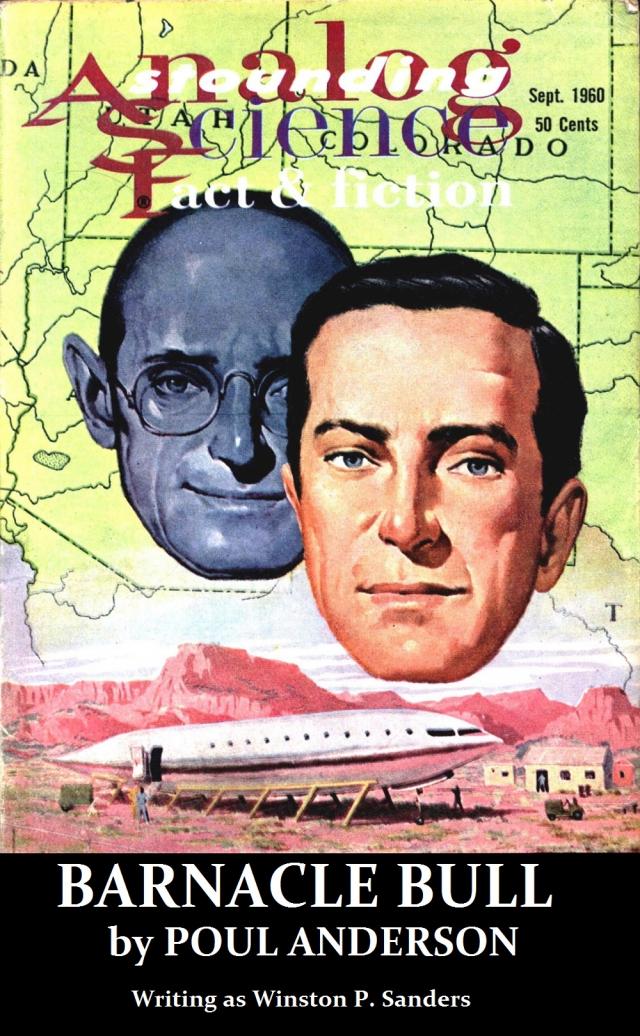
Barnacle Bull (ss),
p.2


He scrubbed down the radar, then paused to examine the spot where he had initially cut off a few dozen samples. New ones were already burgeoning on the ferroplate left by their predecessors—little fellows with delicate glasslike shells which would soon grow and thicken, becoming incredibly tough. Whatever that silicate material was, study of it should repay Terrestrial industry. Another bonanza from the Asteroid Belt, the modern Mother Lode.
“Ha!” said Bull.
It had sounded very convincing. The proper way to exploit space was not to mine the planets, where you must grub deep in the crust to find a few stingy ore pockets, then spend fabulous amounts of energy hauling your gains home. No, the asteroids had all the minerals man would ever need, in developing his extraterrestrial colonies and on Earth herself. Freely available minerals, especially on the metallic asteroids from the core of the ancient planet. Just land and help yourself. No elaborate apparatus needed to protect you from your environment. Just the spaceship and space armor you had to have anyway. No gravitational well to back down into and climb back out of. Just a simple thrust of minimum power.
Given free access to the asteroids, even a small nation like Norway could operate in space, with all the resulting benefits to her economy, politics, and prestige. And there was the Hellik Olav, newly outfitted, with plenty of volunteers—genuine ones —for an exploratory mission and to hell with the danger.
“Ha!” repeated Bull.
He had been quite in favor of the expedition, provided somebody else went. But he was offered a berth and made the mistake of telling his girl.
“Ohhhh, Erik!” she exclaimed, enormous-eyed.
After six months in space helping to rig and test the ship, Bull could have fallen in love with the Sea Hag. However, this had not been necessary. When he had returned to Earth, swearing a mighty oath never to set foot above the stratosphere again, he met Marta. She was small and blond and deliciously shaped. She adored him right back. The only flaw he could find in her was a set of romantic notions about the starry universe and the noble Norwegian destiny therein.
“Oh, oh,” he said, recognizing the symptoms. In haste: “Don’t get ideas, now. I told you I’m a marine reclamation man, from here on forever.”
“But this, darling! This chance! To be one of the conquerors! To make your name immortal!”
“The trouble is, I’m still mortal myself.”
“The service you can do—to our country!”
“Uh, apart from everything else, do you realize that, uh, even allowing for acceleration under power for part of the distance, I’d be gone for more than two years?”
“I’ll wait for you.”
“But—”
“Are you afraidf Erik?”
“Well, no. But—”
“Think of the Vikings! Think of Fridtjof Nansen! Think of Roald Amundsen!”
Bull dutifully thought of all these gentlemen. “What about them?” he asked.
But it was a light summer night, and Marta couldn’t imagine any true Norwegian refusing such a chance for deathless glory, and one thing sort of led to another. Before he recovered his wits, Bull had accepted the job.
There followed a good deal of work up in orbit, readying the ship, and a shakedown cruise lasting some weeks. When he finally got pre-departure leave, Bull broke every known traffic law and a few yet to be invented, on the way to Marta’s home. She informed him tearfully that she was so sorry and she hoped they would always be good friends, but she had been seeing so little of him and had met someone else but she would always follow his future career with the greatest interest. The someone else turned out to be a bespectacled writer who had just completed a three-volume novel about King Harald Hardcounsel (1015-1066). Bull didn’t remember the rest of his furlough very clearly.
A shock jarred through him. He bounced from the hull, jerked to a halt at the end of his life line, and waited for the dizziness to subside. The stars leered.
“Hallo! Hallo, Erik! Are you all right?”
Bull shook his head to clear it. Helledahr’s voice, phoned across the lifeline, was tinny in his earphones. “I think so. What happened?”
“A small meteorite hit us, I suppose. It must have had an abnormal orbit to strike so hard. We can’t see any damage from inside, though. Will you check the outer hull?”
Bull nodded, though there was no point in doing so. After he hauled himself back, he needed a while to find the spot of impact. The pebble had collided near the waist of the ship, vaporizing silicate shell material to form a neat little crater in a barnacle hummock. It hadn’t quite penetrated to the ferroplate. A fragment remained, trapped between the rough lumps.
Bull shivered. Without that overgrowth, the hull would have been pierced. Not that that mattered greatly in itself. There was enough patching aboard to repair several hundred such holes. But the violence of impact was an object lesson. Torvald Winge was almost certainly right. Trying to cut straight across the Asteroid Belt would be as long a chance as men had ever taken. The incessant bombardment of particles, mostly far smaller than this but all possessing a similar speed, would wear down the entire hull. When it was thin enough to rip apart under stress, no meteor bumpers or patches would avail.
His eyes sought the blue-green glint of Earth, but couldn’t find it among so many stars. You know, he told himself, I don’t even mind the prospect of dying out here as much as I do the dreariness of it. If we turned around now, and somehow survived, I’d be home by Christmas. I d only have wasted one extra year in space, instead of more than three-counting in the preparations for this arduous cruise. I’d find me a girl, no, a dozen girls. And a hundred bottles. I’d make up for that year in style, before settling down to do work I really enjoy.
But we aren’t likely to survive, if we turn around now.
But how likely is our survival if we keep going—with the radiation shield failing us? And an extra two years on Holy Ole? I’d go nuts!
Judas priest! Was ever a man in such an ugh situation?
Langnes peered at the sheaf of papers in his hand. “I have drafted a report of our findings with regard to the, ah, space barnacles,” he said. ‘T would like you gentlemen to criticize it as I read aloud. We have now accounted for the vanishing of the previous ships—”
Helledahl mopped his brow. Tiny
beads of sweat broke loose and glittered in the air. “That doesn’t do much good if we also vanish,” he pointed out.
“Quite,” Langnes looked irritated. “Believe me, I am more than willing to turn home at once. But that is impracticable, as Professor Winge has shown and the unfortunate Chinese example has confirmed.”
“I say it’s just as impracticable to follow the original orbit,” declared Bull.
“I understand you don’t like it here,” said Winge, “but really, courting an almost certain death in order to escape two more years of boredom seems a trifle extreme.”
“The boredom will be all the worse, now that we don’t have anything to work toward,” said Bull.
The captain’s monocle glared at him. “Ahem!” said Langnes. “If you gentlemen are quite through, may I have the floor?’
“Sure,” said Bull. “Or the wall or the ceiling, if you prefer. Makes no difference here.”
“I’ll skip the preamble of the report and start with our conclusions, ‘Winge believes the barnacles originated as a possibly mutant life form on the ancient planet before it was destroyed. The slower breakup of the resulting super asteroidal masses gave this life time to adapt to spatial conditions. The organism itself is not truly protoplasmic. Instead of water, which would either boil or freeze in vacuo at this distance from the sun, the essential liquid is some heavy substance we have not been able to identify except as an aromatic compound.”
“Aromatic is too polite/’ said Bull, wrinkling his nose. The air purifiers had still not gotten all the chemical stench out.
Langnes proceeded unrelenting: ” The basic chemistry does remain that of carbon, of proteins, albeit with an extensive use of complex silicon compounds. We theorize the life cycle as follows. The adult form ejects spores which drift freely through space. Doubtless most are lost, but such wastefulness is characteristic of nature on Earth, too. When a spore does chance on a meteorite or an asteroid it can use, it develops rapidly. It requires silicon and carbon, plus traces of other elements; hence it must normally flourish only on stony meteorites, which are, however, the most abundant sort. Since the barnacle’s powerful, pseudo-enzymatic digestive processes —deriving their ultimate energy from sunlight—also extract metals where these exist, it must eliminate same, which it does by laying down a plating, molecule by molecule, under its shell. Research into the details of this process should interest both biologists and metallurgists.
” The shell serves a double function. To some extent, it protects against ionizing radiation of solar or cosmic origin. Also, being a nonconductor, it can hold a biologically generated static charge, which will cause nearby dust to drift down upon it. Though this is a slow method of getting the extra nourishment, the barnacle is exceedingly long-lived, and can adjust its own metabolic and reproductive rates to the exigencies of the situation. Since the charge is not very great, and he himself is encased in metal, a spaceman notices no direct consequences.
” ‘One may well ask why this life form has never been observed before. First, it is doubtless confined to the Asteroid Belt, the density of matter being too low elsewhere. We have established that it is poisoned by water and free oxygen, so no spores could survive on any planet man has yet visited, even if they did drift there. Second, if a meteorite covered with such barnacles does strike an atmosphere, the surface vaporization as it falls will destroy all evidence. Third, even if barnacle-crusted meteorites have been seen from spaceships, they look superficially like any other stony objects. No one has captured them for closer examination.’ ,f
He paused to drink water from a squeeze bottle. “Hear, hear,’* murmured Bull, pretending the captain stood behind a lectern.
“That’s why the unmanned probe ships never were found,” said Helledahl. “They may well have been seen, more or less on their predicted orbits, but they weren’t recognized.”
Langnes nodded. “Of course. That comes next in the report. Then I go on to say: ’The reason that radio transmission ceased in the first place is equally obvious. Silicon components are built into the boom, as part of a transistor system. The barnacles ate them.
“ ‘The observed increase in internal irradiation is due to the plating of heavy metals laid down by the barnacles. First, the static charges and the ferromagnetic atoms interfere with the powerful external magnetic fields which are generated to divert ions from the ship. Second, primary cosmic rays coming through that same plating produce showers of secondary particles.
“ ‘Some question may be raised as to the explosive growth rate of barnacles on our hull, even after all the silicon available in our external apparatus had been consumed. The answer involves consideration of vectors. The ordinary member of the Asteroid Belt, be it large or small, travels in an orbit roughly parallel to the orbits of all other members. There are close approaches and occasional collisions, but on the whole, the particles are thinly scattered by Terrestrial standards, isolated from each other. Our ship, however, is slanting across those same orbits, thus exposing itself to a-veritable rain of bodies, ranging in size from microscopic to sand granular. Even a single spore, coming in contact with our hull, could multiply indefinitely.”
“That means we*re picking up mass all the time,” groaned Bull. ‘‘Which means we’ll accelerate slower and get home even later than I’d feared.”
“Do you think we*ll get home at all?” fretted Helledahl. “We can expect the interference with our radiation shield, and the accumulation of heavy atoms, to get worse all the time. Nobody will ever be able to cross the Belt!”
“Oh, yes, they will,” said Captain Langnes. “Ships must simply be redesigned, The magnetic screens must be differently heterodyned, to compensate. The radio booms must be enclosed in protective material. Or perhaps—”
“I know,” said Bull in great weariness. “Perhaps anti fouling paint can be developed. Or spaceships can be careened, God help us. Oh, yes. All I care about is how we personally get home. I can’t modify our own magnetic generators. I haven’t the parts or the tools, even if I knew precisely how. We’ll spin on and on, the radiation worse every hour, till—“
“Be quiet!” snapped Langnes.
“The Chinese turned around, and look what happened to them,” underlined Winge. “We must try something different, however hopeless it too may look.”
Bull braced his heavy shoulders. “See here, Torvald,” he growled, “what makes you so sure the Chinese did head back under power ?”
“Because they were never seen again. If they had been on the predicted orbit, or even on a completed free-fall ellipse, one of the ships watching for them in the neighborhood of Earth would have— Oh.”
“Yes,” said Bull through his teeth. “Would have seen them? How do you know they weren’t seen? I think they were. I think they plugged blindly on as they’d been ordered to,
and the radiation suddenly started increasing on a steep curve—as you’d expect, when a critical point of fouling up was passed. I think they died, and came back like comets, sealed into spaceships so crusted they looked like ordinary meteorites!”
The silence thundered.
“So we may as well turn back,” said Bull at last. “If we don’t make it, our death’ll be a quicker and cleaner one than those poor devils had.”
Again the quietude. Until Captain Langnes shook his head. “No. I’m sorry, gentlemen. But we go on.”
“What?” screamed Helledahl.
The captain floated in the air, a ludicrous parody of officer like erectness. But there was an odd dignity to him all the same.
“I’m sorry,” he repeated. “I have a family too, you know. I would turn about if it could be done with reasonable safety. But Professor Winge has shown that that is impossible. We would die anyhow—and our ship would be a ruin, a few bits of worn and crumpled metal, all our results gone. If we proceed, we can prepare specimens and keep records which will be of use to our successors. Us they will find, for we can improvise a conspicuous feature on the hull that the barnacles won’t obliterate.”
He looked from one to another.
“Shall we do less for our country’s honor than the Chinese did for theirs?” he finished.
Well; if you put it that way, thought Bull, yes.
But he couldn’t bring himself to say it aloud. Maybe they all thought the same, including Langnes himself, but none was brave enough to admit it. The trouble with us moral cowards, thought Bull, is that we make heroes of ourselves.
I suppose Marta will shed some pretty, nostalgic tears when she gets the news. Ech! It’s bad enough to croak out here; but if that bluestocking memorializes me with a newspaper poem about my Viking spirit—
Maybe that’s what we should rig up on the hull, so they won’t ignore this poor barnacled derelict as just another flying boulder. Make the Holy Ole into a real, old-fashioned, Gokstad type ship. Dragon figurehead, oars, sail … shields hung along the side … hey, yes! Imagine some smug Russian on an Earth satellite, bragging about how his people were the first into space—and then along comes this Viking ship—
I think I’ll even paint the shields. A face on each one, with its tongue out and a thumb to its nose—
Holy hopping Ole!
“Shields!” roared Bull.
“What?” said Langnes through the echoes.
“We’re shielded! We can turn back! Right now!”
When the hubbub had died down and a few slide rule calculations had been made, Bull addressed the others.
“It’s really quite simple,” he said. “All the elements of the answer were there all the time. I’m only surprised that the Chinese never realized it; but then, I imagine they used all their spare moments for socialist self-criticism.
“Anyhow, we know our ship is a space barnacle’s paradise. Even our barnacles have barnacles. Why? Because it picks up so much sand and gravel. Now what worried us about heading straight home was not an occasional meteorite big enough to punch clear through the skin of the ship—we’ve patching to take care of that—no, we were afraid of a sandblast wearing the entire hull paper thin. But we’re protected against precisely that danger! The more such little particles that hit us, the more barnacles we’ll have. They can’t be eroded away, because they’re alive. They renew themselves from the very stuff that strikes them. Like a stone in a river, worn away by the current, while the soft moss is always there.
“We’ll get back out of the Belt before the radiation level builds up to anything serious. Then, if we want to, we can chisel off the encrustation. But why bother, really? We’ll soon be home.”
“No argument there,” smiled Langnes.
“I’ll go check the engines prior to starting up,” said Bull. “Will you and Torvald compute us an Earthward course?”
He started for the doorway, paused, and added slowly: “Uh, I kind of hate to say this, but those barnacles
are what will really make the Asteroid Belt available to men.”
“What?’ said Helledahl.
“Sure,” said Bull. “Simple. Naturally, we’ll have to devise protection for the radio, and redesign the radiation screen apparatus, as the skipper remarked. But under proper control, the barnacles make a self-repairing shield against sandblast. It shouldn’t be necessary to go through the Belt on these tedious elliptical orbits. The space miners can take hyperbolic paths, as fast as they choose, in any direction they please.