Admiralty the collected.., p.25
Admiralty: The Collected Short Stories Volume 4,
p.25


No one hitherto had—openly—attempted a more subtle search. The scientists had too much else to do, as discovery exploded outward. Persons who wished to study supernova processes saw a larger variety of known cases than could be dealt with in lifetimes. Epsilon Aurigae, Sirius B, and Valenderay were simply among the most famous examples.
Coya in Astrocenter had at her beck every fact which Technic civilization had ever gathered about the stellar part of the universe. From the known distribution of former supernovae, together with data on other star types, dust, gas, radiation, magnetism, present location and concentrations, the time derivatives of these quantities: using well-established theories of galactic development, it is possible to compute with reasonable probability the distribution of undiscovered dark giants within a radius of a few hundred parsecs.
The problem is far more complex than that, of course; and the best of self-programming computers still needs a highly skilled sophont riding close herd on it, if anything is to be accomplished. Nor will the answers be absolute, even within that comparatively tiny sphere to which their validity is limited. The most you can learn is the likelihood (not the certainty) of a given type of object existing within such-and-such a distance of yourself, and the likeliest (not the indubitable) direction. To phrase it more accurately, you get a hierarchy of decreasingly probable solutions.
This suffices. If you have the patience, and money, to search on a path defined by the equations, you will in time find the kind of body you are interested in.
Coya had taken for granted that no one before van Rijn had been that interested. But the completeness of Astrocenter’s electronic records extended to noting who had run which program when. The purpose was to avoid duplication of effort, in an era when nobody could keep up with the literature in the smallest specialty. Out of habit rather than logic, Coya called for this information and—
—I found out that ten years earlier, David wanted to know precisely what you, Grandfather, now did. But he never told you, nor said where he and his partners went afterward, or anything. Pain: Nor has he told me. And I have not told you. Instead, I made you take me along; and before leaving, I sent David a letter saying everything I knew and suspected.
Resolution: All right, Nick van Rijn! You keep complaining about how moralistic my generation is. Let’s see how you like getting some cards off the bottom of the deck!
Yet she could not hate an old man who loved her.
“What do you mean by your ‘alternative’?” she whispered.
“Why, simple.” He shrugged like a mountain sending off an avalanche. “If we do not find a retired supernova, being used in a way as original as spinning the peach basket, then we are up against a civilization outside ours, infiltrating ours, same as the Shenna did—except this one got technology would make ours let go in its diapers and scream, ‘Papa, Papa, in the closet is a boogeyman!’” Unaccustomed grimness descended on him. “I think, in that case, really is a boogeyman, too.”
Chill entered her guts. “Supermetals?”
“What else?” He took a gulp of beer. “Ha, you is guessed what got me started was Supermetals?”
She finished her coffee and set the cup on a table. It rattled loud through a stretching silence. “Yes,” she said at length, flat-voiced. “You’ve given me a lot of hours to puzzle over what this expedition is for.”
“A jigsaw puzzle it is indeed, girl, and us sitting with bottoms snuggled in front of the jigsaw.”
“In view of the very, very special kind of supernova-and-companion you thought might be somewhere not too far from Sol, and wanted me to compute about—in view of that, and of what Supermetals is doing, sure, I’ve arrived at a guess.”
“Has you likewise taken into account the fact Supermetals is not just secretive about everything like is its right, but refuses to join the League?”
“That’s also its right.”
“Truly true. Nonetheleast, the advantages of belonging is maybe not what they used to was; but they do outweigh what small surrender of anatomy is required.”
“You mean autonomy, don’t you?’
“I suppose. Must be I was thinking of women. A stern chaste is a long chaste…But you never got impure thoughts.” Van Rijn had the tact not to look at her while he rambled, and to become serious again immediately: “You better hope, you heathen, and I better pray, the supermetals what the agents of Supermetals is peddling do not come out of a furnace run by anybody except God Himself.”
The primordial element, with which creation presumably began, is hydrogen-1, a single proton accompanied by a single electron. To this day, it comprises the overwhelming bulk of matter in the universe. Vast masses of it condensed into globes, which grew hot enough from that infall to light thermonuclear fires. Atoms melted together, forming higher elements. Novae, supernovae—and, less picturesquely but more importantly, smaller suns shedding gas in their red giant phase—spread these through space, to enter into later generations of stars. Thus came planets, life, and awareness.
Throughout the periodic table, many isotopes are radioactive. From polonium (number 84) on, none are stable. Protons packed together in that quantity generate forces of repulsion with which the forces of attraction cannot forever cope. Sooner or later, these atoms will break up. The probability of disintegration—in effect, the half-life—depends on the particular structure. In general, though, the higher the atomic number the lower the stability.
Early researchers thought the natural series ended at uranium. If further elements had once existed, they had long since perished. Neptunium, plutonium, and the rest must be made artificially. Later, traces of them were found in nature: but merely traces, and only of nuclei whose atomic numbers were below 100. The creation of new substances grew progressively more difficult, because of proton repulsion, and less rewarding, because of vanishingly brief existence, as atomic number increased. Few people expected a figure as high as 120 would ever be reached.
Well, few people expected gravity control or faster-than-light travel, either. The universe is rather bigger and more complicated than any given set of brains. Already in those days, an astonishing truth was soon revealed. Beyond a certain point, nuclei become more stable. The periodic table contains an “island of stability,” bounded on the near side by ghostly short-lived isotopes like those of 112 and 113, on the far side by the still more speedily fragmenting 123, 124…etc.…on to the next “island” which theory says could exist but practice has not reached save on the most infinitesimal scale.
The first is amply hard to attain. There are no easy intermediate stages, like the neptunium which is a stage between uranium and plutonium. Beyond 100, a half-life of a few hours is Methuselan; most are measured in seconds or less. You build your nuclei by main force, slamming particles into atoms too hard for them to rebound—though not so hard that the targets shatter.
To make a few micrograms of, say element 114, eka-platinum, was a laboratory triumph. Aside from knowledge gained, it had no industrial meaning.
Engineers grew wistful about that. The proper isotope of eka-platinum will not endure forever; yet its half-life is around a quarter million years, abundant for mortal purposes, a radioactivity too weak to demand special precautions. It is lustrous white, dense (31.7), of high melting point (ca. 4700°C.), nontoxic, hard and tough and resistant. You can only get it into solution by grinding it to dust, then treating it with H2F2 and fluorine gas, under pressure at 250°.
It can alloy to produce metals with a range of properties an engineer would scarcely dare daydream about. Or, pure, used as a catalyst, it can become a veritable Philosopher’s Stone. Its neighbors on the island are still more fascinating.
When Satan was discovered, talk arose of large-scale manufacture. Calculations soon damped it. The mills which were being designed would use rivers and seas and an entire atmosphere for cooling, whole continents for dumping wastes, in producing special isotopes by the ton. But these isotopes would all belong to elements below 100. Not even on Satan could modern technology handle the energies involved in creating, within reasonable time, a ton of eka-platinum; and supposing this were somehow possible, the cost would remain out of anybody’s reach.
The engineers sighed…until a new company appeared, offering supermetals by the ingot or the shipload, at prices high but economic. The source of supply was not revealed. Governments and the Council of the League remembered the Shenna.
To them, a Cynthian named Tso Yu explained blandly that the organization for which she spoke had developed a new process which it chose not to patent but to keep proprietary. Obviously, she said, new laws of nature had been discovered first; but Supermetals felt no obligation to publish for the benefit of science. Let science do its own sweating. Nor did her company wish to join the League, or put itself under any government. If some did not grant it license to operate in their territories, why, there was no lack of others who would.
In the three years since, engineers had begun doing things and building devices which were to bring about the same kind of revolution as did the transistor, the fusion converter, or the neg-gravity generator. Meanwhile a horde of investigators, public and private, went quietly frantic.
The crews who delivered the cargoes and the agents who sold them were a mixed lot, albeit of known species. A high proportion were from backward worlds like Diomedes, Woden, or Ikrananka; some originated in neglected colonies like Lochlann (human) or Catawrayannis (Cynthian). This was understandable. Beings to whom Supermetals had given an education and a chance to better themselves and help out their folk at home would be especially loyal to it. Enough employees hailed from sophisticated milieus to deal on equal terms with League executives.
This did not appear to be a Shenn situation. Whenever an individual’s past life could be traced, it proved normal, up to the point when Supermetals engaged him (her, it, yx…)—and was not really abnormal now. Asked point blank, the being would say he didn’t know himself where the factory was or how it functioned or who the ultimate owners were. He was merely doing a well-paid job for a good, simpático outfit. The evidence bore him out.
(“I suspect, me, some detectiving was done by kidnaps, drugs, and afterward murder,” van Rijn said bleakly. “I would never allow that, but fact is, a few Supermetals people have disappeared. And…as youngsters like you, Coya, get more prudish, the companies and governments get more brutish.” She answered: “The second is part of the reason for the first.”)
Scoutships trailed the carriers and learned that they always rendezvoused with smaller craft, built for speed and agility. Three or four of these would unload into a merchantman, then dash off in unpredictable directions, using every evasive maneuver in the book and a few that the League had thought were its own secrets. They did not stop dodging until their instruments confirmed that they had shaken their shadowers.
Politicians and capitalists alike organized expensive attempts to duplicate the discoveries of whoever was behind Supermetals. Thus far, progress was nil. A body of opinion grew, that that order of capabilities belonged to a society as far ahead of the Technic as the latter was ahead of the neolithic. Then why this quiet invasion?
“I’m surprised nobody but you has thought of the supernova alternative,” Coya said.
“Well, it has barely been three years,” van Rijn answered. “And the business began small. It is still not big. Nothing flashy-splashy: some kilotons arriving annually, of stuff what is useful and will get more useful after more is learned about the properties. Meanwhiles, everybody got lots else to think about, the usual skulduggeries and unknowns and whatnots. Finalwise remember, I am pustulent—dood en ondergang, this Anglic!—I am postulating something which astronomically is hyperimprobable. If you asked a colleague offhand, his first response would be that it isn’t possible. His second would be, if he is a sensible man, How would you like to come to his place for a drink?” He knocked the dottle from his pipe. “No doubt somebody more will eventual think of it too, and sic a computer onto the problem of: Is this sort of thing possible, and if so, where might we find one?”
He stroked his goatee. “Howsomever,” he continued musingly, I think a good whiles must pass before the idea does occur. You see, the ordinary being does not care. He buys from what is on the market without wondering where it come from or what it means. Besides, Supermetals has not gone after publicity, it uses direct contacts and what officials are concerned about Supermetals has been happy to avoid publicity themselves. A big harroo might too easy get out of control, lose them votes or profits or something.”
“Nevertheless,” Coya said, “a number of bright minds are worrying; and the number grows as the amount of supermetals brought in does.”
“Ja. Except who wears those minds? Near-as-damn all is corporation executives, politicians, laboratory scientists, military officers, and—now I will have to wash my mouth out with Genever—bureaucrats. In shorts, they is planetlubbers: When they cross space, they go by cozy passenger ships, to cities where everything is known except where is a restaurant fit to eat in that don’t charge as if the dessert was eka-platinum à la mode.
“Me, my first jobs was on prospecting voyages. And I traveled plenty after I founded Solar, troublepotshooting on the frontier and beyond in my own personals. I know—every genuine spaceman knows down in his marrow like no deskman ever can—how God always makes surprises on us so we don’t get too proud, or maybe just for fun. To me it came natural to ask myself: What joke might God have played on the theorists this time?”
“I hope it is only a joke,” Coya said.
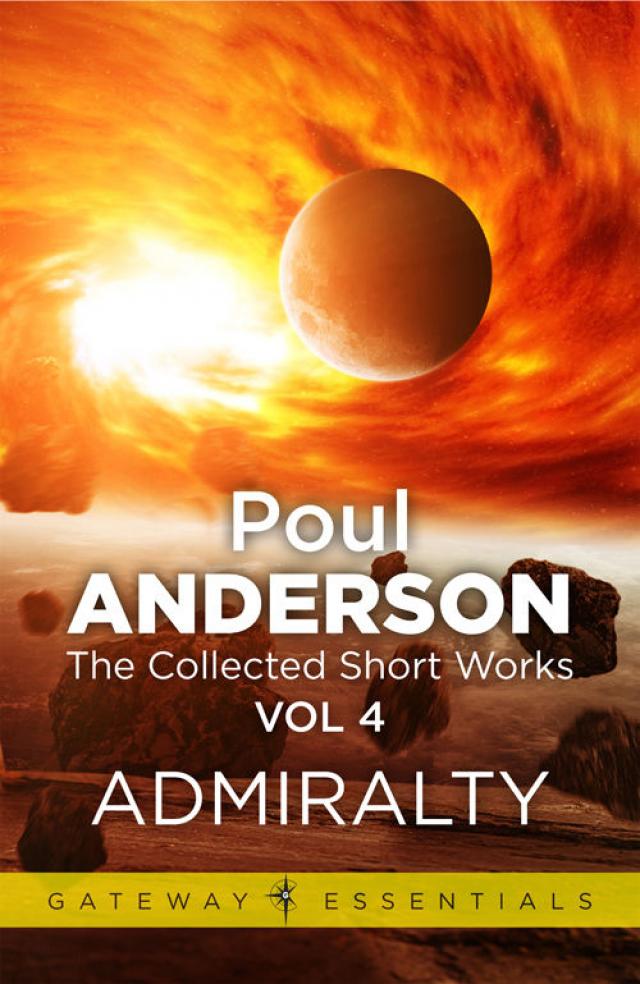
The star remained a titan in mass. In dimensions, it was hardly larger than Earth, and shrinking still, megayear by megayear, until at last light itself could no longer escape and there would be in the universe one more point of elemental blackness and strangeness. That process was scarcely started—Coya estimated the explosion had occurred some 500 millennia ago—and the giant-become-dwarf radiated dimly in the visible spectrum, luridly in the X-ray and gamma bands. That is, each square centimeter emitted a gale of hard quanta; but so small was the area in interstellar space that the total was a mere spark, undetectable unless you came within a few parsecs.
Standing in the observation turret, staring into a viewscreen set for maximum photoamplification, she discerned a wan-white speck amidst stars which thronged the sky and, themselves made to seem extra brilliant, hurt her eyes. She looked away, toward the instruments around her which were avidly gathering data. The ship whispered and pulsed, no longer under hyperdrive but accelerating on negagravity thrust.
Hirharouk’s voice blew cool out of the intercom, from the navigation bridge where he was: “The existence of a companion is now confirmed. We will need a long baseline to establish its position, but preliminary indications are of a radius vector between forty and fifty a.u.”
Coya marveled at a detection system which could identify the light-bending due to a substellar object at that distance. Any observatory would covet such equipment. Her thought went to van Rijn: If you paid what it cost, Gunung Tuan, you were smelling big money.
“So far?” came her grandfather’s words. “By damn, a chilly ways out, enough to freeze your astronomy off.”
“It had to be,” she said. “This was an A-zero: radiation equal to a hundred Sols. Closer in, even a superjovian would have been cooked down to the bare metal—as happened when the sun detonated.”
“Ja, I knows, I knows, my dear. I only did not foresee things here was on quite this big a scale…Well, we can’t spend weeks at sublight. Go hyper, Hirharouk, first to get your baseline sights, next to come near the planet.”
“Hyperdrive, this deep in a gravitational well?” Coya exclaimed.
“Is hokay if you got good engines well tuned, and you bet ours is tuned like a late Beethoven quartet. Music, maestro!”
Coya shook her head before she prepared to continue gathering information under the new conditions of travel.
Again Dewfall ran on gravs. Van Rijn agreed that trying to pass within visual range of the ultimate goal, faster than light, when to them it was still little more than a mystery wrapped in conjectures, would be a needlessly expensive form of suicide.
Standing on the command bridge between him and Hirharouk, Coya stared at the meters and displays filling an entire bulkhead, as if they could tell more than the heavens in the screens. And they could, they could, but they were not the Earth-built devices she had been using; they were Ythrian and she did not know how to read them.
Poised on his perch, crested carnivore head lifted against the Milky Way, Hirharouk said: “Data are pouring in as we approach. We should make optical pickup in less than an hour.”
“Hum-hum, better call battle stations,” the man proposed.
“This crew needs scant notice. Let them slake any soulthirst they feel. God may smite some of us this day.” Through the intercom keened a melody, plangent strings and thuttering drums and shrilling pipes, like nothing Earth had brought forth but still speaking to Coya of hunters high among their winds.
Terror stabbed her. “You can’t expect to fight!” she cried.
“Oh, an ordinary business precaution,” van Rijn smiled.
“No! We mustn’t!”
“Why not, if they are here and do rumblefumbles at us?”
She opened her lips, pulled them shut again, and stood in anguish. I can’t tell you why not. How can I tell you these may be David’s people?
“At least we are sure that Supermetals is not a whinna for an alien society,” Hirharouk said. Coya remembered vaguely, through the racket in her temples, a demonstration of the whinna during her groundside visit to Ythri. It was a kind of veil, used by some to camouflage themselves, to resemble floating mists in the eyes of unflying prey; and this practical use had led to a form of dream-lovely airborne dance; and—And here I was caught in the wonder of what we have found, a thing which must be almost unique even in this galaxy full of miracles…and everything’s gotten tangled and ugly and, and, David, what can we do?