The high crusade origina.., p.6
The High Crusade (original illustrated),
p.6


Branithar gulped. “But you’re not civilized,” he said weakly.
Choking and snarling: “Very
well. I will do it. Curse you for a pack of beasts! When my people have smashed you, it will be my turn!”
“I can wait,” I assured him.
Sir Roger beamed. But suddenly his face fell again. The deaf old executioner was still counting over his apparatus. “Brother Parvus,” said my lord, “would you … could you … break the news to Hubert? I’ve not the heart to tell him.”
I consoled the old fellow with the thought that if Branithar were caught lying, or otherwise failing to give us honest help, there would be punishment. This sent him hobbling happily off to construct a rack. I told Branithar’s guard to make sure the Wersgor saw that work.
TO BE CONTINUED
Second of three parts. A man with a sixteen-inch naval rifle is so apt to forget that someone with a stone axe can kill him just as dead… and that it’s human thought, not weapons, that ultimately determine wars …
Synopsis so far……
The spaceship captain opened the translated chronicle and began to read. It might explain u/hat he had found on this planet. . .
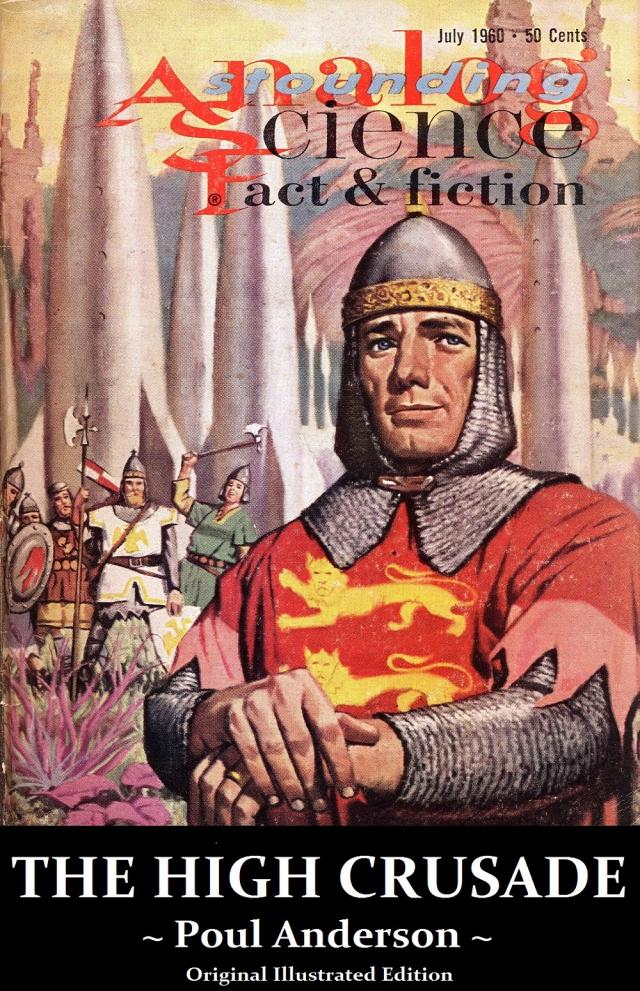
I, Brother Parvus, a friar of the abbey at Ansby in Lincolnshire, do here record that in the year 1345 our baron, Sir Roger de Tourneville, was gathering at his castle an army of free companions to go join King Edward in the French war. Besides himself, the band included two knighted men, old Sir Brian Fitz-William and dashing young Sir Owain Montbelle. Half Welsh, but educated in courtly circles, the latter was a guest pleasing to Sir Roger’s wife Catherine, who in this remote and backward fief missed the graces of her own high-born Winchester family. Even her small children, Robert and Matilda, were scant consolation for her husband’s well-meaning but rough manners and frequent warlike absences.
Our town was a broil of men-at-arms, archers, and cavalrymen when the Wersgor ship landed. A monstrous cylinder, it descended from the sky. As the people crowded around, a squat creature of blue skin and bestial face emerged from a portal and shot down a man with a pre-bolt. Despite their horror, Sir Roger and his English soldiers did not flee as expected, but stormed up the gangway into the vessel, where they attacked so wildly that only one alien survived, I was put in charge of interrogating this prisoner.
He was quick to learn some Latin from me, and to say he was not a demon—a claim somewhat reinforced by the fact that he did not go up in smoke when / led him through the Pater Nos ter—but a member of a nonhuman mortal race, the Wersgorix. His own name was Branithar. Having explained his unique astrological concept of suns and worlds scattered through space, he boasted that his people had been expanding through the universe for the past three hundred years. Where they found a planet similar to their own, they exterminated or enslaved any primitive natives there might be— like ourselves—and colonized the place with a few million only; for each wealthy Wersgor desired enormous and luxurious estates. Branithar’s ship had been a scout searching almost at random for new territory. Its crew had meant to terrorize our neighborhood, load specimens of our soil and life aboard, and return home to report what they had found.
Sir Roger felt as skeptical of this wild tale as I. However, since other blue bandits might arrive from Huy Braseal or wherever they actually lived, he felt we needed knowledge of the captured ship and guns, and had been studying these. Branithar was forced to operate the vessel for us. It was so big that it could hold all the soldiers and the civil population of Ansby, with supplies and livestock. Sir Roger decided to utilize this capability. With such a comfortably housed, well supported force, in such an irresistible flying craftf he could end the French war, liberate the Holy Land, and be back with plunder and glory for even the lowliest serf— before hay harvest. Enthusiastically, his folk went aboard. I was one of a few clerics who accompanied them, with rather more forebodings.
Branithar raised ship—then, suddenly activated an automatic steersman and locked its controls. The ship left Earth itself at a speed faster than light. Branithar defied us to course for his home base, the planet do our worst to him. He had set a Tharixan, on the border of the Wersgor realm; nothing could release the homunculus operating our ship until we arrived. He counselled us to surrender at that time, and we must needs kept him unharmed as an interpreter.
Sir Roger put a cheerful face on the matter which reassured most of his people. Lady Catherine and Sir Owain were among the few who saw through this; more and more, they turned to each other’s company for comfort. The leaders, and my humble self, used the time of the voyage to familiarize ourselves with the strange implements we found. Though these were built on esoteric principles, the actual use proved simple to anyone wont to wrestling with Earth’s hand-operated engines. I also learned somewhat more of the blueskins’ tongue, and more astrology. Their domain included about a hundred worlds, scattered across two thousand light years amidst a far larger number of stars useless to this form of life. Theoretically a republic, in fact the nation was a tyranny centered at its capital planet, Wersgorixan. There were three other star-traveling peoples known so far, hut their power was insignificant and the Wersgorix forced them to remain weak.
Tharixan proved a typical planet of our foes, thinly settled, with only three fortresses. When the locked controls released themselves, Sir Roger flew to the nearest castle, hight Ganturath. Its suspicious commander sent fliers up to hoard us while his great fire-bombards aimed at us from the ground; for this ship was not big enough to carry the generators of those force fields which protected Ganturath from our flame weapons. Sir Roger shot down the fliers, and evaded the antispacecraft defenses by landing our vessel directly on the main keep, thus thoroughly wrecking both. His men rushed out and fell on the garrison. Since the Wersgorix had had no serious rivals for centuries—their conquests being mere slaughter of helpless savages—they had neglected the arts and equipment of hand-to-hand combat. We English soon overran them. Force screens did not stop material objects, so Sir Roger led a cavalry charge against the outlying emplacement and captured it intact, while the long-bowmen of Red John Homeward brought down those small unarmored aircraft which swooped low to shoot at us. fTwas a glorious victory.
Reluctantly, however, the baron yielded to the insistence of his captains that it was best we escape in the lesser spaceships we had seized before overwhelming force arrived from the other castles. But then we learned in horror that the navigational notes of the scouting expedition had been destroyed by a stray fire beam during the battle. Though Earth was not many days9 straight-line travel away, the sheer number of unmapped stars, through which the scout had zigzagged almost at random, and the blurring effect of cosmic clouds, made it impossible to find our way home without close directions. Branithar, an engine-room officer, had not paid heed to the course and could give us no hint. Thus Sir Roger had no choice but to rally us for further trials. The prospect was not uncheering to him and he heartened most others with his promise of gold, glory, and ultimate triumphant return. But Lady Catherine turned on him for his rashness which had brought us to this pass.
Before the long night of Tharixan had worn away, an aerial armada reached us, summoned by fugitives from Ganturath who had gotten to a far-speaker on some estate. Because of the many prisoners we held, as well as uncertainty about us, the Wersgorix did not attack at once. Their leader, agreed to parley. My lord used the time thus gained to interrogate captives, prepare defenses, and let his men practice with the alien machines. Under threat of torture, Branithar proved a sullen but valuable help in all this. He was also learning a little English.
PART 2
X
AT LAST it came time for the conference. Since most of his important followers were occupied with the study of enemy materials, Sir Roger made out a full score for his party by taking their ladies along in their finest clothes. Otherwise only a few unarmed troopers, in borrowed court panoply, accompanied him and me.
As they rode across the field toward that pergola like structure which a Wersgor machine had erected in an hour between the two camps, of some shimmering pearly material, Sir Roger said to his wife: “I would not take you into peril like this if I had any choice. Tis only that we must impress them with our wealth and power.11
Her face remained stony, turned from him toward the vast sinister columns of grounded ships. “I will be no more endangered there, my lord, than are my children back in the pavilion.”
“God’s benison!” he exclaimed. “I have made errors of judgment, aye, perhaps I should have left that cursed vessel alone in England. And yet, is it ever really wrong to do the bold thing?”
“If it endangers the harmless, yes,” she said.
He bridled. “You swore at the wedding—
“Oh, yes. Have I not kept my oath? I have refused you no obedience.” Her cheeks flamed. “But God alone may command my feelings.”
“I won’t trouble you any more,” he said thickly.
This I did not hear myself. They rode ahead of us all, the wind tossing their scarlet cloaks, his plumed bonnet and the veils on her conical headdress, like a picture of the perfect knight and his love. But I set such words down here, conjecturally, in light of the evil luck which followed.
Being of gentle blood, Lady Catherine controlled her manner. When we drew up at the meeting place, her delicate features showed only a cold scorn, directed at the common foe. She took Sir Roger’s hand and dismounted cat-graceful. He led the way more clumsily, with stormy brows.
Inside the curtained pergola was a round table, encircled by a kind of cushioned pew. The Wersgor chiefs filled one half, their snouted blue faces unreadable to us but their eyes flickering nervously. They wore metal-mesh tunics with bronze insignia of rank. In silk and vair, golden chains, ostrich plumes, Cordovan hose, slashed and puffed sleeves, curl-toed shoes, the English showed like peacocks in a henyard. I could see that the aliens were taken aback. The contrasting plainness of my friar’s habit jarred them all the worse.
I folded my hands, standing, and said in the Wersgor tongue, “For the success of this parley, as well as to seal the truce, let me offer a Pater Noster.”
“A what?” asked the chief of the foe. He was somewhat fat, but dignified and with a strong visage.
“Silence, please.” I would have explained, but their abominable language did not seem to have any word for prayer; I had asked Branithar. “Pater Nosier, qui est in coelisI began, while the other English knelt with me.
I heard one of the Wersgorix mutter: “See, I told you they are barbarians. It’s some superstitious ritual.”
“I’m not so sure.” answered the chief dubiously. “The Jairs of Bodavant, now, have certain formulas for psychological integration. I’ve seen them temporarily double their strength, or stop a wound from bleeding, or go days without sleep. Control of inner organs via the nervous system— And in spite of all our own propaganda against them, you know the Jairs are as scientific as we.”
I heard these clandestine exchanges readily enough, yet they did not seem aware of my awareness. I remembered now that Branithar had seemed a little deaf, too. Evidently all Wersgorix had ears less acute than men. This, I learned subsequently, was because their home planet had denser air than Terra, which made them wont to hear sounds more loudly. Here on Tharixan, with air about like England, they must raise their voices to be heard. At the time, I accepted God’s gift thankfully, without stopping to wonder why nor to warn the foe.
“Amen” I finished. We all sat down at the table.
Sir Roger stabbed the chief with bleak gray eyes. “Am I dealing with a person of suitable rank?” he asked.
I translated. “What does he mean by ’rank’?” the head Wersgor wondered. “I am the governor of this planet, and these are the primary officers of its security forces.”
“He means,” I said, “are you sufficiently well born that he will not demean himself by treating with you?”
They looked still more bewildered. I explained the concept of gentle birth as well as I could: which, with my limited vocabulary, was not well at all. We must thresh it over for quite some time before one of the aliens said to his lord:
“I believe I understand, Grath Huruga. If they know more than we do about the art of breeding for certain traits”—I must interpret many words new to me from context— “then they may have applied it to themselves. Perhaps their entire civilization is organized as a military force, with these carefully bred superbeings in command.” He shuddered at the thought. “Of course, they wouldn’t waste time talking to any creature of less intelligence.”
Another officer exclaimed, “No, that’s fantastic! In all our explorations, we’ve never found—”
“We have touched only the smallest fragment of the Via Galactica so far,” Lord Huruga answered. “We dare not assume they are less than they claim to be, until we have more information.”
I, who had sat listening to what they believed were whispers, favored them with my most enigmatic smile.
The governor said to me: “Our Empire has no fixed ranks, but stations each person according to merit. I, Huruga, am the highest authority on Tharixan.”
“Then I can treat with you until word has reached your emperor,“ said Sir Roger through me.
I had trouble with the word “emperor.” Actually, the Wersgor domain was like nothing at home. Most wealthy, important persons dwelt on their vast estates with a retinue of blueface hirelings. They communicated on the far-speaker and visited in swift aircraft or spaceships. Then there were the other classes I have mentioned elsewhere, such as warriors, merchants, and politicians. But no one was born to his place in life.
Under the law, all were equal, all free to strive as best they might for money or position. Indeed, they had even abandoned the idea of families. Each Wersgor lacked a surname, being identified by a number instead in a central registry. Male and female seldom lived together more than a few years. Children were sent at an early age to schools, where they dwelt until mature, for their parents oftener thought them an encumbrance than a blessing.
Yet this realm, in theory a republic of freemen, was in practice a worse tyranny than mankind has known, even in Nero’s infamous day. The Wersgorix had no special affection for their birthplace; they acknowledged no immediate ties of kinship or duty. As a result, each individual had no one to stand between him and the all-powerful central government. In England, when King John grew overweening, he clashed both with ancient law and with vested local interests; so the barons curbed him and thereby wrote another word or two of liberty for all Englishmen. The Wersgor were a lickspittle race, unable to protest any arbitrary decree of a superior. “Promotion according to merit” meant only “promotion according to one’s usefulness to the Imperial ministers.”
But I digress, a bad habit for which my archbishop has often been forced to reprove me. I return, then, to that day in the place of nacre, when Huruga turned his terrible eyes on us and said: “It appears there are two varieties of you. Two species?”
“No,“said one of his officers. “Two sexes, I’m sure. They arc clearly mammals.”
“Ah, yes.” Huruga stared at the gowns across the table, cut low in shameless modern modes.
When I had rendered this for Sir Roger, he said, “Tell them, in case they are curious, that our womenfolk wield swords side by side with the men.”
“Ah,” Huruga pounced on me. “That word sword. Do you mean a cutting weapon?”
I had no time to ask my master’s advice. I prayed inwardly for steadiness and answered, “Yes. You have observed them on our persons in camp. We find them the best tool for hand-to-hand combat. Ask any survivor of the Ganturath garrison.*1 “Hm-m-m … yes.” One of the Wersgorix looked grim. “We have neglected the tactics of infighting for centuries, Grath Huruga. There seemed no need for them. But I do remember one of our unofficial border clashes with the Jairs. It was out on Uloz IV, and they used long knives to wicked effect.”
“For special purposes … yes, yes.” Huruga scowled. “However the fact remains that these invaders prance around on live animals—”
“Which need not be fueled, Grath, save by vegetation.”
“But which could not endure a heat beam or a pellet. They wave weapons out of the prehistoric past. They come not in their own ships, but in one of ours—” He broke off his murmur and barked at me:
“See here! I’ve delayed long enough. Yield to our judgment, or we shall destroy you.”
I interpreted. “The force screen protects us from your flame weapons,” said Sir Roger. “If you wish to attack on foot, we shall make you welcome.”
Huruga turned purple. “Do you imagine a force screen will stop an explosive shell?” he roared. “Why, we could lob just one, let it burst inside your screen, and wipe out every last creature of you!”
Sir Roger was less taken aback than I. “We’ve already heard rumors of such bursting weapons,” he said to me. “Of course, he’s trying to frighten us with that talk of a single shot being enough. No ship could lift so great a mass of gunpowder. Does he take me for a yokel who’ll believe any tinker’s yam? However, I grant he could fire many explosive barrels into our camp.”
“So what shall I tell him?” I asked fearfully.
The baron’s eyes gleamed. “Render this very exactly, Brother Parvus: ‘We are holding back our own artillery of this sort because we wish to talk with you, not merely kill you. If you insist on bombarding us, though, please commence. Our defenses will thwart you. Remember, however, that we are not going to keep our Wersgor prisoners inside those defenses!’”
I saw that this threat shook them. Even these hard hearts would not willingly kill some hundreds of their own people. Not that the hostages we held would stop them forever; but it was a bargaining point, which might gain us time. I wondered how we could possibly use that time, though, save to prepare our souls for death.