

True winter a series of.., p.1
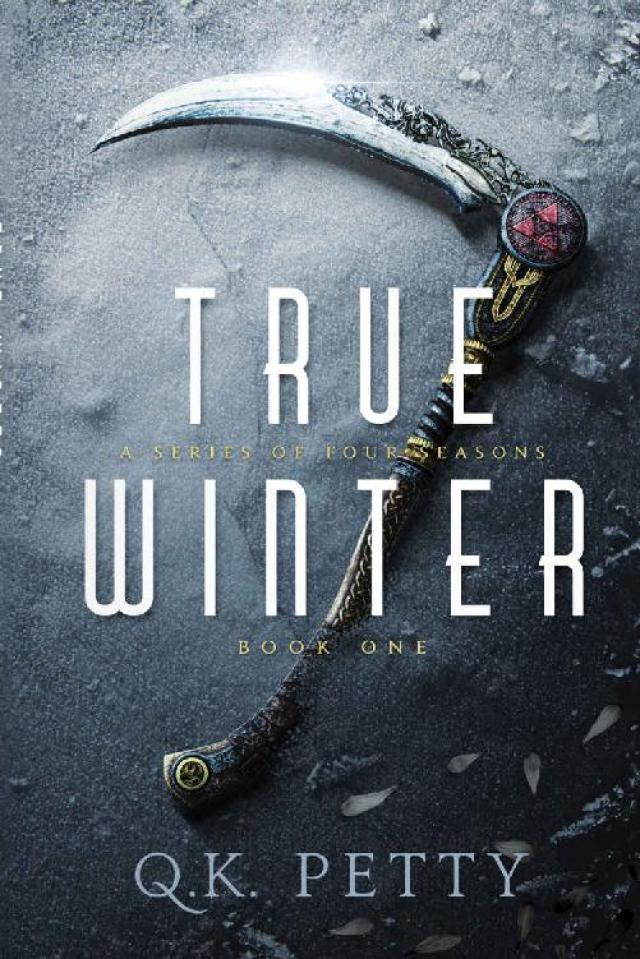
True Winter (A Series of Four Seasons Book 1),
p.1


Copyright © 2022 Q.K. Petty
Prologue
November 1528, Gulf of Mexico
A violent sea tossed Esteban like he was little more than a wooden board splintered off the broken and drowned raft he’d been made to sail. Every makeshift vessel overseen by their leader, Pánfilo de Narváez, had either been washed out to sea or crushed by vicious waves. By some miracle, Esteban had not met the same fate as the rafts. He fought to keep his head above water, but the waves pulled him under again and again until direction itself became as meaningless as his own will.
Was this to be his end? This? He’d been sold into slavery when he was too young to fully grasp how much of his life it would cost. Now, he understood. He was going to lose all of it, every remaining year. All those proud dreams of breaking free one day and making his way back to Azemmur were drowning right along with him.
He swallowed another mouthful of seawater and fought his way back to the surface. Something struck his head, and he turned to see a few tethered planks of wood floating behind him like a gift. He grabbed hold of the flotsam and gave thanks to his secret god, the one he still prayed to when no one else could see.
Bodies floated around him, most of them already drowned. They were tossed like dolls in the storm. But Esteban saw one man still flailing and kicked toward him. When the man grabbed onto the planks, his eyes expressed all the gratitude his voice could not. His fear seemed to recede but reared up again as he got his bearings. Then the nearly drowned man, who should have been even more exhausted than Esteban, kicked violently toward the wreck.
Esteban quickly found his voice and shouted in Spanish, “Turn around! We have to get to land! They’re dead! They’re all dead back there! We’ll die too if we join them!” He began to tug in the opposite direction, fighting the other man’s suicidal endeavor.
Another wave washed over them both. The other man pointed and shouted, “There! It’s right there!”
Esteban spat more water from his mouth and pushed himself partially onto the flotsam to see what the other man was pointing to. It was a wooden crate—just a crate. He’d thought this man was going back for a person, not cargo. “Stop!” he screamed at the man. “You’ll kill us both! It’s not worth it!”
“Then let go!”
Esteban clung to the boards in stunned silence.
The second man paused, his expression equal parts shame and desperation. “Just help me,” he said. “We’ll swim ashore together as soon as I have what I want. I swear it.”
With little choice in the matter, Esteban began kicking toward the bobbing crate. These days, it never took him long to give in to demands. Fighting rarely brought him anything other than pain. Early in life, he’d learned that powerful men would always get what they wanted, no matter how valiantly he fought them. He bled less when he let the current take him where it wanted him to go. That was how he had ended up in the New World, on a Spanish expedition he hated more than he’d ever hated anything he’d been forced to do.
Their leader, Narváez, was a particularly cruel conquistador, and it hadn’t served him well. His reputation among the natives was abysmal. No matter where the expedition went or how gracious the natives were, Narváez found a way to make enemies. He slaughtered those who brought him food when his men were starving. He’d even won himself a curse from the famously gentle Bartolomé de las Casas. If Narváez was dead, Esteban would rather rejoice than grieve, and he’d be perfectly content to let all the man’s gold drown with him.
Whatever was in the crate could not possibly be worth spurning a gift from Allah, but Esteban hadn’t been offered autonomy alongside this chance to survive. An oversight perhaps, or had he thanked the wrong god? He tended to pray to both these days—Allah and Christ—understanding them to be something like bickering parents, both of whom he was expected to placate. So, Esteban set his teeth and followed his new leader, allowing that the fate of this half-submerged wooden crate was now somehow tied to his.
The two men maneuvered the crate inland. Every second thought Esteban might have had was drowned out by a single, screaming idea—I don’t want to die here! Survival was all that mattered.
When they made it to shore, Esteban helped the other man drag the crate further up the beach before he finally collapsed in the sand. His instinctive helpfulness had been part of what had kept him alive all these years, and he supposed it would serve him going forward, too. He wasn’t sure whether his master had survived, but it was best to behave as though he had.
The other man collapsed beside him, and the two lay on the beach for some time, reminding themselves how to breathe. After several minutes, his companion took another splintered piece of raft and started prying the crate open. Esteban watched him, fascinated. What was in that damned crate? When the man finally tore away one side of it, what he lifted out was nothing more than a smaller wooden box. Esteban fell back and groaned. “That had better be valuable, whatever it is,” he said, irritation emboldening him.
The other man brought the box and sat beside him. “I thank you,” he said, holding out his hand. Esteban squeezed it automatically. “You’re Andrés Dorantes de Carranza’s man, aren’t you?”
“Estebanico,” Esteban introduced himself with his Christian name.
The man laughed. “That’s not the name your mother gave you, is it? We’re probably going to die here when the natives find us. You can speak your own name if you like. I’ll not tell Andrés.”
Esteban hesitated. Then he shrugged and muttered, “Mustafa Azemmouri.” It was good to speak his old name again. He hadn’t even allowed himself to think it for fear he’d use it accidentally. He’d been Estebanico as long as he allowed himself to remember. His dreams went back further, though, and this moment felt much like another dream.
“My friends call me Alonso,” the man said. “I now count you among them, señor Azemmouri, if that’s amenable to you. You’ve just helped me save many lives.”
“How?”
Alonso held the small wooden box in his lap. Even if it contained gold, Esteban didn’t think it would be enough to save many lives at all. “This,” Alonso said, “is a miracle, but not the good kind.” Carefully, as though it were made of the finest crystal, Alonso opened the lid. Esteban leaned in to see, but Alonso pushed him back again. “Don’t get too close,” he said, tilting the box so Esteban could glimpse what lay inside. It was only a pair of rusty, old shackles.
The man was mad, no doubt about it. He’d caught some New World disease and wasn’t thinking straight.
“These are rumored to be the shackles of St. Peter,” Alonso explained. “I assume you know who that is.”
Esteban nodded. It had been drilled into his head shortly after he was sold. The first pope, St. Peter, had been martyred for Christ—upside down, if he recalled correctly. “Those were his?” he said.
“Supposedly. We can’t know for certain. What we do know is whoever wears them or even touches them dies shortly after. They say it’s because no one measures up to the holiness of St. Peter—we are unworthy to touch what he touched—but I’m not so sure. I think maybe it’s just a curse.”
“And you didn’t want them to be washed out to sea? Why?”
Alonso carefully closed and latched the box. “Because someone would inevitably discover them and not know what they were. Treasure hunters, maybe. Regardless, they have a pattern, these shackles. They are found, and the finder dies. They are stolen, and the thief dies. They are saved, and the savior dies. Then some eccentric leader realizes how many adversaries he could eliminate with one rusty artifact, and no one would question him. After all, it was God who killed those sinners, wasn’t it? That’s why the House of David hid them, to keep them out of the hands of those who would use them for evil.”
“The House of David?” Esteban was intrigued. Even if it was all nonsense, it made for a fascinating tale.
“The organization I used to work for.” Alonso smiled. “They regulate religion behind the scenes. They ensure that only sanctioned faiths survive. They are the judges and the executioners of gods, in accordance with the individual governments that hire them.”
“And why don’t you work for them now?”
Alonso set the box beside him and laid back on the sand, staring up at a torrential sky, never minding the rain that drenched him anew. “Because no mortal should sit in judgment of God, and no single organization should be handed that much power. Someone had to dissent. It may as well have been me.”
Though the man’s story was incredible, Esteban was inclined to believe it. “Is this organization Catholic or…?”
Alonso shook his head. “They don’t align themselves with any one religion, though they’re not against allowing the governments they work for to believe otherwise.”
“Then why is it called the House of David?”
“The man who founded it was named David.”
Esteban went over his religious training in his head. “The king?”
“Not quite.” Alonso laughed. His voice was hoarse from the seawater he’d taken in. “He was a poor man who happened to live in Jerusalem shortly after the crucifixion. According to the legend, David built the roof of his house with scrap wood he’d stolen, but he was no carpenter, so it collapsed on him. He was impaled by a piece that happened to have come from a very sp
ecific cross. The blood of Christ intermingled with his and healed him.”
Esteban arched a brow at him. “And you believe that story?”
“I’ve seen the proof of it.” Alonso rolled up his sopping sleeve, revealing an old wound on the underside of his arm. “They took my sliver out of me when I dissented, but not before I saw the miracle at work. They call it the Finger of God. There are a limited number of pieces, you understand, and the House of David alone decides who is worthy to receive divine protection. But no one steals my treasure without losing one of theirs in turn.” He patted the wooden box beside him. “They’ll be scrambling to get this one back. They’ll never guess it’s in the New World.” Alonso grinned triumphantly, but Esteban couldn’t join him.
For the rest of that day, Esteban’s eyes periodically found the wooden box and settled on it in abject terror. The power in that box, wielded so carelessly by a man with a grudge, would come to no good in the end. Esteban began to dream of it, and all his dreams were nightmares. The angry natives, the prospect of starving—none of it scared him as much as the curse held by that box.
* * *
Four men survived the Narváez expedition: Esteban, his master Andrés, Alonso, and a man called Álvar Núñez Cabeza de Vaca. They made their way across the New World, working as medicine men, making peace with the natives the only way they knew how. Esteban’s dark complexion gave them the chance to prove themselves to tribes that would have otherwise distrusted them.
It was a far better expedition than Esteban imagined they’d have had under Narváez. He’d never been so grateful for a man’s death. He begged forgiveness of Allah, and Christ, too, for such wicked thoughts, hoping contrition would be enough to keep him from divine wrath. All the same, the curse followed him.
When they finally found a Spanish settlement, Alonso met a woman, married, and returned to Spain. And Esteban woke to find a familiar nightmare waiting at the foot of his bed. He shot up and scrambled away from it, cursing under his breath. A letter had been affixed to its lid, explaining that Alonso wanted the shackles to stay in the New World. “Hide them well, señor Azemmouri. You are their bearer now.”
One night, a thief found the unattended box under Esteban’s bed and opened it. As soon as he touched the shackles, he began to bleed. His ears, eyes, nose, and mouth were fountains of blood by the time Esteban found him. The thief cried out in agony, his screams little more than choking, irregular gurgles, but there was nothing Esteban could do for him. “You shouldn’t have touched them,” he told the dying man. “Why did you touch them? They are a curse, a nightmare. I would have told you as much had you only asked.”
After burying the dead thief, Esteban swore he would never let the shackles take another life. He brought them with him everywhere he went. No matter how heavy his pack, he refused to abandon them. He couldn’t walk away from the responsibility. Suppose the conquistadors found the curse and used it on the natives? The horrors St. Peter’s shackles could unleash were untold.
On his final expedition, word came to Esteban that several Judges from an organization called the House of David were traveling north in the New World in search of a treasure they’d lost. A treasure! Esteban could hardly believe they wanted the curse back, and he didn’t want to imagine what they would do with it once they had it.
He grew sick with worry. The tribe he’d been living with had their own medicine man, who came to Esteban and asked what troubled him. When Esteban finally shared his story, the medicine man frowned. “A curse like that will follow a man to his grave,” he said, shaking his head. “We will simply have to bury you.”
The tribe sent word to the Spanish explorers that the slave known as Estebanico and all those who traveled with him had been killed. Any who followed would meet the same fate. The Spanish believed the messenger and turned back, and Esteban lived the rest of his life in the protective arms of his own rumored grave. Before true mortality caught up with him, he passed the curse to another who knew his story and understood what evil might be done with the shackles.
But his successor did not make the mistake of taking on the burden alone. She gathered a group of like-minded people—those who felt, like Alonso and Esteban, that no mortal should stand in judgment of God, that any way God chose to reveal themselves was valid, and that a powerful organization without a counterpart was merely a symptom of imbalance. Imbalance, they maintained, was a kind of sickness for which there was an obvious cure. In order for every aspect of God to be revealed, life must always walk hand in hand with death, order must be ever at war with chaos, and the law of the land must always, always be met with sedition.
1: To truly
Eden
Present Day, Alabama—Mission: Recover the Chains of Peter
Rain-soaked and humid, the city of Mobile swings into view beyond my windshield. The salty air coming off the Gulf of Mexico mingles with sweat on my lips. Glass and steel skyscrapers tower over the bay like unfriendly giants. It hardly seems the place to find the Chains of Peter—a biblical artifact that’s been missing for centuries, an object that can kill whoever touches it—yet the intel pointed here, so here I came.
I work for an organization called the House of David. Our objective is to secure every powerful, holy artifact before some fool discovers it and uses it to form a dangerous cult. This is what always happens when people discover artifacts like the Chains of Peter; they form cults. People love cults. That’s one of the first things I learned working for the House. The second thing I learned was that my own father had gathered intel for them before he retired. Apparently, he married an American woman after walking away from my mother, settled in Mobile, had one son, and then promptly died of brain cancer without so much as an apology to anyone.
Is it any wonder I signed up for this mission, specifically? I’ve never met my brother. I don’t even know what he looks like, to be honest. All I know is he’s lived in this city all his life with his shockingly wealthy family and their shockingly successful bakery. I doubt he even knows I exist, but he’s been the ghost haunting my thoughts for the greater part of fifteen years, and this may be my only chance to exorcise him.
I park my car downtown and stroll along the main boulevard while the rattle of a passing train fades in the distance. On the sidewalk, two beggars trade words and watch me, their voices drowned out by an echo of sirens. I don’t know why anyone would choose to live here, but apparently, some people like it. Maybe it’s because Mobile, which was a French colony at one point, feels a bit like New Orleans—with its Creole-style architecture, French doors, and wraparound mantels.
On Dauphin Street, tucked between two classier establishments, is a bar called The Opener. A corked bottle of red wine is proudly displayed on its rusty, hanging sign. The windows on either side of the door are cracked, the brick mortar crumbling, and the cement flower pots look like they’re growing cigarettes instead of flowers. Exactly my kind of place.
Inside, a three-piece band plays light jazz in one corner while couples at intimate tables talk loudly over their glasses. Picasso paintings and wine racks with triangular shelves line the brick walls. Some patrons are in their Sunday best, but others are casual enough that I don’t feel underdressed—not that feeling underdressed ever prevented me from enjoying a drink.
I lift myself onto a barstool and adjust my lumbar against the short leather backrest. Behind the copper bar are alcoves of liquor on mirror-backed shelves. The soft light makes every bottle look more enticing than even the most beautiful woman.
The bartender, a perky young woman with long, strawberry-blonde hair, dries an empty glass in front of me. She smiles, and I notice her full lips, bright eyes, and the subtle dimple in the middle of her chin. When I fail to smile back, she frowns. “So, black’s your thing, huh?” she says.
“Say what?”
“You’re decked out all in black like a priest.” She twists her hair into a bun before tapping a finger on the glass she just dried. “So, what’ll it be, father?”
I give her a smirk. She thinks she’s insulted me, but she doesn’t know the half of it. “I just like the color black.”


