Love and murder in the t.., p.1
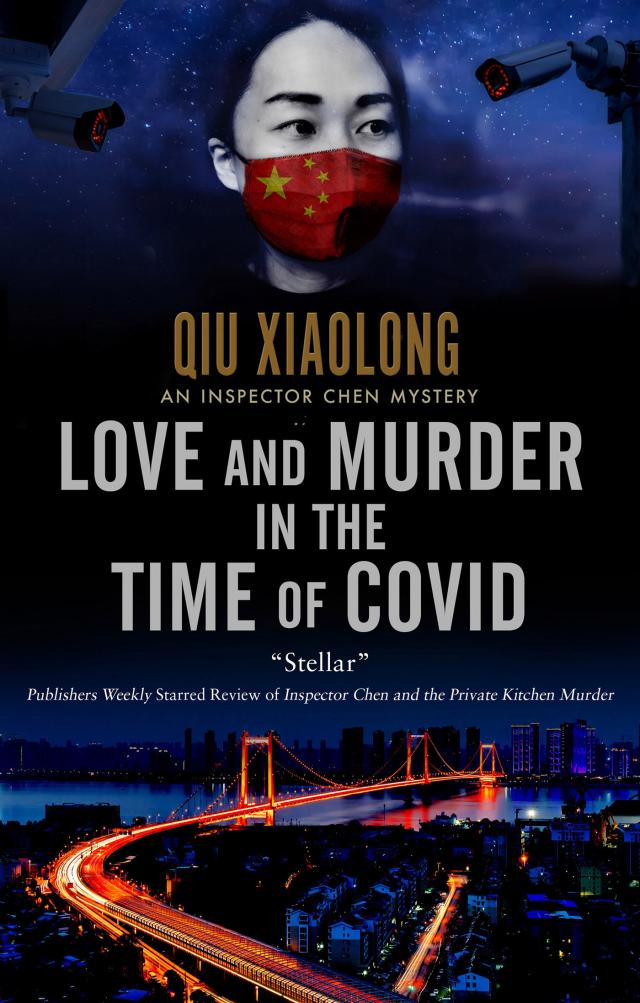
Love and Murder in the Time of Covid,
p.1


Contents
Cover
Also by Qiu Xiaolong
Title Page
Copyright
Praise for Qiu Xiaolong
About the Author
Dedication
Author’s Note
Acknowledgments
Day 1 Morning
Day 1 Afternoon
Day 2
Day 3
Day 4
Day 5
Day 6
Day 7
Also by Qiu Xiaolong
The Inspector Chen mysteries
DEATH OF A RED HEROINE
A LOYAL CHARACTER DANCER
WHEN RED IS BLACK
A CASE OF TWO CITIES
RED MANDARIN DRESS
THE MAO CASE
YEARS OF RED DUST (short story collection)
DON’T CRY, TAI LAKE
THE ENIGMA OF CHINA
SHANGHAI REDEMPTION
HOLD YOUR BREATH, CHINA *
BECOMING INSPECTOR CHEN *
INSPECTOR CHEN AND THE PRIVATE KITCHEN MURDER *
A Judge Dee Investigation
THE SHADOW OF THE EMPIRE *
* available from Severn House
LOVE AND MURDER IN THE TIME OF COVID
Qiu Xiaolong
This ebook is copyright material and must not be copied, reproduced, transferred, distributed, leased, licensed or publicly performed or used in any way except as specifically permitted in writing by the publishers, as allowed under the terms and conditions under which it was purchased or as strictly permitted by applicable copyright law. Any unauthorised distribution or use of this text may be a direct infringement of the author’s and publisher’s rights and those responsible may be liable in law accordingly.
First world edition published in Great Britain and the USA in 2023
by Severn House, an imprint of Canongate Books Ltd,
14 High Street, Edinburgh EH1 1TE.
This eBook edition first published in 2023 by Severn House,
an imprint of Canongate Books Ltd.
severnhouse.com
Copyright © Qiu Xiaolong, 2023
All rights reserved including the right of reproduction in whole or in part in any form. The right of Qiu Xiaolong to be identified as the author of this work has been asserted in accordance with the Copyright, Designs & Patents Act 1988.
British Library Cataloguing-in-Publication Data
A CIP catalogue record for this title is available from the British Library.
ISBN-13: 978-1-4483-1149-1 (cased)
ISBN-13: 978-1-4483-1150-7 (e-book)
This is a work of fiction. Names, characters, places and incidents are either the product of the author’s imagination or are used fictitiously. Except where actual historical events and characters are being described for the storyline of this novel, all situations in this publication are fictitious and any resemblance to actual persons, living or dead, business establishments, events or locales is purely coincidental.
This eBook produced by
Palimpsest Book Production Limited,
Falkirk, Stirlingshire, Scotland
Praise for Qiu Xiaolong
“Newcomers and fans alike will look forward to how Qiu raises the stakes for Chen in the next book”
Publishers Weekly Starred Review of Inspector Chen and the Private Kitchen Murder
“The plot is full of unpredictable detours and sidebars that intensify the pleasure of following Chen’s vibrant curiosity. An exhilarating blend of recent history, mystery, and the writer’s craft”
Kirkus Reviews on Inspector Chen and the Private Kitchen Murder
“While series fans will be delighted at the background Qiu provides, this is an accessible starting point for newcomers … Qiu deepens his Dalgliesh-like series lead in his superior 11th novel”
Publishers Weekly Starred Review of Becoming Inspector Chen
“Both a scathing indictment of contemporary China and an explanation of how poet Chen came to be Chief Inspector Chen. Gripping”
Booklist on Becoming Inspector Chen
“Qiu’s stylish hybrid is half fictional literary memoir and half crisp whodunit”
Kirkus Reviews on Becoming Inspector Chen
“Fans of mysteries about honest cops working for compromised regimes won’t want to miss this one”
Library Journal Starred Review of Hold Your Breath, China
“Fascinating … Xiaolong writes with both urgency and grace about modern China in another well-crafted mystery”
Booklist Starred Review of Hold Your Breath, China
About the author
Anthony Award winning author Qiu Xiaolong was born in Shanghai and moved to Washington University in St Louis, US, to complete a PhD degree in comparative literature. After the Tiananmen tragedy in 1989 he stayed on in St Louis where he still lives with his wife.
Qiu has sold over two million copies of his Inspector Chen mysteries worldwide and been published in twenty languages. The novels have all been adapted as BBC Radio 4 dramas. Qiu is also the author of a brand-new mystery series set in Tang dynasty China, featuring the legendary Judge Dee Renjie. On top of his fiction, he is a prize-winning writer of poetry and poetry critic, having just written a foreword for a new Eliot poetry collection.
www.qiuxiaolong.com
The book is dedicated to all the people that died and suffered in the pandemic, under the CCP’s inhuman zero-Covid policy, and the state surveillance and suppression worse than in 1984. The long, long victim list includes my mentor, Professor Li Wenjun and my schoolmate, Professor Guo Hongan.
AUTHOR’S NOTE
This is a work of fiction, but all the tragic incidents recorded in The Wuhan File are real.
ACKNOWLEDGMENTS
I want to thank all the brave netizens – known or unknown to me – protesting and reporting in China, at huge risks to themselves. But for their undaunted effort, this book could not have been written.
Day 1 Morning
The Way can be said, but not in the ordinary way,
The Name can be given, but not in the common name.
– Laozi
Do not speak, and do not speak.
– Buddha
Yellow Crane Tower
The celestial has left long ago,
riding the celebrated yellow crane
into the legend, nothing remains
except for the Yellow Crane Tower.
Gone is the yellow crane, not returning
to the white clouds drifting,
drifting for thousands of years.
The reflection of the verdant Wuhan trees
so clear in the sun-lit ripples,
the lush, verdant grass
so green on the Parrot Islet,
dusk falling, where is home?
The mist-and-smoke-covered river
only adds to the woes.
– Cui Hao
A short propaganda poem about Covid and the zero-Covid policy on the subdivision wall.
The minute the Covid test is done, go home
in haste. Turning the corner, you may
not meet with your love, but with the virus.
The wind blowing past me blew
past you, does that count as an embrace?
It counts, of course, and it’s termed
as the close contact; I’m walking
on the road you have come along,
does that count as path-crossing?
It counts, of course, and it’s termed
as the sub-close contact.
So all of you have to be put
into the Covid concentration camps
for three weeks (with no further complication)
under the Party’s zero-Covid policy.
– The Wuhan File
Chen Cao, the former chief inspector of the Shanghai Police Bureau, now nominally the director of the Shanghai Judicial System Reform Office – though currently on convalescent leave – found himself stranded one morning in a motionless subway train in the dark.
According to the announcement from the overhead speaker in the compartment, for some unexplained reason the nearly deserted train had to stop there for an unspecified period of time.
The speaker then started playing the patriotic song ‘My Red Chinese Heart,’ which had been performed by a politically popular Hong Kong movie star on China Central Television’s recent New Year’s Eve gala celebration.
Traditionally, the celebration period of the Chinese New Year would last for fifteen days – from the first day of the first lunar month, the Spring Festival, to the fifteenth day of the month, the Lantern Festival. During that period, friends and relatives would be busy and joyful, visiting one another, exchanging a variety of gifts as well as red envelopes, eating and drinking to their hearts’ content, enjoying the lion dance and the rabbit lantern exhibition in the midst of the blissful firecrackers …
For the past couple of decades, some people had even tried to extend the celebration period to more than one month. Consequently, the subway trains were more likely than not to be overcrowded.
But not this Chinese New Year.
This morning, the subway train was practically empty. The only other person in the entire compartment was a slip of girl sitting by herself across the aisle, wearing a patriotic mask of China’s five-star flag as if in a political poster, her finger flashing up and down at the phone, reminiscent of a small hungry bird looking and p
Chen thought he could guess what had been left unsaid, unexplained, in the train announcement.
Such an ironic coincidence, he reflected. Just three or four months ago, he had been invited to a literature forum in Wuhan, where he gave a keynote speech about the translation of classical Chinese poetry. The meeting was organized by his friend Pang, the vice-chairman of the Wuhan Writers’ Association.
Although Wuhan was an ancient city much celebrated in Chinese history, and in classical poetry, too, Chen had never visited before. He had been too busy, doing one investigation after another, and the years had passed. So when Pang sent him the invitation, in his final days serving as a chief inspector in the Shanghai Bureau, it was an opportunity he thought he should grasp.
And it turned out to be a memorable visit. A gracious host, Pang drove him around the city – to the Yellow Crane Pavilion, to the Turtle Hill and Snake Hill, to the East Lake … in short, to all the Wuhan tourist attractions mentioned in classical Chinese poetry.
In addition, Pang knew only too well that the soon-to-be former inspector was also a gourmet – hence the arrangement of plenty of fancy meals at ‘the socialist social expense.’ Not to mention the mouth-watering street food in the ancient city—
He whisked out his cell phone after an unexpected ding from WeChat.
To his surprise, the phone screen showed him a picture of the Spring Festival Gala posted by a ‘netizen,’ a newly coined Chinese word with a very specific meaning that was fast gaining circulation. In China, people were not citizens with any civil rights. Only in cyberspace could they say what they wanted to say – at great risk to themselves because Netcops were surveilling all the time.
The WeChat picture was a screenshot of the Hong Kong movie star singing ‘My Red Chinese Heart.’ He was wearing a bright-red Tang jacket and a snow-white silk shirt, and striking a Tai Chi pose, his mouth opened to sing about how blissful it was for the Chinese people to live under the rules and regulations of the great and glorious Chinese Communist Party.
There was a scathing comment under the picture – ‘Soulless, shameless!’ – along with some lines quoted from a Tang dynasty poem:
Oblivious to the grievances
of a lost country,
the singing girls are still warbling
across the waves the decadent melody
– ‘Flower in the Back Courtyard’
In the last two decades, a grand government propaganda requirement was the New Year’s Eve Spring Festival Gala, sponsored by CCTV. This year, it had been held as before, singing praises of the great achievements of the CCP to the skies. But the next morning, the city of Wuhan had been declared to be in ‘lockdown’ because of the coronavirus outbreak.
Turning off the phone, Chen decided to dwell on his plan for the morning, going through his things-to-do list in his mind: Red Dust Lane on the corners of Fujian and Jiujiang Roads, the Foreign Language Bookstore on Fuzhou Road near Shandong Road, and then a long-overdue visit to his mother.
With the deadly virus permeating the air, the people of Shanghai, as in other cities, had been ordered to stay at home as much as possible, though not in the airtight, breathless lockdown as in Wuhan – not yet.
Actually, this morning’s trip was the first time Chen had ventured out of his subdivision for quite some time – about two weeks after the end of the Lantern Festival. But it was not just because of his convalescent leave and the strict Covid regulations. As he was no longer trusted by the people above, he was not even seen as politically qualified for his new position as director of the Shanghai Judicial System Reform Office, which had hardly any power. He had to keep a low profile …
There was still no explanation whatsoever about the abrupt halt of the subway train. Heaving a sigh, Chen tapped on the online version of Wenhui Daily. According to the official newspaper, the pandemic seemed to be more or less under control in China, thanks to the advantages of the superior CCP rule, with their most powerful surveillance and control system. The editorial then spared no effort portraying the unimaginable losses and miseries suffered in Western countries in their losing battles against the deadly virus.
Chen knew this wasn’t true, but what could he do? He had already been deprived of his job in the police bureau. Much worse could have happened to him – and would still if he tried to turn against the CCP again.
Much worse could have happened to the people in Wuhan … and possibly could happen in Shanghai, too.
He was reminded of a short message from Pang. So there was another thing for him to do this morning.
‘Hell is engulfing the ancient city,’ Pang had sent. ‘People are starving. Food cannot be delivered into Wuhan. All the transportation has jerked to a stop. At night, you can hear an anguished, angry chorus all around: “We are being starved to death!”’
So, food shopping in bulk became the order of the day. He’d better start looking ahead – not just for him, but for his mother.
The train resumed moving, the compartment still in darkness. He hardly noticed, lost in the turbulence of his thoughts …
Finally, the train information panel showed that The Present Stop Is the City God Temple Market, and Chen hurried out. By now, he was the only passenger left in the compartment. The City God Temple Market was close to Red Dust Lane, which was marked on his things-to-do list for the day.
There was a specific reason for him to pay a visit to the lane. He had read that the lane and its neighborhood were going to be razed to the ground in another wave of urban development. Shanghai was an increasingly ‘magical metropolitan’ city, and its grandiose and sublime façade must be maintained – and improved. As an eyesore, Red Dust Lane had to be wiped off the city map. Today, Chen just wanted to take one more look – possibly his last look – at the lane.
It had been important to him in his younger years. He had learned a lot during the ‘evening talk’ in front of the lane entrance, which had served as an integral part of his alternative education amid the thundering Cultural Revolution slogans. At that time, all the schools had closed down for the Red Guards students to ‘make revolution for Chairman Mao.’
And then the lane had happened to serve as the background of the first major investigation in his police career. That was in the late eighties. Time flies.
At a distance, the lane now appeared to be desolate, deserted except for the shivering guards like two squatting stone lions, wearing black masks, their dull-gray cotton-padded overcoats covered with white plastic protective coveralls. Chen did not really expect to meet anyone he had known in the lane. Most of them would have already moved away.
He noticed several surveillance cameras had been installed above the lane entrance. Their presence must have made it impossible for any ‘evening talk’ to go on as in the old days. Alas, Chen thought. Those good old days when he’d been a naïve kid sitting in the audience in summer evenings, listening to the elderly neighbors talking, joking, sharing stories and anecdotes – all of them unimaginable, unavailable in the officially approved textbooks – were long gone.
On this chilly winter morning, he witnessed himself entering a lane drastically different from his memories. He pulled down his hood as a face shield against the chilly wind, though he was unable to prevent a swirl of mud from splashing up around his trousers.
Outside the black-painted shikumen doors which lined the alleyway were piles of filled, half-filled, unfilled cardboard boxes, littering the ground. Several of them appeared to be rain-sodden, decaying with a pungent smell. It was like a deserted battlefield.
He had hoped that putting his feet on the lane would miraculously reinvigorate him, as if in a half-forgotten Greek myth. Instead, a wave of helpless melancholy washed over him.
There’s no stepping twice into the same river, Heraclitus said long ago – or the same lane, for that matter. Not to mention the fact that the lane itself was soon to be bulldozed.
No one appeared to be around, but he failed to shake off a strange feeling of being watched. Big Brother is watching you. History could retrogress so helplessly, as if back into the predictions of 1984.