

Centaur and sensibility, p.2
Centaur and Sensibility,
p.2
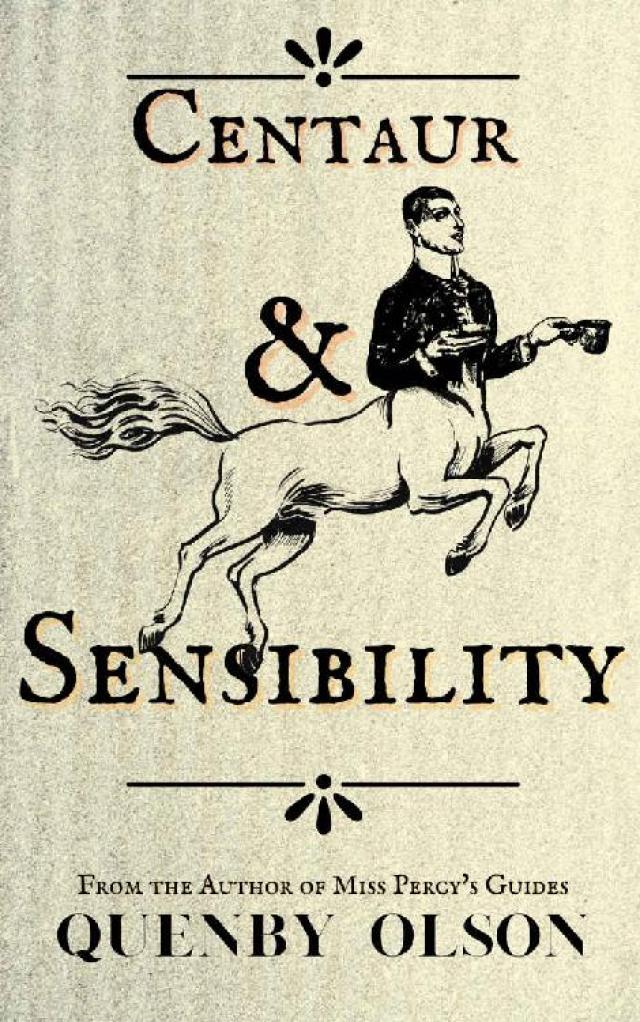


“Oh, um,” she said. Which was not the greatest example of speech ever exhibited, but she felt she deserved credit for having a voice at all under the circumstances.
“My apologies.” He moved backwards several steps, his tail twitching like an agitated pendulum behind him. “I did not mean to intrude.”
She sat up straight again, all of her mother’s lessons on etiquette and deportment rushing upon her at once. Shoulders back, chin up. Was her bonnet still on her head? Did she look open or approachable, or like someone who had consumed a bad fish pie? “You’re not intruding, no. I was only resting, for a moment.” She cleared her throat and smoothed her hands over her lap. Her gaze darted towards him again, or rather the part of him that was all gleaming flanks and another nervous twitch of his tail. She stood up then, recalling her manners, and bobbed a very short, very awkward curtsy. “I’m Miss Mary Clegg, from Millcross? I seem to be a little lost.”
“Lost?” He tilted his head to the right as he regarded her.
“Well, I stepped into the woods for a minute, only to… Anyway, that part isn’t important. But I took care not to go in very far, and yet I cannot find my way out again.”
It was a terrible confession to make, to immediately admit to a failing and set herself on unequal footing with a complete stranger in the middle of the woods. But she had begun to doubt she would find her way out again without help, and here was someone capable of helping her. That is, if he was amenable to it.
His gaze narrowed. Whatever color his eyes were, they were one of the lighter shades. A watery blue or green or a very pale gray. “Are you a witch?”
“I beg your pardon?” No admonishment from her mother could have sent a shot of steel into her spine faster than his question. “Why would you think I’m a witch?”
He shrugged, as though it was obvious. “You look like one.”
“I… I…” she spluttered, then snapped her mouth shut. She was tired and frustrated, and nothing so far had gone according to plan. “I have had a difficult morning,” she said, instead of several other much ruder things she had considered and discarded. “I’m afraid you have not encountered me at my best.” She brushed her hands down the front of her rumpled skirt, as though that small movement could return her gown to the condition it had been in when she’d retrieved it from the wardrobe several hours before. “And what is your name?” she countered, turning the attention from herself as quickly as possible. “I’ve told you mine. The least you can do is extend the same courtesy.” She tried to sound polite, to keep her voice measured and calm, but there was only so much civility one could display after hours of fruitless walking in addition to being told one resembled a witch.
“Beechum,” he said, after several moments had passed and Mary had begun to think he would not give her a reply.
“Beechum,” she said again, embedding it into her memory as she had always been terrible at recalling names only three seconds after hearing them. “Is that your given name or your family name?”
He hesitated. His tail twitched, but he walked forward again, rather than taking another opportunity to retreat. “Mr. Peregrine Beechum,” he said, in a tone that made it clear he had not wanted to say it.
He did not like his name. That much was startlingly clear. But as she boasted a surname that sounded like a drain unclogging itself, she would not comment on it or make fun. “Mr. Beechum,” she said, nodding her head. “Do you happen to know how I can find my way back to the road? To Millcross? It should be just around here,” she gestured vaguely at a portion of the woods beside her, “but I fear I’ve gotten myself turned around a bit.”
He took another step forward. “Miss… Clegg, is it?”
She nodded.
“Um, Millcross is several miles from here. At least a dozen, if I’m not mistaken.”
She shook her head. “No,” she said. “You are very much mistaken. It can’t be that far.”
Mr. Beechum opened his mouth and closed it again. He placed his hands on his waist before letting them fall back to his sides. “How long have you been here? In the woods, I mean.”
Mary glanced up at the sky, checking the position of the sun as it rose above the treetops. “Oh, not more than an hour and a half, and that’s being generous.”
He raised his left hand and pointed at a vague point somewhere beyond her right shoulder. “That way, twelve miles, lies Millcross.”
She looked over her shoulder. Did she expect to see the familiar shapes of Millcross’s homes and shops through the tree trunks? “I’ve not walked twelve miles,” she said, more to convince herself than out of any need to contradict him. Her legs did not ache as though they had walked twelve miles, nor did her feet throb with blisters or her shoes threaten to split into their original strips of leather. And the sun itself had not traveled far enough through the sky to show that she’d been traipsing around through the middle of nowhere — or as much of a nowhere as Yorkshire could provide — long enough to have put twelve miles between herself and her home village. She looked back at Mr. Beechum. “You’re wrong.”
“Very well.” He raised his hand to his forelock. “I bid you good day, Miss Clegg. Good luck on your… adventure,” he added, before turning away.
Mary watched him walk several yards away from her before astonishment washed over her. Was he really going to leave her there? “No, wait!” She rushed after him, hoisting up her skirts and stumbling over a hidden tree root before she caught up to his side. He was considerably taller than her at this proximity, and she reared back a pace at the realization that he easily towered over her. “Mr. Beechum,” she said, suddenly breathless or anxious or possibly a combination of the two. Beyond that, she couldn’t decide how best to phrase her request, or even what that request should be.
“Yes?” he prompted when she continued to cogitate in silence.
She licked her lips. They were dry, while in contrast too many other parts of her had begun to perspire. “It’s clear that I need your help. Or someone’s help. And as you are the only one around, then…”
Was she implying that he was obligated to help her? As a gentleman, perhaps? And yet society — at least the small circle of it to which she’d been exposed — did not count centaurs as belonging to the gentry. But here she was, expecting him to adhere to the rules of a class to which most would not permit him entry.
“Please,” she added. Because she could not think of anything else.
He looked at her. It was less the look of someone appraising her and deciding whether or not she was worthy of help, but rather a study of himself and if he wished to risk assigning himself the role of possible accessory to her difficulties. “Where are you going? Back to Millcross?”
She looked back towards the brook, where her bag still sat like a deflated souffle beside a large rock. “To Leeds, actually.” Might as well be honest about it, she realized.
“Leeds?” His eyes — definitely blue, she realized, but with splotches of hazel nearer to the pupils — widened at her pronouncement. “And you were going to walk all the way there by yourself? On foot?”
“And why not?” She raised her chin, but it merely made her bonnet shift on her head in an uncomfortable way. “I’ve walked that far before.” Not all at once, she failed to add, but at least over the course of a single day. Or three.
“Without anyone to accompany you?”
Ah, he would notice that part. Because it was not proper for a young woman, a young woman from a genteel family, with barons (Scottish, yes, but still) and earls flitting around in the front page of the family Bible, to travel far from home without some manner of chaperone. A man could go wherever he wished without accompaniment, but a young and unmarried woman was liable to fall into a pit or an elopement if left to her own devices.
“There were particular circumstances,” she explained, without explaining anything at all.
He raised his eyebrows. She averted his direct scrutiny by lowering her gaze to the vicinity of his neck, where it snagged on the openness of his shirt collar and the lack of neckcloth hiding the bare skin there. Along with the shadow of something that might have been hair, if she was going to be imaginative.
“I need to go to Bath,” she went on, parceling out the details like bread crumbs. “My aunt lives there.”
“Is she ill, then?”
“No, she… um.” She scuffed the sole of her boot on the ground, rolling a battered pine cone beneath her heel. “I don’t want to get married.”
“Ah,” he said. Which was not what she expected him to say. She expected a reprimand of some sort, an oral treatise on the dangers of a young and unmarried woman scampering about without anyone to make sure she was not scampering off to do something illicit. But instead he said, “Ah,” and he scratched at the back of his head and he glanced around as though there might be someone else wandering through the woods onto whom he could tip the responsibility of lending her aid.
“It’s nothing scandalous,” she assured him, this statement succeeding in creating a furrow above his brow.
“I had not assumed it was.” And there, a quirk at the corner of his mouth. Was he laughing at her? Or trying not to?
“Are you saying I am not capable of embroiling myself in something scandalous and untoward? I assure you that I am.” Though she didn’t know why she felt the need to insist that she was. Maybe because he probably thought her a fool, a silly young woman who’d gone and lost herself in the woods because she didn’t know any better. That scandal was only for intelligent women, women who thought beyond the boundaries of stitching samplers and marriage to a chinless gentleman.
“Oh, I do not doubt it, Miss Clegg.”
She glared at him. The grin — the one he was attempting to hide — did something to the rest of his face. Sharpened it, somehow, as though that curve of his lips worked as a whetstone to his other features. And so she glared at him even more, funneling all of her ire towards him, despite the fact he had done nothing wrong. But he was there, and he was not her, and she wasn’t yet ready to measure her own culpability into her present predicament. “So will you help me?”
He sighed. And with that, she knew she almost had him. “With what? Taking you to Bath?”
“No, no. Not so far as that. Only Leeds. I shall take the mail coach from there.”
He walked back a bit, his hooves remarkably quiet on the forest floor. She envied him that, his ability to move around without causing too much of a disturbance. “It is six miles to Leeds,” he pointed out, and she was frustrated that he knew how far they were from everything while she could not trust if they were even still in England any longer. “That is, if these woods will even permit you to travel there.”
“The woods?” She glanced up at the canopy, the leaves shifting in a slight breeze that had yet to make itself felt beneath the branches. “Surely you don’t mean…?”
“I’m not entirely sure what I mean. But either you’re lying to me, you’re delirious from hunger, or you have somehow managed to travel a dozen miles without realizing it. Which shouldn’t be possible.”
“It would be possible if I was a witch,” she pointed out, attempting to inject some levity into the conversation.
He swore. She didn’t hear it, but she saw the quick movement of his lips, a cannon shot of vulgarity sent out on a rush of air.
“And anyway, how do I know you’re not lying to me?” She narrowed her gaze at him, the same way she did when she suspected one of her sisters of riffling through her wardrobe or borrowing one of her bonnets without asking. “Millcross might be just on the other side of that little copse of oaks, and I might never know it because of your subterfuge.”
“Subterfuge?” He blinked at her.
“Yes, subterfuge,” she repeated. “It means—”
“I know what it means,” he interrupted. “But what purpose would there be in me deceiving you?”
“You could be a villain,” she stated with matter-of-fact directness.
Exasperated. That was how he looked, the very dictionary’s definition of the word having leapt from the page and shaped its letters and examples into the figure before her. “Do I look like a villain, Miss Clegg?”
“As much as I look like a witch.” She smiled at him, teeth and gums and amusement on fully display.
“Very well.” And Mr. Beechum did a little wave with his hand, gesturing that she should follow him.
Her weight shifted forward onto the balls of her feet. “You’ll do it? You’ll take me to Leeds?”
“It is either that or abandon you here.” Spoken as though he had given the latter option a fair amount of consideration.
“I’ll fetch my bag!” And she was off like a streak, back to the edge of the brook, crouching down for one last hasty palmful of water before she picked up her bag and returned to his side.
“Is that everything?”
She looked down at the bag — a small monstrosity of worn leather and too many buckles she had filched from the back of her father’s closet — and its paltry appearance. “Well, I didn’t think I would need very much. And there are some buns in here if you’re hungry. Hettie makes excellent buns.”
“I do not doubt it,” he said.
They started forward, Mary allowing Mr. Beechum to go first, as he claimed to know the way. She did not mind following him, as it allowed her to cease worrying about whether or not she was heading in the right direction. And even if they weren’t, then the mantle of responsibility for any further mistakes no longer rested solely on her shoulders, a fact that provided a tremendous amount of freedom.
A freedom that allowed her to study Mr. Beechum without him realizing it.
It was true that she had not encountered many centaurs before now. She had only ever seen a few as close as Leeds, and that had been several years ago. Her father said they kept to the larger cities more often, tending to gravitate towards where industrialization and railroads blazed a trail of metal and smoke across the countryside. Not that they had only arrived in England with the beginning of modernization, but their presence had become more prominent as the populations had shifted in the direction of the cities. They found jobs as builders and architects, the ones tasked with changing a landscape that had remained untouched for centuries. Mary looked at him and she wondered—
“Oh, I’m not keeping you from your work, am I?”
Mr. Beechum stopped suddenly, so suddenly that Mary almost stumbled into the broad expanse of his left flank. “What was that?”
Mary stepped back, her face flooding with warmth. “I mean, you must have a job, surely. Or a family? Is there something you should be doing or somewhere else you should be? I wouldn’t wish to be an inconvenience.”
He sidestepped around until he faced her. “I doubt anyone sets out with the specific purpose of being an inconvenience, Miss Clegg.”
“You’ve not met my mother,” she countered.
He blinked, as though he could not discern whether or not she was being serious. “I do not have family,” he said, returning to her previous question. Or at least one of them. “A family of my own,” he amended quickly at the look of concern on her face. “I live with my brother and his family, near Sheffield. And at the moment, I am working for the railroad. Surveying for them, actually.”
“So what brought you all the way out here?”
Mr. Beechum looked away from her, in the direction they’d been heading in before she had begun to lob her interrogations at him. His tail flicked at an insect that was intent on pestering him. “I think we should keep walking.”
“Right,” she said, and switched her bag from one hand to the other. “Of course.”
They continued on in silence for several minutes. Mary walked beside him, occasionally lagging back towards his hips before she increased her speed and brought herself back in line with his shoulders. Around them, the woods were serene. She noticed that Mr. Beechum had taken to following the brook through the trees, so the constant burble of water accompanied them, while the ground continued with its subtle downward slant.
“The railway is coming to Leeds,” Mr. Beechum said, after nearly a quarter of an hour had passed.
“Oh?” Mary glanced up at him. He kept his own attention fixed ahead, the ground becoming more rocky and uneven in this part of the forest, allowing her to keep pace with him. But she made a quick tracery of his profile with her eyes, playing a quick game of Shades if only for her own memory. “My mother said there were rumors but that it would never happen.”
“It has already begun.” He looked down at her then, a quick flick of his eyes that barely settled on her before it was away again. “There was talk of the line coming through Millcross, but there was too much opposition.”
“I can imagine,” Mary said under her breath, thinking of her parents and their antipathy towards anything that smacked of progress and a threatened change to their current way of life.
“And so we discussed cutting through the woods instead, bypassing Millcross entirely and making our way to Leeds that way.” He looked at her again, his gaze holding hers more steadily than before. “In a way, I am at work right now. Doing a bit of reconnaissance. At least I was, until…” He sighed and turned his head away.
Until her. Mary added her own sigh to the minor gale of exhalations. It would be nice, she thought, to one day no longer feel like an impediment, an obstruction to someone else’s happiness. To her family she was little more than a burden, a thing to be married off and shifted into someone else’s care. Even her plan of going to Bath and foisting herself on her Aunt Addison would not fix her current predicament. No, she would not have to marry Eustace Haverstick, but she would still be dependent on her aunt for the necessary things like food and shelter. Which made her wonder if perhaps being a governess was indeed the better option. She could at least earn a wage, and—


