Red as blood, p.22
Red as Blood,
p.22


‘I know I’m not exactly at my best right now,’ she said. ‘But would you like to come in for a drink?’
Helena smiled and shook her head, and Sirra opened the door and got out of the car.
‘Thanks for the lift,’ she said. ‘And for telling me about how Guðrún died. The last twenty-four hours have been pure hell.’
Helena looked at her and felt a pang of sympathy at the sight of her tousled hair and creased clothes. Sirra, usually such a glamorous figure, went up to her own front door with her handbag in her arms, holding it like a baby and taking slow, cautious steps, as if she didn’t trust the ground beneath her feet.
‘Sirra,’ Helena called, and Sirra turned. ‘When your case is closed and out of police hands, then I’d be up for a drink.’
Sirra stared back in surprise, and finally Helena saw a smile cross her face and she nodded. Helena started the car and headed back to the station. There was much still to be done.
87
Daníel was in the unsettled mood that always descended on him at the conclusion of a murder investigation. He was indescribably relieved, so much so that he longed to crack open the bottle of champagne he had bought on the way home and revel in his own delight for a few hours. At the same time, his heart was heavy with a disgust sprinkled with sorrow. The last thing Flosi had said to him stuck in his mind, as if the words had been carved indelibly into his memory.
‘The hardest thing I’ve ever done was to throw Guðrún off that cliff,’ he had said.
The image of Guðrún’s body floating like a bloodstained angel in the sea was fixed in Daníel’s mind, while Flosi’s words echoed repeatedly in his memory.
He spent a long time under the shower, shaved and scrubbed his face with a flannel, allowing the hot water to overwhelm his senses, as if it could wash away those memories: the vision of the dead woman in the sea, her husband’s regret, the gleam of fury in the eyes of the mistress, concern for the future of the child she carried. He knew from experience that it would fade. He would concentrate on going over the case records, writing reports, following the case as it was handed to the prosecutor, and then his heart would be lighter. But now he could concentrate on Áróra, who was coming to dinner.
He put on clean jeans and took a white shirt from the dry cleaner’s plastic wrapping, and when he had applied some of the post-shave moisturiser his daughter had given him, he followed it with a generous splash of aftershave on his throat. Áróra had told him that she liked the smell of it. She had whispered to him in bed, breathing deep, as if she had wanted to inhale him whole, inside her, deep inside. He shivered with pleasure at the thought.
He took two woollen blankets out onto the decking and placed them on the garden chairs, switched on the gas heater and placed it where it would do its best to keep them warm while they sat outside in the still evening air. He had lit a couple of candles and placed them in glass jars on the windbreak when he heard the doorbell.
A little later Áróra sat with a glass of champagne in her hand, watching him at work at the barbecue. They had kissed and laughed, and the echo of Flosi’s miserable voice had begun to fade. He had seared the fatty edge of the fillet of lamb and turned it over, away from the direct heat, and closed the barbecue. It would need a few more minutes.
‘There’s something I need to tell you, Áróra,’ he said, and sat in the chair next to her. ‘As the investigation into your sister’s disappearance is still open, I’ve had to take myself off it now that we have a relationship.’
Áróra put the champagne glass down, hard.
‘What do you mean by that?’
‘We are forbidden involvement in cases in which there’s a personal connection,’ he said. ‘So I took myself off the investigation and the head of CID will allocate it to someone else.’
‘But I want you to continue to investigate this,’ she said. ‘You’re the best detective in Iceland. Everyone says that. You’re the guy who never gives up. If anyone can find out what happened to my sister, it’s going to be you.’
‘There are plenty of excellent police…’ he began as she got to her feet.
‘We may have slept together, but that doesn’t mean we’re in a relationship,’ she said. ‘I want you to investigate Ísafold’s disappearance. You have to stay with the search!’
She went to the edge of the decking and stepped down onto the grass. There was desperation in her eyes, and he was about to go over to her and take her in his arms, but she strode away, the hurt clear on her face as she vanished around the corner of the building.
He had known well enough that she wouldn’t be happy with him signing off the investigation, considering she seemed to be settling in Iceland with the aim of being able to search for her sister. And she seemed to have such an unshakeable belief that he was the man who could resolve this mystery. All the same, he hadn’t expected such a powerful reaction. It had become clear that this was a more painful and sensitive matter than he had realised.
Daníel stood by the barbecue and thought that his legs were about to give way beneath him. The smell of food cooking on the coals suddenly became unbearable along with the insistent echo of Flosi’s voice and the vision of Guðrún’s body floating in the sea, arms undulating like wings in the swell.
‘You make a tragic hero, darling,’ said Lady Gúgúlú as she appeared from the darkness, wrapped in a dressing gown and with a large turban around her head. ‘The tragedy is that your greatest talent is the obstacle to your happiness. Why do you have to be such a good cop?’
Daníel was so relieved at the interruption that he forgot to scold Lady Gúgúlú for having listened in. He opened the barbecue and the fillet of lamb looked ready.
‘Would you like champagne with your dinner?’ he asked, and there was no need to ask Lady Gúgúlú twice as she planted herself on the garden chair.
88
The door to her flat stood ajar when Áróra came home. If she hadn’t just told Daníel that they didn’t have a happy future together ahead of them, she would have called him right now. She would have gone out to the car and waited for him to arrive and go into the flat with her. But this notion, that she had almost allowed herself to rely on a man, irritated her so much that she pushed the thought aside and marched straight in.
The hoodie-clad thug from Tækjakistan who was waiting behind the door for her used the same tactic as before. He shoved her so that she lost her balance and pressed his forearm against her throat as he forced her up against the wall in the hall. She could hardly believe that she had fallen for the same trick twice in a row. She knew how to get out of it, as she had done it before, as the blue bruises around both the man’s eyes showed. But this time it was hopeless as he hadn’t come alone. He had brought two guys dressed in shell suits and with gold chains around their necks, one of them standing and waiting, ready to take over if she managed to free herself from the reception thug’s grasp, while the other one dragged out all the drawers from the IKEA chest and emptied them onto the floor, disappointed at how little there was to be found there.
Áróra wondered what they were looking for and tried to figure out a plan of how she could break free and get out of the door, or just loosen the chokehold so that she could scream and attract the attention of the neighbours upstairs. If they were at home. She hadn’t noticed if the lights were on when she approached the house. She had been too occupied thinking of Daníel, and that she had hurt him. Again. And if by that she had hurt herself. The expression on his face when she had snapped at him that she wanted him to continue investigating her sister’s disappearance flashed through her thoughts and triggered the tears.
‘The fucking bitch is crying,’ the hoodie guy called, laughing, clearly imagining that this was his doing.
Áróra felt an urge to wrench herself free and beat him to a pulp, but she allowed wisdom to prevail. She knew from past experience that she could handle him, but was in no doubt that three of them would be too much for her.
‘Good. Very good. This is how we want her,’ said a fourth man, who now appeared from the living room, a Slavic lilt in his English. He was different, dressed in a shirt and a high-quality woollen coat over it, and his hair was barbered in a way that wasn’t simply an all-over crop. His steps clicked on the tiles as he walked; he wore smart shoes, not trainers like the others. If her guess was correct, this had to be Leonid Kuznetsov.
‘We just wanted to let you know, Áróra, that we know who you are and what you do, and we also know where your mother lives,’ he said, holding up her laptop. ‘We’ll take this with us. And I’d like your phone as well.’
The one who had searched the chest of drawers reacted as if he had been given an order, rounded on Áróra and went through her pockets. He took her phone and handed it to the man in the coat.
‘Very good,’ he said as he made for the door. ‘I don’t suppose you want any more visits from us,’ he added, and then smiled. ‘And your mother definitely wouldn’t want another visit.’
Áróra would have shaken her head if she had been able to move, but instead she blinked rapidly to indicate her agreement.
‘Very good,’ he said. ‘Very, very good.’
He dropped her phone into his pocket and turned in the doorway, smiling amiably, as if he were leaving after a pleasant chat over coffee.
‘Just to be sure we’re in agreement, nobody is selling anything to anyone, are they?’
Áróra blinked rapidly. The man in the coat jerked his head quickly to one side, and the hoodie guy released his grip. She sank to her knees and gasped for air, grimaced and felt the relief at being able to breathe, filling her body with oxygen and feeling it flow to the starved cells.
When she looked up, they had gone. She sat still for a moment and stared at the new chest of drawers, wondering if the drawers had been damaged when the man had hauled them out and hurled them to the floor. At the same time, she wondered how these men could know that she had offered to sell the authorities information about them. They clearly had a long reach.
She got to her feet and went to the bedroom, pulling out the bedside table to get the spare phone that was taped to the back of it. As soon as it was working, she punched in Michael’s number and paced the floor while she waited for it to make the connection. She almost wept tears of relief when he answered.
‘I take it you’ve had a visit from some Russian gentlemen?’ he said, and she closed her eyes and sighed.
‘Was yours bad?’
‘No. But I don’t want another one,’ he said.
‘No,’ Áróra said. ‘Neither do I.’
‘You’re not thinking of selling information to the Icelandic tax authorities, are you?’ he asked.
‘No,’ Áróra said. ‘It was a possibility, but these Russians have taken my computer and all my files.’
This wasn’t completely true, as she naturally had copies of everything. She always had a backup. But she wouldn’t use it. She knew checkmate when she saw it. This was one of the most valuable lessons that martial arts had taught her, knowing when it was time to submit. A competition isn’t worth broken bones, her father had always said, and this was a piece of wisdom she was coming to appreciate more and more as the years went on.
‘I’m sorry,’ Michael said. ‘Sorry I got you caught up in this dirty business.’
Áróra laughed, wincing at the pain in her throat.
‘And I’m sorry I tried to sell information that you let me see in confidence,’ she said.
Now it was Michael’s turn to laugh.
‘I know you were doing it for the right reasons,’ he said. ‘But these guys are no shrinking violets. I’ll find a way to get out of this and Flosi can find some other accountant to manage his fishy business.’
Áróra said goodbye to Michael, and had to smother a stab of fear as she punched in her mother’s number. Hopefully she hadn’t had a visit as well.
‘Thanks for the flowers, darling,’ her mother said in a cheerful voice as she answered the phone.
‘Flowers?’
‘The ones your friend delivered,’ her mother replied. ‘He said he was from Iceland, but I couldn’t place his accent. But he brought me the flowers you sent. Thank you, sweetheart.’
‘You’re welcome, Mum,’ Áróra said, shivering at the thought that these men really had found her mother, and from the relief that their visit to her had been no worse than that. They did not make empty threats.
The phone to her ear, Áróra went through the flat and looked at the damage while she chatted about this and that with her mother. The contents of the kitchen cupboards had been smashed on the floor, but otherwise little harm had been done. She felt a strange wish that there had been more to wreck, almost a regret that there had not been more to her life here, more substance.
‘Mum,’ she said, stopping by the map of the Suðurnes region that lay on the living-room floor. This was the map marked with the roads she had searched. ‘I bought a flat in Reykjavík.’
There was silence on the line for moment, as if her mother needed to digest this information. Then she spoke more gently than Áróra could have expected.
‘You know that she might never be found, my love.’
Áróra felt a sob rise in her throat and coughed to conceal it.
‘I know she’ll be found, Mum.’
Áróra picked up the map and smoothed it out on the coffee table, and her finger traced a track near Sandgerði that she hadn’t yet checked. If tomorrow turned out to be a windless day, she could fly the drone.
‘Sooner or later she’ll be found, and we can lay her to rest properly. Next to Dad.’
Acknowledgements
Red as Blood was inspired by a mysterious case in Norway, in which Anne-Elisabeth Hagen disappeared on the 31st of October from her home in an Oslo suburb. A ransom note was left in the house but despite the efforts of the Norwegian police, Anne-Elisabeth has never been seen again and her disappearance remains a mystery.
Any similarity to the Hagen case ends, however, after the opening pages of Red as Blood, and I want to emphasise that the book is not based on it. The book is a product of my imagination and is the second instalment in my An Áróra Investigation series.
Being a writer is a privilege. Doing what you most enjoy in life as a job is the best situation one can possibly think of. I am eternally grateful to my readers for their enthusiasm and loyalty, and hope I can continue entertaining you all for years to come.
But to get a book out in the world takes more than a writer. It needs a team of dedicated and creative professionals, to whom I am indebted for doing such an amazing job in getting my work ready for publication.
Iceland’s number-one crime editor, Sigríður Rögnvaldsdóttir, is always the first person to read my books and is my guiding hand when the original Icelandic version is published by Forlagið.
Translator extraordinaire Quentin Bates then does his magic to get the story into English. He is what we call in Iceland a snillingur. English-language editor West Camel then polishes the manuscript to perfection so that Karen Sullivan publisher of Orenda Books will approve. Thank you both for your professionalism, guidance and friendship.
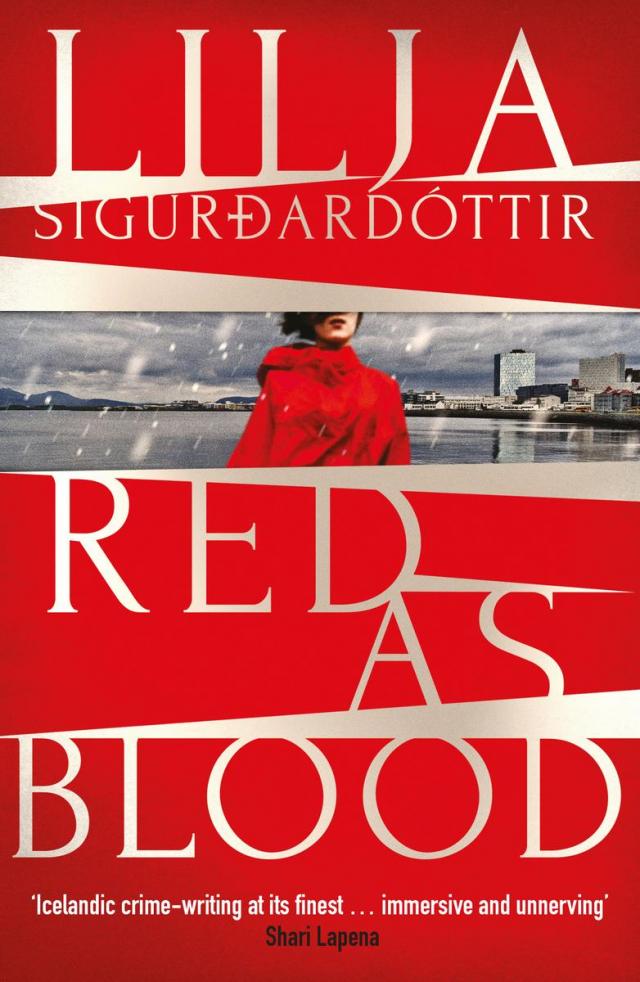
But the text of the book is not the only thing that matters. A book needs a cover, and I have been so lucky to have Mark Swan design mine. I could not be happier with how Red as Blood looks. Cole Sullivan and the rest of the Orenda Books team also deserve a shout-out for all of their hard work, plus Mary Picken for encouragement and assistance, and bloggers and reviewers for getting the word out there. I really appreciate it.
I also appreciate my fellow crime writers. The international community they form is a very important support system and has been inspirational to me.
But first and foremost, thank you readers; this book is for you. I hope you enjoy it.
—Lilja
ABOUT THE AUTHOR
Icelandic crime-writer Lilja Sigurðardóttir was born in the town of Akranes in 1972 and raised in Mexico, Sweden, Spain and Iceland. An award-winning playwright, Lilja has written ten crime novels, including Snare, Trap and Cage, making up the Reykjavík Noir trilogy, and her standalone thriller Betrayal, all of which have hit bestseller lists worldwide. Snare was longlisted for the CWA International Dagger, Cage won Best Icelandic Crime Novel of the Year and was a Guardian Book of the Year, and Betrayal was shortlisted for the prestigious Glass Key Award and won Icelandic Crime Novel of the Year. The film rights for the Reykjavík Noir trilogy have been bought by Palomar Pictures in California. Cold as Hell, the first book in the An Áróra Investigation series, was published in the UK in 2021.
She lives in Reykjavík with her partner. You’ll find Lilja on Twitter @lilja1972 and on her website liljawriter.com.
ABOUT THE TRANSLATOR
A series of unlikely coincidences allowed Quentin Bates to escape English suburbia as a teenager with the chance of a gap year working in Iceland. For a variety of reasons, the year stretched to become a gap decade, during which time he went native in the north of Iceland, acquiring a new language, a new profession and a family.
He is the author of a series of crime novels set in present-day Iceland. His translations include works by Guðlaugur Arason, Ragnar Jónasson, Einar Kárason and Sólveig Pálsdóttir, as well as Lilja Sigurðardóttir’s Reykjavík Noir trilogy, standalone novel Betrayal and the Áróra series. Follow Quentin on Twitter @graskeggur.
Also by Lilja Sigurðardóttir and available from Orenda Books
The Reykjavík Noir trilogy
Snare
Trap
Cage
Betrayal
The Áróra Investigation Series
Cold as Hell
Copyright