

Time for a change, p.3
Time for a Change,
p.3
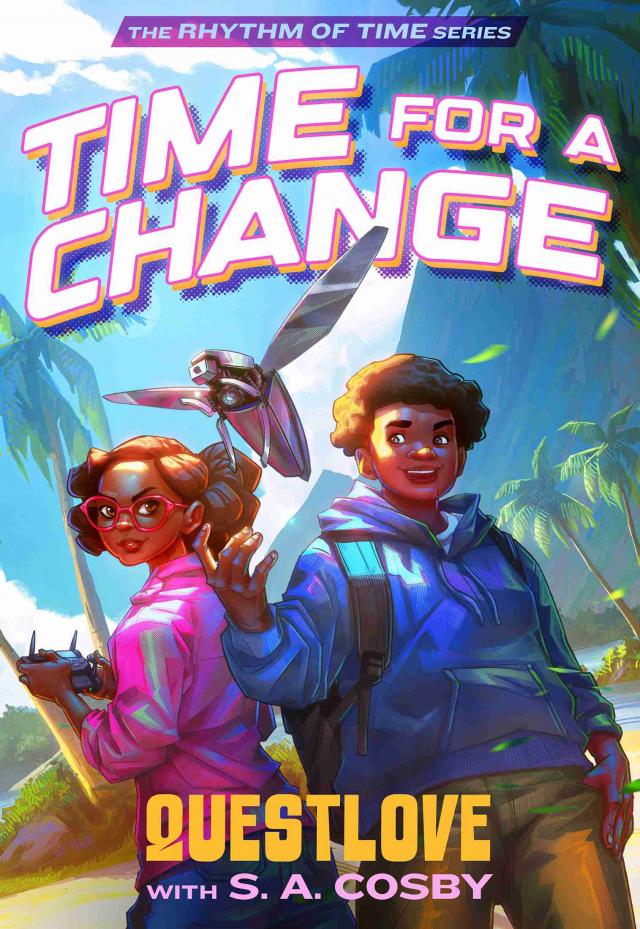


Rahim pushed the button at a crosswalk.
“I ain’t scared. I just don’t wanna do it until I’m ready,” he said.
“That’s the thing,” she said. “You are ready. Look, I’m good at making beats, but you … you have a talent for lyrics. You call me a genius, and I am one, but when it comes to lyrics, you’re a genius, too. This is your thing. It’s the thing you said you wanna do when you grow up. You need to make that happen.”
“Well, does that guy on the screen look like a hip-hop lyricist? He lives in some sort of time-travel crime lab.”
“You know their present doesn’t have to end up being our future, right? If we find Dr. Jackson and stop these Chrono-whatevers, maybe things change. That’s our best chance at getting the futures we want. You can be a famous rapper, and I can run NASA.”
The WALK sign turned white.
“Yeah, maybe,” Rahim said. “Or maybe the dodo birds show up. Either way I know I’m not ready to go onstage.”
“I don’t get you. I know you’re brave enough. You need to do this. And I’m not just saying that because I got some fire new beats for you,” Kasia said.
They stopped on the corner. They were home, more or less. They were next-door neighbors. Their houses were only ten feet apart.
“Thanks for believing in me,” he said. “I mean it.”
“No biggie. Just telling the truth,” Kasia said.
Rahim lingered on the corner. He shifted his backpack from one shoulder to the other. That was another good thing about one-strapping. It was a way of spending time and extending a conversation.
“What now? You nervous about going on this mission? You want me to go with?” Kasia asked hopefully.
“Nah, it’s not that. I mean … it’s kinda that. The way they were talking about the end of the world and everything,” Rahim said.
“Not just the world. The universe,” Kasia corrected.
Rahim let out a sigh.
“Well, today’s a bad day for the universe to end. Remember I told you my dad wants me to go to a music college? Today is supposed to be my first trumpet lesson,” Rahim said.
“Trumpet? Why’d you pick the trumpet? Doesn’t your mom teach violin and cello and stuff? Or drums, wouldn’t the drums be easier? I mean, they look easy,” Kasia said.
“Drums are too complicated. You gotta pat your foot and then move your hands and … it’s just a lot. I don’t know how people do it. The trumpet’s definitely easier. Anyway, today is my first lesson. Hey, you wanna walk over there with me? We can get doughnuts after,” Rahim said.
This time it was Kasia’s turn to frown.
“I mean, I would, but I told Tomas I’d go over some beats with him for his song. We gonna video call. I think Dasha is going to come, too. Maybe I can go over there with you tomorrow,” Kasia said.
“Don’t worry about it,” Rahim said. “It’s cool.”
It definitely wasn’t cool, but he didn’t feel like starting that up all over again. He wasn’t even mad. He felt around in his head and decided that he was disappointed. Most disappointed people, he thought, are disappointed at least partly in themselves. His next thought was, That’s something my dad would say.
“I gotta go to this lesson. I might go on the mission from there if I get a chance,” Rahim said.
“I’ll be ready. Have fun at your class,” Kasia said
“I don’t know if that’s going to be possible.”
* * *
Rahim walked into his house. Violin music filled the air. He could hear his mother’s voice coming from her studio, where she gave private lessons.
“Good, Shia. Very good. Now remember your finger placement.”
Rahim moved toward the stairs.
“Any homework tonight?” his father said.
Rahim stopped and shifted his backpack again.
“Yeah. Just some math stuff. Is it okay if I skip dinner?” Rahim said. He wanted to rush upstairs and put together his supplies for the time-travel mission. He wasn’t sure when he’d be going, but he needed to make sure he was wearing clothes that wouldn’t stand out too much in 1978, and that he had a little bit of money on him.
His father leaned forward in his recliner. Dr. Omar Reynolds put aside the book he was reading and motioned for Rahim to come closer.
“You know,” he said. “When my students are having a difficult time with one of my assignments, I notice things. I see how they stop taking breaks. How they skip meals. Now, in college most of my students are adults, so I generally don’t interfere unless they ask for help. But I’d be remiss in my duties as your father if I didn’t ask after your general welfare. Are you okay, Rahim?” Professor Reynolds asked. His father taught history and sociology at a small local college. His mother said his dad could have taught at Penn State or Temple, but he was dedicated to helping kids who couldn’t afford to go to those schools.
Rahim sighed. He hated the part where his dad put maximum focus on him and the way he was feeling.
“I’m okay, Dad,” he said. “I just wanna get this assignment done.”
“Okay. You know I’m always here for you. Remember, we are going to pick your sister up from conservatory this weekend. Maybe we can take a look at the place while we’re there. There are several good music-theory programs, including ones that deal more directly with rhythm and form. So get ready for a Reynolds family road trip!” Dr. Reynolds said.
“We don’t have a car,” Rahim said.
“That’s what they made rentals for, son,” his dad said. “The universe provides.”
Rahim laughed. His dad smiled.
“You ready for your first music lesson? Your mom picked your trumpet up this morning. Soon as she is done with her lesson, she’ll get it for you,” Professor Reynolds said.
Rahim shrugged, which pleased his father not at all.
“Humph,” Professor Reynolds said. “We’ve talked about this, Rahim. If you want to go into music as a career, you need a foundation.”
Before Rahim could respond, his mother and her student came out of her studio. Shia was older than Rahim by about three years, but he was a little taller than her. She got out of high school an hour early to come study with his mom. She was carrying her violin case under her arm.
“Hey, Rahim,” Shia said. She smiled at him.
“Hey,” Rahim said.
“All right,” his mom said. “We’ll see you Thursday. Keep practicing your scales, okay?”
“Yes, Mrs. Reynolds. I will, bye. Bye, Rahim,” Shia said.
“Bye,” Rahim said.
Shia went out the door.
“I think you have a fan,” Mrs. Reynolds said.
Rahim felt his face get hot.
“Aw, Mom, stop,” Rahim said.
“I’m not going to stop, because I’m not starting anything,” she said. “Come on in the studio. I got something for you.”
Rahim followed his mom inside. One wall was lined with a bookshelf that went from the floor to the ceiling. Most of the books were about music, but there were some about history and politics and a few that were about science. Both his mother and his father were voracious readers, but neither was into fiction. Rahim sometimes dreamed of a shelf filled with horror novels and comic books.
The other side of the studio had a thick noise-canceling padding on the wall. In the center of the room there were two music stands, three chairs, a small desk with a metronome on it, and a small glass dish full of mints. Also sitting on the desk was an open black instrument case with a shiny new trumpet.
Rahim looked at the trumpet lying on the black velvet lining inside the case. It reminded him of a dead body in a coffin. If he didn’t like being untruthful with his parents, he liked arguing with them even less. He loved them. But he had to say something.
“Mom,” he said. His dad had come into the room, too. “Dad. Listen. I want to be a rapper. I want to go to college and study hip-hop. Kasia showed me some schools that have degrees in hip-hop. I know what you guys always say about being serious about studying and having a foundation. I will do that. And I’m not being stubborn. I will take lessons like you want. I appreciate you getting me this trumpet. But I also want to do what I want to do,” Rahim said.
His father walked over to the table and stood next to him.
“Rahim,” he said. “That’s a fantasy. I know you and Kasia have fun making your little songs. But a degree in hip-hop? What’s next, a degree in coloring or playing with blocks? I have talked with your mother about this.” His mother nodded. “We agree that I shouldn’t push you into a career in academia like me. Still, you will absolutely get a real college degree like your sister. A legitimate one. You want to work in music? Then this is how you do it. You learn an instrument; you go to the Curtis Institute and you get a degree; and then you get a career.”
“You mean a job,” Rahim mumbled.
“Are you talking back to me?” his dad said.
“Omar, stop. Rahim, I think your father is right. Learning an instrument is a good first step. Besides, you don’t like to sing.”
“I don’t like to sing because I don’t want to sing. I want to rap. I want to be a part of hip-hop. Four the Hard Way did it. Why can’t I?”
His father shut the lid of the instrument case.
“Why? Because Four the Hard Way is a one-in-a-million shot. I’ll say it again, Rahim. You learn an instrument; you get a degree; then, yes, you get a J-O-B. Then and only then can you make your own decisions about your career. Until then you do what we tell you. Now put your books upstairs. You don’t want to be late for your first lesson,” his dad said. Rahim looked at his mom. She smiled at him, but her smile was sad around the edges.
“Let me run upstairs for a minute,” Rahim said. “I want to change.”
* * *
His parents walked him to Mr. Alves’s studio, which was in an office building near Federal Donuts. Rahim wondered if they went with him because they thought he was going to ditch. He wouldn’t ever do that, no matter how much he thought they wanted the wrong things for him.
Mr. Alves was an older Hispanic man with long black-and-gray hair and a bushy moustache. Rahim thought he looked a little scary, but when he spoke his voice was kind and gentle.
“Rahim, it’s so nice to meet you! Bring your trumpet into the studio and we’ll get started,” Mr. Alves said.
“We’ll be back at five to pick you up,” Rahim’s father said.
Rahim went into the studio, which was a simple room with wood flooring, two chairs, and a stand for sheet music. It wasn’t as nice as his mother’s studio at the house. There were dozens of black-and-white photos on the walls. Rahim noticed many of them were autographed. He figured they were some of Mr. Alves’s former students. His mom had a similar wall in her studio: When former students joined an orchestra or went on tour with a band, they would send her promotional shots.
“So, how long have you wanted to play the trumpet, Mr. Reynolds?” Mr. Alves asked.
“Uh, you can call me Rahim. Uh, well, I don’t really want to play the trumpet.” He hurried to add more so the man wouldn’t be offended. “I mean, I don’t know about it, is what I mean.”
“Hmm. I see. Let me guess. You dad wants you to get a degree in music. Is that what you want?”
Rahim shook his head.
“So what is it that you do want?” Mr. Alves asked.
“Promise you won’t laugh?” Rahim asked.
Mr. Alves smiled. “I promise, Rahim.”
“I want to be a rapper. I like to write lyrics. My friend Kasia makes the beats on her computer.”
Mr. Alves put his fist to his chin.
“Hmm. Well, I am not in the business of making someone do something they don’t want to. However, your parents have paid for three months of lessons. So what if I could teach you some things that you could maybe use in your own songs? I can teach you about melody and time and rhythm. Does that sound like something you might be interested in?”
Rahim thought about it.
“Okay. I mean, it will keep my dad from getting mad at me, I guess. And thanks for not laughing when I said I wanted to be a rapper.”
Mr. Alves chuckled. “Why would I laugh at something legitimate?” he said. “One of my favorite artists is Pete Rock. Do you know who that is?”
“Um … no,” Rahim said.
“Well, he is one of the great producers in hip-hop. He is known for his use of horns and sampling. Horns like that trumpet you’re carrying. So, Rahim, think you’d be interested in learning how to make beats with your trumpet? I’ll even play some Pete Rock songs that I can teach you.”
Rahim suddenly felt a little better about music lessons.
“Sure, Mr. Alves. That sounds cool.”
Mr. Alves found a few songs from Pete Rock and C.L. Smooth on his phone and played them through a small Bluetooth speaker on his desk. After a few seconds, he would stop the song and write out the notes on sheets of staff paper. Mr. Alves showed him the difference between a half note, a sixteenth note, and an eighth note. He used a trumpet of his own to show Rahim the difference between a C-sharp and a D-flat and how they were used in not only Pete Rock’s songs but in other hip-hop songs that used horn arrangements. Then he got Rahim trying to play the horn parts himself.
“Okay,” Mr. Alves said. “Let’s take a break. It’s been an hour.”
“Really?” Rahim said. It had felt like twenty minutes at most.
“You’re not doing so bad, but you have to work on your breath control. And we have to get you more familiar with reading sheet music. Still, for a beginner you’re showing great promise.”
Rahim doubted he was showing any kind of promise, but learning the different notes was kinda fun. It was like a secret code. Didn’t make it any easier for him to play the trumpet, but it was cool anyway.
Rahim felt his phone vibrate in his pocket.
“Mr. Alves, can I use the bathroom?”
“Sure, down the hall on the left.”
Rahim hurried down the hall. In the bathroom, he pulled out his phone and answered it.
“You still at your music lesson?” Kasia said.
“Yeah. I got like thirty minutes left. You finished with Dasha and Tomas?”
“Yeah, I made up a couple beats for them, but now I’m thinking maybe we should add your trumpet to it. How long you gotta do this?”
“At least three months. That’s how much my parents paid for in advance,” Rahim said.
“My parents never make me do anything I don’t like,” Kasia said.
“You don’t have to rub it in. But it ain’t that bad. The teacher, Mr. Alves, is pretty cool. He is teaching me some songs by a guy named Pete Rock. He uses horns for his beats sometimes. It’s pretty fire.”
“You know what? Instead of adding horns to the dance thing, we should use them in our song.”
Rahim rolled his eyes hard enough that he wondered if Kasia could hear him.
“Anyway, that’s not why I am calling.”
“I figured,” Rahim said. “What’s up?”
“I heard from our future selves,” Kasia said. “They were wondering when you were gonna go grab this volcanic rock.”
“Igneous Rock and C.L. Boom,” Rahim said under his breath. If Kasia heard the joke, she chose to ignore it. “Do you have any idea of the schedule?” Kasia said.
“It never freaks you out that we have a phone and a computer that get messages from the future?”
“No. I mean, I built the first phone, and it looks like I’m still building things in the future. Nothing I can do surprises me. Should I tell them that you’ll go tomorrow?”
Rahim shook his head and laughed softly. When he had gone back in time the previous winter, he had met his Uncle Shaka, his father’s brother. Shaka liked to say it wasn’t bragging if you could actually back up what you were saying.
Kasia never bragged because she always backed up what she said.
Rahim looked around the bathroom. “I guess I can go now. I can set the phone to come back right when I’m leaving. Mr. Alves won’t even realize I’m gone,” Rahim said.
Rahim locked the door to the bathroom and sat on the toilet.
“Okay, I’m ready,” he said.
“Okay. I got a lock on your phone. Do you think you need to take Iago with you? I can send him over to do the trip with you. Where are you at, anyway?”
“I’m over near Federal Donuts. But I shouldn’t need him. I’m just picking up a rock, right?”
“Okay, if you’re sure. I just upgraded his didactyl functions. He might could help.”
“I don’t even know what that means. No, no. I’m ready. I’m about to open the portal.”
“All riiiiiiight … got it,” Kasia said.
Rahim took a deep breath and touched the hourglass icon on the phone. A screen popped up with two empty fields. In one field he typed Honolulu, Hawaii. In the other field he typed September 1978.
Taking another deep breath, he touched the hourglass icon again.
Soon the air in front of him began to shimmer. A light-green glow began to fill the bathroom. Numbers started to fly across the display on the phone. Suddenly he felt like he was diving into the deep end of a pool, and for a moment he had to hold his breath.
I’ll never get used to that, he thought.
And then he was gone.
4
The first sound he heard was the ocean. The rhythm of the waves crashing against the shore was like thunder.
Rahim opened his eyes and found himself standing on a bone-white beach. The sun was a huge orange circle in the crystal-blue sky. He could smell salt in the air. It reminded him of when he went down south to visit his grandfather and grandmother during summers, but this was like a postcard version of that. The beach was full of people sunbathing, running, swimming. In the distance he could see people surfing. The waves weren’t that high, at least not to Rahim, but he could see figures executing complex moves on their surfboards while more people paddled out to shore.
Most people were wearing shorts and tank tops. He saw a few of them in tropical shirts and pants that stopped at their calves. He looked down at his own clothes. Whenever he went on one of these time-travel excursions, he tried to make sure he wasn’t dressed in a way that would make him stand out too much. He hadn’t been able to do much research on the fashion in 1978 Hawaii, but he was dressed down enough that he wasn’t noticeable. He was wearing a Spawn T-shirt and jeans and his Converse.


