Extinction the dark fae, p.1
EXTINCTION: The Dark Fae,
p.1
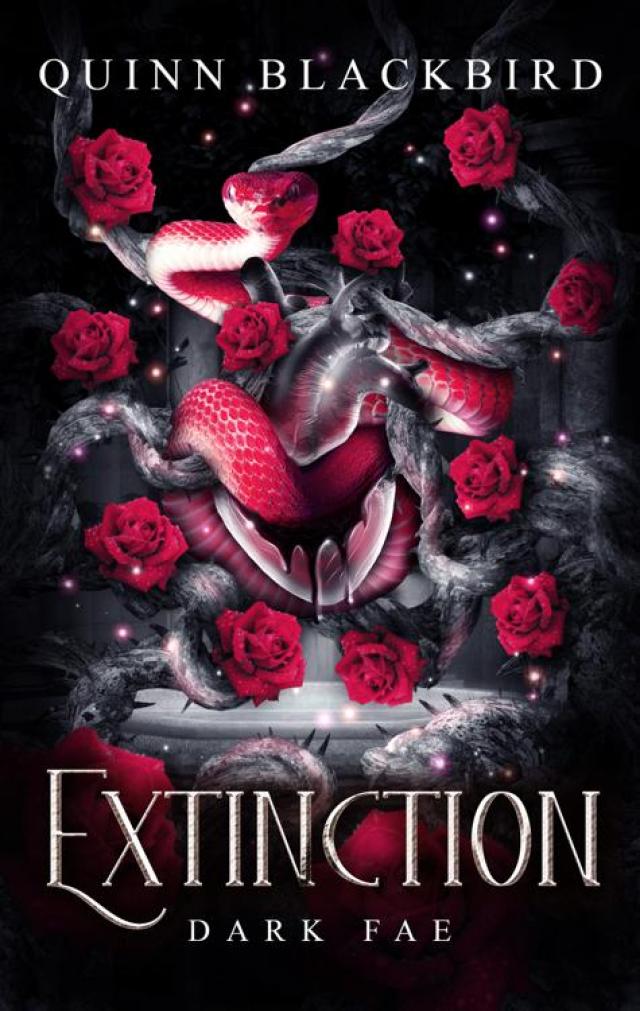


THE DARK FAE
EXCTINCTION
1
QUINN BLACKBIRD
Extinction The Dark Fae
A series in the Dark Fae Universe
Copyright © 2024 by Quinn Blackbird
All rights reserved.
No part of this book may be used or reproduced in any manner whatsoever without written permission—this includes scanning and/or unauthorised distribution—except in case of brief quotations used in reviews and/or academic articles, in which case quotations are permitted.
This is a work of fiction. Any resemblance to actual persons, whether alive or dead, is purely coincidental. Names, characters, incidents, and places are all products of the author’s imagination.
Imprint: Independently published.
EXTINCTION 1
THE DARK
1
2
3
4
5
6
7
8
9
10
11
12
13
14
15
16
17
18
19
20
21
22
23
24
TWO DAYS AND ONE NIGHT LATER
25
26
27
28
29
30
31
32
33
34
35
36
37
38
39
40
41
42
43
44
45
46
47
48
49
50
51
52
53
54
55
56
EXTINCTION 1
THE DARK
First came the darkness, billowing out of Britain.
Then the world went quiet. Radios turned silent, planes fell out of the sky. Our technologies died.
Famine erupted through the world like a bomb, bloodying battlefields between countries
It was the plague, however, that wiped out most of our numbers.
My name is Coralie and I fell victim to that very virus. I was one of the few who survived.
But nothing—absolutely nothing—could have prepared us for what came next; them charging into our globe in their hundreds of armies, spreading across the world like a new darkness and plague combined…
The dark fae have come to finish what they started. They have come to end us.
1
I have almost died too many times to count. Most of us who have survived this long can say the same. Lives lived with bunches of almosts and nearlys and not-quites.
The last time I met my almost death was only a couple of days ago—if the concept of ‘day and night’ even exists anymore.
Since before the dark fae came to this world, their pitch-black air billowed out of the Scottish Highlands and rolled over the world. From above, nothing can penetrate the thick blackness that engulfs us—not the moon, the stars, the sun. We are lost in the nothingness down here with only the occasional weak torches to give us dusty light.
That darkness brought with it the loss of all that we knew. Technology, abundant food sources, sight, safety—all gone. And the black air brought so much more; a plague. One so rampant yet silent and wholly aggressive that, even though I was one of the very few to survive the virus, I still feel its effects in my body today.
The chills cling to my bones, my fingers tremble and twitch, and there is a constant pallor of my weak skin that—if I’m cut—bleeds for too long before healing. All mere echoes of the pain I once suffered for weeks, trapped in quarantine with dying patients littered in iron beds all around me.
Memories of those gruelling, torturous quarantine days haunt me. They come in flashbacks so vibrant that a violent shudder rolls through my body.
On a stuffy, torn couch, I wrap my arms around myself and bring my legs up to tuck my knees to my chest. I’m all balled up, resting my heart-shaped chin on my creaky kneecaps (symptoms of too-long walks through the rough cobblestone streets and paths of France’s West).
I clench my hands at my legs to stifle the trembles taking root there. Cutting my dark-blue eyes (not the hue to stand out with blazing brilliance) around the crammed apartment kitchen, I see that sometime during my supressed memories, most of the small group has found sleep.
We reached the town of Tours—our torches illuminated the town signs on the main road a while back—no more than some hours ago, so I’m amazed that so many of us have caved to sleep already. It’s like the traumas of this cold, dark world don’t haunt them in the quiet moments, and as though out there, the dark fae don’t pillage and burn and destroy in a never-ending burden of loathing.
And loathe us, the dark fae do.
Why else would they have waged war on us? These creatures that we knew so little of, beasts that we thought to be old tales spun by ancient peoples, utter myths—they came to our world, darkness and plague and war, to end us, all without us even having the slightest suspicion that the dark fae existed.
Well, joke’s on us. And we are the punchline.
A bitter smile warps my face into something of a grimace. I bury my face into my knees, protecting my grim expression from those few of us still awake in the kitchen. Slightly, I shake my head at my own twisted sense of humour.
In a heartbeat, the smile is wiped right off my freckle-dusted face. The trembling in my hands surges with a sudden vengeance. I flex my fingers, peeling them apart from each other then give them a good shake.
This gesture draws in a few glances. The two lingering stares come from a married middle-aged couple tucked in the corner of the room, pressed against chipped white-painted cabinets. I can make them out only due to the blue gas-flames burning on the cooktop. We lit them when we barricaded ourselves in here for a rest.
Any chance not to use up our torches is an opportunity not to be missed. Torches aren’t all that difficult to find, it’s the batteries you’ve got to look out for. It all comes down to them, and back when quarantines were popping up and the darkness caused evacuations to spring up all over the world, batteries were one of the things looted by most, and left behind in the so few.
At the reminder of the black world and early days, I look at the window. It’s propped up above the sink, overlooking the street below, where medieval-faced houses line the cobblestone. A set of cheap metal-like blinds covers the window, but through the creaks and dents and gaps, I can make out the pitch-black air beyond the window.
The darkness came before the virus did, but it was in quarantine that I recall the true bone-deep terror of it.
My bed was tucked at an angle beside the panelled window. I spent my days staring out of it, picturing the grassy hills of Southern France that should have been there—and they were there, somewhere devoured by the dark air. But I didn’t see a damn thing other than the pure black nothing so thick and glossy that I remember thinking back then that it was as though the window was lacquered obsidian from the outside
I’d lived most of my life alone, but it was then that I felt it most. With so many dying around me, and all that I could face was the darkness on the other side of the window—an omen of what was to come to this world—I wondered then if it would be best to simply die along with everyone else in the flooded hospital room.
Alas, my luck meant that I survived it. I caught it, suffered for most of the wars that erupted between neighbouring countries (food shortages will drive just about anyone to violence) and the dark fae coming and the evacuations, then simply woke up one day without a fever. The next day, I could move. And on the third day, no one came to my bedside when I finally managed to call out for help.
It was on the fourth day that I was able to wander (or stagger) around the hospital and I realised that those who had survived—doctors, nurses, patients, whoever—had abandoned the place.
I’d tried the phone. Every phone I could find. Got no dial tone, it was just silence. I couldn’t get in touch with anyone; not my mother, nor my father, not even that one girl, Natalie, from boarding school who might be considered a friend if being generous. In truth, there are no friendships among the rich, only pacts.
And I was left without alliances, in a world I didn’t know, where things had happened that I knew nothing about.
It wasn’t for weeks that I came across others—a surviving group—and learned all that I’d missed. Needless to say, everyone I’ve ever known in the Before is presumed dead.
Most of the world is dead. We know that since the dark fae spread out around Europe first, left it mostly intact, then reached the farther ends of the world. With all the rumours drifting between surviving groups over time, one theme was constant—the dark fae were burning their way through the world back to us.
And they have reached us, leaving behind a world—cities, towns, villages, farms—completely decimated. Swarms of their armies have burnt our human world to ashes, and now it’s all we can do to keep a day’s distance between us and the nearest dark fae army. There aren’t many survivors anymore, not with so many of the dark fae coming back this way, killing the humans they find, burning all of our histories.
There is no escaping them. No outrunning
the inevitable.
We all know that, every single person in this group has accepted this glaring truth. But the question remained for a while—what do we do about it?
Waiting around to be butchered just didn’t seem to be a popular option in our group. So we came up with a scrap of a plan.
In this kitchen, with the perfect vantage point to the street down there, an almost-finished homemade bomb tucked away in the corner, and some stray dark fae separated from their army and headed our way, we will go out with a bang.
That’s what we’re doing here.
We are here to fight.
And we are here to die.
2
EARLIER
The handful of dark fae strays coming our way isn’t something we would have known if it weren’t for the most recent almost-death I mentioned earlier.
Loudun, France is a commune about a day’s walk from Tours, where we are now. It was in Loudun that we were hiding out, gathering supplies, getting some real rest (well, everyone else got some zzz’s but I find it hard to sleep longer than twenty minutes at a time without the sudden terror of dark fae hunting us zapping through my body and jolting me awake). Good thing I wasn’t sleeping that night, since I was the first to feel it—
The tremor.
It shuddered the floor of the grocer’s shop, rattled the windows in their frames with the sounds of faint whispers, like wind whistling through cracks. At first, that’s exactly what I thought it was—wind creeping into our dark space. But it was no breeze, no gush of air. It was the first symptom of what was to come: an earthquake.
It wasn’t my first thought. Even when all twelve of us had woken up to the third surge of rattles whose violence increased with enough power to rain down dust from the panelled ceiling, no one suspected that we were about to be thrown into the midst of an earthquake, cracks in the earth beneath us.
I’m from the South of France, spent much of my time at our villa there, gone for those semesters at boarding school. I know my country. France doesn’t get earthquakes … at least not before the dark fae invaded us.
Now, there is little to recognise in this new world. Whether the earth is rejecting the invaders, the darkness, the loss of its original and wretched guardians, I don’t know. All I know is that the earth is angry, and we wound up in the middle of its rage.
That day was a brutal one; more so than any I’ve ever faced before.
Mere rapid heartbeats after the third tremor, the entire group flew up in a flurry. Hands were snatching at duffel bags, clattering sounds of people fumbling with torches echoed out, the scuffs of boots scraped over the linoleum floor.
Everyone grabbed what they could, even with the ceiling dust turning to chunks of cardboard-like wood starting to rain down on us. One, the size of a half-torn torso, whacked me on the head, good and hard. The hit was enough to drop me to the floor like a sack of rice. But it didn’t knock me out.
Dazed, I staggered to my feet, felt around in the shuddering shop for my things. I managed only to grab the thin spaghetti-strap of my shoulder bag before a meaty hand snatched up my bony bicep and a gruff voice growled my name with exasperation, “Coralie.”
I sucked in a sharp breath before Paul swung me out of the danger zone of collapsing chunks of ceiling.
We stumbled forward, his hand slipping away from my arm. The crash of wood smacked down behind us with enough impact to cause a tremor of its own.
Distantly, I was aware of the shop door being booted open. The bell above it rang for a beat before it was drowned out by the sudden rise of crashes and bangs and rattles ripping through the air. Sounded almost like a fast train tearing off the rails, if that heart-stopping noise was magnified to flood an entire town.
Footsteps pounded on the linoleum, piling ahead to the open glass door. We poured out onto the street, bodies slamming into bodies, arms bouncing off arms. A bag whacked me over the shoulder at one point, but I hardly felt it. I don’t think I even noticed it at the time.
There was a moment out the front of the rattling shop; a moment of deafening songs of tremors, strangled breaths and shuddering bodies, and the flickers of torches giving off their faint light in the suffocating darkness.
The light did little. The dust in the air was too thick to see through—and I could already feel it starting to crawl down my itchy throat. Panicked gasps were breaking out all around me; everyone, suffocating on the dust spraying down from the buildings around us, hidden deep in the dark.
“Get to the middle of the road,” a familiar gravelly voice commanded, and I recognised it even in the faint wispy light of the torches to belong to Paul. If we had a leader among us, it would be him. But in the cold, harsh reality, we are a band of individual survivors—each one of us out for themselves.
But an earthquake?
That was a danger we hadn’t faced before. And sticking together was our best chance to survive.
We herded ourselves like sheep without a shepherd to the middle of the road. Before we could form a solid wall, someone squeezed into the middle of the group, and I caught the faint scent of peach-juice from a tin. It must have been Elsa, since she was devouring the canned peaches earlier before sleep came for most of us.
I couldn’t bring myself to be annoyed at Elsa for using us like shields against falling debris; wood house-faces and roof-tiles rolling down to crack against the cobblestone. Really, the tinge of annoyance that twisted my narrow face into a grimace was sprung through me purely because I hadn’t thought of that.
A soft murmured voice somehow carried over the shattering violence in the air, “Shouldn’t we find cover?”
That question speared memories through me.
Much of the year at Strath boarding school in Scotland meant a lot of days and nights spent binging TV shows. Drama, you know? And of course, earthquakes were a classic trope for those types of shows. So the memories came back to me in flashes, people seeking shelter in bathtubs with mattresses pulled over top, crammed underneath solid dining tables, hiding out anywhere but in the middle of the street—right between two danger points of collapsing buildings. But then, if they were collapsing, were they really all that safe?
“Stay tight,” Paul grunted, the clutch of fear evident in his shaky undertones. His hand—sweaty and too-large—grips onto my shoulder firmly, and it was just in that moment that I realised we were all holding onto each other in a circle around Elsa. “Wait for the tremor to stop, then we run for it.”
Run for it?
Run where?
Who knew how far this earthquake stretched? Did it reach other towns nearby, forgotten farms and lost villages?
All the ramblings and anxieties whirling around my mind didn’t bring an argument to my tongue. I had no better alternative. I wasn’t the one with the plans around here. I was more of a follower—not because I wanted to be, but because I simply couldn’t be bothered with the burden on my shoulders. The less weight to carry in this world, the better.
But now the weight of the world was raining down on us. Well the weight of Tours was, at least.
Beneath my feet, the shudders were starting to slow. Tremors were dying out. My breath hitched audibly and I dug my hold even tighter onto the stretched t-shirts I was gripping onto—Paul’s and whoever else’s. It was impossible to tell with the faint torches aimed down at the cobblestone.
I watched the stones.
Elsa was crouched over, hands pressed against the nape of her neck, shoulders hunched and head buried between her knees.
Bowed over her, we waited for the last shudders of the earthquake to dissolve, disappear back into the earth.
And when it did, we moved fast.
It might have come back. It very well should have since none of this could have been predicted, and the world is now just the opposite of that; it is wholly unpredictable.
The group jumped into shambles.
Hands snatched onto shoulders and fingers clutched the back of t-shirts and cardigans. The rapid thumps of our shoes smacked against the stones as we jogged in a line down the middle of the street. Unsteady, torchlight swerved over glimpses of debris and abandoned cars (whose roofs wore dents) and the glitter of pulverised glass on the ground.
Instinctively, we followed our plan and headed south. Well, back south. For months, we’d been moving around in circles, but it was time to circle around the dark fae when we could and find an already destroyed place by the coast. That was our plan. There, we might be able to rebuild some semblance of a life, with the sea to provide fish and nearby water to keep us alive.