

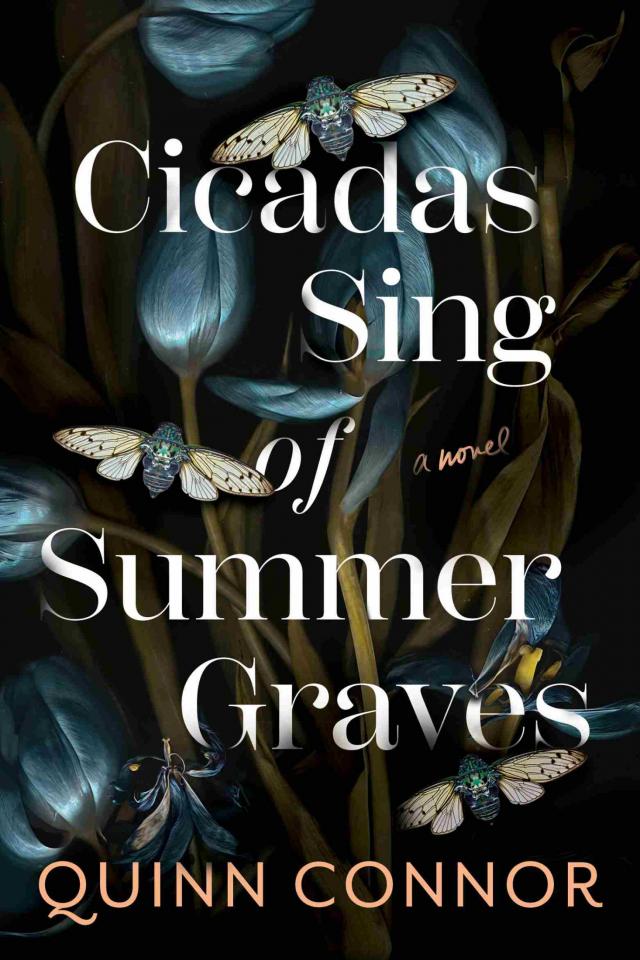
Cicadas sing of summer g.., p.31
Cicadas Sing of Summer Graves,
p.31


Mitch nodded, pondering all this in that way he had, very seriously. He leaned in to catch her mouth for a moment. “Coffee. Coming right up.”
There wasn’t much in the way of breakfast, only granola with the freshest honey, a peculiar rich blend that was nearly as dark as molasses. The bees whispered of a new source, buzzing about spooling black-eyed Susans, beautyberries blooming purple, Solomon’s seal drooping blossoms in the shade, and showy azaleas. She took Mitch’s hand, and they rushed down the banks toward water she hadn’t wanted to look at. It was still difficult to think about the ragged dock, which she hadn’t cared for in years, which might have drifted off entirely if not for Diego’s seasonal care. Even with Mitch waiting for her, even though it was her idea, even though she’d braved it on the Fourth of July, Cassie still stopped herself instinctually on the edge of the water, as if a hand might reach out and snatch her, a shard of cruel glass might be waiting for her foot, as if again she would find only torture waiting for her.
Cassie pulled in a deep breath and stepped in.
Nothing but those soft, muddy waves and mossy algae greeted her. She walked deeper, water cool against her skin, welcoming on a hot day. She sank, dropping to her shoulders, and pushed into the water past Mitch. Out in the heart, it was crystal blue, and boats roared now and then, though none came close. The Grand Destiny was closed today. Bolt had returned home. Valerie and Diego were on an exotic vacation to northwest Arkansas, and the place was shut up and peaceful.
Mitch waded out, keeping pace with her, dipping under to get wet. He held her hand, eyes attentive. “I never thought I’d see the day,” he admitted, mouth curving.
She cupped her hands, filled them, and poured water over his head, letting it tip down his back. “I didn’t either.” They swam together, tangled up.
Cassie had told Mitch her secrets, whatever was left. He helped her repopulate the beehives, and she taught him to see the patterns in the bees’ dance. She told him about the little Frankenstein miracles Grandad had taught her to make out of scraps of metal and gave him the roaring grizzly bear Grandad had made of some clock gears and springs. Finally, she told him about Grandad’s first love and the twisted merging of their lives. She’d talked until her throat was sore, and he’d kissed it better.
Mitch swam now in a perfect breaststroke toward the nearest small island, and Cassie splashed around, imagining the new freckles that would form on her shoulders and how he might try—again—to count them.
She had spent so many years cleaning whatever drowned trinkets she could find, drying them and polishing them, trying to erase water damage and give them absolution. Wholeness. Restoring Prosper, piece by piece. Her life had been spent waiting on shore for the lake to vomit antiques up in a storm or for some intrepid diver to yank old heirlooms from the muddy lake bed, just so she could avoid seeing or touching that water.
Maybe it was time to see what treasures she could pull from the deep—time to dive herself, to trust the place that had raised her. With a final smile at Mitch, she turned on her back and did a backstroke the way Catfish had taught her long ago, propelling herself out past the dock, into where it was blue and glistening.
Once her momentum had slowed to a ramble, she filled her stomach with air. Just like that, she could imagine Catfish’s smile again, her strong arms underneath her back.
I’ve got you, she would assure her, while they drifted in their little cove, two girls safe in the shallows. Okay, toes up, arms out.
Cassie fanned her arms out, fingertips skating on the glassy top the way dragonflies did, those water-skiers in miniature who first taught people to glide.
Good, Catfish would say and step back, gently drawing away. First her support. Then her warmth. And finally her voice would trail off the way an inlet faded into dry land. Now breathe and rest.
“Okay, Catfish.” Cassie closed her eyes, sunlight warm as a kiss on her face, warm as Mitch’s laughter. Whenever she breathed in, the water lifted her.
And she dove.
READING GROUP GUIDE
What did you know about the real histories of towns being drowned in “development-induced displacements” prior to reading the book? What ideas or feelings were awakened in you thinking about these true stories while reading?
Cassie is terrified to go near the lake, yet she spends her days lovingly restoring objects salvaged from its depths. Why do you think she has devoted her life to this practice? What does it say to you about the ways we are shaped by childhood experiences?
What was the significance of the telescopes, and what did they really show to Lark? If you were Lark, would you choose to look through the spyglasses? Why or why not?
Lark, Cassie, and June each have a complicated relationship with a parent, whom they both love and yet feel some essential disconnection from. How do they each choose to cope with these relationships? Have you ever had to navigate similar dynamics?
June is introduced as a character who has felt pressure to hide parts of herself—like the flowers that grow in her hair. Is the need to hide or reduce some part of yourself a struggle you relate to? How does June’s inner conflict unfold through the story?
Each of the three main characters is an inheritor of the history of the lake, with familial roots linking them to the past. How do they each contend with this legacy? Where do you come from, and are there any complexities to the way you feel about your own home?
The ghostly fisherman retells part of the biblical story of Moses to June. How does that story function in this novel? What did the fisherman mean when he said, “Sickness came, and Pharaoh didn’t do a single thing. Didn’t lift one finger. Times like that, we do what needs done to save our kin. We let them other people go.”?
Bolt spends much of his summer with his old friend Rig. But over the course of the book, the dynamics in their friendship radically shift, culminating in violence on the Fourth of July. How are the larger conflicts of the lake reflected in the teenagers’ shared tumble into violence?
How do June and Lark find each other, and what connects them in the novel? Is it possible to carve out spaces of queer joy in fraught landscapes?
The Fourth of July provides a pivotal backdrop to some of the book’s most climactic scenes. How does patriotism or the State inflect the events/themes of the novel?
Was Jeff Daley a bad person? He came to Lake Prosper with ambitions of building up tourism and “saving the town.” How did/didn’t he bring about his fate?
Who was the fireworks man? What role did he play in the lives of the characters of the book? The fireworks man clearly felt a deep affinity to June. In what ways (if any) was June like him, and how was she different?
Near the close of the novel, Lark thinks, “The lake and the town below were both real, pressed together…the histories were layered like a spiraling shell… Not every old hurt could be healed. People, like water, had a way of flowing imperfectly on.” How does living near or alongside histories affect the way you live your life? Everyone has been hurt before; how do we honor that pain and still find new joys?
ACKNOWLEDGMENTS
The authors would first like to thank their precious cats, Theo and Prosper, who napped through most of the work we put into this book. To our agent and third Beatle (So, George?), Amy Stapp, a thousand thanks for being our steadfast champion. And to our brilliant editor, Mary Altman, thank you for being Quinn’s perfect match in voice, enthusiasm, and favorite drag queens.
Thank you to Sourcebooks Landmark: our production editor, Jessica Thelander; our copy editor, Manu Velasco; our marketing team, Cristina Arreola and Anna Venckus; our amazing cover designers, Brittany Vibbert and Erin Fitzsimmons. And to our thoughtful sensitivity readers, Lashaunda, Margeaux, and Dee, thank you so much for sharing your perspectives and engaging with our work. For input in the course of our research, we humbly thank Cheryl Batts, the CEO and founder of the Uzuri Project in Hot Springs, Arkansas, an organization devoted to preserving local African American history; the Garland County Historical Society; and Dr. Wendy Richter.
Thank you to photographer extraordinaire Frank for capturing our author photo, and to Shelly for flawlessly editing it. Ayana, thank you for loving, for reading, and for always offering your strength and your insights on the publishing process. We may never have even gotten an agent without you.
Thank you to our alma mater, Rhodes College. And finally, gratitude for the other half of Quinn Connor: one always believes when the other can’t; one picks up the pieces of our stories the other can’t hold alone.
Robyn: thank you to my best friend, my mama. Thank you to Daddy; all the Barrows (what’s the next minor holiday I can see y’all for?); Uncle D; my ride-or-die, Kyleigh; until-death, Jessica; my Yorkshire sunshine, Emily; my ever-interlocutor, Erin; my poet, Aylin; my peregrina, Lauren; “hello my dear!” Amanda; Jessi, from the lake; puddin’; Ramey; my strawberry, Ayana (once wasn’t enough); Jenny and those Tokheim-Hubbards. Sally Dormer, thank you. To the art history department at Penn, especially my venerable adviser, Sarah, as well as Darlene, Julie, Libby, Shira, Ivan, and Bob. And thank you to my special ones who are gone.
Alex: thank you to my family. Mom, because when I got tired, you picked up the pencil and let me dictate my first story to you. Adrian: because what’s a sister, if not God giving you a ride-or-die? And Aunt Loli, for fostering my early love of reading, even when you lived a whole ocean away. (Also Dad, but you already got the dedication.) Thank you to my two very best friends. Nancy, for being the first audience for my amateur, early drafts, and giving me a thousand tiny pushes to keep writing. And Courtney, for being my biggest cheerleader; your friendship carries me through. Thank you to my mentors. Lynn, for your steady counsel; Christian, for your mentorship that transformed my journalistic work; and finally the late Mark Behr, whose fiction writing lessons (monologues) guide me to this day.
ABOUT THE AUTHORS
Quinn Connor is one pen in two hands, Robyn Barrow and Alex Cronin.
Both writers from a young age, Robyn and Alex met at Rhodes College in Memphis and together developed their unique cowriting voice. An Arkansan and a Texan, they can often be found arguing about the differences between queso and cheese dip. Whether Robyn is wandering the Far North for her PhD or Alex is chasing down homemade pasta in Prospect Heights, they write all the time. It’s their preferred form of conversation.
Thank you for reading this Sourcebooks eBook!
Join our mailing list to stay in the know and receive special offers and bonus content on your favorite books and authors!
CLICK HERE TO SIGN UP
Books. Change. Lives.
Quinn Connor, Cicadas Sing of Summer Graves


