

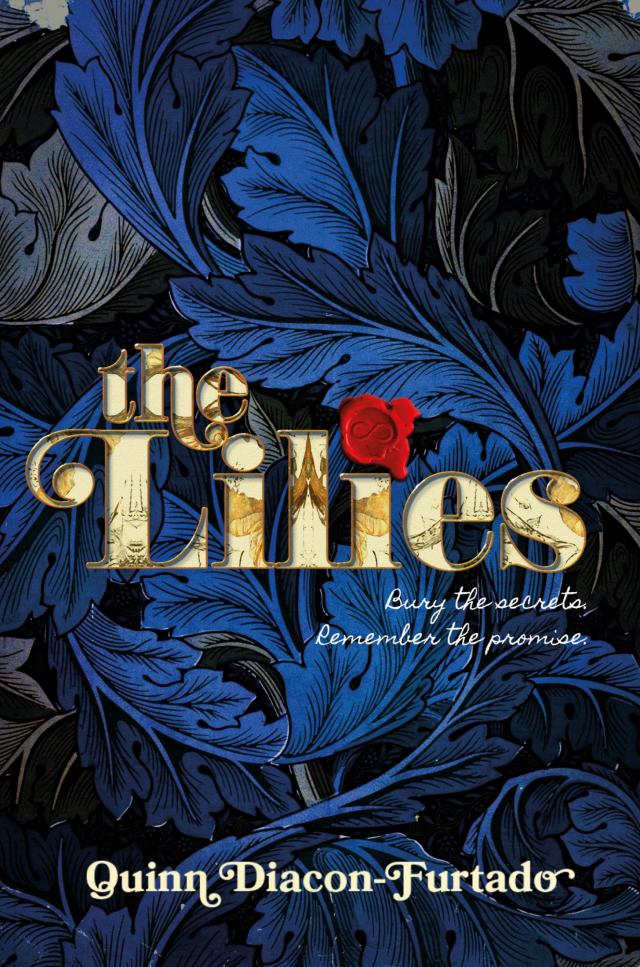
The lilies, p.1
The Lilies,
p.1


Epigraph
As long as women are using class or race power to dominate other women, feminist sisterhood cannot be fully realized.
—bell hooks,
Feminism Is for Everybody: Passionate Politics
Dedication
This book is dedicated to everybody
Contents
Cover
Title Page
Epigraph
Dedication
Prologue
1: Drew
2: Rory
3: Blythe
4: Veró
5: Drew
6: Blythe
7: Rory
8: Veró
9: Rory
10: Blythe
11: Veró
12: Drew
13: Rory
14: Veró
15: Blythe
16: Drew
17: Blythe
18: Rory
19: Drew
20: Veró
21: Blythe
22: Drew
23: Veró
24: Rory
25: Veró
26: The Lilies
Veró
Blythe
Rory
Drew
27: Blythe
Acknowledgments
About the Author
Books by Quinn Diacon-Furtado
Copyright
About the Publisher
Prologue
Can you keep a secret? Most Archwell girls can. Particularly the ones who call themselves the Lilies.
They say they chose this name out of love, just as I chose mine. They pretend it is some kind of tribute. But I know the difference between chosen and stolen. I hear the truth of what they did every time they utter my name in the dark: Lillian . . . Lillian.
They took my name and buried the secret of me. Then they kept it underground with whispered threats, hushed confessions, and empty vows of sisterhood.
This is how the Lilies Society came to be, and this is how it continues—in an infinite loop.
I feel their unblinking stares on me and my ears fill with the sounds of sirens. Again and again, they watch me fall into nothingness.
The Lilies killed me . . . if you could call this death.
And to this day, they keep the school’s biggest secret: at Archwell Academy, sometimes names are erased—
—sometimes girls disappear.
1
Drew
Death grins up at me. Mocking. For a moment, I’m so angry to see it that I think about sliding it back into the beaten-up tarot deck. But I know that won’t change anything.
Have you ever had a card that just won’t leave you alone?
Death, number thirteen in the Major Arcana, is hounding me these days—ever since Grandma Simmons died and I transferred to this school. I dare you, Drew. I dare you to ignore me, it rasps.
The Death card can be a sign of new beginnings and endings. But I know—sitting here in the Archwell Academy library—the symbol is literal.
At first glance, the library seems an unlikely place for death to occur. Monday-morning sun penetrates the stained-glass windows. It shoots rainbows across the library’s Victorian arches. The shelves of the stacks wrap around me, deadening any outside noise. The books make a heavy, mildewy promise to keep me safe from violence. The library wants to be my hiding place, a place where I can be myself. But I know better than to trust it. October glow spills over Death’s sneering face.
I know what happened here, Drew. I know what you did, it taunts me.
Cold anxiety slithers through my veins. Before it can lure me into the memory of everything that happened last Friday, the sound of encyclopedias thudding to the floor makes me jump. I lean back in my chair and peer through a slat in the bookshelf. In my first couple of months at Archwell Academy, I’ve learned to watch my back. I wish it were something I didn’t have to do, but as a nonbinary kid, I’m already used to looking over my own shoulder.
I can’t see much through the gap in the bookshelf. Just someone with dark curls, bent over a mess of paper and books splayed all over the floor. They pause, tense, and, finally, lift their head. Pleasantly disorganized curls frame their round face. Their skin is a light shade of brown. Their eyes are a sparkling umber. They have a look about them that’s both sincere and a little chaotic.
“Sorry,” they whisper to me. “I didn’t mean to bother you. I thought I could reach, but . . .”
“No big,” I say. “Need some help?”
“Oh no,” they mutter as they stoop down again, frantically gathering their papers. But I’m already on my feet and rounding the corner of the bookshelf to help clean up.
I catch the stranger’s eyes as I stoop down next to them to pick up their mess. “I’m Drew, they/them.”
“Huh?” The stranger’s response is familiar. Because Archwell Academy is an ‘all-girls preparatory,’ people here sometimes get tripped up when I tell them my pronouns. It’s something I wish Grandma Simmons had considered before she requested I transfer to her alma mater for my senior year. But, then again, she probably didn’t even know the words nonbinary or gender fluid. It likely never occurred to her that I would be desperately out of place at Archwell with my buzzed head and faint little mustache (of which I’m very proud).
When I transferred, I expected people to look at me like I was beamed down to earth by my mothership, an effect I usually revel in, as I’d rather be in an other-worldly body than my own. But I’ve quickly learned what makes me alien here is not something to be celebrated. At Archwell, I’m an interloper, most easily defined by what I am not. Feminine. Familiar. Legible.
If I weren’t a legacy student, I likely never would’ve been admitted to this school.
In the end, I don’t care whether people at Archwell like me, but I hate being made to feel like a fly in the ointment. It takes me out of my body . . . makes me feel like I need to hide myself . . . to escape this place.
The library has generally been a good spot for that . . . at least until today.
Eventually, recognition spreads across the stranger’s face and she speaks. “I’m Verónica . . . Well, Veró. Never Verónica, unless someone’s calling roll. She/her pronouns are good for me.”
“Hi, Veró,” I say, offering her a handful of pages and rising to my feet.
“Hi,” she says, fumbling with the last of her papers. For the first time, I notice that they’re all the same: mostly white space with the words Error 404: Page Not Found artfully scrawled in calligraphy letters. Veró’s brow clouds over as she sees me eyeing her stuff. She resists my gaze as she tries to stash the papers out of sight. I wish she weren’t so pretty. It would be easier to look away.
“Feeling retro?” I ask, bending down to flip the last of the fallen books closed.
“What?” Veró’s voice is low and edgy.
“You were pulling down encyclopedias that were printed in 1999. That’s some pretty old source material.”
“Oh,” Veró says, returning two of the books back to their place on the shelf. She’s taller than me, but only by a little. “I was just poking around.”
She shoves the last of her papers into an overstuffed leather satchel. I recognize the bag. It’s Hermès, the kind my mom was going to buy for herself with the inheritance money from Grandma Simmons. She changed her mind about the bag when she found out that the thing cost ten thousand dollars. The inheritance would’ve more than covered the cost, of course, but Mom refused to buy it on principle. Veró throws the bag over her shoulder like it’s nothing.
Before the inheritance money arrived, a bag like that would have been out of the question for me and Mom. A million dollars is a life-changing amount for ninety-nine percent of people, and we were no exception. But Grandma Simmons left us more than a million . . . a lot more. All I had to do was agree to finish high school at Archwell Academy and the money was ours.
“It was your grandmother’s last wish. Her only condition,” the estate lawyer explained. “It’s your call on what you’d like to do, but it’s a no-brainer if you ask me.”
Mom didn’t pressure me to transfer to Archwell, but . . . I mean . . . did I have any other choice? I would’ve done anything to wipe away her worry lines. Anything to nullify the threat of those red-edged envelopes with Final Notice printed on the outside. I knew the cash from Grandma Simmons would change our lives—but I didn’t realize it would end the world as I knew it.
Veró snaps the authentic silver clasp of her bag shut. “You’re Charlotte Vanderheyden’s friend, right?” she asks.
The muscles in my neck tighten. I close my eyes for a split second. Death smirks at me from behind my eyelids. I know all about Charlotte, it croaks. I know what you did. But I don’t have a choice. I open my eyes and look at Veró.
“Charlotte and I aren’t friends,” I say. It’s the truth. Charlotte Vanderheyden was the only sophomore at Archwell who would dare treat a senior like dirt. You can guess some of the reasons why a girl like her might treat a senior like me that way. “We were assigned to the same room in Chatham House. Turns out when you transfer in, you’re sort of at the bottom of the barrel when it comes to roommates.”
I’m surprised when Veró’s caginess melts instantly. “I hear that.” She laughs. “I transferred in last year. I lived in Chatham House then too. Whew . . . they put me with a freshman. She was a Park Avenue princess. We did not hit it off, to say the least. Did the chancellor assign you a babysitter too?” Veró doesn’t have to explain what she means by babysitter. She’s
talking about an Archwell sponsor: a girl to help you “get acclimated” to the culture of the school. Read: someone to introduce you to the pantheon of this place’s unwritten rules. It’s just one more of a thousand Archwell traditions—traditions that I’m mostly not a part of . . . not necessarily because I don’t want to be. I just know that I’m not wanted.
“Charlotte was my sponsor.”
“Was?” Veró asks.
I try not to react. I don’t want to lie to this girl, but no one can know the whole truth about what happened to Charlotte. And obviously, I don’t want anyone to know how I was involved. Only Death knows.
I try to pivot. “I fired her,” I say, forcing a smile.
Veró grins at me. “I bet,” she says. “For real though, is she lurking around?” Her voice shifts, the hint of nervousness is back again.
“I haven’t seen her since Friday night,” I answer honestly. “Her parents live just down the road in Potomac. I think maybe she went home for the weekend?” I make sure to say this last bit like I’m not exactly certain. Yes, it’s misleading, but it’s not quite a lie, so it doesn’t weigh heavily on my conscience.
“Word,” Veró says. “Just between you and me, I don’t think she’d keep her big mouth shut if she saw me up here.”
“Yeah? Why’s that?” A touch of guilt twitches in my left eye.
Veró peeks around the shelves into the aisle to make sure we’re truly alone before she starts to whisper. “Pretty much all the librarians, except for Ms. Katz, refuse to get rid of these reference books even though a lot of the information is outdated. It’s also almost always patriarchal. Sometimes racist. You know the drill. So, I have this little project I’ve been working on.”
She opens an encyclopedia that’s still lying on the polished mahogany desk. “Go ahead and look up Christopher Columbus.” Her smile gleams. I take a step toward the desk and leaf to the Cs. There, pasted over the encyclopedia’s Christopher Columbus entry, is the message Error 404: Page Not Found. The ink of the swirling letters is fresh on the parchment pasted over the entry. I turn to Veró, who is holding a finger to her lips as she pulls a tube of stick glue out of the side pocket of her bag.
“Dude!” I laugh.
“Shh!” she insists. “You never know who’s around. Your roomie is the kind of Archwell girl who would for sure narc on me, ya know?”
I nod and latch my lips closed with an invisible key even though I absolutely know that Charlotte is not around to expose Veró’s prank. My left eye twitches again. I rub it away with the heel of my hand.
I exchange social media handles with Veró. Mine is @much.gay.very.enby. Hers is @therealvero. I get a little zap of excitement as I scroll through her photos after she leaves. Cool girl. Arty. I’ve finally met someone who is interesting in this purgatory of a place.
I take a moment to scroll through my feed. There’s a new post from @QueerCovenMD. Next, there’s a clip from my favorite astrologer about Scorpio season. Then I see her. Charlotte. Her red hair is gleaming in the sunlight, offset by her caramel-colored coat. My heart starts racing. In the video, she’s standing on the central quad, smiling at the camera. The muscles in my chest tighten. She throws a fistful of fall leaves into the air. The tight, jittery feeling spreads to my fingers. The eye twitch passes from my left lid to my right. “Happy Founder’s Night,” she shouts. Her smile seems to stretch across her skull.
The video is a few days old. Founder’s Night was last Friday. The clip was posted before the Founder’s Night party . . . before everything that happened. I try to steady the tremor in my fingers as I silence the screen. The phone goes black. Still, I can’t quite shake the feeling that Death has found me again.
It’s strange to watch a person pass from one realm into another. At least when I watched Grandma Simmons die, I was expecting it. She was gray faced in her hospice bed. When she pulled me in close, her breath was shallow and sour. She whispered something to me. “Look . . .” She gestured for me to lean in close. “The Lilies.” Her hands shook as she slipped off one of her gold rings and pressed it into my palm. Her fingers felt papery against my sweaty hand.
Grandma Simmons had never given me anything before. Mom had seen to that. It was only when she went into hospice care that we started to visit. The shadow of death forced Mom to bury the hatchet with her. She never said what exactly had gone on between the two of them that caused the years of silence.
“Go find the Lilies, Drew,” my grandmother croaked.
“You want your flowers, Grandma?” I asked, motioning to the vase of white lilies sitting on the windowsill. They’d arrived the day before and were already starting to wilt.
“She’s not lucid,” my mother whispered to me, but Grandma Simmons continued to speak.
“Find the Lilies. It’s your birthright. Your duty.”
I let go of her hand and walked over to the floral arrangement. It seemed wrong to send a dying woman funeral flowers. There, embedded in the leaves, I noticed an unmarked, unopened card.
“You want this, Grandma?” I asked, picking up the envelope and unsealing it. The first strange thing appeared on the inside flap—someone had drawn an infinity symbol.
“Sacram memoriam,” Grandma Simmons wheezed. Mom lifted a cup of water to her lips.
“It’s okay, Mother,” she said. “Just try to relax.”
Without having read the card, Grandma Simmons had called out the second strange thing—whoever sent the flowers included a very weird note:
Ut sacram memoriam.
Her memory is sacred, beyond the bounds of time.
But as the clock hands turn, memory erodes the mind.
Her secrets are best buried in a loop that turns to dust,
where the present turns to past and past remains unjust.
Therein lies infinity—the place where she survives—
while we protect our sisterhood, our secrets, and our lives.
For only when her sisters’ wrongs are once again made right
will she escape anew and take her place within the light.
And so shall four return again beneath the waning moon
to resurrect the memory, or find our way to ruin.
Ut sacram memoriam.
I don’t get poetry . . . and I don’t know Latin. So, I didn’t understand what any of it meant. But later I noticed the phrase ut sacram memoriam was cast into the bottom of the gold, crested ring my grandmother had given me. Above the words was an infinity symbol, a double loop set in delicate diamonds.
I didn’t realize the ring had something to do with Archwell Academy until the reading of the will. Along with her dying wish for me to transfer to her alma mater, Grandma Simmons wanted me to wear her ring everyday “for protection.”
“Apparently, the ring promises you entrance to the Lilies Society,” the estate lawyer explained.
“What’s that?” I asked.
“It’s one of the secret sororities at Archwell Academy,” my mom sighed. “I can’t believe she wrote that in there. That is so her . . .” I watched as my mom gulped down whatever else she was about to say. She wasn’t going to speak ill of the dead, but I could tell there was more to all of this.
“It says here your grandma was one of the founders of the Lilies Society,” the lawyer continued, pretending as if my mom hadn’t said anything at all. “That makes you a legacy member.”
“She always wanted me to join and I never did,” my mom muttered. “This is her way of getting what she wanted all along.” She turned to me then, jaw locked and arms crossed. “You don’t have to do this, you know,” she said. “Transferring schools, accepting the ring . . . you don’t have to do any of it if you don’t want to.” I could tell Mom meant what she said, but money was money. And I couldn’t refuse a request from beyond the grave.
I agreed to wear my grandma’s ring, even though I didn’t know what it meant. It was probably worth more than Mom’s and my house at the time. Wearing it still makes me feel like I am committing some kind of crime. It doesn’t seem right for a seventeen-year-old, white enby kid to go around wearing inherited diamonds while most other folks are barely getting by. And it really doesn’t seem right that something like my grandmother’s death would solve so many problems for me and my mom. But then again, it created some problems too: I had agreed to transfer schools without knowing what Archwell Academy was like. I wish I had read the fine print.


