The back door of history, p.1
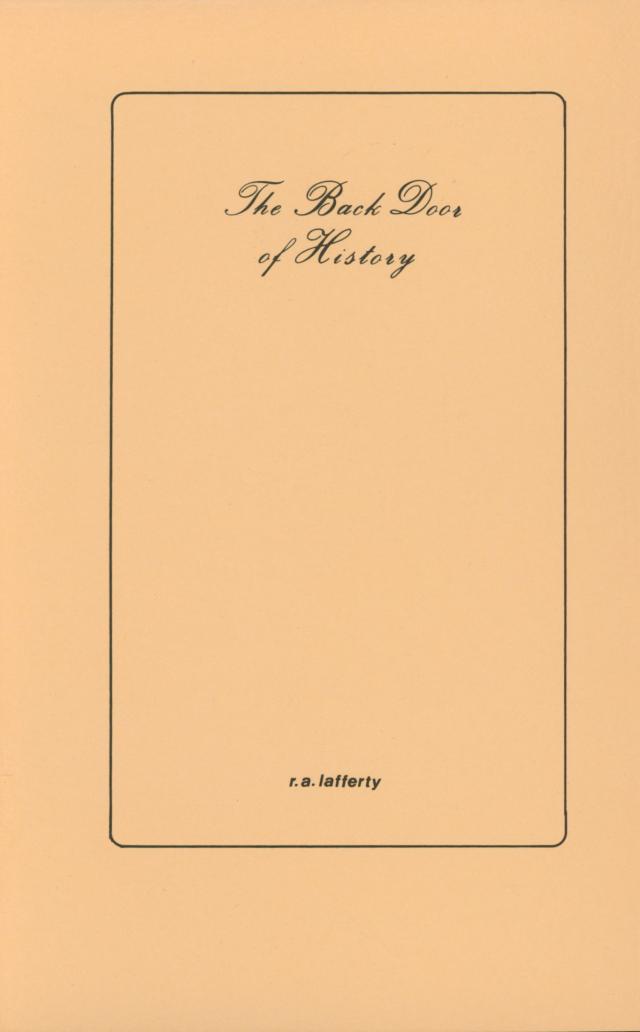
The Back Door of History,
p.1


02-04-2023
Aug. 15, 1988
Due to an error that was not caught until after the printing of this booklet; the conclusion of Phoenic will not be found on page 6 but instead may be found at the end of the booklet.
United Mythologies attempts to produce only the finest quality booklets possible.
We deeply regret any inconvenience or interruption of your reading pleasure this error might cause.
Thank you once again for your patronage and on-going support.
Dan Knight
Toronto, CANADA
The Back Door
Of History
r. a. lafferty
Contents
Phoenic
~from the Anthology of Speculative Poetry #4, 1980
Six Leagues from Lop
~ from Pilgrim In Time and Space (first English language appearance- originally published in German), 1982
Rainy Day in Halicarnasses
~ from At The Sleepy Sailor, Deep South Con booklet, July 1979
Assault on Fat Mountain
~ from Beyond Time Oct. 1976
Calamites of Last Pauper
~ from Fantasy Book#6 Nov. 1982
Rogue Raft
~ from Edge, Autumn-Winter 1973
Phoenic Conclusion
THE BACK-DOOR OF HISTORY is © Copyright 1988 by
R.A. Lafferty, All Rights are Reserved
Published by United Mythologies Press, P.O. Box 390
Station A, Weston, Ont., Canada M9N-3N1
ISBN 0-921322-04-6 Trade
0-921322-05-4 Signed
Phoenic
He was an ancient Phoenician, perhaps the oldest nan in the world. It was not that he had shriveled. He was a tall, gaunt old man with a beak on him like a bird of prey, and his complexion was of royal Phoenician purple.
He was of the race that had traveled to the ends of the Earth. Indeed, this oldest of then had cone all the way from Pittsburgh, Pennsylvania; which is farther than Punt, farther than Ophir, clear on the other side of the treacherous globe; on the Greater Antilla, and inland.
He was a coat-and-suit maker there in Pittsburgh. Now he had cone home.
A Phoenician, however, does not cone home to a town.
He comes home to a continent. The narrow shore, which no longer belonged identifiably to his ancestry, held him for only short weeks. Then he fared inland, crossed a small desert, and cameout on the south sea.
On this day he was in the port town of Esion-Geber, built by his people for Jedidiah long ago, and now named Aqaba.
And tonight he was on passage to Yenbo with the old Jew who not only owned the boat but also lived upon it. The fact is that this Jew had no other home, though he could well have afforded one; for he was rich, though not quite so rich as Wiedervogel, the Phoenician. He was also quite old, though again not so old as the Phoenician.
The Jew’s name was John Counts and he was a florid man, not by nature, but by pose. There is always room for a certain number of sharp men; there is room for a number of personables. There is some room for smooth raconteurs and also for competent solid men. There is hardly room for the intellectuals, and not nearly enough room for the honest men. The opportunities for many of these have been exaggerated.
But Counts, when he chose his vocation, believed that there were empty niches for several more florid men. He became one of them.
“You are taking a useless voyage, old bird,” he told Wiedervogel. “It cannot be for gain. It must be for curiosity.”
“I have none.”
“Nobody goes beyond Yenbo. That is the end of the World. There is nothing beyond.”
“I have an appointment beyond. It was made long ago.”
“How long ago? There has been no water traffic between these two ports for a generation.”
“It was quite a few generations ago that I made the appointment.”
“You, Wiedervogel. are what I call a phoney in depth. Do you know that you are grotesque in that old ready-made suit? But grace isn’t given to everyone.”
“It is one of ny own models, now (it is true) obsolete. It was dead stock, but it is heavy and warm.”
“So is the night. I beg you, do not grasp that glass as with a claw! Hold it lightly. There will be more when it is gone. Surely you are old enough to have acquired a few of the airs. It must be that you have kept your nose too close to the needle. Live a little. You never know how much tine you have left.”
“Yes, I know how much tine I have left.”
“Do you, now? How long, old turkey?”
“Five days.”
“And your old appointment is with the dark lady at the end of the passage?”
“In our old language her name was masculine.
Yourselves use a later borrowed name. I have an appointment in what is called the ‘House of Ashes’”.
“Is it not the elk who knows his time to die and who goes North to end it all in the ancestral bone-yard?”
“No. It is the elephant, and he goes South. But in my case there will be no bones left.”
“Interesting, but not very. Otto, we are in immediate danger of going thirsty! Is not Otto a fine steward, Wiedervogel?”
“He is a fine Stewart, but he is not otherwise fine.
I suspect that he is an unholy creature, a Golem.”
“You are too old to believe in legends, Wiedervogel. You couldn’t believe it of Otto on any other coast. However, legends are the only crop that will grow here. They can’t grow cane, they can’t grow maise, they can’t even grow grass here. But how they can grow legends! And the irony of the locale is that all the legends are true.
Not two years ago, I drove right through a grand old sail-ship on just such a night as this. It had no body to it. It must have been made out of fog. The lanterns on it. and the sea-men on the deck, and the smells up out of the open hold must have been made out of fog too. But they seemed real enough. It was a great lateen with a high poop from the old Caliphate days of sail. You see cuts of them in old hooks. They haven’t sailed for near five hundred years.”
“I remember them a little bit,” Wiedervogel said.
“I picked up a passenger near here once,” said Counts, “Once! Before it was over with I picked him up four times. The crewmen were afraid of him. They came to me and said that the man was already dead. They said that it was bad luck to have a deadman on a boat, but I have never found it so. I asked the man about his status, but he gave me an equivocal answer that first time.
Then a storm came up out of a dead calm. The boat tumbled all over itself and it tumbled that passenger overboard, and he drowned. ‘It is no great loss,’ one of the crewmen told me. ‘He has been drowned before*.
“I didn’t think much of it, not till it had happened the second and third and fourth time. Always that man would come to me briskly and pay his fare in very old coin. And always there would come up a sudden storm, and he alone would fall overboard and be drowned. I finally asked him about it.
I keep thinking it night turn out differently this time,’ he said, ‘and that I need not be drowned at all.’ He is still along this coast trying to undo fate. He has been around here for a long while.”
“I believe that I know the fellow,” Wiedervogel said.
“I took a live mermaid not far from here one morning,” said John Counts. And then he paused. “That pause, old Wiedervogel,” he said after a bit, “that pause was for you to say ‘Incredible!’ or something similarly apropos.”
“Consider it said. Was she real?”
“She said that she was. She seemed to be. She was ugly as sin, to use an old phrase. Her skin was green and rough, and perhaps it was scaled. She had a deformity of her feet and legs that turned them into serviceable flippers.
She smelled like a mermaid, or at least like a fish. She was a diver, and it was as such that her husband made his living from her. Her hair would have been human hair, if the infestations that lived in it has been cleaned out.”
“What did you do with her?”
“I tried to sell her in England. There is a man there who goes in for such things. ‘But I already have a mermaid,’ this man said. ‘A real one?’ I asked him. ‘No, not a real one, but this is not the first real one that has been offered to me. What I have is better than a real one.’
“It was. What the man has was incomparably better than a real one. She was a beautiful human girl who happened to terminate in a fish-tail. But she was no great whiz at swimming or deep diving. She wasn’t a real mermaid. I gave my mermaid back to her husband on my return voyage and paid him for her service. We did not understand the same thing by the term, but she was a real mermaid.”
“I used to see them sometimes,” said Wiedervogel.
It was four hundred miles, and it was third dawn when John Counts hoved to in his boat off Yenbo.
There was a boy who seemed to be moulded of clay, with a driving oar in his hands, standing on a board in the middle of the Sea. There had been no communication, but he was waiting for them.
The Old Phoenician went over and down the side with no baggage except a small sandalwood box under his arm. The creaking could have been either from his bones or from the cordage, but he went down easily.
“In four days?” called John Counts.
“Yes, pick me up here in four days,” said the Old Man.
“It’s a good thing you pay well, but it will be a little unusual to pick up a passenger one day after he is dead.”
“It i
& a little unusual,” the Old Man said. “It is for that I pay well.”
John Counts went across the Sea to Ras Banas where he would load a small cargo. And the Old Phoenician, Wiedervegel, went ashore with the boy on the small float that was ankle-deep awash.
* * * *
Travelling inland from the shore, the boy often had to cut brush to clear a path. It was a very old path, and it had not been used for a long while. Though it was oven-hot, the Old Man always wished to push on.
“But drink a little water then,” said the boy. “I worry for you.”
“I believe it would be wasted on me. Keep it for yourself.“
“But you will die of the heat.”
“Die? Of the heat? Why yes, but how did you know?”
They went a day and a night, or it may have been two days and two nights. Time becomes confused as it approaches its end. It was as hot at midnight as at noon. Only just before dawn did it cool a little bit. It was the morning of the vernal equinox, as required by ancient prescription.
The boy cleaned off the old rock. It had been fouled with bird and animal droppings, but from a long time ago.
They were like dust. The boy cut wood (he had been told what to do, and laid a fire. It was a great flat rock and a great hot fire.
Six Leagues from Lop
Millions of persons when reading The Travels of Marco Polo have surely felt that several of the major Travels or Adventures, three or four of them, have been left out. Oh, the texts do not show conspicuous sutures where the material has been removed. Going all the way back, the texts seem inviolate. But Marco was a natural story-teller. Why are three or four of his stories pointless and too short?
The travelling itself was from the year 1271 when Marco was sixteen years old to 1295 when he was forty-one years old. Then, three years after his return to his home city of Venice, Marco was taken prisoner in a naval war between Venice and Genoa and he found himself in a prison in Genoa.
For cell-mate Marco had a political prisoner named Rusticiano who was a professional scribe and also a writer of fantastic romances. Rusticiano had writing materials. Marco had his head and heart full of stories, his own travel adventures which would prove to be true wherever they could be checked; but Rusticiano believed them to be tall stories and fictional romances such as he himself sometimes wrote.
In their odd hours for a little less than a year,
Marco dictated and Rusticiano wrote. They used a French-Italian pidgin or lingo that was then common to international merchants as well as to mercenary soldiers and sailors. This was the ‘Italian’ that was still used in the Turkish navy until World War One.
The book thus produced was a success and was soon circulating in hundreds of manuscripts. Its first name was Il Milione (million); the exuberance of it could be expressed only by this largest number known to the common people; and Marco Polo acquired the nickname of ‘Marco Millions’ throughout Italy and France and England.
But the ‘missing adventures’ are not to be found in the earliest versions of Il Milione any more than they are in the latest editions of The Adventures of Marco Polo. Nor, for that matter, are they to be found in the known fantastic romances of Rusticiano.
Then I heard rumors of an old manuscript named The Romance of the Stone Balloons written by Emilone Rusticanus, which name might be translated as Big Emil the Rustic. But Emilone was certainly an echo of Il Milione the first title of the Marco Polo book; and Rusticianus was certainly an echo of Rusticiano. If Rusticiano had filched this romance out of Macro’s dictating, the pseudonym tied in well.
I began to look for a copy of The Romance of the Stone Balloons. It took me thirty years to find it. Early in my search T was sure that I was on the right track when I found the first sentence of the Stone Balloons (in the fourteenth century, cataloging of manuscripts used often to give the first sentence of a work in addition to the title, because works sometimes had different titles to the different manuscript versions). And the first sentence of The Romance of the Stone Balloons was:
“It was when we came within one day’s travel of Lop that we began to see two sorts of people in greater numbers; Sea Captains, and People of the Third Eye.”
But Lop was in The Travels of Marco Polo. Lop was at the end of Turkestan and at the beginning of Cathay and the Great Desert of Cathay. And chapter thirty-nine of book one of the Travels, the chapter that mentions Lop, is one of those narrations which is pointless and too short, one of those narrations which cries out the absence of substantial material.
After a thirty year search I did find a copy of The. Romance of the Stone Balloons, in a castle on a hill above a small town in Albania. The shoemaker in that town was also the notary; and in addition he rented out various little machines by the hour. From him I rented an Albanian typewriter (which, as you know, has no a or B.) for an hour, carried it up the hill where the Balloon manuscript reposed, made a good type-copy of it, hurried back down the hill with the typewriter, and completed the whole transaction in fifty-eight minutes. The shoemaker had to take my word for it that I was on time; he had just rented his only clock out for a half hour.
Here, translated from the old French-Italian pidgin, is the text of The Romance of The Stone Balloons by Emilione Rusticanus or Big Emil the Rustic.
“It was when we came within one day’s travel of Lop that we began to see two sorts of people in greater numbers; Sea Captains, and People of the Third Eye. I myself thought it unusual that there should be so many captains in this neighborhood when Lop is perhaps furthest from any Sea or Ocean or any town in the world.
“One of the sea captains explained to me that he was indeed such, but that the sea he sailed was the sea of the air and of the upper air and of the empyrean which is still higher than the upper air. This sea captain was one of the people of the third eye, as were at least half of the sea captains on the road that day. ‘I see that you have three dromedaries, twenty-two asses, and nine she-asses loaded with bales of merchandise,’ he said to me. ‘You will not find good market for it in Lop, and you will not want to cross the desert so heavily laden. But come with me tomorrow to our sky-port and you will be able to trade it with great profit to everyone. I myself will surely take parts of it, and other captains will take other parts. We trade for everything.’ ‘How far from Lop is this sky-port?’ I asked him. ‘Six leagues from Lop, a short day’s journey across the Leapers Plain,’ he said. ‘I am the captain of a ship of the sort commonly called stone balloon’, and you might want to go on a short journey with me in my vessel. Whenever we come to port here I like to take several days leisure and go to the dromedary races and other local entertainments. It is so rustic here in these boondocks.’
“We came into the town of Lop at sundown. I unloaded my animals to give them rest, and watered them and gave them hay. The sea captain put little pellets into the hay I gave them. Lop was a busy little trade town but it had the air of being only - ‘Yes, of being only a suburb of a more important place,’ the sea captain said as if he read my feelings, ‘for it is really only a suburb of space-port.’ ‘How many of these space-ports or sky-ports are there in the world?’ I asked. ‘Only three others on this world,’ the sea captain said, ‘and two on the noon, one each on Mercury and Venus (stifling places those!), others on the noons of Saturn and Jupiter, and very nany space-ports on more distant worlds.
My own home port is on one of the Trader planets. Me can eat supper here in Lop and by that time it will be moonrise and we will go to Sky-Port by moonlight. I have put pellets into the hay your animals are eating and these will revivify them and take their weariness away. You can buy Leapers Shoes here in Lop, two for yourself and four for your riding donkey. These will provide a sort of boyish amusement for you, and I see that you are really still a boy. The ground around Space-Port is saturated with anti-geodic force which leaks from our balloons. This gives a bounciness to those who wear leapers shoes that are made of an alloy that is one part iron and nine parts of the metal that is called ‘chamron’ by the Jews and ‘Al-Aminyoum’ by the Arabs.’ He had supper. Then I bought leapers shoes and put two of them on my own feet and four of them on the feet of my riding donkey. I loaded my animals again, and they were very lively and had not a trace of travel weariness left. He set out by moonlight over the six league road from Lop to Sky-Port.