Hamlet is not ok, p.1
Hamlet is Not OK,
p.1
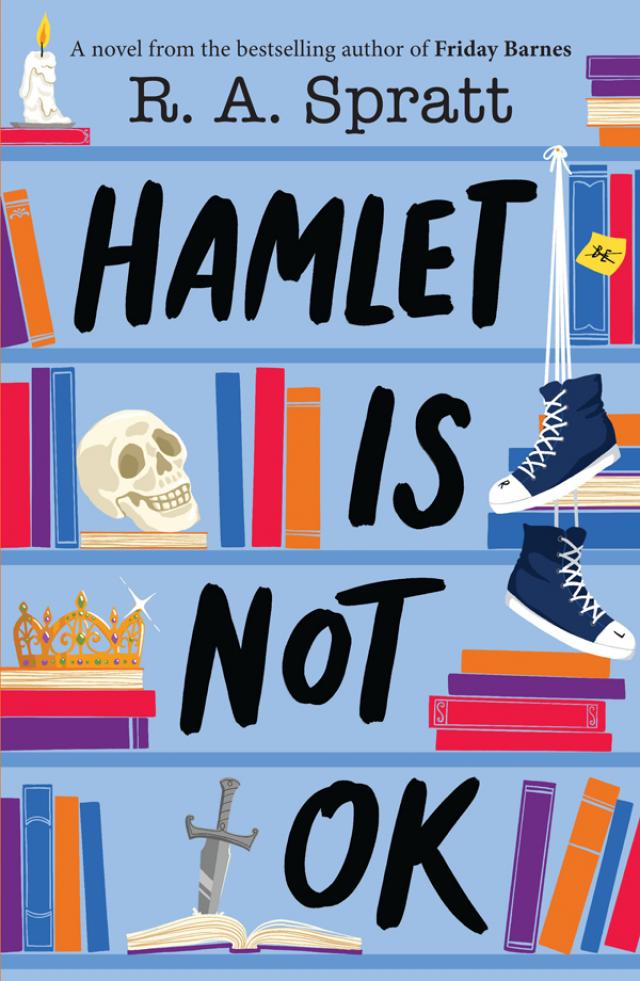


About the Book
FUNNY, SHOCKING AND BRILLIANT.
Selby hates homework.
She would rather watch TV – anything to escape the tedium of school, her parents’ bookshop and small-town busybodies.
So Selby didn’t plan to read Hamlet. She certainly never planned to meet him.
Hamlet, the much-maligned miseryguts, is seen here with the empathy of a modern teenager’s gaze. With warmth, brilliant banter, deadpan humour and, well, dead people, R. A. Spratt brings her trademark wit to Shakespeare’s famous play.
Contents
Cover
About the Book
Title Page
Dedication
Warning
1. Curtain Up
2. Crime and Punishment
3. Another World
4. Crossroads
5. Love
6. Good Bit
7. R U OK
8. The Play Within a Play
9. Things Turn Nasty
10. Kidnapping Through Alternate Realities
11. Hamlet, Prince of the Bookstore
12. To Be, or Not to Be . . . A Pain in the Butt
13. Something Very Bad
14. Helping Ophelia
15. Criss Cross
16. Back Again
17. Full Circle
Need Help?
About the Author
Books by R. A. Spratt
Have You Read Friday Barnes?
Imprint
Read More at Penguin Books Australia
I wrote this book during Covid times. When all of us had much more time with our own thoughts. It brought me great joy to sink myself into this world. A world constructed in William Shakespeare’s imagination.
So I want to dedicate this book to all the storytellers who bring us joy, comfort and catharsis in turbulent times.
Stories remind us how much of our human experience is shared. The plot points in our lives are constantly happening in distant places and even different times. Hopefully, by continuing to tell stories, we can learn from each other, laugh with each other and comfort each other.
WARNING
This book contains Shakespeare.
Not literally him, the man. That would be impossible (I think). I definitely know that the Royal Shakespeare Trust would be very annoyed with me if I tried to dig up his remains and make them into paper. What I mean is – this book contains bits of text directly quoted from Shakespeare’s play Hamlet.
In some places, I have weaved the quotes into the dialogue of the book so that it will be easy for you to understand. In other places, I have put the quotes in italics and indented them. These bits are to give you a sense of what Selby (the main character) is reading. It doesn’t matter if you don’t understand every word (or even any word). It’s best to just let the words wash over you, the way you listen to music. If you listen to a pop song on Spotify you don’t painstakingly identify every note and chord as you go along. So if you find yourself struggling with the old fashioned vocabulary I recommend this approach.
Now, if you’re really, really struggling, you can in fact just skip these indented bits. Get on with enjoying the story of the book. It will make sense without them. You can come back and have a look at them later. You will probably find them easier to understand on a second reading.
I hope you enjoy this book.
Best wishes,
R.A. Spratt
1
Curtain Up
‘Imagine you’re standing on a castle in Denmark,’ said Ms Karim.
This idea caught Selby Michaels’ attention. She looked up from her doodling. She wished she was in Denmark. There were so many layers of stories there. It was the home of Vikings. It was the birthplace of Hans Christian Anderson and all the fairy tale characters he created. The legends of the kraken, Thor and all the Norse gods – they all came from that part of the world too. And, of course, Lego. There was so much scope for the imagination there.
Selby tried to visualise Denmark. Her imagination leapt straight to the movie Frozen. Which made her think of fjords, which was just a fun word to say with the j sounding like a y. She was itching to say it out loud right now, but she couldn’t. The other kids in her class would think she was strange if she started saying ‘fjords’ in the middle of English class.
Selby looked about her classroom. It was a state school so everything was worn out. The formica on the desks had worn thin because graffiti had been scrubbed off them with super strong solvents so many times. The once-white walls were greying and pockmarked where Blu Tack had come off with chunks of paint. And the lesson plan had been written on the white board with a green marker that didn’t quite work. If you were sitting any further back than the third row, there was no way you could read it. Selby wished she could go to Denmark.
She imagined a European forest – like in Hansel and Gretel. A real forest with green trees. Not like her hometown where the trees were more grey than green, and everything was so dry. When you went hiking round her area, there was no time for imagining fictional fairies and goblins. You were too busy keeping a look out for very real snakes.
‘Okay, so imagine you’re up on that wall,’ continued Ms Karim. ‘It’s night time, so it’s spooky, right?’
‘Woooooo,’ said Ben, one of the sillier boys in the class.
Ms Karim just ignored him. ‘When suddenly – the ghost of your father appears before you!’
Isla put her hand up, ‘My father isn’t dead, miss!’
‘We’re imagining,’ said Ms Karim, valiantly not losing her temper.
‘But ghosts aren’t real, miss,’ Simon called.
‘It’s a play, we’re talking about a play,’ snapped Ms Karim, the last remaining thread of her temper had snapped. ‘The whole thing is fictional. Reality is what you study in science and history and maths. This is English. We study fiction here. If you can’t wrap your mind around that concept, you are going to get very bad marks in your leaving exams.’
Selby looked out the window. She didn’t like it when Ms Karim lost her temper and started ranting. It made her feel guilty. Even when she hadn’t done anything. Although, usually the problem was that she hadn’t done anything.
‘You think this subject is silly because it’s about imagination?’ accused Ms Karim. It was a question, but everyone in the class had the sense to realise it was rhetorical, and they should stay quiet. Ms Karim may be only five-foot-one but she was terrifying when she got on a roll. ‘You all want to study practical subjects because that’s the only thing that will get you a job? Well, I’m here to tell you every job on earth requires problem-solving. The people who get promoted are the people who are good at problem-solving. And problem-solving is all about imagination and creativity. Lateral thinking is your key to success in life.’
Selby glanced at her classmates. She could see they had all tuned out. Ms Karim was right, but there was no point talking to fifteen-year-olds about real life after school. It all seemed so far away. It might as well be fictional too.
Suddenly, the school bell blasted. It was more of a horn than a bell. It was so loud it was impossible to talk over no matter how good a teacher was at voice projection. Everyone started packing up their books and pens.
As soon as the bell fell silent, Ms Karim called out, ‘You should be up to act three with your reading.’ She had used those three seconds while the bell was sounding to regain her composure. ‘Make sure you’ve finished reading it by tomorrow, so we can discuss Hamlet’s motivations in class.’
Everyone groaned. Except Selby. She wasn’t going to do the reading. She never did.
Selby Michaels was not a loner by choice. She was just alone because no-one wanted to spend time with her. She was the odd one out. This happens all too easily in a small town when there aren’t enough odd people to form your own group.
People liked her well enough. She was polite. She made jokes. She didn’t smell bad. There just wasn’t anybody else like her. You see, she had all the outward appearance of being a huge nerd, but she wasn’t actually good at anything. To be a nerd, you really have to make up for your eccentric behaviour by being a genius at maths, or a prodigy at English, or really good at hacking into Defence Department computers.
This was not Selby. She struggled at school. She couldn’t get ideas down on paper without getting herself and her teachers hopelessly confused. She was okay at maths but she hated it. It was so boring, and it always took her three times as long to understand a new concept as it did the other kids.
The worst part was everyone had expected the opposite for her. Selby’s parents ran the only bookstore in town. They loved books and words and ideas. Her mother had a master’s degree in English literature and her father had given up a career as a geological engineer just so he could run a bookstore – which he did badly, because he was more interested in reading the stock than selling it.
Selby also had an older sister and brother who had excelled at everything. Her sister had been dux of the whole school and was now studying law in the city. Her brother had topped the state in English and Ancient History and won a scholarship to go and study the classics at Durham in England. This left Selby alone at home with her parents, so she could disappoint them all by herself.
Of course, Mr and Mrs Michaels never said they were disappointed. They were really good people. But that was the problem. They were so endlessly encouraging about everything. They so desperately wanted Selby to be a bookworm like everyone else in the family, that if she so much as glanced at
a book they would gift it to her. They didn’t mind what she read. They’d be happy with anything – romance, graphic novels, action adventure. They even offered to read to her or to buy her audio books. They just wanted her to love books as much as they did. And Selby couldn’t be mad about that. She knew it was just because they loved her, and books made them happy and they wanted her to be happy too. But the pressure was crushing.
They’d never gotten angry with her about anything, until now.
It was stocktake time at the bookstore, which was Selby’s favourite time of the year, because her parents got so busy at the shop she had lots of time to herself at home. Day after day, her parents worked until seven or eight o’clock at night and Selby loved it. It was a little lonely, but she got to make whatever she wanted for dinner and watch whatever she wanted on TV with no-one to judge her.
Selby had taken to coming home from school and spending two hours watching daytime soap operas. She really enjoyed the ridiculous plots and terrible acting. Then she would make herself dinner, which usually involved baking bread from scratch because there was never enough food in the house. Her parents never prioritised grocery shopping. They ate most of their meals in their own shop. Selby didn’t mind being left to sort herself out. She liked cooking. Then her parents would come home and Selby would go for a walk before bed.
You may have noticed there was something missing from this schedule – homework. If you didn’t notice, you’re in good company because Selby didn’t notice either. She just stopped doing it. And nothing happened. So she forgot about it entirely.
That was until it all went horribly wrong.
It hadn’t really occurred to Selby that she was doing anything bad. If anyone found out how she spent her time she would have been embarrassed, because what she was watching on TV was so silly. But it was almost as if the part of her brain that had a conscience when it came to homework had been switched off. That circuit breaker had tripped and no-one had noticed, so no-one had gone to the fuse box to flick it back on.
So it came as a complete surprise to her when her parents returned from the parent-teacher conference at school in a towering rage. She had never seen them so angry before, unless it was with a politician they disagreed with. But this was worse than just anger – it was anger plus disappointment. Anger that she had not done any homework for six months and was now hopelessly behind in every subject, and disappointment that she had deceived them.
This second accusation felt a bit harsh to Selby. She hadn’t gone out of her way to deceive them, they just hadn’t noticed. But it is often the way that people are angriest with others when they are really angry with themselves, or angry to have been embarrassed themselves. They had been embarrassed to realise, in front of their daughter’s English teacher, that they had no idea what Selby had been up to.
‘What have you been doing all these months?’ asked her mother when they confronted her.
Selby shrugged.
‘Really? You don’t know?’ asked Mum. ‘Well I know, because I checked your viewing history on the television.’
‘Urgh,’ groaned Selby.
‘That’s it, no more TV, no more computer, no more music, nothing!’ yelled her father. ‘You come home and you work in the shop until dinner, then you do your homework, study and go to bed.’
Selby sighed. She couldn’t argue. It was fair enough. She deserved to be punished.
‘Aren’t you going to say something!?’ demanded Dad. ‘You let us down. We trusted you.’
‘I’m sorry,’ said Selby. But she didn’t really sound sorry and her apathy only seemed to make her parents angrier.
‘We give you all this freedom,’ said Dad. ‘We never give you a hard time about school and your bad grades year after year. And in return we get this! Binge watching some brain-dead romance.’
Selby stared at her shoes. She’d hand painted them last year. Her mother hated them. There was an L painted on one and an R painted on the other. She’d done it as a joke. As if she was too stupid to know which foot to put her shoe on. It occurred to her as she stared that if she had really wanted to annoy her mother, she should have painted the L and the R on the opposite shoes. That would have made her mum’s inner OCD explode. The longer Selby stared at the shoes, the longer she could go without making eye contact with either of her parents.
‘Things have to change,’ said her mother. ‘This isn’t working. You need to do better. We’re going to get you a tutor.’
Selby’s head snapped up, ‘What?’
‘Someone to coach you until you catch up on all the work you’ve missed,’ said Mum.
‘I can do it myself,’ protested Selby.
‘You don’t have that choice,’ said Dad. ‘You’ve proven we can’t trust you.’
‘The time for hand-holding and patience has gone,’ said Mum. ‘You need to knuckle down and work hard.’
‘Work hard so I can go to university, get a brilliant degree, then run a dilapidated old shop and earn a pittance like you two?’ accused Selby. She realised she shouldn’t have said it as soon as the words were out of her mouth. But she was a teenager and she had all kinds of hormones coursing through her veins, which is why it’s traditional for teenagers to say things that are thoughtless and hurtful.
‘Life isn’t about money,’ said Dad, struggling to control his voice as he simmered with rage. ‘There’s no shame in having a modest income. There is shame in ignorance – wilful ignorance. A good education is worth more than gold, and it doesn’t have to be a degree. It doesn’t even have to be high school graduation. It’s about a thirst for knowledge, a curiosity to know more. You need to wake up and take responsibility for your own learning.’
‘I know stuff,’ argued Selby.
‘What, like how to kill a duck with a rock?’ demanded Mum.
‘What?’ said Selby.
‘Mrs Tink was in the shop this morning,’ said Mum. Mrs Tink was an old lady who had lived in the town since before everyone was born. She knew everybody, was related to most people and always knew what was going on. ‘She saw you throwing rocks at the ducks in the river.’
‘I wasn’t doing that,’ said Selby. ‘I was just throwing rocks in the river.’
‘Every day for the last three months?’ demanded Mum. ‘Did you actually kill any?’
‘I wasn’t throwing rocks at ducks,’ said Selby.
‘She saw them flapping away,’ said Dad.
‘I wasn’t aiming for the ducks,’ said Selby. ‘I may have thrown one that went a bit off target.’
Mum shrugged. ‘We can’t believe a word you say anymore.’
2
Crime and Punishment
And so the next day after school, Selby came straight home because home was the bookstore. They lived in the apartment above the shop. She dropped her bag behind the counter and went to work.
It was not a very busy bookstore at the best of times, but it was particularly quiet in the afternoon. Mum and Dad were still really angry with her, so Mum disappeared down to the back of the store to do stocktaking and Dad took all the deliveries down to the post office to ship. Selby just had to sit at the counter so that passers-by could tell that the shop was open, and shoplifters wouldn’t come in and steal anything.
Not that there was a lot of shoplifting in their town. The Venn diagram of the literate community and the type of people who would steal didn’t overlap much. Most of the stealing was done by old ladies too embarrassed to be seen buying romance novels, and they wouldn’t be put off by a sixteen-year-old sitting at the counter. You’d actually have to insist on looking in their handbag to catch those. Then they’d probably just pretend to have dementia. It sounded harsh, but Mrs Dunk was eighty-seven and she had been doing it for years. Her son was good about coming in once a month and paying up for her, though.