Friday barnes no escape, p.13
Friday Barnes: No Escape,
p.13


‘Don’t,’ said Melanie, grabbing her hand. ‘Close your eyes. It’s best if you don’t see it.’
Friday closed her eyes, but it was too late, she had worked out what it was. She had blood running down her face. Friday hated blood. She fainted.
The first thing Friday noticed when she woke up was that Ian wasn’t wearing a shirt. The second thing she noticed was that he had more muscles than when she’d seen him last. Then she began to wonder why she was lying flat on her back, inside a train carriage. Then she remembered the bang on her head.
‘She’s awake.’ It was Melanie’s voice. Friday realised that she was lying down with her head in Melanie’s lap.
‘Why is . . .?’ Friday whispered. Her mouth was very dry. It was hard to speak. ‘Why isn’t Ian wearing a shirt?’
‘Because it’s wrapped around your head,’ said Melanie. ‘Try not to think about it. Or look. You definitely don’t want to look. At your head, I mean. You can look at Ian’s naked chest as much as you like. Most of the girls, and some of the boys, in the carriage haven’t stopped since he took it off. You’re going to be quite a hero for making that happen.’
‘Oh,’ said Friday. She closed her eyes again. The neon lighting was making her head hurt worse.
‘Except Tatiana,’ said Melanie. ‘She looks like she wants to smash you over the head with the iPad again.’
‘All right, everyone back to your seats,’ instructed Mr Maclean. ‘The police are here.’
The rear door of the compartment opened.
Inspector Benatti stepped into the carriage. The first thing he saw was Ian, shirtless and with blood stains on his forearm.
‘I might have known,’ said the Inspector. ‘All right, everyone off. Get your bags and get off the train.’
‘But this isn’t our stop,’ said Mr Maclean.
‘Yes, it is,’ said the Inspector. ‘The train company is refusing to transport your group any further. They know where the emergency brake was tripped. They know it was someone in this carriage. The train will continue on. You will all remain here until we get to the bottom of who exactly pulled the emergency brake. Unless . . . someone would like to confess?’ He glared pointedly at Ian. ‘They will face an enormous fine and criminal prosecution. But at least their classmates will be able to go on without them and see the beautiful city of Pisa.’
The Inspector continued to glare at Ian, waiting to see if he would crack. Ian just stared back.
‘Fine,’ said the Inspector. ‘I should have known that someone selfish enough to stop an entire train, disrupting the whole timetable for the region of Tuscany, would be too selfish to let their friends enjoy their excursion. Everyone off! We will get to the bottom of this the hard way.’
It didn’t take long to herd the surly teenagers off the train. While they usually ignored their teachers, they were inclined to obey the armed police officers. Especially as the police officers had very dashing uniforms.
Friday was still pretty dazed. She had only managed to walk with the help of Melanie and Ian. Now she sat on the platform, a polo shirt wrapped around her head and an ice-cold can of lemonade on the back of her neck. She was not sure how that got there, but it was very soothing. Mr Nestor had a first-aid case and used a Steri-Strip to hold the cut closed. He assured her she wouldn’t need stitches. Friday’s mind began to clear.
Memories of everything that had just happened started running through Friday’s brain. It was like it was all coming into focus. All the implications and ramifications and contributing factors began to fall into place in her mind, all the possible causes and consequences filed out and ran through her huge computer-like brain. What had happened? Why had it happened? Friday might not want to return to crime solving. But her brain was already on the case. She rubbed her temples, the pain eased and her thoughts became clearer still.
While Friday struggled to recover herself, the Inspector had lined up all the students on the platform and was making his way along, interviewing them one at a time. A junior officer was standing next to him with a notepad, taking down everything that was said. Friday was at the end of this line, no doubt because of her head injury. They didn’t expect she would have much to contribute. Ian and Melanie were still with her.
‘Aren’t you cold?’ asked Friday. ‘Would you like your shirt back?’
‘That’s okay,’ said Ian. ‘You can keep the shirt. I don’t think it’s going to be fit to wear again. Except perhaps as a Halloween costume.’
Tatiana was being held off to one side by a female officer. She had argued loudly with her father in Italian when they first got off the train. She had essentially been sent to stand in the naughty corner.
‘You,’ said the Inspector, contemptuously glaring at Ian. ‘Put some clothes on!’
‘I don’t have any,’ said Ian.
The Inspector clicked his fingers at an officer nearby. ‘Give him your jacket!’
The officer slipped out of his navy blue police jacket and handed it to Ian. It fit him like a glove. It looked a little strange without a shirt and tie, but it was a really dashing uniform with shiny buttons and epaulettes. Ian looked even better. Several of the girls took photos. Ian smiled for them.
‘Enough!’ snapped the Inspector. ‘I should have interviewed you first. You’re the most likely suspect.’
‘No,’ said Friday. Her voice still sounded weak and distant to her own ears. She tried again. ‘I know who did it. It wasn’t Ian.’
The Inspector had barely paid attention to Friday. He wasn’t particularly interested in this statement or anything she had to say. All he saw was a scruffy short girl with a bloody t-shirt tied around her head. Not an impressive-looking witness. But everyone around her seemed to think otherwise. All the students and the teachers turned, in many cases shuffled closer, to hear what she would say.
‘What are you talking about?’ demanded the Inspector.
‘The key is motivation,’ said Friday. Her brain was still very foggy. She was talking to herself as much as anyone else. ‘This isn’t a case of theft where the motive is obvious – material gain. Or assault – where the motivation would be revenge or retribution. This is a victimless crime.’
‘It is not!’ yelled the Inspector. ‘Stopping this train inconvenienced hundreds of passengers, it will have a knock-on effect to every train in this region today. Hundreds of thousands of people will be affected.’
‘But not by much,’ said Friday. ‘They’ll be a little late for dinner, or they’ll have to rush to get to an appointment in time. That’s nothing to a certain sort of criminal.’
‘What is she talking about?’ the Inspector asked Ian.
He shrugged. ‘Nobody knows. But she’ll explain eventually.’
‘A self-absorbed teenager,’ said Friday. ‘They’re not evil. They’re just thoughtless. Literally thoughtless. They wouldn’t have given the scheduling concerns of the other passengers a single thought, let alone a second thought.’
‘So, you admit it was someone in your group!’ said the Inspector.
‘It seems most likely,’ said Friday. ‘This type of thing is often done by disgruntled staff members, but the railways have reduced staff so much, there were no rail employees in the carriage. I suppose it could have been one of the teachers,’ continued Friday. ‘But Mr Nestor is too nice. Mrs Cannon was too busy enjoying making Mr Nestor blush. And Mr Maclean would never do something like this because he is very vain and he would have been looking forward to taking selfies with the Leaning Tower of Pisa.’
‘So, it was a student?’ said the Inspector, glaring at the row of teenagers.
‘Yes, but why?’ asked Friday.
‘Because you’re all a bunch of no-good, useless degenerates!’ said the Inspector.
‘That’s simply not true,’ said Friday. ‘Yes, these students are rich and entitled. But they don’t go out of their way to cause trouble. They’re too lazy for that. No, the train was stopped by someone with a specific reason.’
‘To break the law,’ said the Inspector.
‘To avoid arriving in Pisa,’ said Friday.
‘But they could have just stayed home,’ said Ian.
‘Yes,’ agreed Friday. ‘That would have been the easiest solution. So, something happened between arriving at the station that made them really really not want to arrive in Pisa.’
‘Perhaps it was someone who found out they were going to Pisa and not Pizza?’ said Parker. ‘I know that’s what I thought up until this morning. I was bitterly disappointed when I found out we weren’t going to see a giant leaning tower of pizza.’
‘Oh, Parker,’ said Melanie, kindly. ‘I don’t think there is anyone else that stupid.’
‘So, what happened after we arrived at the station?’ asked Friday.
‘Not much,’ said Ian. ‘We waited.’
‘Melanie knocked a strawberry milkshake on Mr Maclean’s head,’ said Friday.
‘That was fun,’ agreed Parker. ‘Almost made up for the pizza disappointment.’
‘Are you saying this teacher did it?’ asked the Inspector.
‘No,’ said Friday. ‘That can’t have been it. But after that, Mr Maclean made an announcement. He said that he’d bought us all expensive tickets to climb up the tower, and that we all had to do it. There would be no excuses.’
‘What has that got to do with anything?’ said Mr Maclean. ‘I was making a perfectly reasonable announcement.’
‘But it may have been a surprise for some,’ said Friday. ‘For many years no-one could climb the tower because it was unsafe. What if someone hadn’t realised they would be climbing 296 steps up a spiral staircase and then stepping out onto an open balcony to see the view, while standing on an uneven surface? What if that person was afraid of heights? And what if that person liked a girl a lot and didn’t want her to know he was afraid of heights, because then she might not want to go out for gelato with him?’
‘Are you saying . . . that Ian is afraid of heights?’ asked Melanie.
‘No, we know Ian hasn’t got a problem with heights,’ said Friday. ‘Because I sat on a cliff face with him for five hours once.’
‘Good times,’ said Ian.
‘But this morning someone else revealed themselves to be more squeamish,’ said Friday. ‘When you knocked the milkshake on Mr Maclean’s head, it was very funny. He looked ridiculous. Only one person did not stand up to look – Pietro. He didn’t want to look over the balcony. Because he is afraid of heights.’
‘Are you saying that Pietro is in love with you?’ asked Melanie.
‘No, with you,’ said Friday. ‘You’re supposed to be better at noticing these things than me.’
‘Gosh,’ said Melanie.
Pietro stared at the floor, but they could tell he had blushed bright red because his ears were almost purple.
‘Is that true?’ asked Melanie.
Pietro looked up and smiled sheepishly at her. He was obviously embarrassed but not particularly ashamed about stopping the train.
‘No-one has ever stopped a packed commuter train to impress me before,’ said Melanie. ‘I’ll go out for gelato with you.’
‘You will?’ said Pietro.
‘To be honest, I wouldn’t have taken much persuading,’ said Melanie. ‘I really like gelato.’
Pietro smiled. He looked very handsome.
‘He won’t be able to afford gelato after I’m through with him!’ yelled the Inspector.
‘No matter,’ said Melanie, smiling adoringly at Pietro. ‘Daddy gives me a very generous allowance, I can pay.’
Pietro looked like he wanted to kiss Melanie right then and there, but he didn’t get a chance because the Inspector had him taken away to the station so they could fill in a report.
Friday was very excited when she woke up the following morning. They were going to the Galileo Museum. She could relate to Galileo. Sure, he was a four-hundred-year-old dead Italian man, but apart from that they had a lot in common. They both loved science and they both really irritated people. And they had both been imprisoned. Although to be fair, Galileo had been imprisoned for being right about the earth rotating around the sun – which really shouldn’t have been a crime. Whereas Friday had been imprisoned for aiding an act of terrorism, which definitely was a crime, even if you didn’t mean to do it. Nevertheless, she was very excited to be visiting a collection of scientific artefacts dedicated to the memory of her great hero.
The rest of the school group did not share her enthusiasm. They were already pre-bored just at the mention of the word ‘museum’. When you added ‘science’ to that and, to make matters worse ‘old science’, the sullen teenagers practically gave themselves concussion from the force of their eyes rolling back in their heads.
Ian’s school group were joining them. They were meant to do a collective project on the international bond of science afterwards. But most of the students were only interested in making personal international bonds with each other when the teachers weren’t looking.
The students shuffled towards the entrance of the museum with about the same level of enthusiasm Galileo must have felt when going before the Roman Inquisition. A few of them did briefly perk up when they saw there was a gift shop, then their spirits dropped again when they saw that it mainly contained books, and those books were about science.
‘This is so exciting!’ said Friday. She was practically vibrating with enthusiasm. ‘To think we are going to see some of the first scientific instruments ever invented. Artefacts that made the birth of science possible.’
‘Urgh,’ said Mirabella. ‘These places always stink of dust. We’re in Europe. It’s a waste of our time when we could go somewhere with real culture – like Euro Disney.’
‘Disneyland wouldn’t be possible without the scientific breakthroughs made with the instruments we’re about to see,’ said Friday. ‘This is where the fundamental laws of physics were first discovered and understood.’
‘Disneyland is a monument to capitalism,’ said Mirabella. ‘Daddy says we should spend more time learning about that at school.’
‘It’s not exactly high culture. It’s a fun park inspired by a talking mouse,’ said Ian. He and Tatiana were in the line right ahead of them.
‘Yes, and it’s fun,’ said Mirabella. ‘More fun than anything Galileo ever did.’
‘I don’t know,’ said Parker. ‘He did drop a lot of stuff off the Leaning Tower of Pisa. That would be fun.’
‘I wonder if he carried it all up himself, first?’ said Melanie.
‘There’s not much point being a genius if you can’t think up a way to get out of carrying cannonballs upstairs,’ said Ian.
‘They were cannonballs,’ said Parker. ‘You could fire them to the top with a cannon.’
‘But how would he catch them?’ asked Ian.
‘I don’t know,’ said Parker. ‘He was the scientist. I can’t think of everything.’
Friday walked on ahead. She wasn’t going to let anyone’s apathy ruin her enjoyment of the museum. Even seeing Ian with Tatiana wasn’t going to upset her today.
All museums in Europe had very strict security, but particularly the Uffizi ever since the 1993 bombing and the Galileo Museum was part of the Uffizi. So they had to leave their backpacks and coats in lockers before passing through metal detectors, then ticket turnstiles before finally entering the part of the main museum where the collection was housed.
Once they passed through, Friday was surprised at how empty it was. ‘Where is everyone?’
‘The Galileo Museum is not overly popular,’ explained Ian. ‘They only get about five hundred visitors a day compared to 12,000 at the Uffizi.’
‘But this museum houses the lens from Galileo’s telescope!’ said Friday. ‘The lens he used to observe the movement of the planets and confirm Copernicus’s theory that the earth revolved around the sun, not the other way around. It is one of the most significant objects in the entire history of science.’
‘Yes, but the Uffizi has paintings of naked ladies,’ said Ian.
‘And men’s private bits,’ said Melanie. ‘It’s quite disturbing really. I have four brothers but I still learned a lot about male anatomy from renaissance sculpture.’
‘Maybe Galileo used his telescope to look at naked ladies,’ said Parker. ‘When he wasn’t looking at the stars of course. You know, peeping through windows on the other side of the street, that sort of thing.’
‘You’ve done that with a telescope, haven’t you?’ guessed Ian.
Parker looked sheepish. ‘Well, my grandfather did give me a telescope and I was never very good at finding planets with it. Too much maths involved for me.’
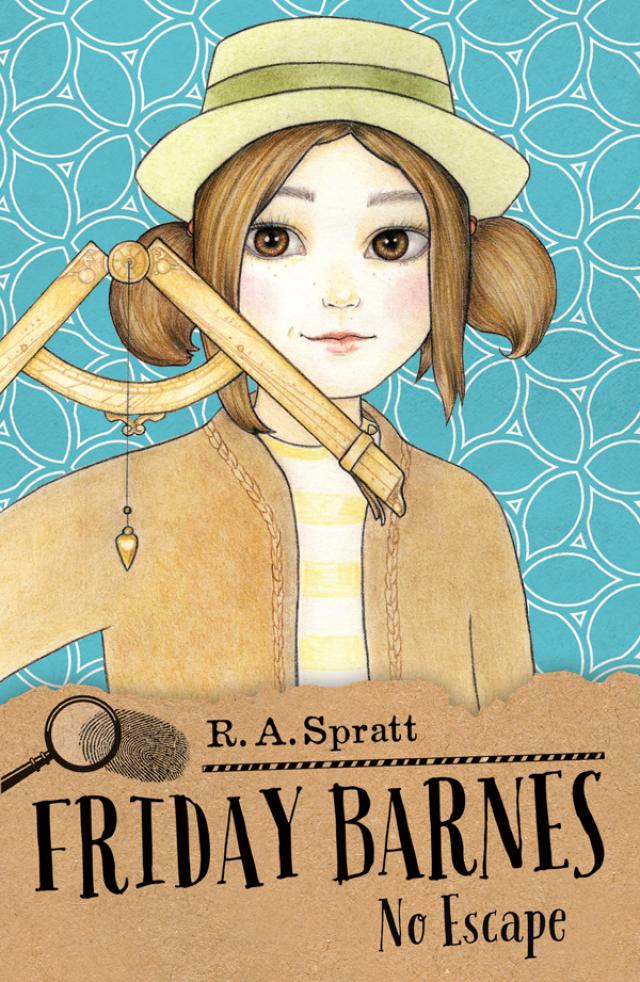
‘The first room has compasses,’ said Friday, consulting the museum’s floor plan. ‘I want to see Galileo’s compass. It’s ingenious. It measures elevating arcs, surface areas, inclined planes, arithmetic lines, distance and the declination of celestial bodies.’
Melanie went over with Friday to have a look. ‘Oh, that is a nice one. It’s pretty and shiny.’ It was the same principle as the compasses they used to draw circles in geometry at school, only made of brass and way more complicated.
‘It’s ingenious,’ said Friday. ‘So much mathematical capacity in one simple device.’
Melanie leant in and read the inscription, ‘Compasso Geometrico e Militare.’
‘Yes, that’s how Galileo made his money,’ said Friday. ‘He made one hundred of these and sold them to military officers, then gave them geometry lessons. Imagine that – having Galileo as your teacher.’
‘I bet his lessons were confusing,’ said Melanie.
Friday drifted away from the rest of the group. She had read about many of the items she was now viewing, but she had not thought about them in their cultural context. All this scientific work had been sponsored by the Medicis, the wealthiest family in Europe in the fifteenth century. The development of measuring tools, the compass, the understanding of parabolic movement – these were all fundamental tools and concepts of science. But here in context, Friday realised, the Medicis were only paying for it because these breakthroughs were immediately used in warfare to expand the Grand Duchy of Tuscany. The compass and the sextant allowed better navigation for precise military manoeuvring. Parabolic movement was used to fire cannons more accurately. And astronomy was used to better measure time, which was used for navigation of armies. Engineering breakthroughs were used to make bridges, to sack cities. It was all so lowering to realise that these great intellectual idols were pawns in the giant bloodthirsty chess game of European warfare.