Friday barnes 10, p.16
Friday Barnes 10,
p.16



Now I’m sure if you’re good at maths, you will have noticed that if you have children eighteen months apart over a four-and-a-half-year period, that gives you four children in total. Mr and Mrs Barnes had their four children and everything went to plan. They taught them to read with flash cards, they sent them to the best extra-curricular maths workshops and they even allowed them to participate in sport. If you call yoga sport.
Then nine years later, just as their youngest child was gaining early admission to high school, the unexpected happened: Mrs Barnes got pregnant again. There was no time in her schedule for childbirth. On the due date, she was committed to speak at a conference in Bern, Switzerland about the possibility of the International Super Collider opening a black hole and destroying the planet. For the first time in her adult life, Mrs Barnes saw her iron-clad grasp on order and reason begin to slip.
Mr Barnes was, however, a man of action. If the action did not require him to leave his office or get up from his desk. He googled Bern and maternity hospitals. They discovered that there was one just three kilometres from the conference centre. Mr and Mrs Barnes both breathed a sigh of relief. From that moment on, life proceeded exactly as if Friday did not exist.
Later in her third trimester Mrs Barnes travelled to Switzerland and gave her lecture. Halfway through she started to feel labour pains, but she was able to hold on throughout the powerpoint presentation. And only the people in the front row noticed when her waters broke.
And so Friday was born. And she was named Friday because that was what her parents thought was the day of the week. (Being academics they often became confused about such trivial matters as times and dates.) It was actually a Thursday. But the people at the births registry did not question the name; they just assumed Mr and Mrs Barnes were Robinson Crusoe fans, which of course they were not because neither of them believed in reading fiction.
Eleven years later, Friday Barnes had largely raised herself. She was fairly small and dull-looking, with light brown hair, muddy brown eyes and the trick of finding the exact spot in a room with the least light, so that if she stood perfectly still nobody would notice she was there.
Friday found it was best to go unnoticed as much as possible. Being noticed just caused trouble. If her mother noticed Friday was eating an entire block of milk chocolate, she would take it off her and tell her to eat an apple. If she didn’t notice, Friday could eat as much as she liked.
If her father noticed that Friday was reading a shocking tell-all book about serial killers, he would take it off her and give her a copy of the periodic table to memorise (never having noticed that she already memorised it by the age of four). Friday found that if she was able to go unnoticed, which is very easy when you have academic parents whose brains are totally consumed with thoughts of quasars and electrons all day long, then she could do whatever she liked.
When her father walked past her bedroom at 1 o’clock in the morning on a school night and noticed that her light was still on, he would, like a normal parent, say, ‘Shouldn’t you be in bed?’
But unlike a normal parent, when Friday said, ‘No, Father, it’s only 8 pm,’ he would just nod, take her word for it and go back to thinking about quasars.
Now this may all sound very idyllic to many of you; to have disinterested parents who never interfere with anything you do. But the problem is that when you devote your entire life going unnoticed by your parents, that talent seeps over into every other aspect of your life. Friday went unnoticed at school, on the bus and at shops as well.
And if no-one notices you, then no-one talks to you, and if you spend your entire childhood in silence, you will not develop very good social skills. It is hard to make friends when your idea of a conversation starter is, ‘How many moles of acid do you use to make your hair turn that shade of yellow?’
So at school, while all the other kids were playing, giggling and gossiping, Friday would just read . . . a lot.
She had become so bored the summer she turned eight that she began reading every single book her parents had in the house. They had quite a few books (several thousand to be exact) and many of them were on painfully dull subjects involving the minutiae of chemistry and physics. But Friday read quickly so it only took her a year and a half to get through them all.
As a result, Friday’s primary school teachers rarely had any information to share with her that she did not already know, so they left her alone to sit at her desk at the back of the room reading detective novels.
Friday enjoyed detective novels because being a detective seemed to give a person a licence to behave very eccentrically indeed, and yet people were always so glad to see you, especially when their maid or mother-in-law had just been murdered and they were desperate to prove that despite holding the bloodstained murder weapon in their hand as the police arrived, that they were entirely innocent.
The only dark cloud on the horizon for Friday was high school. Everything she knew about high school she’d learned from watching television, which had led her to believe that high school was a terrifying social ordeal full of bullying, dodge ball and having to find a date for the prom.
It looked like she was going to have to go, though. She had tried not applying (it never would have occurred to her parents to apply for her) but the counsellor from the school had noticed and sent a social worker over to the house to check on her.
Naturally, no-one in the Barnes family let the social worker in. You should never let a social worker in your house unless you can absolutely avoid it (i.e. they are accompanied by a police officer with a warrant). But the social worker did insist on standing on the front doorstep calling awkward questions in through the living room window, such as, ‘Is Friday all right?’, ‘Is there a responsible adult in the house?’ and ‘Do you realise that it is mandatory under the law for your daughter to attend school until the age of seventeen?’
Friday tried to compromise. She didn’t want to go to high school. But the government seemed insistent that she attend some kind of educational institution, so Friday applied to university instead. Naturally she passed the exhaustive seven-hour entrance exam to study medicine with flying colours. But when the university found out she was only eleven they were not impressed. Hospitals will not allow medical students to administer medication if they are not even old enough to attend M-rated movies on their own (no matter what television programs might make out to the contrary).
So this was the situation Friday found herself in. It was November, school was breaking up in four weeks and she would have to enrol in the local high school and face six years of drudgery if she didn’t think of some alternative quickly.
Friday had considered joining the French Foreign Legion but they didn’t take women, or children, and she didn’t really want a job where she might have to kill people. She considered running away to join the Peace Corps but was afraid if she did they might force her to wear tie-dyed shirts. And of course there was always the circus, but Friday had no intention of running away there, because physical bravery was not her thing. The idea of standing on a tightrope, or in front of a man throwing knives or, worse yet, in the same room as a clown trying to be funny, scared the living daylights out of her.
So Friday decided to do something tremendously out of character. She decided to ask for advice.
Friday normally never asked anyone for advice. She didn’t ask anyone her own age because she found that children gave terrible advice. And she didn’t ask adults because she found that adults almost never knew as much as they made out that they did. But there was one adult Friday was particularly fond of: her Uncle Bernie.
Uncle Bernie was an ex-cop who worked as a private investigator for an insurance company. He babysat Friday every Thursday night. This was her favourite night of the week because as soon as her parents pulled out of the driveway, Uncle Bernie would throw out the macrobiotic lasagne her mother had left for their dinner, order two pizzas and let Friday watch TV.
Surprisingly, Friday’s parents actually did own a television. But they had tuned it to receive only the most boring channels – the free ones from the public broadcaster. The first thing Uncle Bernie did was tune in the commercial channels so Friday could watch reality TV shows about housewives needing plastic surgery so they could still be attractive to their teenage gardeners.
Uncle Bernie would spread his paperwork across the dining room table and pretend to concentrate on it while secretly watching the housewives on TV too, speculating with Friday about whether botulism from their botox injections was leaking into their sinuses and seeping into their brains.
Altogether, Thursdays with Uncle Bernie were always a tremendous amount of fun. They were much more educational than Wednesday nights in the Barnes household, which was ‘Conjugate That Verb’ night, when Friday’s grown-up brothers and sisters would come over. Someone named a verb and then everyone had to compete to see who could conjugate it in the most languages. Friday usually spent Wednesday nights in the garden shed, pretending she had to do a school project on dirt.
Anyway, on this particular Thursday night, Friday was waiting for an opportunity to ask Bernie what to do about her compulsory high-school attendance dilemma. She was hoping, being an ex-cop, that Bernie might know someone in people trafficking who was prepared to sneak her out of the country and away to a distant land where they didn’t believe in free compulsory education.
But Uncle Bernie was clearly distracted. He kept sighing loudly and he wasn’t making any of his usual fun comments that started with, ‘That woman’s face looks like a . . .’ and ended with some outrageous comparison usually involving an alien suffering third-degree burns.
In the end Friday muted the television. (She wasn’t going to turn it off entirely. She loved her uncle but she didn’t love him that much.) Turning to Uncle Bernie at the dining table, she asked, ‘Are you all right? You’ve been sighing very loudly, which leads me to deduce either you have a lower respiratory tract infection that is inhibiting your body’s ability to absorb oxygen, or something is troubling you. And given that you don’t have a girlfriend, have no large outstanding debts and are sitting with all your office paperwork spread out in front of you, I surmise that you are troubled in some way by your work situation.’
‘I am, I’m afraid,’ replied Uncle Bernie. ‘I’m sorry I haven’t been able to give the housewives my full attention.’
‘No matter,’ said Friday. ‘I’ve recorded it for you. I knew that once you’ve resolved this, no doubt temporary, work dilemma you would want to watch it again because Brianna’s confrontation with the pool boy when she finds out he has secretly been canoodling with the gardener is priceless and just the thing to take your mind off any career difficulties.’
‘I’m under a lot of pressure from the higher-ups to solve this one,’ said Uncle Bernie.
‘The higher-ups?’ questioned Friday.
‘The CEO of the whole company rang me to talk about this case,’ said Uncle Bernie.
‘He took time away from the golf course to speak to you?’ asked Friday, astounded. She knew the CEO of the insurance company where Uncle Bernie worked was so important that he played golf all day and only came into the office when people least expected it so he could scare the living daylights out of everyone.
‘No, he rang me from the ninth hole,’ said Uncle Bernie. ‘He was waiting for security to come and remove some lady golfers so he could play through, and he gave me a call.’
‘Was it about your diabolical dress sense?’ asked Friday with concern. ‘Have members of the public been making complaints?’
‘What?’ said Uncle Bernie.
‘For a start, there is the fedora you insist on wearing,’ said Friday.
‘It’s traditional for great detectives to wear silly hats,’ said Uncle Bernie defensively.
‘Then there’s your suit,’ added Friday.
‘There’s nothing wrong with my suit,’ protested Uncle Bernie. ‘Insurance investigators are meant to wear grey suits.’
‘Do professional norms also stipulate that you must never get it dry-cleaned or hang it up properly on a coat hanger?’ asked Friday.
Uncle Bernie was not offended. He knew she didn’t mean any harm.
‘It is an important tool for an investigator to trick a suspect into underestimating you,’ explained Uncle Bernie as he tried to hide the coffee stains on his shirt with his tie.
‘Are you very good at that trick?’ asked Friday.
‘I like to think of it as my greatest talent,’ said Uncle Bernie.
‘So why did he call you?’ asked Friday.
‘Who?’ asked Uncle Bernie, trying to remember the last time he had his suit dry-cleaned. It definitely hadn’t been in this calendar year.
‘The CEO,’ reminded Friday. ‘Why did he take time out of his golf game to call you?’
‘Oh, because of the case,’ said Uncle Bernie. ‘I’m working on a bank robbery. A diamond worth five million dollars was stolen from a safe deposit box at the central branch of First National Bank.’
‘One diamond worth five million dollars?!’ exclaimed Friday. ‘That’s ridiculous! Don’t they know diamonds are just compressed carbon, and carbon is everywhere? In pencils, in wood, in every cell of our bodies?’
‘Yes, but the cells in our bodies aren’t shiny and beautiful when set into necklaces,’ said Uncle Bernie.
‘I know some molecular biologists who would disagree,’ said Friday. ‘But I understand the point you are making, and merely shake my head at the ridiculous flights of fancy in our modern world.’
‘Anyway,’ said Uncle Bernie, ‘I’ve got to catch who did it and get the diamond back, or our insurance company is out of pocket six million dollars.’
‘I thought you said it was worth five million dollars,’ said Friday.
‘It is, but the policy has an additional one million for hurt and suffering,’ explained Uncle Bernie.
‘Will you get a promotion if you find out who did it?’ asked Friday.
‘If by promotion you mean will I get to keep my job, then yes,’ said Uncle Bernie. ‘The company really wants that diamond back. They’re even offering a $50,000 reward to anyone who provides information that leads to its return.’
‘$50,000!’ Friday exclaimed. Then, in the only athletic action she had taken in the last five years (since she had run away from the doctor trying to give her a tetanus injection), she leapt over the couch. ‘Why didn’t you say so?!’ Friday exclaimed. ‘Let me see that paperwork.’
R.A. Spratt is the author of Friday Barnes, Shockingly Good Stories, The Peski Kids and The Adventures of Nanny Piggins. When she isn’t writing stories she is telling them on her podcast ‘Bedtime Stories with R.A. Spratt’. R.A. lives in Bowral, NSW, where she has three chickens, five goldfish, many tadpoles and a desperately needy dog called Henry. She also has a husband and two daughters.
For more information, visit raspratt.com
Books by R. A. Spratt
The Adventures of Nanny Piggins
Nanny Piggins and the Wicked Plan
Nanny Piggins and the Runaway Lion
Nanny Piggins and the Accidental Blast-Off
Nanny Piggins and the Rival Ringmaster
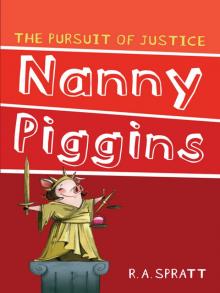
Nanny Piggins and the Pursuit of Justice
Nanny Piggins and the Daring Rescue
Nanny Piggins and the Race to Power
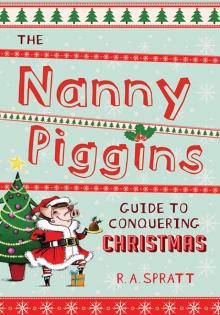
The Nanny Piggins Guide to Conquering Christmas
Friday Barnes: Girl Detective
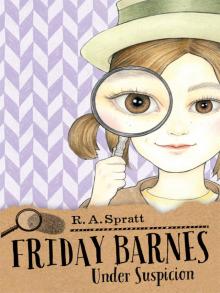
Friday Barnes: Under Suspicion
Friday Barnes: Big Trouble
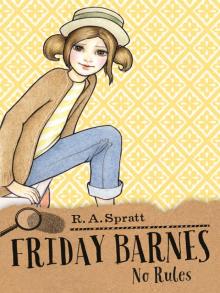
Friday Barnes: No Rules
Friday Barnes: The Plot Thickens
Friday Barnes: Danger Ahead
Friday Barnes: Bitter Enemies
Friday Barnes: Never Fear
Friday Barnes: No Escape
Friday Barnes: Undercover
The Peski Kids: The Mystery of the Squashed Cockroach
The Peski Kids: Bear in the Woods
The Peski Kids: Stuck in the Mud
The Peski Kids: Near Extinction
The Peski Kids: The Final Mission
Shockingly Good Stories
PUFFIN BOOKS
UK | USA | Canada | Ireland | Australia
India | New Zealand | South Africa | China
Penguin Random House Australia is part of the Penguin Random House group of companies whose addresses can be found at global.penguinrandomhouse.com.
First published by Puffin Books, an imprint of Penguin Random House Australia Pty Ltd, in 2022
Copyright © R.A. Spratt 2022
The moral right of the author has been asserted.
All rights reserved. No part of this publication may be reproduced, published, performed in public or communicated to the public in any form or by any means without prior written permission from Penguin Random House Australia Pty Ltd or its authorised licensees.
Cover illustration by Lilly Piri, www.lillypiri.com
Cover design by Kirby Armstrong © Penguin Random House Australia Pty Ltd
Internal design and typesettng by Midland Typesetters, Australia
ISBN 9781760148317
penguin.com.au
Sign up to Read More and discover new favourites
Visit penguin.com.au/readmore
R.A. Spratt, Friday Barnes 10