White bird, p.17
White Bird,
p.17
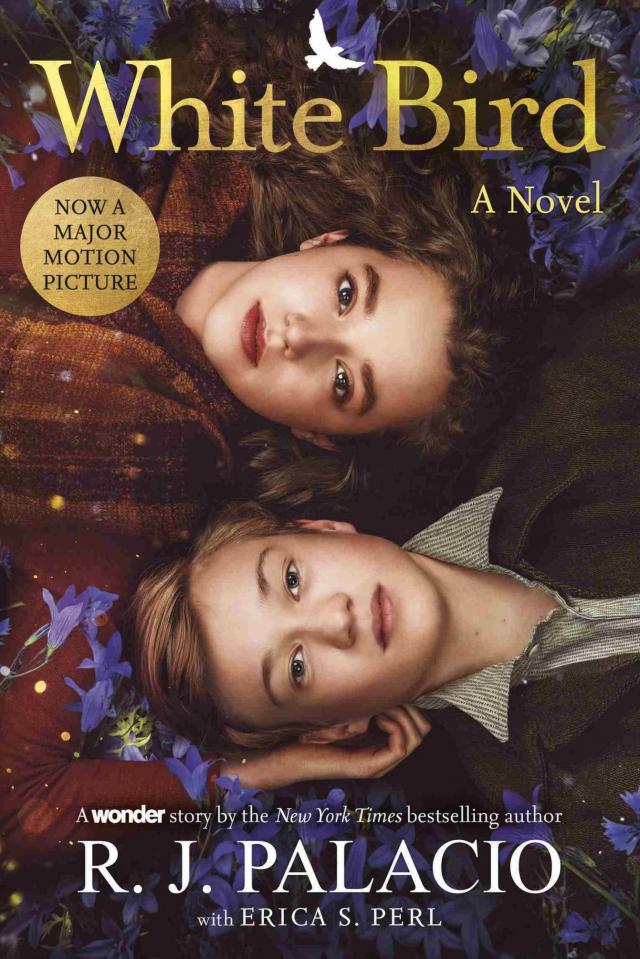


Like Lois Lowry’s Number the Stars, White Bird is a fictional—though historically based—story of a child in hiding and the heroism of those who come to her aid. Notably, the book is not told from the point of view of the non-Jewish helpers, as is far more common in Holocaust literature for children and young adults, but from the perspective of the hidden child herself. White Bird’s message, too, is very much its own. “Evil will only be stopped when good people decide to put an end to it,” says Vivienne, Julien’s mother. For her part, Sara will come to understand—and deeply regret—her own moral crime in not standing up to her classmates as they bullied Julien.
When Sara apologizes to Julien, he consoles her: “The truth is, it doesn’t matter how you used to be. It only matters how you are now.” It’s a message that everyone can relate to: Which of us has not, at some point, been a bystander to someone else’s pain? The stakes in our own lives aren’t usually as high as they are for Sara and Julien, but we never know when that might change. While we can’t undo pain that we have caused, we can act differently in the future.
Holocaust survivor Elie Wiesel often quoted a line from Leviticus: “Do not stand idly by while your neighbor’s blood is shed.” Research has demonstrated that the Holocaust could not have taken place without the passive participation of millions of ordinary people who looked the other way as the Nazis exterminated their Jewish neighbors. But it’s also true that the good deeds of those who saved the lives of their friends and fellow citizens—many of whom are honored by Yad Vashem, Israel’s Holocaust memorial and research center, as “the Righteous Among the Nations”—are valuable beyond measure. Jewish tradition teaches that if someone saves a single life, it is as if they saved an entire world.
White Bird ends with a call to resist contemporary manifestations of prejudice and xenophobia. One needn’t necessarily agree with the direct line the book draws from Nazi Germany to current events to be moved by its encouragement to stand up against tyranny and cruelty wherever we may find them, from the treatment of refugees to the tormenting of a disabled child in school. Sara’s story has the power to transform her grandson from a bully into an ally. It might transform you, too.
* * *
—
Ruth Franklin is a book critic and the author of A Thousand Darknesses: Lies and Truth in Holocaust Fiction and Shirley Jackson: A Rather Haunted Life.
AUTHOR’S NOTE
Those who cannot remember the past are condemned to repeat it.
—George Santayana
The first time I heard this quote, which I use at the beginning of White Bird, was in my seventh-grade English class. We had just finished reading The Diary of Anne Frank, and my teacher, Ms. Waxelbaum, read the quote aloud as part of our discussion of the book. It has always stayed with me. So has the book. In fact, I would say that of all the books I’ve read in my life, The Diary of Anne Frank is the one that has had the greatest effect on me, not just as a writer, but as a person. The Diary of Anne Frank is one of the reasons I wrote this book.
Another reason—far more subtle—was a book I came across in a bookstore when I was nine years old. (It was actually the first “grown-up book” I ever purchased for myself.) It was called The Best of LIFE, and it was a large coffee-table book of photographs from the archives of LIFE magazine. The Best of LIFE was, in many ways, my introduction to the history of the world. It was from its pages of captioned photographs that I learned about the World Wars and the Vietnam War, the Cold War and the space race, Hiroshima and the atom bomb. I saw photographs of the civil rights movement, peaceful marches, hippies, famous people and ordinary citizens, visionary leaders and dictators. But the photographs I remember the most, too devastating to describe here, were of the concentration camps. Until then, I’d never heard of the Holocaust. Not at school. Not at home. All I knew about Nazis was from The Sound of Music and a TV show called Hogan’s Heroes—which is to say I knew nothing.
That was not the case for my husband. He will tell you, as a Jewish man, that there was never a time in his life in which he did not know about the Holocaust. All of his mother’s aunts, uncles, grandparents, and cousins had died in the Shoah (the Hebrew term for the Holocaust). It was an ever-present reality for her. It was an ever-present reality for almost every family in their predominantly Jewish neighborhood. It was taught in Hebrew school and Sunday school. It was discussed in temple. Just about everyone my husband grew up with had at least one relative—and sometimes an entire branch of the family—who had perished in the Holocaust.
In America today, there are children who may know a lot about the Holocaust, like my husband did, or very little, like I did. It’s understandable that there would be a gap in what some kids know and some kids don’t. The Holocaust, and the events leading up to the annihilation of six million Jewish people, is an extremely difficult subject to grapple with, whether you’re an adult or a child. Most schools don’t teach the subject until the seventh or eighth grade, if even then. This was explained to me by my husband’s uncle Bernard, a New York City principal for many years, who was the first to suggest that the story of Grandmère, which I introduced in “The Julian Chapter,” was the “perfect introduction”—his words—to the Holocaust. This is yet another reason why I wrote White Bird. (Thank you, Bernard!)
Although I did not know a lot about the Holocaust as a child, I’ve studied it a great deal as an adult, even before I wrote this book. It’s a subject I think about often, which may seem odd to some people because, although I’m married to a Jewish man, I’m not Jewish myself. I know there may be some people who question whether I even have the right to tell this story, fictional as it is, because the Holocaust is not my story to tell. My feeling is that it should not fall solely on the victims of the Holocaust and their descendants to tell the story of the Holocaust. It should fall on everyone to remember, to teach, to mourn the loss. The millions of innocent people who died were the ultimate victims, but it was humanity itself—the very essence of who and what we are as human beings—that was attacked. It’s not for Jewish people to stop anti-Semitism, after all—it’s for the people who aren’t Jewish to stop it in its tracks whenever they see it. That goes for any group that is discriminated against: the preservation of what is good and decent in our society falls on all of us.
That is what I believe, in any case, and why I made this book. To me, the heartbreak of a little girl, separated from her parents, forced to flee, living in fear of capture, is extraordinarily relevant at this moment in history. There are connections to be made between the past and the present. There are things we must always resist, wherever and however we can. I am a storyteller, so White Bird was my act of resistance for these times.
That the Holocaust took place, that people and nations let it happen, is something we should always struggle with, talk about, and learn from, so that we can make sure it never, ever happens again. Not on our watch.
A NOTE ABOUT THE DEDICATION
This book is dedicated to my mother-in-law, Mollie (Malka), whose parents, Max (Motel Chaim) and Rose (Rojza Ruchla), immigrated to America from Poland in 1921. Like hundreds of thousands of Jewish immigrants fleeing persecution and poverty in their homeland, Max and Rose settled on New York’s Lower East Side, which is where Mollie grew up.
Mollie’s high school graduation portrait.
The rest of Max’s and Rose’s families—their parents, grandparents, siblings, aunts, uncles, cousins—all stayed behind in Poland. Max’s family was from Maków Mazowiecki. Rose’s lived not far away, in Wyszków. In 1939, when the Germans invaded Poland, that entire region was annexed by the Third Reich. Of the 3,000 Jews who lived in Maków before the war and the 9,000 Jews in Wyszków, none survived. We know this from archives that are carefully kept by organizations dedicated to preserving the names of the Jews who perished in the Holocaust. What we cannot know is the impact this must have had on Mollie’s mother and father. But we can imagine.
We are, all of us, a collection of those who have come before. In my children, I see my husband. In my husband, I see his parents. In his parents, I see an infinite past. This book is for Mollie, a beautiful, kind woman, who loved to laugh and sing; for her ancestors, who I’m sure also loved to laugh and sing; and for her descendants, including my sons, who carry in them a lineage that goes back to the dawn of time, and a light that will never fade.
GLOSSARY
This book is a work of fiction. It was not based on any one person’s story, but was influenced by the many inspiring stories I’ve read over the years about children who went into hiding during the Holocaust and the ordinary citizens who helped them.
Some young readers, after reading White Bird, may decide they don’t want to learn anything more about the Holocaust right now, which is totally okay. Some kids may wish to find out a little more. For these kids, I’ve provided a short glossary of some of the terms and events referred to in the book, as well as brief descriptions of the real-life inspiration for some of the characters and situations depicted in the book.
Anti-Semitism
Anti-Semitism is defined as the hatred of Jews as a group, be it religious or ethnic, which is often accompanied by hostile or passive discrimination against Jewish people. Anti-Semitism can be traced back to the Middle Ages in Europe, when Jewish communities were targeted for persecution. Examples of anti-Semitism: In Spain in 1492, Jews were expelled from all Spanish territories unless they converted to Christianity; in Russia, starting in the nineteenth century, pogroms were organized by local authorities to loot Jewish homes and businesses. The worst manifestation of anti-Semitism came in the twentieth century, when the Nazis committed genocide—the deliberate killing of six million Jewish people (see the Holocaust).
The Beast of Gévaudan
My inspiration for the wolf of Sara’s nightmares came from the stories of the Beast of Gévaudan. This was a man-eating wolf that was purported to have roamed the forests of the Margeride mountains in the eighteenth century. Eyewitness accounts describe the beast as having enormous teeth and a gigantic tail. In a span of three years, from 1764 to 1767, it was said that the Beast of Gévaudan had attacked and killed over 100 people, including many children.
An eighteenth-century engraving of the Beast of Gévaudan.
Although no one could prove that the victims had all been killed by the same wolf, or even by a pack of wolves, the legend became such a phenomenon throughout France that hunting parties were organized to find and kill the beast. This may have been the inspiration for numerous folktales and stories that have sprung up over the centuries involving a wolf-like beast living in the woods or the mountains, like “Beauty and the Beast,” the legend of the werewolves—voirloups in French—and even “Little Red Riding Hood.” Recent forensic studies have led scientists to speculate that the true Beast of Gévaudan was, in fact, not a wolf but a lioness, an animal that eyewitnesses might not have even known existed in that part of the world.
Concentration Camps
Concentration camps are detainment centers used to house large concentrations of people who have been imprisoned indefinitely, without legal cause or judicial oversight. During World War II, the Germans kept millions of captives inside concentration camps within both Germany and German-occupied territories. Some concentration camps were work camps, where captives were used as forced labor. Others were extermination camps, where large numbers of people were killed in gas chambers.
A group of child survivors at Auschwitz on the day of the concentration camp’s liberation, January 27, 1945.
In White Bird, Mademoiselle Petitjean is last seen en route to the camp in Pithiviers after being turned away from the camp in Beaune-la-Rolande. These two were transit camps inside France in which prisoners were held before being deported to concentration camps farther east.
Sara’s mother, Rose, is taken to the Drancy camp, which was another transit camp in France. From there, Rose was transferred to Auschwitz, the largest and most notorious of the concentration camps. Located in Poland, Auschwitz was both a labor camp and an extermination camp in which, historians estimate, over one million Jews were killed until its liberation in January 1945.
Deportations/Roundups in France
In White Bird, Sara’s family stops receiving letters from their relatives in Paris after the roundup of Vel’ d’Hiv.
The Vel’ d’Hiv roundup occurred in May 1942. Over 13,000 Jews—including more than 4,000 children—were arrested and detained inside the Vélodrome d’Hiver stadium, and held without adequate food, water, or sanitation. From there, most were transported to concentration camps.
Although other roundups of foreign-born Jews had taken place in the Occupied Zone as part of the Vichy government’s ongoing collaboration with Germany, the Vel’ d’Hiv roundup is considered the worst for several reasons: 1. the number of people arrested; 2. its location in the heart of Paris; 3. the arrests, for the first time, of women and children along with men. By this time, the Vichy government had published its “Statute of the Jews,” outlining the restrictions placed on Jews living in the Occupied Zone.
The yellow Star of David badge that Jews were required to wear. This one is from 1941.
In White Bird, Max refers to the roundup of Marseille, which occurred in January 1943. This was notable because it took place in the Free Zone. Two thousand mostly foreign-born Jews were immediately deported to concentration camps, and over 30,000 Jews were forced to leave when the Germans set fire to that sector of the city.
The roundup depicted in White Bird, which results in the arrest of Sara’s mother, is based on these well-documented roundups, as well as other, smaller ones that occurred after the Germans occupied the Free Zone in November 1942. Although the Vichy government never sanctioned the deportation of French-born Jews, it did allow the denaturalization of some Jews not born in France. Sara’s parents, both born outside of France, may have ended up on a deportation list because of this.
The Diary of Anne Frank
Anne Frank was just ten years old when the Nazis invaded the Netherlands, where she lived with her parents and her older sister, Margot. As they did in every country they occupied, the Nazis began systematically oppressing the Jewish population. Anne’s father, Otto, decided his family would hide behind his business to avoid the roundups he knew would come. With the help of his former employee Miep Gies, the Frank family, along with members of the Van Pels family, moved into the tiny quarters. The families had to stay very quiet during the day. They relied on Miep to bring them food. For the two years they were in hiding, Anne kept a diary, recording her thoughts and feelings and documenting the daily routines and drastic difficulties of being imprisoned inside a tiny room.
In August 1944, the police were tipped off and the secret annex was discovered. Everyone living in the secret annex was arrested and sent to concentration camps. Anne, her sister, and her mother were deported to the concentration camp Auschwitz, and then Bergen-Belsen. They did not survive. Neither did anyone else from the annex, except Anne’s father.
After the war ended, Otto returned to Amsterdam, and Miep gave him Anne’s diary, which she had kept hidden from the Nazis. The Diary of Anne Frank has been published in over seventy languages and has made a lasting impression on millions of people around the world.
Anne Frank writing in a journal in 1940.
The French Resistance
When Nazi forces invaded France in June 1940, the French government surrendered to Germany and signed an armistice, agreeing to split France in half. The Occupied Zone would be run by Germany. The Unoccupied Zone, or Free Zone, would be run by a German-approved French government located in a town called Vichy.
Shortly after, a French general named Charles de Gaulle gave a radio speech from London that called on French citizens to resist the occupation. By then, many small resistance groups, made up of men and women from all over the country and from all different social and economic backgrounds, including students, academics, artists, writers, doctors, housewives, and clergy from every denomination, had already formed secretly all over France, intent on fighting the Nazi occupation in whatever way they could. De Gaulle’s speech became a clarion call for these resisters, whose actions—both great and small—were collectively known as the French Resistance. In the beginning, there was no central authority governing the French Resistance, but eventually it became a network of organized activity under the leadership of Jean Moulin, a civil servant, who parachuted into the heart of France to unite the various resistance factions under de Gaulle’s Free French banner. Moulin was eventually captured and died in Nazi custody.
Members of the Maquis, a group within the French Resistance, study the mechanism and maintenance of weapons dropped by parachute into the Haute-Loire region in 1940.