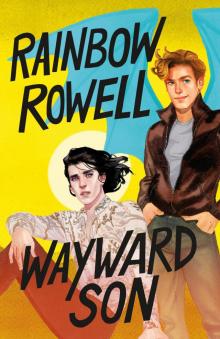
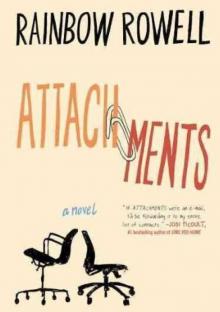
Attachments a novel, p.3
Attachments: A Novel,
p.3



He spent the rest of the night archiving and compressing files, just to spite Greg. (Even though Greg would never notice that the work was done, let alone that it was done spitefully.) Lincoln archived and compressed and thought hard about quitting. He might have walked out, there and then, if anyone had been in the IT office to accept his resignation.
It was almost ten o’clock when he remembered his mother’s tandoori chicken.
The container had tilted open in its paper bag, and there was a pool of bright orange sauce on the carpet under his desk. The girl who sat there during the day, Kristi, would be angry. She’d already left Lincoln a Post-it note asking him to stop eating at her workstation. She said he was getting crumbs in her keyboard.
Lincoln took what was left of the chicken up to the second-floor break room. Almost nobody used the break room at night—the copy editors ate at their desks—but it was still livelier than the empty information technology office. He liked all the vending machines, and sometimes his break would overlap with the janitors’. Not tonight. Tonight, the room was empty.
For once, Lincoln was glad to be alone. He grabbed a plastic fork and started eating his chicken at a table in the corner. He didn’t bother heating it up.
Two people walked into the break room then, a man and a woman. They were arguing about something. Amicably. “Give our readers some credit,” the woman said, wagging a rolled-up Sports section at the man and leaning against the coffee machine. “I can’t,” he said. “I’ve met too many of them.” The man was wearing a dingy white shirt and a thick brown tie. He looked like he hadn’t changed his clothes or gotten a good night’s sleep since the Carter presidency. The woman was younger. She had bright eyes and broad shoulders and hair that fell to the middle of her back. She was too pretty to look at.
They were all too pretty to look at. He couldn’t remember the last time he had looked a woman in the eyes. A woman who wasn’t his mother. Or his sister, Eve.
If he didn’t look, he didn’t risk accidental eye contact. He hated that feeling—at the bank, in elevators—when you inadvertently catch someone’s eye, and she feels compelled to show you she’s not interested. They did that sometimes, looked away pointedly before you even realized you were looking at them. Lincoln had apologized to a woman once when their eyes had met, unintentionally, over a gas pump. She’d pretended not to hear him and looked away.
“If you don’t get a date,” Eve kept threatening, “I’m going to start fixing you up with nice, Lutheran girls. Hard-core Lutherans. Missouri Synod.”
“You wouldn’t,” he told her. “If any of your church friends met Mom, it would totally ruin your rep. Nobody would want to sit next to you at adult Bible study.”
The woman in the break room laughed and shook her head. “You’re being perverse,” she said. She was so preoccupied with her argument, it almost felt safe to watch her. She was wearing faded jeans and a soft green jacket that inched up when she bent over to get her coffee. There were freckles on the small of her back. Lincoln looked away.
“There’s nothing wrong with you, Lincoln,” his sister would tell him. “You’ve been on dates. You’ve had a girlfriend. There is nothing about you that is inherently un-dateable.”
“Is this supposed to be a pep talk? Because all I’m hearing is ‘inherently un-dateable.’”
Lincoln had been on dates. He’d had a girlfriend. He’d seen the small of a woman’s back before. He’d stood at concerts and football games and basement parties with his hand on a woman’s back, on Sam’s back, with his fingers sliding inside her sweater. He’d felt like he was getting away with some secret intimacy, touching her like that when no one was paying attention.
Lincoln wasn’t inherently un-dateable. He’d gone on a date three years ago. A friend’s sister had needed a date to a wedding. She’d danced all night with one of the groomsmen, who turned out to be her second cousin, while Lincoln ate exactly thirteen cream cheese mints.
He wasn’t scared, exactly, to start dating again. He just couldn’t visualize it. He could imagine himself a year in, at the comfortable place, the hand-at-the-small-of-the-back place. But the meeting, the making a girl like him …He was useless at all that.
“I don’t believe that,” Eve said. “You met Sam. You made her fall in love with you.”
He hadn’t, actually. He hadn’t even noticed Sam before she started poking him in the shoulder during tenth-grade world geography. “You have very nice posture,” she’d said. “Did you know you have a mole on the back of your neck?
“I spend a lot of time looking at the back of your neck,” she said. “I could probably identify your body if there was ever an accident. As long as your neck wasn’t hopelessly disfigured.”
It made him blush. The next day, she told him that he smelled like peaches. She was loud. And funny. (But not as funny as loud.) And it was nothing for her to look you straight in the eye—in front of people—and say, “No, really, Lincoln, you smell like peaches.” And she would laugh, and he would blush.
She liked embarrassing him. She liked that she could.
When she asked him to Homecoming, he thought that it might be a joke, that she’d spend the night teasing him in front of her friends. But he said yes anyway. And she didn’t.
Sam was different when they were alone. She was quiet—well, quieter—and he could tell her anything, even things that mattered. She liked to talk about things that mattered. She was wholehearted, and fierce.
He hadn’t made Sam fall in love with him. She just did.
And he’d loved her back.
Lincoln looked up at the coffee machine. The man in the rumpled shirt and the girl with the freckles were gone.
CHAPTER 7
From: Beth Fremont
To: Jennifer Scribner-Snyder
Sent: Mon, 08/30/1999 11:24 AM
Subject: Who looks good in a strapless dress?
Not just strapless. A strapless sheath. Who can pull that off?
<
<
1. Do you only watch the Lifetime Network? Or do you also occasionally watch Hollywood Squares?
2. Even those lovely ladies would look hippy standing next to my sister’s bridesmaids. They’re all 20 years old and have “I might not be throwing up in the Tri-Delt bathroom after dinner, but my roommate is, and I like to borrow her jeans” hips.
Maybe I could have gotten away with a strapless sheath once …for like one day in 1989, but that day is long gone.
<
<
<
<
<
<
<
<
Except for that I’m not happy for you. I kind of want you all to drop dead. When Kiley showed me her ring—platinum, 1.4 carats—I really wanted to say something mean about it. Who really needs a ring that big? I ask you. It was rings that big that made our grandmothers think Elizabeth Taylor was a whore.
And then I actually did say something mean, quite a few some-things mean.
We were at the bridal shop for our first fitting (yes, already), and I said that sage green is the color of dirty aquarium water. And that polyester crepe smells like B.O. even before you put it on.
And when she told us her wedding song—of course, they’ve already picked their wedding song, and of course, it’s “What a Wonderful World” by Louis Armstrong—I said that choosing that song is the sonic equivalent of buying picture frames and never replacing the photos of the models.
<
<
Nobody was listening to me snipe. Kiley was trying on veils, and the other bridesmaids were too busy counting each other’s ribs to pay attention.
I felt like such a lousy human being when I left that bridal shop. I felt bad for making a scene. I felt mad that no one had noticed. I felt like the sort of person who would set something on fire just to get attention. Which suddenly seemed like a really good idea …
Setting something on fire. Something made of polyester crepe.
I couldn’t torch Kiley’s dress—not yet, I won’t even get it for 10 to 12 weeks—but I have a whole closet full of dead dresses. Prom dresses. Bridesmaid dresses. I was all prepared to scoop them up in big fluffy armfuls and throw them into the Dumpster outside my building. I was going to light a cigarette in their flames, like I was the cool girl in Heathers …
But I couldn’t. Because I’m not that girl. I’m not the Winona Ryder character in any movie. Jo from Little Women, just for example, never would have started laying all those dresses out on her bed and trying them on, one by one …
Including the off-the-shoulder number I wore to my brother’s wedding 12 years ago. It’s teal (that was 1987’s sage green) with puffy sleeves and peach rosettes at the waist. Of course it was too tight, and of course it wouldn’t zip—because I’m not 16 anymore. That’s when it hit me—I’m not 16 anymore.
And I don’t mean that in an offhand “well, obviously” way. I mean it like “Jack and Diane.” Like, “Oh, yeah, life goes on, long after the thrill of living is gone.”
I’m not even the same person who could zip up that dress. That person thought that wearing an ugly dress on the happiest day of someone else’s life was just the beginning—the line you have to stand in to get to your own happiest day.
There is no such line. There’s just the waiting room scene from Beetlejuice. (Another movie where I’m not Winona.)
I had dresses spread all over the spare bedroom when Chris came home. I tried to come up with some normal reason to be wearing a dusty bridesmaid dress and crying. But he reeked of cigarette smoke and went straight in to take a shower, so I didn’t have to explain—which was even more upsetting because what I really wanted was for someone else to feel sorry for me.
<
<
<
<
<
CHAPTER 8
“WHAT DO YOU care if they pay you to sit there?” Lincoln’s sister asked.
He’d called Eve because he was bored. Because he’d already read everything in the WebFence folder. He’d read some of it twice …
Beth and Jennifer again. He didn’t send them a warning. Again. He was starting to feel like he knew them, like they were his work friends. Weird. Yet another reason to quit this job.
“I don’t care,” he said to Eve.
“You must. You called me to whine about it.”
“I’m not whining,” Lincoln said, a little too forcefully.
“This was supposed to be your nothing job. You told me you wanted a job that wouldn’t take too much brainpower, so that you could devote all your energy to deciding what to do next.”
“That’s true.”
“So, what do you care if they’re paying you to do nothing? That sounds ideal. Use that time to read What Color Is Your Parachute? Start working on your five-year plan.” She was practically shouting to be heard over some mechanical noise.
“Are you vacuuming?”
“I’m DustBust-ing,” she said.
“Stop. It makes you sound strident.”
“I am strident.”
“Well, it makes you sound excessively strident,” he said. “Now I don’t remember what I was saying.”
“You were whining about getting paid to do nothing.” Eve turned off the DustBuster.
“It’s just that getting paid to do nothing is a constant reminder that I’m doing nothing,” Lincoln said. “And doing nothing takes more energy than you’d think. I’m tired all the time.”
“How could you possibly be tired all the time? Every time I call, you’re asleep.”
“Eve, I don’t get off work until one in the morning.”
“You should still be awake by noon.”
“I get home at one thirty. I’m wired. I mess around on the computer for another hour or two. I fall asleep at, like, four. I get up at one, one thirty. And then I spend the next three hours thinking about how there’s not enough time to do anything before I go to work. I watch Quantum Leap reruns and mess around on the computer some more. I go to work. Rinse. Repeat. ‘Second verse same as the first.’”
“That sounds awful, Lincoln.”
“It is awful.”
“You should quit that job.”
“I should quit this job … ,” he said, “but if I keep it, I can move out of Mom’s house.”
“How soon?”
“As soon as I want. The money’s good.”
“Don’t quit,” Eve said firmly. “Move out. Find a new job. Then quit.”
He knew she would say that. In Eve’s mind, all of Lincoln’s problems would go away if he moved out of their mother’s house. “You’ll never have your own life as long as you live there,” Eve told him whenever she had the chance. She’d tell him to keep a job at a meatpacking plant if it meant getting his own apartment.
But Lincoln wasn’t sure he even wanted to move out. He liked his mom’s house. He liked the way everything about it was already broken in. Lincoln had the whole upstairs to himself; he even had his own bathroom. And he usually didn’t mind being around his mom. He wished she would give him a little more space sometimes. Headspace.
“Don’t you hate telling people that you still live at home?” Eve would ask.
“Who asks me where I live?”
“New people.”
“I don’t meet any new people.”
“You won’t ever meet any new people as long as you’re living at home.”
“Who am I going to meet if I get my own apartment? Do you see me hanging out at the pool? Starting conversations in the community weight room?”
“Maybe,” she said. “Why not? You know how to swim.”
“I don’t like apartment complexes. I don’t like the carpet and the little concrete balconies and the cabinets.”
“What’s wrong with the cabinets?”
“They’re made of fiberboard, and they smell like mice.”
“Gross, Lincoln. Whose apartments have you even been in?”
“I have friends who live in apartments.”
“Gross apartments, apparently.”
“Single-guy apartments. You don’t know what it’s like.”
Eve had moved out when she was nineteen. She’d married Jake, a guy she’d met at community college. He was ten years older and in the air force. He bought her a ranch-style house in the suburbs, and Eve painted every room a different shade of cream.
Lincoln used to sleep over at their house on weekends. He was eleven, and Eve let him have his own bedroom. “You’re always welcome here,” she told him. “Always. For as long as you want. This is your home, too.”
He liked staying at Eve and Jake’s house, but he never felt like he needed to escape to it. He’d never felt like he needed to escape from their mother, not like Eve had. He didn’t understand the anger between them. He didn’t even recognize his mother in the stories Eve told.
“Mom never had a bong,” he’d protest.
“Oh yes, she did. It was made out of a Dr Pepper bottle, and she kept it on the coffee table.”
“Now I know you’re lying. Mom would never drink Dr Pepper.”
WHEN LINCOLN GOT to work the next afternoon, Greg was arguing with someone on the phone. He’d hired an outside consultant to take care of the newspaper’s Y2K issues, and now the consultant was saying he wouldn’t be able to get to The Courier until early February. Greg called the guy a charlatan and a one-eyed gypsy, and hung up on him.
“I can help with the Y2K stuff,” Lincoln said. “I’ve done some programming.”
“Yeah,” Greg said, “we’ll have you, me …a couple of eighth-grade magnet students …I’m sure it’ll be fine …” He turned off his computer by yanking the power cord from the surge strip. Lincoln cringed. “‘Despite all my rage, I am still just a rat in a cage,’” Greg said, gathering up his papers and jacket. “See you tomorrow, Senator.”
Huh. Programming. Debugging. It wasn’t Lincoln’s favorite, but it beat archiving and compressing. At least it was a problem to solve. And it would only be for a few months, maybe less.
He checked the WebFence folder. There were only two red flags. Which meant Lincoln had anywhere from thirty seconds to five minutes of actual work to get him through the night. He’d already decided to save it for after dinner.
Tonight, he had a plan.
Well …a plan to make a plan. He’d gotten up early that day, at noon, and gone to the library to check out that parachute book Eve had mentioned. It was in his backpack right now with a copy of today’s want ads, a yellow highlighter, a ten-year-old Mead notebook, an Entertainment Weekly, and a turkey sandwich that smelled so good he was having a hard time thinking about anything else.