The cooking of books, p.1
The Cooking of Books,
p.1
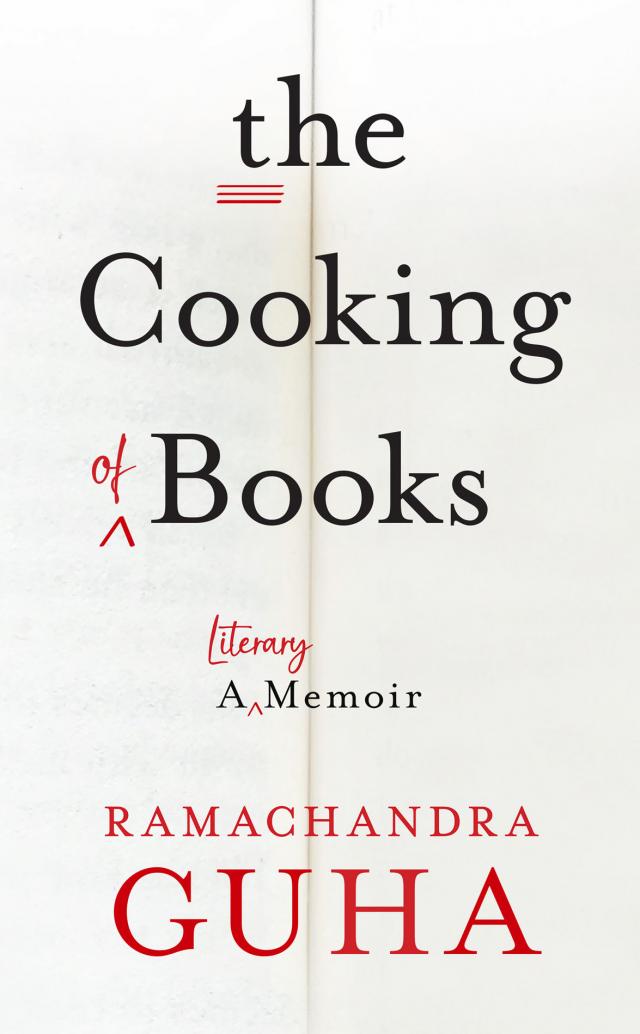


THE COOKING OF BOOKS
A Literary Memoir
RAMACHANDRA GUHA
Copyright
William Collins
An imprint of HarperCollinsPublishers
1 London Bridge Street
London SE1 9GF
WilliamCollinsBooks.com
Macken House, 39/40 Mayor Street Upper,
Dublin 1, D01 C9W8, Ireland
This eBook first published in Great Britain by William Collins in 2024
Copyright © Ramachandra Guha
Ramachandra Guha asserts the moral right to be identified as the author of this work
Cover design by Bhavi Mehta
A catalogue record for this book is available from the British Library
All rights reserved under International and Pan-American Copyright Conventions. By payment of the required fees, you have been granted the non-exclusive, non-transferable right to access and read the text of this e-book on-screen. No part of this text may be reproduced, transmitted, down-loaded, decompiled, reverse engineered, or stored in or introduced into any information storage and retrieval system, in any form or by any means, whether electronic or mechanical, now known or hereinafter invented, without the express written permission of HarperCollins
Source ISBN: 9780008670146
Ebook Edition © January 2024 ISBN: 9780008670160
Version 2024-01-18
Dedication
For Sujata, my second-best editor
Epigraph
Good editors, really good editors, are very rare, in fact even rarer than good writers. It’s a special kind of talent because it takes two qualities that rarely go together in the same person. On the one hand, great arrogance, and on the other hand, great selflessness. The arrogance lies in the fact that you, the editor, thinks he knows better than the author, who is usually a specialist, on how to say what it is he wants to say. The humility or selflessness, which is very important, is that you are willing to lend your talents to someone else’s work without getting any credit for it.
NORMAN PODHORETZ
Photo credit: Anuradha Roy
Rukun Advani and Ramachandra Guha in conversation, Ranikhet, April 2019
Contents
Cover
Title Page
Copyright
Dedication
Epigraph
Preface (Why this book was written)
1. Sportsman and Scholar
(How Rukun Advani and I first met, his early antipathy to me, and the college where we studied which quickened and shaped our minds)
2. Finding One Another
(How Rukun shed his prejudices towards the sportsman I once was, and warmed to the historian I had now become, and sought to publish my books with the Oxford University Press, where he worked)
3. Author and Editor
(On the process of working together on the writing of my books, with copious extracts from Rukun’s editorial comments and personal letters on the subject, highlighting his role in turning a stuffy sociological historian into a biographer and essayist with a lighter touch)
4. Exiting the OUP
(On the self-willed destruction of the Indian Branch of the Oxford University Press, and Rukun starting an independent press that was soon publishing the best works of history and social science on the subcontinent)
5. Writer and Critic
(On the role played by Rukun in my work as an essayist and newspaper columnist, with examples of how he polished my prose and refined my arguments, with I taking all the credit)
6. Patriot and Sceptic
(On our arguments about the redemptive potential of Indian democracy, with Rukun mocking what he saw as my naïve and sentimental patriotism, in a series of sarcastic responses to some of my published pieces, the criticism hitting home)
7. The Editor at Home
(On Rukun’s increasing retreat into himself, his refusal to meet or relate to people, the chapter [and book] ending with me visiting him in his remote mountain home in the Himalaya)
Footnotes
About the Author
About the Publisher
Preface
I am a creature of habit, from the way I structure my day’s work to the manner in which I organize my year’s travels. After moving to Bangalore in 1995, I started making four trips each year to India’s capital city, to raid the rich archival collections of the Nehru Memorial Museum and Library (NMML). These were generally in January, April, September, and November, enabling me to avoid the brutal heat of the Delhi summer and the sapping stickiness of the monsoon. I would book myself for a week or ten days in a boarding house within walking distance of the NMML. I would reach the Manuscripts Room at 9 a.m., as soon as it opened, colonize a desk by the window, order my files, and settle in for a day of concentrated research. Apart from a short break for lunch and two shorter breaks for chai, I took notes until 5 p.m., coming back the next day for more.
I have worked in dozens of archives around the world, but the NMML has always been my favourite place to do research. The reasons are various: the setting, a tree-laden campus rich in birdlife, behind the magnificent Teen Murti House; the range of primary materials on all aspects of my country’s history; the capable and helpful staff; the planned and unplanned meetings with other scholars who came to work there.
For a quarter of a century I made four, and occasionally five, pilgrimages each year to this shrine for historical researchers. When I was there in January 2020 I had no clue that year would be any different. Then the pandemic set in, and for the rest of the year, and much of the next, I was marooned in south India. Even if I had somehow got on a flight to New Delhi I would have found the NMML shut.
Denied access to my best-loved public repository, I took recourse to my personal archive. In my study I had a vast cache of my correspondence with a man named Rukun Advani, a Cambridge scholar with a PhD on E.M. Forster who helped transform the Indian branch of the Oxford University Press (OUP), making it the go-to place for the best scholarship on the subcontinent, whether written by historians, sociologists, political scientists, or economists, whether these were Indian or British or American or Japanese.
Rukun and I had been contemporaries at St. Stephen’s College in the 1970s, when he was already deep into serious books while I was an anti-intellectual sportsman. In those days he had contempt for me (preferring, naturally, the company of the future novelist Amitav Ghosh and other literary-minded folks) but later, after I rebooted myself and did a PhD as well, we became acquaintances and then friends. He published all my early books, and was instrumental in my becoming, successively, a historian, a biographer, a cricket writer, and an essayist. It was also he who encouraged me to leave the OUP for trade presses that, he felt, could do more justice to the books I was now writing. Meanwhile, he had himself left the OUP and started a small, boutique press called Permanent Black, which he ran from a small town in the Himalaya, where he lived with his wife (the novelist Anuradha Roy) along with an assortment of dogs picked up from the street.
In an author’s life, the person next in importance to his or her romantic partner is his or her editor. I first saw Rukun Advani several years before I met my wife Sujata Keshavan, and these two relationships have run in parallel for more than four decades now. My early encounters with Rukun were discomforting – for me – but once the initial barriers were surmounted, matters have been more or less smooth (if not always sweet) ever since. While we have had many disagreements, we have never really had a fight. This may be because our friendship has largely been conducted by correspondence. Had we seen each other more often, face to face, we might have gone our separate ways long ago.
After the pandemic prevented me from travelling to the archives I needed for my scholarly work, I went through my correspondence with Rukun (handwritten or typed from 1986 to 2003, via email thereafter). While our professional roles are (or were) complementary, our personalities are utterly dissimilar. I am gregarious and outgoing, with a zest for travel, whereas Rukun is notoriously reclusive, preferring the company of dogs to humans. I give many talks and too many television (lately, Zoom) interviews each year. Rukun detests speaking in public, and after his first two books (the second being a novel, Beethoven among the Cows, published by Robert McCrum at Faber in the early 1990s), pretty much stopped writing for public consumption too. But he continues to maintain a regular private correspondence with me (and a few others), his letters sparkling with wit, intelligence, learning, and sarcasm.
The Cooking of Books is based on the letters and emails exchanged between Rukun and myself. There are some recollections of personal meetings. The reader is introduced to the two institutions, an undergraduate college and a publishing house respectively, that shaped the minds and lives of the book’s protagonists. There are cameo portraits of our colleagues and contemporaries. There are a few quotations from published books and articles. But it is the personal correspondence, the letters and emails exchanged between Rukun Advani and myself, that lies at the heart of the narrative.
Rukun and I have had some sharp disagreements over literary and political matters, and these find their place in what follows. At the same time, the narrative does, I think, touch on larger questions of literary and sociological importance, such as the role of editors in shaping books and writers, the craft of history and the art of biography, the degradation of humanistic scholarship by the virus of political correctness, and the transformation of Indian public discourse from the age of Jawaharlal Nehru, under whose p
rime ministership both of us grew up, to the time of Narendra Modi, under whose prime ministership we are both growing old.
In many respects this memoir also records a vanished world. When Rukun and I first came together as editor and writer, the universe of books was a less visible and much less flamboyant place than it has since become. There were no literary festivals at which authors and publishers were compelled to talk up and sell not just their wares but their professional identities and their own importance within the book world. Because there was no Facebook, no Instagram, no Twitter/X, no rampant social media, no instant and continuous communication, there was less hype and no vigorous selling of the book, the author, and the editor/publisher. A few writers were much celebrated, but they were not seen as celebrities. The book and its author had not yet arrived as an image that the whole reading universe felt it had better see if it wanted to be ‘with it’. It was not important – or at least a lot less important – in that earlier time for readers to demonstrate (to themselves and others) that they hadn’t missed out on this wonderful book, author, and publisher that everyone who mattered seemed to be familiar with (and taken a selfie with) already. The thinking then was that just the making of a book – the very fact that a book had been conjured up and made to exist – was more important than selling it. This was especially so in the sphere of academic publishing, where the lordly view was that since scholarly books always sell in small numbers and can never be hawked in vast quantities, the sheer merit acquired by author and publisher in having brought out a fine book had positioned them among the Elect. In contemporary publishing, where the blaring of trumpets is among the most important aspects of the trade, this Olympian worldview is now likely to be seen as at best laughable and at worst contemptible.
There have been memoirs written by editors which feature writers they have worked with.[fn1] In their own autobiographies, scholars and writers sometimes devote a few pages or a chapter to the editor who chiselled and refined their prose. However, as far as I know, the relationship between an author and his/her editor has never resulted in a whole book – at least not in English-language publishing.[fn2] Partly, this may be because each such relationship tends to be short-lived, lasting for the duration of the editorial process over which a book is shaped – typically three or four months – at the end of which the author and editor go their own separate ways, unless they happen to come together later to craft a second and a third book. But the continuous collaboration of an author with one specific editor and of the two befriending each other are not unknown. Consider the partnership between Robert Caro and Robert Gottlieb over the writing of the former’s multi-volume biography of Lyndon Johnson, or between Roy Hawkins and Jim Corbett over the latter’s shikar stories. But it was always uncommon and has certainly become uncommoner in recent decades.
An obvious reason is the decline, with email and the ease of instant replies, of letter writing on paper. By and large, authors and editors no longer keep a record of their interactions, seeing them as transient or inconsequential or not of general interest. So there is usually no epistolary or other archive from which to write a book like this one – a matter of regret, perhaps, because exchanges between authors and editors can provide insights not merely into book history and the culture of publishing but also into the intellectual and social history of their time.
A related reason for the absence of this kind of book is that editorial functions in publishing have grown more specialized since the time Rukun and I began corresponding. Between c.1950 and c.2000, an editor who acquired a manuscript was usually also the editor who would copyedit it. In the Indian context this kind of editor who both acquired and edited books began to fade out of publishing in the 1990s. More and more, there were on the one hand acquisitioning editors who plied authors with lunch, beer, and the promise of a royalty advance, and on the other hand copy editors to whom manuscripts were farmed out once they had been contracted. Especially in the Indian context, copyediting became the domain of freelancers, and this function – which requires advanced skills in language use, a trustworthy understanding of refined narration, and persuasive communication with authors who can be as difficult as opera divas – came to be regarded as the inferior end of editing.
The greater specialization within editorial functioning made business sense, increasing editorial productivity and therefore publishing profitability. But it did not result in an equally happy situation for authors who, when deciding on the best publisher for their book, also hoped for an accomplished copy editor whom they could trust to curtail, elongate, and polish what they had written. When my own writing career began in the 1980s, I was fortunate to encounter a publisher’s editor whose counsel on possible or prospective books I greatly valued, with the same person acting, once a manuscript was ready, as its meticulous and highly skilled copy editor. In this sense, my relationship with Rukun, which has lasted more than forty years – with hardly a week having passed without our exchanging strings of letters – has been atypical. I do not see this kind of relationship being replicated, given the very changed world of writing and publishing in which we now live.
In what follows, Rukun Advani’s letters and emails are quoted more abundantly than mine. This is not an accident. Back in 2009, I wrote to Rukun:
What is that line of Gray’s (unlike my son, wife and esp mother-in-law I know no poetry) about blushing unseen in the desert air, etc. Your lines and lobs[fn3] are too funny and serious to be merely in cyberspace floating between your address and mine. Put them all in a book – a novel about lunatic academics, even.
Rukun Advani, had he agreed to write this book, is likely to have written a frivolous and spoofy account, his instinct as a writer being iconoclastic, seeking to provoke rather than inform. Perhaps it is just as well he declined to write this book, and that it has fallen to me to do it instead. The result is a memoir that has nothing in it of the artifice of fiction.
I suppose readers of The Cooking of Books will interpret it in different ways: as a memoir of friendship, as an elegy to a lost world, as a partisan account of publishing in India, as a self-indulgent celebration of elite male privilege. It may (or may not) be any or all of these things. I see it in more straightforward terms, as an author’s tribute to the remarkable (and remarkably self-effacing) editor who made his books possible, and, occasionally, popular and even profitable.
The Cooking of Books was read in draft by Keshava Guha, Ian Jack, Niraja Gopal Jayal, Joan Martinez-Alier, Rupert Snell, Brijraj Singh, Chiki Sarkar, Rivka Israel, K. Sivaramakrishnan, David Gilmour, Arabella Pike, Anjali Puri, and A.R. Venkatachalapathy, and I am grateful to them all for their (sometimes brutal) comments. Although the printed book appears in my name alone, Rukun Advani is entirely complicit in its contents, arguments, evocations, and evasions.
ONE
Sportsman and Scholar
I
In July 1973, a Bengali boy named Amitav Ghosh joined St. Stephen’s College in Delhi, hoping to take an honours degree in history. Like every other freshman, he was nervous about the first few weeks, when one was ‘ragged’ – shorthand for being verbally harassed, harangued, interrogated, and intimidated – by those who had already spent a year or more in the college. Twenty-five years later, by now an established novelist, Amitav Ghosh began an essay on his time at St. Stephen’s with this paragraph:
The year I joined College, 1973, the word among us freshers was that the most terrifying ragger in College lived in Rudra Court, in L5. Terrifying because he wasn’t the usual kind of bullying, bellowing senior. No, he was to them as the panther is to the elephant, the scimitar to the war club, the rapier to the broadsword. He was bearded, they said, and soft-spoken, so stealthy that you never sensed his presence until he had you square in his sights.
Young Amitav was able to escape the clutches of this fearful senior for a fortnight. But then he ‘was “nabbed while attempting to abscond” as the Indian Express used to say’. The ‘legend of L5’ caught hold of the fresher, and quizzed him about his interests. ‘I like classical music,’ answered Ghosh, nervously. ‘You do?’ said the legend, and walked him into his room in Rudra North. The legend put a record on the turntable and began to play it. He asked Ghosh to identify the composer and composition. Beethoven’s Emperor Concerto, answered the fresher, correctly. It was followed by the same composer’s Pastorale, 3rd movement. Three or four more records were played and all except one accurately identified. At this, ‘The legend stuck out his hand. “I’m Rukun Advani,” he said. “Let’s go down to Maurice Nagar and have a cup of tea.”’