Two sparrowhawks in a lo.., p.1
Two Sparrowhawks in a Lonely Sky,
p.1


Also by Rebecca Lim
Tiger Daughter
The Relic of the Blue Dragon
The Race for the Red Dragon
The Letterbox Tree*
The Sweet Life
Totally Stylin’
Whiffy Newton in the Case of the Dastardly Deeds
Whiffy Newton in the Riddle of the Two-Tone Trousers
Whiffy Newton in the Affair of the Fiendish Phantoms
Whiffy Newton in the Mystery of the Marble Beach Mugger
For older readers
Mercy
Exile
Muse
Fury
Wraith
The Astrologer’s Daughter
Afterlight
* with Kate Gordon
The author acknowledges support for this work through an Australian Government Research Training Program (RTP) Scholarship.
First published by Allen & Unwin in 2023
Copyright © Rebecca Lim 2023
All rights reserved. No part of this book may be reproduced or transmitted in any form or by any means, electronic or mechanical, including photocopying, recording or by any information storage and retrieval system, without prior permission in writing from the publisher. The Australian Copyright Act 1968 (the Act) allows a maximum of one chapter or ten per cent of this book, whichever is the greater, to be photocopied by any educational institution for its educational purposes provided that the educational institution (or body that administers it) has given a remuneration notice to the Copyright Agency (Australia) under the Act.
Allen & Unwin
Cammeraygal Country
83 Alexander Street
Crows Nest NSW 2065
Australia
Phone:(61 2) 8425 0100
Email:info@allenandunwin.com
Web:www.allenandunwin.com
Allen & Unwin acknowledges the Traditional Owners of the Country on which we live and work. We pay our respects to all Aboriginal and Torres Strait Islander Elders, past and present.
ISBN 978 1 76118 022 4
eISBN 978 1 76118 757 5
For teaching resources, explore
www.allenandunwin.com/resources/for-teachers
Extract from letter, Frank Kum Shiu Liu to the Department of Immigration, Canberra, 1950 (pages 4, 104, 226, 289, 305)
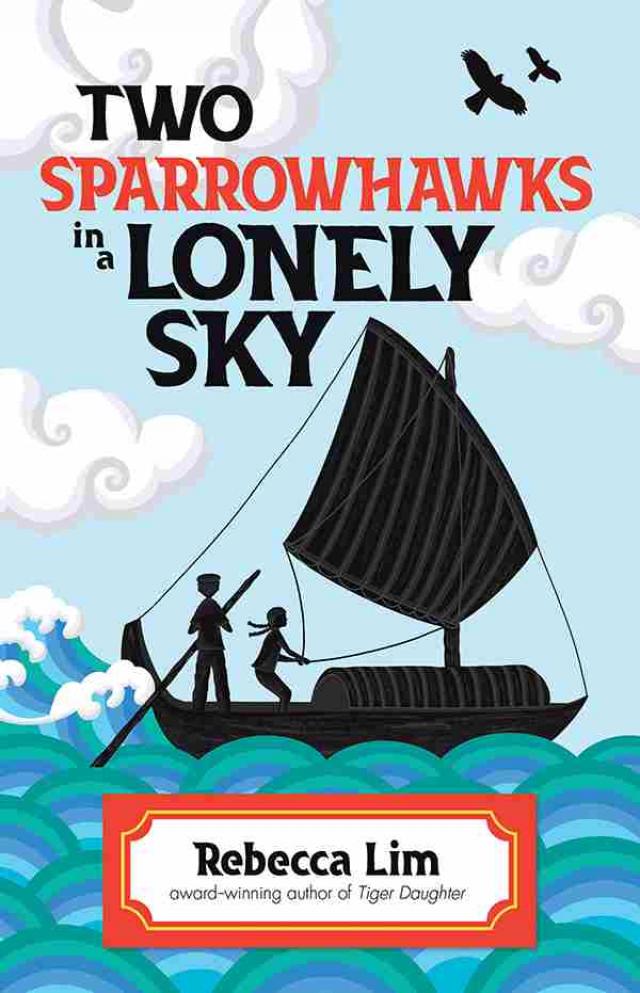
Cover design and illustration by Hana Kinoshita Thomson
Text design and illustrations by Hana Kinoshita Thomson (frontispiece) and Rebecca Lim (page 53)
Set by Midland Typesetters, Australia
To the far-sighted travellers in our family – Lim Yean Kai, Ko Sock Mui, Wong Wai Sau and Barry, Robert, Tina and Judy Liu
And in loving memory of Lim Koon Yaw, Lau Eng Swan, Choi Chai Y, Frank Kum Shiu Liu and William Joseph Lumb Liu OBE, pioneers all, who made it possible for my family to be here
Contents
Extract from a letter
Part 1: Village Life 1951–1958
Laughter
Dragon sleeping in the well
Speak bitterness
The Co-operative
A Chinese menu from the bottom of the world
Hidden miracles
Yun’s bargain
Part 2: Passage
Sampan Queen
Blue tears
Sea pigs
The ghost
Dealings with aliens
Part 3: Border Crossings
Assisted passage
English lessons
The bottom of the world’s bottom
Author’s note
Acknowledgements
About the author
In reading Two Sparrowhawks in a Lonely Sky, note that China’s seasons are the opposite of Australia’s, broadly:
Spring – March to May
Summer – June to August
Autumn – September to November
Winter – December to February
Extract from a letter to Mr A. G. Turner, Acting Secretary, Department of Immigration, Canberra, 1949
The above-named is a beloved nephew, well-educated, a teacher at a high school in southern China, with some knowledge of English. I am desirous for him to come to Australia, as he fought against invading Japanese forces in the Second World War and, most recently, as an intelligence officer with the Kuomintang against the Communist forces.
In light of the prevailing conditions in his district, indeed, across all China, wherein millions have died from combat, starvation and disease, he remains extremely lucky to be alive. He is a decent, hardworking fellow in a very precarious position.
I well understand the existing policy, and that his case must be made to fit within an exceedingly narrow opening for admission under it.
In our many years of correspondence on Chinese–Australian matters, this will be the first occasion I have asked a personal favour. I would not be alive today, were it not for this man’s father.
Please enable me to bring him here soon. It is not placing too fine a point on things to say that his life is in your hands, Arthur.
With anticipation, and warmest well wishes,
BOB CHEN
Part 1
Village Life 1951–1958
Ice in springtime is thin;
but human compassion is thinner
春天的冰很薄;
但人类的同情心更薄
Laughter
Winter, 1951
When Fu’s father still lived in the house, Fu remembered laughter.
It seemed to come from everywhere in the small, wood-framed dwelling, which had a tiled and gabled roof, a rammed-earth floor covered in uneven, cold flagstones that scratched the soles of Fu’s feet, a wood-fired stove and oven, hand built from rough bricks, and walls of pounded earth, stone, brick and plaster. Beside the modest house was a small wireand bamboo-fenced courtyard where they kept their mother pig, her baby, and three chickens.
Most of the houses in the village looked like theirs, although the chieftain’s house was far grander and larger, and was situated in the middle of the village; better protected from the elements by all the homes around it. Muddy laneways ran between the simple, low-slung dwellings.
Fu’s house had no electricity or inside toilet, no running water. All washing was done with water drawn daily from the two wells that had been dug on the outskirts of the village, and kept in covered buckets until more was needed. Dinners were eaten beneath the dim glow of kerosene lamps.
Electricity had not yet come to the village streets either. At night it was very dark, and few ventured out after the sun went down. Dragon Well Village – Long Jing Cun – was bounded by a dense wood of bamboo, fir, oak, elm and cypress to the north, extending up the flanks of a small mountain, where the villagers buried their dead.
From when Fu’s father rose in the morning before it was light, to when Fu and his younger sister, Pei, fell asleep, their father, Ru, and their mother, Yun, would talk and laugh whenever they were together. When Ru was away from home, working as a schoolmaster at a local high school, Yun would hurry Fu to his own one-roomed school in the village, shared with younger children of all ages. She would then work their own three modest mu of farmland that the family rented from the chieftain, growing rice, green vegetables, melons, pumpkins, yams, taro and beans for the family to eat, while keeping her eye on Pei, who was not yet old enough for school.
‘Ru means scholar,’ Fu told his younger sister, who had only just learnt to speak. She often followed him around their two-roomed house with wide, serious eyes as he named things for her; leaves, feathers or twigs caught in the ends of her pigtails. ‘Yun means clouds. Ba means Father, Ma means Mother. This here is a pot, this here, inside the oven, is fire. Don’t touch it, Pei, because you’ll be sorry – I mean it!’
Fu had never seen the sea, but on still, hot, humid days, or days so cold and windy the breath was stolen right out of his throat, he imagined he could smell it – salty and immense, just out of sight. It wasn’t far away, the sea – only an hour or two, due south, by car; maybe a day’s walk. But it might as well have been on the moon. Fu had never been in a car. He’d only seen one in the distance, filled with visiting officials in uniform looking out at people like them – peasants – before driving on.
‘The sea seems as if it will always be out of reach,’ Fu told his parents one evening, at dinner. He’d learnt about it at school that day, seen fuzzy tinted photographs of the vast expanse of water to the south called, not surprisingly, Nan Hai, or Southern Sea.
‘You’ll reach it one day, Fu,’ their father replied, laughing, eyes sparkling, seated at their square wooden table, so small that his knees nearly touched his son’s underneath, ‘because the sea is always waiting.’
‘Waiting for you to finish your dinner,’ Yun added sternly, as she stood and gathered the dishes, bowls, spoons and chopsticks, for washing up in the wooden bucket outside. Yun, like the clouds she was named after, was never still and was always mending, sweeping, cooking, planting, washing, teaching. Watching over them, like the sky.
Then, one day, Ru went out to teach – wearing his old navy officer’s cap and threadbare, loose-fitting navy suit, all trace of his former officer status stripped from the shoulders and collar, and his cracked leather shoes that let the water in on rainy days – like he always did after the sun had risen just above the horizon. And he never came home again.
After that, there was no more laughter in the house, only a tight and terrible fear. It slept with the three of
them in their shared and narrow wooden bed, with its falling-apart thin topper of woven straw that dug into Fu’s back in the broken places. Fear ate beside them at the table where they crouched over small porcelain bowls of rice with salted vegetables that were never full to the top.
Dragon sleeping in the well
Winter, 1954
The home where Fu, Pei and their mother lived, like many of the houses in the village, faced a long, rectangular body of water to the south. This was the ‘dragon well’ after which the village – Long Jing Cun – was named. But the water had not been suitable for drinking for many years, and the children of the village were warned that this was because it was the preserve of a sleeping dragon.
The ‘well’ was separated from the village square by a low wall of irregular grey bricks, each one made and placed by hand, centuries before. Barefoot children often sat on the rough wall and tried to push each other into the water, which, depending on the day, sometimes looked grey, but other times looked brown, the surface covered in fallen leaves from the trees that surrounded the water on three sides. No one in the village could swim – who had time for that when there was so much work to be done? – but the children still pushed each other in anyway. A passing adult would save whoever was too unlucky or slow from drowning.
Pei’s mother said that Pei’s grandfather – Ru’s father – had once saved a boy from drowning there, many years before. A boy who was half Chinese and half from across the sea, who’d been sent back to the village for a few years to learn how to speak the village language by his Chinese father after his foreign mother’s death. Because the boy did not look like them or speak like them, the villagers had treated him like an outcast at first – they’d called him foreign devil boy, never by his proper Chinese name – until Pei’s grandfather rescued the boy from the well and took the child under his wing.
After that, no one dared call the boy a foreign devil ever again. In the decade that the outsider lived in the village, he had taught young Ru a language called ‘English’ in return for learning the local language, treating Ru like the little brother he’d never had. Pei could not even imagine what such a boy would look like, and wished she’d had a chance to ask her father about him. There was no one like that in the village now, and she had never heard this ‘English’ spoken.
The ‘well’ had once contained tough and wily fish – enough fish for every family to occasionally catch and steam to eat with their evening rice if they were quick, and willing to get wet. But there had not been any fish for many years, and Pei – just turned seven – could not remember seeing any fish in the water, ever. Not even one bubble from one fish. The water seemed as dead as the stark winter sky over the village.
Pei was bored. School was finished for the day. As usual, her mother was in the fields with the other villagers planting a crop that would tolerate the colder months; different families’ plots ran side by side, their boundaries clearly marked by low, raised walls of earth. Her brother was climbing trees by the river with other boys, and the girls Pei’s age were indoors out of the cold, learning how to be ‘proper’ girls from their grandmothers and aunts.
Pei had neither grandmothers nor aunts, and ran around barefoot in all weather, and could not sew a single seam. She could not cook, she could not prepare tea, but she could already write more than a thousand characters and read three times that number in two languages – her father’s tough, loud, southern village language that could cut across fields with ease, and her mother’s quieter northern one, which sounded very different.
‘Your father is a teacher,’ Yun often reminded her children, especially when Fu rolled his eyes and pushed his script book away with a groan, grumbling about more school after school. ‘We honour learning in this house. It’s how we met – at teachers’ college in the city. When your eyes are open, children, you learn. Everything is a lesson; everything can be used. You never stop learning. It will save you.’
‘We don’t even know if he’s still alive!’ Pei had exclaimed once, angry at having no father.
It made her and Fu different from all the other kids. Their father had not died, unlike Zhang Wei’s or Ah Lum’s – apparently he’d run away. That’s what everyone in the village said, usually in scoffing voices, which always made Pei’s blood boil. It was a source of great and enduring shame.
Yun had gone very still at her daughter’s words, then gestured at an old clay ding – a plain, blackened, fat-bellied lidded pot on three stubby legs – sitting high on a shelf in the corner among other cooking pots and utensils. ‘Of course he’s alive,’ she almost whispered, looking around. ‘He sends money when he has it, and letters whenever he can. I walk for half a day to collect them from a man he trusts, three villages over. I keep the letters in there. And the money – how do you think we bought Ai Ai?’
Ai Ai was their new mother pig, due to give birth any day and still the subject of raised eyebrows in a village with more chickens in it than people. Even after almost a decade in the village, Yun was still considered an outsider. It had long been rumoured that Ru’s handgun – the one he’d carried as an intelligence officer for the Seventh War Area while in the Kuomintang – was still hidden somewhere in their home, but no one had ever seen it. The chieftain, seeking the gun, had caused the home to be searched, more than once, after Ru disappeared. He’d had some men in the village paw through the cutlery and plates stored in the dresser, lift all the furniture, even the flagstones, and look beneath them. But no one had ever found it. And, to Yun’s great relief, no one had ever looked inside the plain clay ding, high up on its shelf of cooking vessels – the only thing Yun had brought with her from her old home in the north.
But the suspicion remained that there was a valuable weapon in Yun’s house, and that this family was not like the others in the village. Ru’s disappearance and the children’s urban northerner mother, who could not properly tie a knot or mend a quilt, but could read and write as fluently as an educated city man, only strengthened this view.
‘I’d rather have Ba at home than Ai Ai,’ Fu had replied, frowning. ‘We don’t have any family in this village now Ba’s not here. Some of the kids call us outsiders, because of you.’ His gaze drilled into his mother’s accusingly. ‘They say we’re elitists and northern spies.’
Fu and Pei had no idea what those words meant, but they knew they were bad.
‘Ba is working very, very hard to make you a new home,’ their mother had replied quietly, face troubled. ‘Someday, we’ll go there, and we’ll all be together again. Until then, you’re as much of this village as he was. It doesn’t matter where I came from – I gave all that up, didn’t I? Because I’m the woman.’ She laughed, but it sounded hollow. ‘I’m supposed to be an outsider. I have crossed the bridge and I can never cross back. And we only speak of Ba at home. Nowhere else. If people ask about him, you simply say, I do not know.’
For that reason, the village girls looked on Pei with great pity that often made her grit her teeth in fury. Because, they said to each other with significant looks, Pei had a mother from the north, and no father, or a father that was questionable.
Every night, into the narrow, wooden bed against the back wall of their two-roomed house would first go Pei, then Fu, then their mother on the outside, farthest from the wall, so that she could get up to tend the fire in the kitchen. They lay, head to toe, toe to head, wrapped up like caterpillars in their individual padded cotton quilts, to stay warm and conserve space. Fu had had to train himself not to kick in his sleep, or he would get a sharp elbow in the kidneys from both directions. Once, while her mother was braiding her hair into tight plaits before bedtime, Pei had asked her what that meant, that her father was questionable.
‘Your father was a hero,’ Yun had replied sharply. ‘He was an intelligence officer in the army that fought against the foreign invaders that killed hundreds of people near here. Then he was an intelligence officer in the civil war that followed. He has always fought for one country, ruled by its people, not by emperors.’
‘The other girls say he is a traitor,’ Pei insisted, ‘that he fought on the wrong side, the side that made us poor.’