The schoolmarms convenie.., p.1
The Schoolmarm's Convenient Marriage,
p.1


~~~
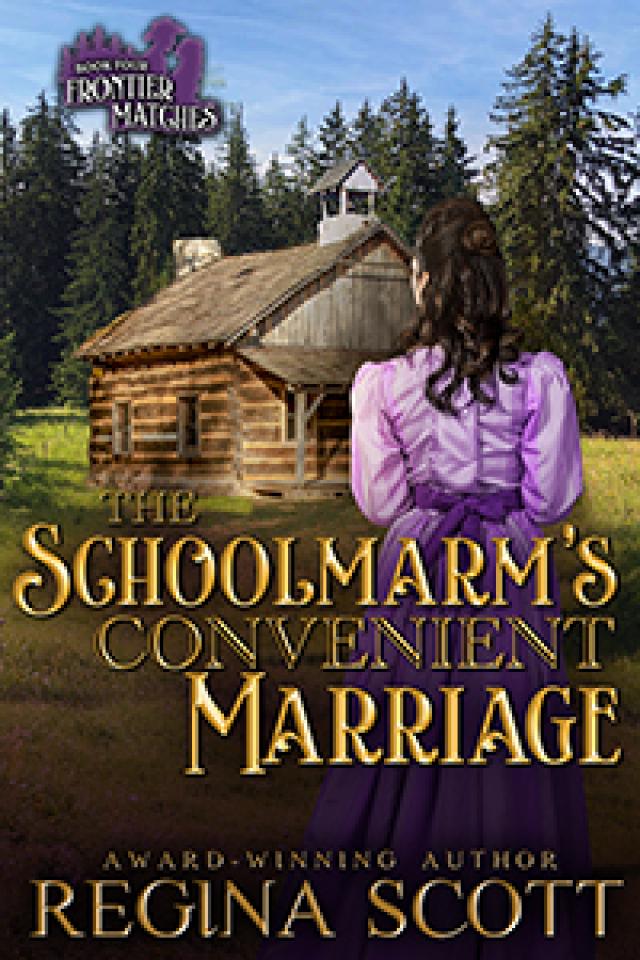
The Schoolmarm’s Convenient Marriage
~~~
By Regina Scott
Frontier Matches, Book 4
© 2023 Regina Lundgren
License Note
This eBook is licensed for your personal enjoyment only. It may not be re-sold or given away to other people unless it is part of a lending program. If you’re reading this book and did not purchase it, or it was not purchased for lending, please delete it from your device and purchase your own copy. Thank you for respecting the author’s work and livelihood.
Find more warm, witty romance to love.
Sign up for Regina Scott’s free newsletter to hear when the next book is out or on sale, plus get exclusive access to stories from her beloved series. When you sign up, you’ll receive four free stories from Regency England to the American West. Don’t miss out.
Praise for Regina Scott’s Work
“Regina Scott writes some of today’s best Historical Romance novels!” Huntress Reviews
“Swoony, sweet, and full of heart.” Reading is My Superpower on The Perfect Mail-Order Bride
“Scott dazzles.” Booklist on A Distance Too Grand, which was given a starred review and named one of the top ten romances of the year
To all the schoolteachers who have instructed and inspired me over the years, especially my mother, and to the Lord, who patiently teaches us in all His ways.
Contents
Chapter One
Chapter Two
Chapter Three
Chapter Four
Chapter Five
Chapter Six
Chapter Seven
Chapter Eight
Chapter Nine
Chapter Ten
Chapter Eleven
Chapter Twelve
Chapter Thirteen
Chapter Fourteen
Chapter Fifteen
Chapter Sixteen
Chapter Seventeen
Chapter Eighteen
Sneak Peek: Sudden Mail-Order Bride, Book 1 in Frontier Brides
About the Author
Chapter One
Seattle, Washington Territory
October 1876
Must a lady travel to the ends of the Earth to gain command of her own future?
Apparently so, for Alice Dennison could only shake her head at the telegram gripped in her gloved hand.
“I hope it isn’t bad news,” her friend, Ciara Weatherly, said as they stood outside the telegraph office along the wharves. The shouts of the sailors offloading goods punctuated the whir of machinery at the nearby sawmill. Tar and cedar and brine mixed for a potent aroma under skies that hovered lower and darker every moment. Or maybe it was the words she’d read that had lowered her spirits.
THIS IS UNNECESSARY RETURN AT ONCE
“Nothing that requires a reply,” Alice said. “I’m sorry we delayed our visit to check.”
“We always check when we come in for the mail.” The voice rumbled from behind her, and she forced herself not to stiffen. Mr. Willets, who had accompanied them to town, was a giant of a fellow, towering over everyone except Mr. Drew Wallin, who was apparently a legend in the territory. Mr. Willets was also a man of few words. She had yet to determine whether it was because he had an economy of speech or because he simply knew few words.
“Then we have done our duty,” she said. As they started forward, she crumpled the note and shoved it into her reticule to be summarily burned in the fire when they reached Wallin Landing.
That is, if she could remember how to rekindle the fire.
They had all been so patient with her, from Mrs. Rina Wallin, who was the lead teacher at the Lake Union School, to Alice’s darling students ranging in age from five to eight. Mrs. Rina had explained the expectations of Alice’s position. She had shown Alice how to clean and trim the lamps that lit her side of the two-room schoolhouse at the back of the village nestled along the shores of the lake.
And Mrs. Rina or one of the local gentlemen had repeatedly shown Alice how to lay the wood they brought her into the grate to keep the school warm as the autumn weather grew more brisk. She was the one who couldn’t seem to get the wretched fire to stay lit!
She should have expected it would be a challenge to find her footing so far away from everything she’d once known, from everyone with whom she’d once thought to share her life. But she was more than ready to meet that challenge. Wallin Landing was her home now. She would do her best to be a good citizen, a good teacher, and a good friend. No more would she allow others to direct the course of her life, even if that meant remaining a spinster to the end of her days.
Ciara craned her neck to see into the bed of the wagon that had brought them to town, the breeze catching at her bonnet. Like Alice, she had dark hair, but hers seemed more easily tamed. Alice hadn’t the time to pamper her hair here. So, she pulled it up and let it tumble down her back. So far, no one had protested.
“At least the things you ordered for the school came in,” Ciara said. “Six slates and enough chalk to color Mount Rainier like a rainbow.”
Alice’s cheeks warmed, and again she chided herself. It was her classroom and her choice of instruction. She did not have to ask anyone’s approval.
For once.
“The children and I like to draw pictures,” she explained. “I find it helps the learning process if they can visualize what we’re discussing.”
“I wish you’d been around when I was in school,” Ciara said with a smile. She relaxed back beside her, chocolate-colored eyes brightening. “Now, to Kellogg’s for my supplies.”
Ciara was the proprietress of the Wooden Rose Inn, the first such establishment in the settlement. And it was flourishing thanks to her expertise in cooking, another skill Alice lacked. But then, she hadn’t been raised to cook and clean, merely manage those who did.
“Best we move fast,” Mr. Willets said with a look to the sky.
Likely he was right. In Cawthorn, where she’d been raised, and in Boston, where she’d attended a teachers’ college for the last year, rains often came in the evenings with a sudden passion, then faded to leave everything fresh and clean. Here, rain spit and spat in fussy little mists, often for days at a time, before the sun came out as if opening its arms for an embrace. But the sky had been stingy today, threatening to pour but never letting go of a single drop.
“Then let’s stop by the Pastry Emporium first,” Ciara said. “I want Alice to meet my sister.”
Frisco and Sutter, twin boys who were in Mrs. Rina’s class, had made sure to tell Alice all about Ciara’s famous older sister. Maddie O’Rourke Haggerty had opened the first and now the premiere bakery in Seattle.
“Everyone loves her cinnamon buns best,” Sutter had said with a reverent lift of his blond brows.
“Her gingersnaps,” his brother had insisted.
Sutter had shoved him in the chest. “Cinnamon buns.”
“Gingersnaps!”
“Perhaps I’ll see if I can bring back some of both,” Alice had said, “for those who remember their manners.”
They had instantly stood upright like tin soldiers and vowed to be complete gentlemen in her absence.
Now, Mr. Willets set his hands on Ciara’s waist and boosted her onto the wagon’s bench. Alice waited patiently for her turn. But the big logger seemed suddenly at odds. He shifted on his feet, and his gaze, a lighter gray than the sky, darted here and there like that of one of her students caught in an infraction.
“Is there a problem, Mr. Willets?” she asked, frowning.
“No.” She could see his Adam’s apple bob as he swallowed. Unlike many of the men in the area, he was clean shaven, the planes of his face firm and rather pleasant to look upon. His hair reminded her of a fading fire, russet and warm. And his physique in the flannel collarless shirt and wool trousers could only be called impressive.
Not that a lady should notice such things.
Alice lifted her arms a little to encourage him. “I’m afraid I cannot climb up on my own, sir. Would you mind?”
He sighed as if she’d asked him to perform the labors of Hercules, then put his hands on her waist. His fingers spanned the width, and suddenly she found it difficult to breathe even though his touch was light. Then, whoosh! He all but tossed her up onto the bench as if she had burned him. She clutched at Ciara to keep from falling into her friend’s lap.
“Are you in such a hurry, Jesse?” Ciara asked with a frown as she helped Alice settle herself.
The third overskirt on her gown snagged on a splinter of wood, and she had to tug the blue-sprigged material free. She’d thought she’d chosen such practical gowns when she’d sent her trunk ahead and stolen away in the middle of the night to catch the train west, but the silks and linens of summer had proven impractical here. Her next pay would go toward something more useful. Wool. No overskirts. No lace.
This time she was the one who sighed.
But she kept a smile on her face as Mr. Willets climbed into place beside them and drove them up the hill to Second Avenue, where Mrs. Haggerty had her bakery.
“I see a crowd has already gathered,” she told Ciara as the wagon drew next to the boardwalk. “Testimony to your sister’s skills, no doubt.”
But Ciara wasn’t smiling, and Alice realized why. No lights gleamed inside the bakery. Someone had affixed a large sign, hastily scrawled by the look of the lettering, on the big front window, proclaiming the establishment cl
osed. Several men were clustered around, muttering.
“Maddie never closes except on Sundays,” Ciara said, voice trembling. “Even when she came out for my wedding, she baked ahead and had someone keep the shop open. Take me to Fourth Avenue, Jesse. I need to see my family.”
***
Jesse nodded. Family came first. He’d heard his father say that many a time, and he believed it, even if he’d chosen a different path than his brothers. He urged the horses around the corner and up the steep hill for Fourth, where many of the nicer houses had been built.
Ciara pointed out which one belonged to her sister, but he thought he might have guessed. Like many of the sweets Maddie Haggerty baked, the top dripped with curlicues that looked like icing.
“Stay here,” Ciara said as he reined in the horses, “until I know who’s sick and with what. That’s the only explanation for Maddie missing a day of work.” She clambered over Miss Dennison and scrambled down before Jesse could come around to help her.
Leaving him sitting with the schoolmarm.
He stayed on his side of the bench.
She stayed on hers.
“I do hope no one is terribly ill,” she murmured in a voice that the songbirds must envy. That was the thing with Miss Dennison. Everything about her was dainty and sweet, from the shiny black hair that tumbled down behind her back like an obsidian waterfall to her delicately featured face and the slender figure her fancy clothes outlined. Even her hands fluttered like little birds. Next to her, Jesse felt like a giant.
A great, lumbering, not-too-bright giant.
“Probably just took a chill,” he managed.
Immediately she turned her gaze to his. She had eyes the purple-blue of the wildflowers his sisters like to pick, and they too often brimmed with tears that could make a man promise anything to see her smile again.
“Do you think so?” she breathed.
“Sure,” he said. He caught his balance and realized he’d slid as far as dignity allowed to his side of the bench.
“Have you a great deal of experience with such things?” she asked, and there was no skepticism in her tone, only a wide-eyed wonder. “Some training as a physician?”
“No,” Jesse said. “Only nine little brothers and sisters.”
Now her lashes were fluttering too. “Nine!”
Did she think that a good thing? A bad thing? He’d met folks in both camps. Not that it mattered. He wouldn’t have traded any of his brothers or sisters, for all each of them had given him a bad time or two along the way. In fact, he’d once dared to hope he might have a passel of little ones of his own. That hope dimmed with each passing year. Too few women, too many expectations.
Her delicate black brows drew together, and so did his stomach. “I don’t believe I’ve met any of them,” she said. “Do they attend the school?”
“My family lives near Puget City, closer to Olympia.” There. A full sentence with subject and verb. Ma would be so proud. He could hear her in his head.
You’re a fine man, Jesse. You’re kind and sensible, and you don’t use that height and strength of yours to bully. You have no reason to be bashful.
“Olympia,” she said, brow clearing. “Yes, the town at the southern end of Puget Sound. It is the territorial capital and the third city incorporated in the territory.”
She sounded as if she were reciting from memory. He knew the same facts, but his family’s ranch meant far more to him. When he thought of home, he felt the wind rippling the grasses, caught the flash of a salmon leaping out of the Nisqually. He heard his brothers and sisters laughing as they hunted the woods for blackcaps and mushrooms. He caught the scent of milk in the pail, of bread baking and steak sizzling. So, he just nodded.
“I would very much like to see Olympia someday,” she said. “Perhaps you’d care to share your experiences there.”
The memories evaporated from his mind, leaving nothing but a wall of white broader than Rainier’s glaciers. That had ever been his problem. He had seldom been the center of attention in his family. He didn’t know how to deal with it when strangers focused on him. Would he sound as if he were bragging? Would he sound illiterate?
He was just thankful to see Ciara returning, hands fisted in her skirts.
Until she spoke.
“Leave,” she said, voice once more trembling. “Go back to the Landing. Tell Kit I’ll be home when I can.”
“Oh, Ciara!” Miss Dennison cried, reaching out a hand toward her. “What is it?”
“They’re not sure,” Ciara admitted with a glance back to the house, “and I haven’t been inside yet, so you are both safe. My brother-in-law Michael spoke to me through the glass on the front window. Maddie’s sick, and he fears it’s smallpox.”
Jesse’s grip on the reins tightened, and Lancelot, the lead horse, protested. He forced his hands to relax even as his mind whirled. He’d never lived through a smallpox epidemic, but his parents told stories of the fast-moving disease. Its rash could disfigure, even kill! Was Ciara’s family safe? Was his?
Miss Dennison must have heard of the disease as well, for she clutched the sideboard, and he could only hope she wouldn’t faint.
“Oh, no!” she cried. “I heard rumors in San Francisco when I came through but I didn’t think the disease had progressed beyond the city.”
“We don’t know yet,” Ciara cautioned. “But I can’t leave them. And I don’t dare bring it home to baby Grace. Tell Kit I love him.”
Now her body was trembling. So was Miss Dennison’s. Jesse raised his head. He was strong, he was healthy. It was his duty to help others who might be affected.
“We will,” Miss Dennison promised. “Please, be careful.”
Ciara nodded. And all Jesse could do was urge the horses forward again.
“How horrid,” Miss Dennison said, voice small and frightened as they headed for the road out to Wallin Landing. “Of course we must carry her words to her dear husband and baby. I will pray for her safety and the health of her sister and her family.”
Jesse nodded. He’d pray too. Not out loud with a lot of words. God didn’t expect that, and he was forever grateful for the fact.
Seattle was always pushing outward, but the wagon soon reached the brush that marked the edge. The schoolmarm fell silent as they entered the tunnel of trees that covered the road out to the Landing. It was cooler here, but it wasn’t just the overlapping branches of fir and cedar. The temperature was dropping. A storm was coming. He just had to get them to the Landing before it hit.
He slapped down the reins. “Lancelot! Percival! Yah!”
“Lancelot and Percival?” she asked, voice sounding brittle, as if she was searching for anything to talk about besides the danger they were fleeing.
“The horses,” he clarified.
“Named for the knights of King Arthur’s court? How marvelous! Are they yours, Mr. Willets?”
She was new. “Mr. Wallin’s. He allows the use of them.”
“Which Mr. Wallin?” she asked. He was relieved when she continued speaking as if answering her own question. “Not Mr. Drew—he is your employer. I believe Mr. Simon has horses, but they would be needed at the farm, so I doubt he could allow others to use them on a regular basis. Mr. James, the proprietor of the mercantile, perhaps?”
Jesse grinned at her. “That’s right.”
She stared at him, and his smile faded. What had he done wrong now?
She dropped her gaze, fiddled with the little beaded sack in her lap. A shiver went through her.
Well, of course, Jesse. If you noticed the cold in your flannels, how do you think she feels in that frilly dress?
“Extra blanket in the bed,” he offered.
She twisted to pull up the thick wool he had packed before they’d headed out that morning. “How very wise of you to think to bring this.”
Once again, she was making him feel clever. But the weather mocked him, daring him to try to make the run. The trees were starting to talk, swaying and gossiping in breathy rustles as the wind freshened. In the distance, he thought he heard a rumble.
Lancelot and Percival picked up their paces, as if they had heard it too and longed for the safety of their barn.