The sirens captain, p.4
The Siren's Captain,
p.4
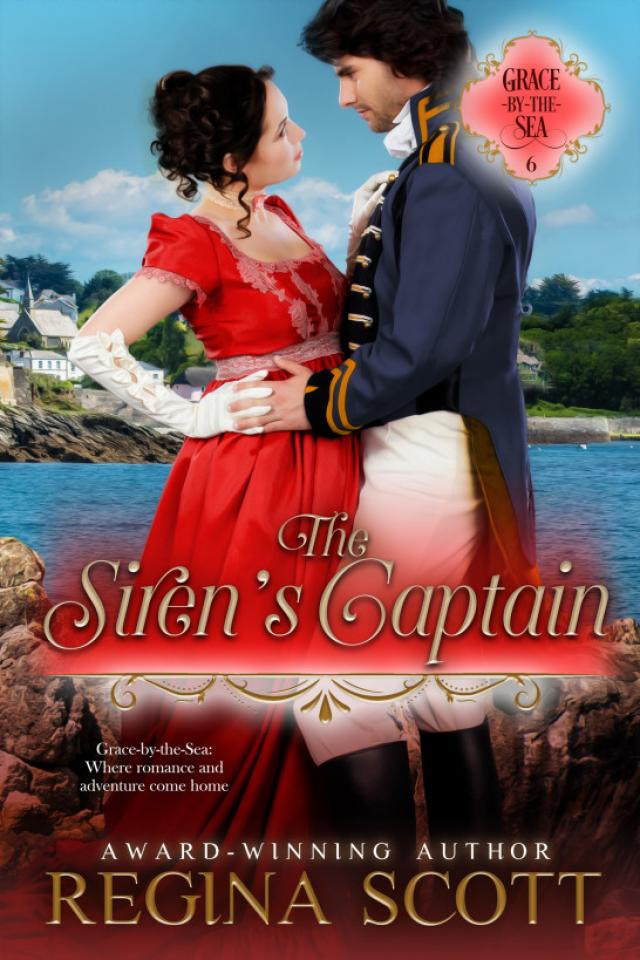


She stiffened. He would not be the first to suggest that she compromise more than her reputation to ensure England’s safety or France’s liberation.
“Oh?” she asked, challenge in the word and fingers moving toward her hairpin.
He glanced between her and the captain. “You could pretend to be engaged to be married.”
Chapter Four
Pretend to be engaged? Quill was shaking his head before Mademoiselle Fortier could answer. “No,” he told them both. “I won’t lie.”
Now James raised a brow. “Your wound comes and goes as you will, you deny knowing the Lord of the Smugglers, and you quibble at this?”
“Those deceptions are necessary to protect my men and my work,” Quill argued. “This one could endanger Mademoiselle Fortier’s reputation and even her person if the assassin thinks to reach me through someone I allegedly love.”
She shrugged. “I am ready. He will not find me an easy target.”
“He should not find you a target at all,” Quill insisted. He turned to his friend. “James, you must see the folly in this.”
“I’m afraid I don’t,” James said, and Quill recognized the same stubborn tone his friend had used to argue some philosophical point at Eton. “Being engaged gives you an easy excuse to spend time together and makes it more likely you’ll be surrounded by well-wishers and therefore never alone.”
He’d been alone, even in a crowd, from his first memories, but he could not deny his friend had a point. If he was constantly in company, it would be harder to single him out for a blow.
Quill sighed. “Mademoiselle, does this plan not concern you?”
“You are correct about the possible effects to my livelihood,” she said. “I must appear a proper lady to attract women willing to pay to hear me sing. But think how much more interesting I will be when it is known I jilted the famous Captain St. Claire.” Her smile made his own lips lift.
“Then it’s agreed,” James said briskly. “It’s probably best if you make a public scene of your proposal, Quill. Perhaps at the assembly Wednesday evening. If you are seen often together over the next few days, more will believe the fiction of true love.”
True love. A part of him had always longed to feel that Siren’s call. Pretending it had happened seemed a betrayal somehow. But he had to own it was a reasonable approach, however little he liked it.
“Stay at the spa with me this afternoon,” she advised as if he needed help looking like a man in love.
“It doesn’t have to be the entire afternoon,” James said as if he’d seen Quill’s frown. “I’ll ask Alex Chance to come for you. He’s Captain St. Claire’s first mate and the brother of our spa hostess,” he explained with a look to the lady.
“Then he is Mrs. Tully’s nephew,” she said.
Quill shouldn’t be surprised she’d figured out some of the village’s connections. Understanding her audience could only help her performances.
“He is,” James said. “And brother-in-law to the Countess of Howland and soon the Viscountess Peverell.”
“My,” she said with an arch look, “I must meet this paragon. A shame he has no reason to pretend an engagement.”
He had the sudden urge to drop the lad overboard in the middle of the Channel. Where had that come from? Alex had been his right-hand man since he had discovered Quill’s plans one night when the two had met by accident in the caves under Castle How. Quill had been coming back from a run to France with two Royalists seeking asylum. Alex had just proved his sailing skills by navigating the Dragon’s Maw at the turn of the tide, a time-honored tradition among the youths of Grace-by-the-Sea. He and Quill had been working together ever since.
“You should return inside,” James said, stepping away from them. “Look for Alex around teatime.”
Which couldn’t come soon enough.
“You are not comfortable with this plan,” she surmised as they turned for the door of the spa.
“I’ll do my part,” he told her.
She caught his arm to stop him, then glanced up at him, dark blue eyes sparkling like lapis in the autumn sunlight. “You must do better than this. Surely you know how to look attracted to a lady.”
He couldn’t remember the last time anyone had questioned his abilities. He took her hand, cradled it in his own, gazed down into her face, and deepened his voice. “My dear, how could any man look less than enthralled in your company?”
Her eyes widened, and he was bending closer before he thought better of it.
She pulled away. “Yes, yes. That will do nicely.” She seemed to be walking unaccountably fast as she headed inside.
Maudie pounced on her the moment they came into the Grand Pump Room.
“There you are,” she proclaimed, swooping in like a raven on a choice morsel. “I thought the mermaids might have snatched you.”
“You must not worry about me,” Mademoiselle Fortier said, bending to press her cheek to the widow’s. “Though your kindness warms my heart. I feel as if I am surrounded by friends here at Grace-by-the-Sea.” She cast Quill an adoring look.
Easy enough to fall in with that. “You would be surrounded by friends wherever you go, I wager, mademoiselle,” he told her, allowing his gaze to linger on her lips. The memory of them against his rose up, surprisingly hard to banish.
“Ah, but some friends are so much more dear than others,” she simpered.
Maudie glanced between the two of them. “You aren’t in love.”
If they could not convince her, they were in trouble.
“No, of course not,” Quill said. “We’ve only just met.” He favored the Frenchwoman with a steamy glance. This time she returned it in force, and suddenly he found himself tugging at his cravat, adjusting his coat. What was this? He was used to subterfuge. As James has said, this pretense should be nothing different.
But, as the afternoon wore on and he planted himself in the singer’s pocket, it felt different. Playing the game was all too easy, and admiring her was no burden. Besides enthralling them all with her performance that afternoon, she had apparently never met a stranger, for she conversed easily with any who approached her. Her clever quips, her gossamer laugh, had him smiling along.
“She’s a Siren,” Maudie confided at one point. “Follow her, and your ship will sink.”
He could almost believe it.
Still, he wasn’t as eager as he’d thought to transfer himself into Alex’s hands when his first mate came to rescue him as Mrs. Denby and her aunt began trundling around the tea cart. He took a lengthy farewell from Mademoiselle Fortier, bowing over her hand and holding it overly long. A blush bloomed in her cheeks. He walked with Alex out the door.
“The magistrate told me about your plans,” he said as they headed for Dove Cottage. “I’m happy to help. I’d like to stop these French agents once and for all.”
At only nineteen, Alex was ready to take on the world. Taller than Quill by an inch or two, slender and tough as a whip, he still wasn’t above a tease or a lark from time to time.
“I’m not convinced finding this assassin will have that effect,” Quill confessed as they neared the top of the hill and the Downs stretched away in the distance, grasses now brittle brown. “But I suppose we won’t know until he’s been captured.”
“How do you know it’s a him?” Alex asked, tawny hair bright in the sunlight. “Napoleon could have sent a woman this time.”
He likely could. The emperor at least pretended to give women equal footing at times. Why not a lady spy?
Mademoiselle Fortier’s face came immediately to mind, light in her dark blue eyes, lips turned up in a smile. How did they know she’d come from the War Office? What if she’d concocted the tale? What if she was the assassin?
She could have killed him twice over last night. Instead, she’d argued for his protection. She’d done the same this morning and at a possible cost to her. No, the assassin had to be someone else.
“Mr. Chance,” Hugh heralded, coming from the back of the house as if alerted by the sound of the door opening. “Are we heading out tonight, then?”
“No,” Quill said, motioning him to join them in the sitting room.
Alex took one of the leather-bound armchairs by the hearth. Hugh perched on the sea chest under the window. Quill quickly explained to his bosun the message the French singer had brought and what he and James intended to do about it.
When he was finished, Hugh shook his head. “It’s over then. We have to stop going over to France. It’s too dangerous.”
Alex angled himself to keep the bosun in sight. “No more dangerous than before, from what I can tell. Napoleon’s been aware of the Siren’s Call for some time now. We still manage to get through.”
“And how do you know he doesn’t want us to get through?” Hugh challenged, black boots planted on the wood floor. “What if he’s watching, waiting for a mistake so he can round up all the Royalists at once and be done with them?”
“He can’t reach all of them through me,” Quill reminded him. “We may know a number, but I’m convinced there are others.”
“You know enough,” Hugh insisted. “I say it’s time we stayed home and let someone else take the risks.”
Alex frowned at him. “It’s not like you to be afraid, Mr. Baffin.”
“It’s not like me to be watching for an assassin either,” he countered. “Pretend engagement or no, we’d be wiser to give up now, before something bad happens.”
~~~
Ree could have lived in the spa. Everything conspired to make it a delightful place: Congenial company, engaging conversation, the harpsichord for music, and the view down to the cove. She just wasn’t sure why the sunlight seemed to dim when Quillan St. Claire walked out the door. Perhaps it was because she no longer had to pretend she adored him.
The other ladies of the spa certainly adored him. Mrs. Harding asked her what Ree thought of him. Mrs. Greer, an angular blonde with a nasal tinge to her voice, went into raptures about his consequence, his condescension. Others speculated on how soon he would need to return to the sea and how empty their village would seem without his presence. Small wonder the fellow thought himself above everyone else!
Though Ree suspected Napoleon’s agent would not show himself at the spa this time, she kept an eye on the Newcomers. Maudie had explained the taxonomy. Regulars were those who had come to the spa often enough to be considered friends or family. Irregulars had come occasionally and had possibilities. Newcomers had arrived recently and generally required the most attention.
Almost all who appeared that afternoon were couples—husband and wives, father and daughter, or widow with companion. The only single gentleman was an older fellow with a mass of curly grey hair, a neat beard and mustache, and thick spectacles that magnified his bright brown eyes. He seemed rather healthy and trim for the age his looks implied. A disguise, perhaps?
“What do you know about our scholarly-looking gentleman?” she asked Maudie as the lady finished her afternoon stint on the harpsichord.
Maudie frowned as she slid off the bench. “Newcomer,” she pronounced. “He could be a French spy.”
Ree’s thoughts entirely. She linked arms with her new friend. “We should see what he has to say for himself.”
They hadn’t crossed half the space before Mrs. Denby, who had asked Ree to call her Jesslyn, met them, the gentleman in question in tow.
“Mr. Guthrie requested an introduction,” she explained.
Ree offered her best smile, but Jesslyn looked to her aunt. “Maudlyn Tully, Mademoiselle Fortier, allow me to present Mr. Dennis Guthrie. Mr. Guthrie is a writer and illustrator of some renown.”
He dropped his gaze and fiddled with the gold fob on his watchchain. “Well, perhaps not renown. Not everyone enjoys tales of the supernatural.”
Maudie’s grey eyes were narrowed as she studied him, and Ree wished she knew what the lady saw. “Supernatural?” Maudie asked him.
“Yes,” he said, releasing the fob, which Ree saw resembled the tail of a whale. “Fairies, pixies, trolls, that sort of thing.”
Maudie cocked her head, making her look a bit like an inquisitive sparrow. “Mermaids?”
“Certainly,” he allowed. “One of my reasons for coming to Grace-by-the-Sea was to learn about the local legends.”
He seemed entirely sincere, but Maudie was clearly not ready to admit defeat to her theory of him being a French spy. “And what do you know about legends?” she demanded.
He smoothed down his embroidered silk waistcoat. “Some claim I may be England’s foremost authority.”
Her eyes widened, and she seized his arm. “Then you see them too?”
A blush came to his sallow cheeks, and Ree didn’t know whether he was pleased or embarrassed by Maudie’s attentions. “I have made a few discoveries.”
“Come with me,” Maudie ordered, tugging him toward the closest set of chairs. “We must talk.”
Ree and Jesslyn watched them go.
“Are you certain he will be kind to her?” Ree murmured. “I would not see her hurt for the world.”
“Neither would I,” Jesslyn assured her. “But he was asking questions about the local legends, and there’s no one more versed in the subject than my aunt.”
Mrs. Harding joined them then. “A distinguished Newcomer, I see.”
“Mr. Dennis Guthrie,” Jesslyn explained. “From Cumberland.”
“A great distance to come,” Mrs. Harding mused. “Word must be spreading about the spa.”
Perhaps. Yet Ree vowed to keep an eye on the fellow, for Maudie’s sake, as well as Quill’s.
“Don’t look now, ladies,” Mrs. Harding said as she and Ree accompanied Jesslyn toward the fountain. “But our valiant captain is back.”
Jesslyn tapped one finger against her chin. “What could we have done to warrant such an honor?” Her look to Ree said she suspected their attraction. Ree made herself push back her hair, pat down her skirts, and bite her lip as if she wasn’t sure he would approach her.
Of course, he did, but by the most roundabout way possible, as if everyone else was far more fascinating. Mrs. Harding finally had to wave her gloved hand above her auburn hair.
“Captain! Won’t you join us?”
Her beau, Mr. Crabapple, at the chess board nearby, looked up with a frown.
St. Claire strolled to their sides. “Mrs. Harding, Mrs. Denby, Mademoiselle Fortier.”
He lingered over her name in a way that sent tingles up her spine. How silly! This was all for show.
“Captain,” she said with a look of concern. “Is your wound troubling you so that you must come for another glass of the spa water?”
Immediately the other two women were all consideration.
“You poor thing,” Mrs. Harding soothed. “You should sit. Warfield, give the man your chair.”
Her beau managed to get to his feet. He was all arms and legs, that one, and none of them particularly coordinated. “Certainly, Captain,” he said, blinking bleary blue eyes. “You are most welcome.”
“Allow me to pour,” Jesslyn said, suiting word to action.
In the wink of an eye, Ree’s pirate was seated in the place of honor across the chessboard from Lord Featherstone, crystal glass in his grip and a dozen people hovering solicitously around him. Ree caught his gaze and rolled her eyes.
He uttered a sigh. “You are too kind, my friends. I will forever bless the day I came to your fair village.”
They all beamed at him.
He downed the water and handed the glass to Jesslyn. “Thank you. I feel refreshed already.” He rose, and they scuttled back as if expecting him to fly up to herd the fat sheep painted on the ceiling. Instead, he extended his hand. “Mademoiselle Fortier, might I have your company for a stroll?”
“Lucky lady,” someone muttered. It might have been Mrs. Greer.
Ree moved to place her hand on his. “I would be delighted, Captain.”
They collected her things and left the spa together.
“Was that performance necessary?” she asked as they started down the hill for the shops along High Street. “When I mentioned your wound, I supposed you would simply assure me you were fine like the stalwart fellow you are.”
“And disappoint my audience?” he chided. “Never.”
She shook her head. “Do you even notice your wound anymore?”
“When it rains,” he said. “And it rains often.”
“I am not sure I believe you.”
“I knew you were a clever woman.” He tucked her arm closer and nodded to a grey-haired gentleman they were passing.
“The vicar,” he said.
“And them?” She nodded to a group of people coming out of another shop, Mr. Carroll’s Curiosities.
“I don’t know them,” he said. “And I make it my business to know everyone who comes into the area. I’ve noticed we’ve had quite the influx of visitors in the last week, all here to listen to you sing.”
A tingle of pleasure went through her. Even years after she’d first stepped in front of an audience, at a home of an émigré in London, she couldn’t quite accustom herself to the idea that others enjoyed listening to her. To see all gazes on her, to watch them brighten in delight, awe. She could only be honored. And she could tell none of them she would rather be in the kitchen. Much as she loved combining ingredients, she had chosen a different path, one with great possibilities of aiding England’s fight against the French. Cooks must stay in their domains. Singers could move, gather information, and return it to those who would most benefit.
“Perhaps we should meet those Newcomers,” she suggested, and he turned their steps to intersect. The men were younger than Mr. Guthrie, but all good friends, on their way, they agreeably informed her and Quill, to visit a friend newly returned from the Navy and recuperating at Portsmouth. Doubtful Napoleon had sent so many. Quill led her on.
“It is not as easy as I had hoped to identify this fellow,” Ree confessed. “I did not expect this village to be so busy.”
“You should have seen it this summer,” he said. They must be approaching the bakery, for the scents of cinnamon and freshly baked bread overpowered the brine of the sea.