

Daughter of the deep, p.1
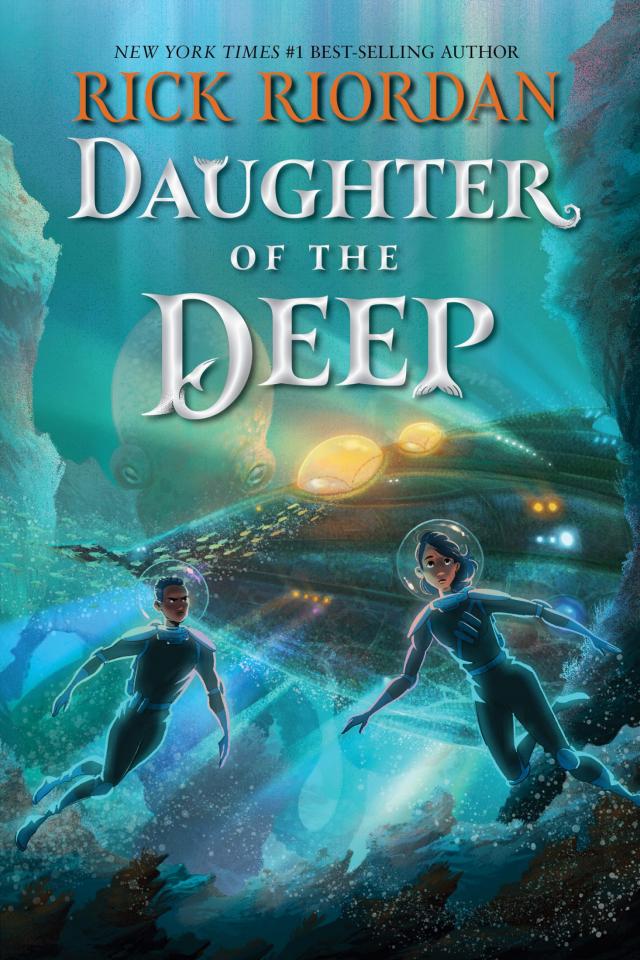
Daughter of the Deep,
p.1


Series by Rick Riordan
PERCY JACKSON AND THE OLYMPIANS
THE KANE CHRONICLES
THE HEROES OF OLYMPUS
MAGNUS CHASE AND THE GODS OF ASGARD
THE TRIALS OF APOLLO
Text Copyright © 2021 by Rick Riordan
Illustrations © 2021 by Lavanya Naidu
Cover art © 2021 by Lavanya Naidu
Hand-lettering by Russ Gray
Cover design by Joann Hill
All rights reserved. Published by Disney • Hyperion, an imprint of Buena Vista Books, Inc. No part of this book may be reproduced or transmitted in any form or by any means, electronic or mechanical, including photocopying, recording, or by any information storage and retrieval system, without written permission from the publisher. For information address Disney • Hyperion, 77 West 66th Street, New York, New York 10023.
Designed by Joann Hill
Library of Congress Cataloging-in-Publication Data
LCCN 2021009226 (ebook) • ISBN 9781368077941 (ebook) • LCC PZ7.R4829 (ebook)
LC ebook record available at https://lccn.loc.gov/2021009226
Follow @ReadRiordan
Visit www.DisneyBooks.com
Contents
Title Page
Copyright
Epigraph
Foreword
Introduction
Harding-Pencroft Academy
The Freshman Class of Harding-Pencroft
Chapter One
Chapter Two
Chapter Three
Chapter Four
Chapter Five
Chapter Six
Chapter Seven
Chapter Eight
Chapter Nine
Chapter Ten
Chapter Eleven
Chapter Twelve
Chapter Thirteen
Chapter Fourteen
Chapter Fifteen
Chapter Sixteen
Chapter Seventeen
Chapter Eighteen
Chapter Nineteen
Chapter Twenty
Chapter Twenty-One
Chapter Twenty-Two
Chapter Twenty-Three
Chapter Twenty-Four
Chapter Twenty-Five
Chapter Twenty-Six
Chapter Twenty-Seven
Chapter Twenty-Eight
Chapter Twenty-Nine
Chapter Thirty
Chapter Thirty-One
Chapter Thirty-Two
Chapter Thirty-Three
Chapter Thirty-Four
Chapter Thirty-Five
Chapter Thirty-Six
Chapter Thirty-Seven
Chapter Thirty-Eight
Chapter Thirty-Nine
Chapter Forty
Chapter Forty-One
Chapter Forty-Two
Chapter Forty-Three
Chapter Forty-Four
Chapter Forty-Five
Chapter Forty-Six
Chapter Forty-Seven
Chapter Forty-Eight
Chapter Forty-Nine
Chapter Fifty
Chapter Fifty-One
Chapter Fifty-Two
Chapter Fifty-Three
Chapter Fifty-Four
Chapter Fifty-Five
Chapter Fifty-Six
Chapter Fifty-Seven
Chapter Fifty-Eight
Chapter Fifty-Nine
Chapter Sixty
Chapter Sixty-One
Chapter Sixty-Two
Chapter Sixty-Three
Acknowledgments
About the Author
Nature’s creative power
is far beyond man’s
instinct of destruction.
—Jules Verne,
20,000 Leagues Under the Sea
FOREWORD
Don’t Pick Up a Starfish by Its Arm
Did you know more than 80 percent of the ocean remains unexplored? EIGHTY, PEOPLE! It is very possible that at this moment a mermaid and a giant squid are munching on macroalgae macaroni and wondering when we’re going to catch up and discover that Atlantis was just a theme park that went terribly wrong. Who knows?
No one can say for certain, because so much of the ocean is unknown. And I am terrified of the unknown, so it goes without saying that I am absolutely terrified of the ocean. Perhaps it started when, at the age of ten, I picked up a starfish by one of its arms…and soon found myself holding a single wiggling appendage. At the time, I didn’t know that starfish arms could regenerate. I believed I was a murderer. I fell to my knees and bellowed with horror. (CURSE YE, FORMIDABLE MIGHT! SUCH INNOCENCE…DESTROYED! DOES THIS MEAN I CAN PERMANENTLY SKIP GYM?)
But the more that something terrifies me, the more I tend to obsess over it. And ever since that fateful starfish encounter, the ocean, with its strange inhabitants—that’s right, I’m looking at you, various echinoderms and ophiuroids—has loomed large in my mind as a place of unknowable power, unimaginable beauty, and untapped potential.
Rick Riordan’s Daughter of the Deep captures every single facet of that awe and terror.
If you have ever craved a story that will leave your heart racing, your lungs gasping from numerous twists and turns, your soul heaving from the effort of carrying around an ensemble cast that includes smol, ingenious, and possibly bloodthirsty cinnamon rolls (oh, and a humongous creature of the deep who, truly, just wants love), you will find all that and more in the pages ahead. Our story begins with two warring schools and a cataclysmic event that sends the freshman class of the elite Harding-Pencroft Academy on a deadly mission to unearth a secret about the kind of technological power that can remake the world. I was on the edge of my seat the whole time as the crew navigated high-tech high jinks, deep-sea riddles, and the sort of military tactics that somehow make me feel smarter despite the fact that I have been ensconced in a soft blankie for the better part of the day.
I cannot think of a better captain to helm this watery adventure than the formidable Ana Dakkar. Ana is everything I wished I could be at fifteen. Fearless, brilliant, a linguistic whiz, friends with a dolphin named Socrates, and—most importantly to a daydreaming adolescent Rosh—burdened with an ancestral legacy that is the stuff of legends.
You see, Ana is one of the last descendants of Captain Nemo, and that’s where things get complicated. As the last of the Dakkars, Ana not only finds herself grappling with an inheritance that could change the entire world’s understanding of technology, but she’s also struggling with larger questions, like what are we owed, and what do we owe others? It’s easy to make the right decisions when all the world is watching, but when you’re deep underwater, where the sun can’t see you, you might just end up doing something you never expected….
To me, this story is a lot like the ocean. Equal parts thrilling and terrifying, and, no matter which way you look at it, downright cool. Enjoy! And don’t eat too many cinnamon rolls.
INTRODUCTION
My journey under the sea started in landlocked Bologna, Italy, in 2008. I was there for a children’s book fair, right before The Battle of the Labyrinth and The 39 Clues: The Maze of Bones were scheduled for release. I was having dinner in the basement of a restaurant with about fourteen of the top brass from Disney Publishing when the president of the division turned to me and said, “Rick, is there any existing Disney intellectual property you’d love to write about?” I didn’t hesitate in saying, “20,000 Leagues Under the Sea.” It took me another twelve years before I was ready to write it, but my version of that story is now in your hands.
Who is Captain Nemo? (No, not the cartoon fish.)
If you’re not familiar with the original Captain Nemo, he’s a character created by the French author Jules Verne in the nineteenth century. Verne wrote about him in two novels, 20,000 Leagues Under the Sea (1870) and The Mysterious Island (1875), in which Nemo commands the world’s most advanced submarine, the Nautilus.
Captain Nemo was smart, well-educated, courteous, and massively wealthy. He was also angry, bitter, and dangerous. Imagine a combination of Bruce Wayne, Tony Stark, and Lex Luthor. Formerly known as Prince Dakkar, Nemo had fought the British colonial government in India. In retaliation, the British killed his wife and children. This was Dakkar’s supervillain/superhero origin story. He renamed himself Nemo, which is Latin for no one. (Greek myth fans: This was an Easter egg about/shout-out to Odysseus, who told the Cyclops Polyphemus that his name was Nobody.) Nemo dedicated the rest of his life to terrorizing the colonial European powers on the high seas, sinking and plundering their ships and making them fear the unstoppable “sea monster” that was the Nautilus.
Who wouldn’t want to have that kind of power? As a kid, every time I jumped in a lake or even a swimming pool, I liked to pretend I was Captain Nemo. I could sink enemy ships with impunity, go all over the world undetected, explore depths no one had ever visited, and uncover fabulous ruins and priceless treasures. I could submerge into my own secret realm and never return to the surface world (which was kind of horrible anyway). When I eventually wrote about Percy Jackson, the son of Poseidon, you can bet that my old daydreams about Captain Nemo and the Nautilus were a big reason I chose to make Percy a demigod of the sea.
Now, I’ll be honest, I found Verne’s novels slow going when I was a kid. But I did enjoy my uncle’s old Classics Illustrated editions, and I loved watching the Disney film version of 20,000 Leagues Under the Sea—even the cheesy bits like Kirk Douglas dancing and singing, and the giant rubber squid attacking the ship. Only when I was older did I realize ho
w rich and complex the original stories were. Nemo was even more interesting than I had imagined. And I began to see little openings in the narrative where Verne had left room for a possible sequel….
Why does Captain Nemo still matter?
Verne was one of the first writers of science fiction. Looking back from the twenty-first century, it can be difficult for us to appreciate just how revolutionary his ideas were, but Verne imagined technology that would not exist for hundreds of years to come. A self-powered submarine that could circle the globe continuously and never have to dock for supplies? Impossible! In 1870, submarines were still newfangled inventions—dangerous tin cans that were more likely to blow up and kill everyone on board than to complete a trip around the world. Verne also wrote Around the World in 80 Days at a time when making the trip that quickly was unthinkable, and Journey to the Center of the Earth, a feat that is still far beyond human technology, though someday, who knows?
The best science fiction can shape how humans see their own future. Jules Verne did that better than anyone. Way back in the 1800s, he suggested what could be possible, and humans rose to the challenge. When people talk about how fast a plane or a ship can circle the world, they still use Around the World in 80 Days as a benchmark. At one time, eighty days was an incredibly short trip for circumnavigating the globe. Now we can do it in less than eighty hours by plane, and less than forty days by sea.
Verne’s Journey to the Center of the Earth inspired generations of spelunkers to explore the earth’s cave systems and spurred geoengineers to figure out how the layers of the earth function.
Captain Nemo, on the other hand, raised awareness of the importance the oceans would have for the future of the planet. We know most of the Earth is covered with water, and 80 percent of the oceans are still unexplored. Figuring out how to tap the power of the sea, and to live with the power of the sea as our climate changes, may be key to human survival. Verne envisioned all of that in his books.
Nemo and his crew are able to live self-sufficiently without ever touching dry land. The sea provides all their needs. In 20,000 Leagues, Nemo tells Aronnax that the Nautilus is entirely electric, and draws all its power from the ocean. In The Mysterious Island, Cyrus Harding speculates that when coal runs out, humans will learn to draw energy from the abundant hydrogen of the ocean. That is still a goal people are trying to achieve today, and one of the reasons I decided that Nemo must have unlocked the secret of cold fusion.
In 20,000 Leagues, Nemo’s crew uses electrical Leyden guns that are more effective and elegant than standard arms. They have almost limitless wealth thanks to the many shipwrecks they’ve plundered. They’ve discovered the secrets of subaquatic agriculture, so food is never an issue. Most importantly, they have freedom. They are independent of any nation’s laws and can come and go as they please. They answer to no one except Nemo. Whether that is good or bad…I guess that depends on what you think of Nemo!
The importance of the sea, the importance of imagining new technological advances—these are great reasons to still read Jules Verne. But there’s one more critical thing to consider. Verne made Captain Nemo an Indian prince whose people suffered under European colonialism. His character explores themes that are just as critical now as they were in Victorian times. How do you find a voice and power when society denies you those privileges? How do you fight injustice? Who gets to write the history books and decide who were the “good guys” and the “bad guys”? Nemo is an outlaw, a rebel, a genius, a scientist, an explorer, a pirate, a gentleman, an “archangel of vengeance.” He’s a complicated guy, which makes him a lot of fun to read about. I was fascinated by the idea of fast-forwarding his legacy into the twenty-first century and looking at what his descendants would be dealing with all these years later.
What would you do if you had the power of the Nautilus at your command? I hope Daughter of the Deep will inspire you to think about your own adventures, the way Jules Verne inspired me. Make ready to dive. We’re going deep!
HARDING-PENCROFT ACADEMY
HOUSE DOLPHIN
communications, exploration, cryptography, counterintelligence
HOUSE SHARK
command, combat, weapons systems, logistics
HOUSE CEPHALOPOD
engineering, applied mechanics, innovation, defensive systems
HOUSE ORCA
medicine, psychology, education, marine biology, communal memory
THE FRESHMAN CLASS OF HARDING-PENCROFT
HOUSE DOLPHIN
Ana Dakkar, prefect
Lee-Ann Best
Virgil Esparza
Halimah Nasser
Jack Wu
HOUSE SHARK
Gemini Twain, prefect
Dru Cardenas
Cooper Dunne
Kiya Jensen
Eloise McManus
HOUSE CEPHALOPOD
Tia Romero, prefect
Robbie Barr
Nelinha da Silva
Meadow Newman
Kay Ramsay
HOUSE ORCA
Franklin Couch, prefect
Ester Harding
Linzi Huang
Rhys Morrow
Brigid Salter
Here’s the thing about life-shattering days.
They start just like any other. You don’t realize your world is about to explode into a million smoking pieces of awfulness until it’s too late.
The last Friday of my freshman year, I wake in my dorm room at five a.m. as usual. I get up quietly so as not to disturb my roommates, change into my bikini, and head for the ocean.
I love the campus in the early morning. The white concrete facades of the buildings are turning pink and turquoise in the sunrise. The quad’s grassy lawn is empty except for seagulls and squirrels waging their eternal war for the snack crumbs we students have left behind. The air smells of sea salt, eucalyptus, and fresh cinnamon rolls baking in the cafeteria. The cool Southern California breeze raises goose bumps on my arms and legs. It’s times like this I can’t believe I’m lucky enough to go to school at Harding-Pencroft Academy.
Assuming I survive this weekend’s trials, of course. I might wash out in disgrace, or die tangled in a net at the bottom of some underwater obstacle course…. But hey, it’s still better than ending the term doing five jillion multiple-choice problems on some state standardized test.
I follow the gravel footpath that leads to the ocean.
A hundred yards past the naval-warfare building, the cliffs drop into the Pacific. Far below, white surf ribs the steel-blue sea. Waves rumble and reverberate around the curve of the bay like the snores of a giant.
My brother, Dev, is waiting for me at the edge of the cliff. “You’re late, Ana Banana.”
He knows I hate it when he calls me that.
“I will push you off,” I warn.
“Well, you could try.” When Dev grins, he does this lopsided squint, like he can’t equalize the pressure in one ear. The other girls tell me it’s adorable. I’m not convinced. His dark hair is spiky in front, like a sea urchin. He claims it’s his “style.” I think it’s just because he sleeps with a pillow over his face.
As usual, he’s wearing his standard black HP wetsuit with the silver Shark logo on the front, indicating his house. Dev thinks I’m crazy to make the dive in a bikini. In most ways, he’s a tough guy. When it comes to cold temperatures, though, he’s kind of a baby.
We do our predive stretches. This spot is one of the few places along the California coast where you can free dive without getting smashed to pieces against the rocks below. The cliffs are sheer, plunging straight into the depths of the bay.
It’s quiet and peaceful this time of morning. Despite Dev’s responsibilities as a house captain, he is never too busy for our morning ritual. I love him for that.
“What did you bring for Socrates today?” I ask.
Dev gestures nearby. Two dead squid lie glistening in the grass. As a senior, Dev has access to the aquarium’s feeding supplies. This means he can sneak little treats for our friend under the bay. The squid are about a foot long from tail to tentacles—slimy, silver and brown like oxidized aluminum. Loligo opalescens. California market squid. Life span six to nine months.
I can’t turn off the data stream. Our marine biology professor, Dr. Farez, has trained us too well. You learn to remember the details because everything, literally everything, will be on her quizzes.


